Used Flail Mower.

/ Used Flail Mower. #1  
Joined
Jul 18, 2011
Messages
32
Location
Augusta/Martinez Georgia
Tractor
2011 Kubota L3200 4X4 FEL
I am in the market for a Flail Mower and have located a used one near me. It is a Ford 917H. I am looking for some advice on what to look at, problems with that model, how much wear on the knifes/hammers is considered in need of replacement. Any help would be great.

Thanks.
 
/ Used Flail Mower. #3  
I purchased one at a auction and it had always been shedded. My renters removed the tarp covering it in their never ending search for scrap metal to steal. The bearing on the left side with the belts on it filled up with water and froze. When greasing in the spring I helped but did not solve the ruined bearing. Keep the thing covered up and you will be pleased with the performance. Used it to mow lots in town . Really kept me from raking alot of leaves in the fall. Ford carries most parts and the belts are metric.
 
/ Used Flail Mower. #6  
Rounding of the knives equates to narrowing of the individual cutting swath, so when to replace is dependent upon how finished you want the completed cut to look. If you're satisfied with less than a golf-course cut, a little rounding on corners of the cutting edge is acceptable. By design, there is individual cutting swath overlap that compensates in part for the missing metal. But at some point, individual knife wear progresses to the point where this overlap is compromised. That's the point at which the knives should be replaced. All this depends upon the original width of the knife and the degree of knife overlap. On the 917H I'm pretty sure the OE knife width (cutting swath) is around 2-5/8". When corner wear takes the swath below 2", I'd say it's time for new ones.

And when it becomes time to change the knives on a 917H, it's likely also time to change the hangers. The swinging knives wear grooves in their brackets. The deeper the grooves, the closer the knives swing toward the inside housing. When I bought mine, I replaced knives, hangers, hanger brackets, and the nuts/bolts/washers that held them in place.

//greg//
 
/ Used Flail Mower.
  • Thread Starter
#7  
Rounding of the knives equates to narrowing of the individual cutting swath, so when to replace is dependent upon how finished you want the completed cut to look. If you're satisfied with less than a golf-course cut, a little rounding on corners of the cutting edge is acceptable. By design, there is individual cutting swath overlap that compensates in part for the missing metal. But at some point, individual knife wear progresses to the point where this overlap is compromised. That's the point at which the knives should be replaced. All this depends upon the original width of the knife and the degree of knife overlap. On the 917H I'm pretty sure the OE knife width (cutting swath) is around 2-5/8". When corner wear takes the swath below 2", I'd say it's time for new ones.

And when it becomes time to change the knives on a 917H, it's likely also time to change the hangers. The swinging knives wear grooves in their brackets. The deeper the grooves, the closer the knives swing toward the inside housing. When I bought mine, I replaced knives, hangers, hanger brackets, and the nuts/bolts/washers that held them in place.

//greg//

Thanks greg for answering my question.
 
/ Used Flail Mower. #8  
I owned a couple of these and love them. One got badly abused with the stones around here and the drum with its knife attachments plates was quite mangled but still serviceable. I sold that machine and kept another with the fine cut knives that I bought cheap at a municipal auction.

All in all, I love the fine cut better and the knives didn't disintegrate as I figured they would. Maybe the mass of the normal blades causes them to be destroyed when striking stones. At one point, I tried welding knives back together with obvious unsucessful results. One day I got an early christmas, when I found a pile of brand new knives at the dump! Maybe someone saw my welding attempts to save money and took pitty on me.

At one point I started removing all blades for sharpening and service but that became old, very quickly. In general though and in retrospect, that machine was a pleasure to work on. Years later, I found a specific electric sharpening machine at a municipal auction for those regular blades. I gave it along with my regular machine when I sold it to a friend.

Those machines arn't great for high grass (unless totally dried out) not good for wispy grass, and don't do much on very short grass, but anything in between works good. Watching the grass cascade out over the rear roller is like magic! Not sure why those machines have never been more popular. They don't use much HP either.
 
/ Used Flail Mower. #9  
Just bought a 917 flail. Is the rear roller height adjustable? It resides at my property a couple of hours from home so I can't just go outside and look. Hope I'm not guilty of thread hijacking by asking the question here.
 
/ Used Flail Mower. #10  
The issue with any high grass or heavy brush and a flail mower is the knive count. and power for the mule!!!!!!!!!!!!!!

Sadly for the mower buyer the death of the son of the founder of the Mott Mower Corporation
is what killed the greater use of these beautiful mowers.

They use flail mowers to a greater extent in Europe due to thier stricter mower safety standards.


Getting back to the construction issues of these things:


The Mott folks went to a smaller diameter flail mower rotor which
was a huge mistake simply because it created a need for longer
side slicers/grass knives.

These longer side slicer knives alway get tangled up with the
knives behind or in front of them and as result they are dinged quite often

This does not happen with a flail mower rotor that has a larger diameter as it requires
shorter knives.

The other item is rotor balancing where the smaller rotor "essentially a piece of bar stock"
was easier to obtain and use.

Larger diameter flail mower rotors are built with heavy metal tube steel and the
end discs are welded after the tube is eiter cut from a longer section or rolled
and welded together. then placed on a high speed balancer.

The small diameter tubes that are used have to be balanced when the weldments
are attached to them.


The problem with the current knives is simply one of cost as a tapered knive costs more
to make as it requires more grinding BUT the tapered knive also offers more
cutting edge to the job at hand and it also allows the knive sto last longer as they
are less prone to being damaged.

Sadly The folks at flailmaster are not at all interested with making tapered knives and
its shame because once people start using them they will see how well they cut and
they will sell many more knives.


If they offered the type of knive mounting stations/flail mower rotors
used on the mathews company lawn genies they would sell a lot of them
(they require no tools to change knives or add dethatching knives)


Sadly that is something you can not accomplish on the flail mowers sold today.

I have the same 32 year old motorised towed flailmower my father owned and I
would still have the first one he had if I had not offered it in trade for the wheel horse
I bought in 1990 and still own. need some work and a new seat but.......
 
Last edited:
/ Used Flail Mower. #11  
Just bought a 917 flail. Is the rear roller height adjustable? It resides at my property a couple of hours from home so I can't just go outside and look. Hope I'm not guilty of thread hijacking by asking the question here.

Hello Jerry,

I want to welcome you as the newest Member of the "Flail Mower Nation"


Yes the rear roller is what controls the mowers Cutting height as long as it is properly adjusted at the top link and leveled using a bubble level from front to back on the top of the gear box using the top link ONLY.
 
/ Used Flail Mower. #12  
Curious if the son of Mott was killed by the mower of their namesake.

My Dad once took my 917 out with our old Universal 445 tractor. Seems he doesn't have much feel for this sort of thing. He thought he was doing a great job, essentially using it more like a harley rake. Didn't stop until he burned the belts off!

I would be the happiest man alive if I could get a flail mower for the front of my Steiner 430! Seems they used to make one, but apparently dust and chaff was an issue, plugging up everything. Maybe a little common sense and slight modifications could avoid any trouble.

When we traded the Universal for our JD 6200, I started breaking the 3ph bars that go up to the third point. Not sure what that was about. Seems that tractor is just too big for that mower. One reason why my remaining fine cut 917 has been sitting in the barn on racking for at least ten years.

One interesting note. I have a steep hill behind our house, which is why I initially bought the first 917. I could not understand why I was scalping the crest of the hill going down. Anyway, I build a small model duplicating the pivot points of mower and tractor. Seems that if the front of the tractor goes down, the mower doesn't go up as might seem intuitive, but down. Hard to explain but the model confirmed this.
 
/ Used Flail Mower. #14  
Things that can wear on these mowers: 1) knives/flails - look also for cracked knives. Sometimes the front edge is cracked or broken where the metal is folded. I replaced mine and I think it was about 6 dollars each. 2) pulleys and idler. I have seen worn spines on the pulleys and of course seized idlers. 3) bearings at each end of the drum (one is covered by the pulleys and pulley cover) - especially if the drum is bent and out of balance. 4) cracked bodies - especially when the drum is our of balance. 5) rear roller is subject to getting bent out of shape too and the bearings are subject to a lot of dirt and moisture. These mowers sometimes hit large rocks in ditches (which can bend a drum) and also get a lot of hours on them. It would be good to at least hear it run to make sure everything is in balance. They are built to last, but it seems that they are often subject to poor maintenance.
 
/ Used Flail Mower. #15  
Curious if the son of Mott was killed by the mower of their namesake.

My Dad once took my 917 out with our old Universal 445 tractor. Seems he doesn't have much feel for this sort of thing. He thought he was doing a great job, essentially using it more like a harley rake. Didn't stop until he burned the belts off!

I would be the happiest man alive if I could get a flail mower for the front of my Steiner 430! Seems they used to make one, but apparently dust and chaff was an issue, plugging up everything. Maybe a little common sense and slight modifications could avoid any trouble.

When we traded the Universal for our JD 6200, I started breaking the 3ph bars that go up to the third point. Not sure what that was about. Seems that tractor is just too big for that mower. One reason why my remaining fine cut 917 has been sitting in the barn on racking for at least ten years.

One interesting note. I have a steep hill behind our house, which is why I initially bought the first 917. I could not understand why I was scalping the crest of the hill going down. Anyway, I build a small model duplicating the pivot points of mower and tractor. Seems that if the front of the tractor goes down, the mower doesn't go up as might seem intuitive, but down. Hard to explain but the model confirmed this.


You have to remember the rear roller is trailing and the lower links will sink even further as they are designed to do.

if you ever look at them fully lowered they may only miss the ground by 2 or three inches depending on the position they are mounted in if you have a splined lower link stub coming out of the transmission.

Also the tire size, type and rolling radius is an issue too mowing on hilly ground.


The younger Mott (who was going to take over the company from his father)was killed when he was trying to land his experimental aircraft on the company property if I remember my history correctly.


It was sad day for the business of safer lawn mowers.
 
Last edited:
/ Used Flail Mower. #16  
Just bought a 917 flail. Is the rear roller height adjustable? It resides at my property a couple of hours from home so I can't just go outside and look. Hope I'm not guilty of thread hijacking by asking the question here.
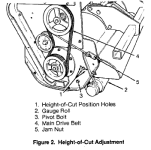
Three pair of holes, they're considered coarse cutting height adjustments. Fine adjustments are subsequently made with the toplink. Top holes put mower chassis closest to the ground (short cut). Middle and bottom holes progressively increase chassis height. Mine's just for pasture & roadside maintenance, so I stay in the bottom holes full time.

//greg//
 
/ Used Flail Mower. #17  
Three pair of holes, they're considered coarse cutting height adjustments. Fine adjustments are subsequently made with the toplink. Top holes put mower chassis closest to the ground (short cut). Middle and bottom holes progressively increase chassis height. Mine's just for pasture & roadside maintenance, so I stay in the bottom holes full time.

//greg//
Greg, are the adjustments made from the inside of the rotor housing?
 
/ Used Flail Mower. #19  
Greg, are the adjustments made from the inside of the rotor housing?
roller.png
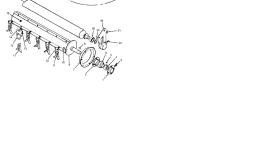
There's a bearing carrier on each end of the rear roller, which double as the roller height adjustment points. That's the triangular bit in the diagram (#18). Obviously, the other one is at the opposite end of the roller. The bottom hole is for the pivot bolt, the upper hole is the one that can be fastened to any of the three roller height holes on the frame. See below: #3 is the pivot, #1 is the adjustment selection
pivot.png

//greg//
 
/ Used Flail Mower.
  • Thread Starter
#20  
Talked with the guy about it and he said it is in pretty good shape. He used to mow pecan orchard and some pasture. I will probably go look at it weekend after next if he still has it. He is wanting $800 for it. Red Flag went up about the pecan orchard, I have never seen a pecan orchard that didn't have limbs laying it. Anyway is there a place I could download a manual for it in case I decided to purchase it?


Top