3-Point Hitch Using Box blade With No Draft/Float Control

   / Using Box blade With No Draft/Float Control #1  

Sarge338

Bronze Member
Joined
May 6, 2020
Messages
53
Tractor
Mahindra 2555
Hey Folks,

I recent did some culvert repair and extension. I want to level the area with dirt and then gravel it. I have a Mahindra 2555 with with no draft control on the 3-point, and 6’ box blade. The ground is not even, so do you have any recommendations on how to use the box blade to accomplish this without a draft control? I don’t want to end up with lumps of earth every time the tractor bounces over a lump of something. It seems every time I try to smooth something (gravel, dirt, whatever), that is exactly what happens.

Thanks for the help!
 
   / Using Box blade With No Draft/Float Control #2  
Same issue on most small, low spec tractors.

Part of the appeal is low cost, but then, you have to learn to live with the lack of features.

If I had to do it again, I would go with a Kioti NX instead of my CK. Draft control was standard on the NX.
 
   / Using Box blade With No Draft/Float Control #3  
Same issue on most small, low spec tractors.

Part of the appeal is low cost, but then, you have to learn to live with the lack of features.

If I had to do it again, I would go with a Kioti NX instead of my CK. Draft control was standard on the NX.
It's more of a US market thing than a low spec thing. In Europe, draft control comes standard on pretty much all tractors starting at 35 HP. And some will offer right at 25 to 35HP as well.
 
   / Using Box blade With No Draft/Float Control #4  
Hey Folks,

I recent did some culvert repair and extension. I want to level the area with dirt and then gravel it. I have a Mahindra 2555 with with no draft control on the 3-point, and 6’ box blade. The ground is not even, so do you have any recommendations on how to use the box blade to accomplish this without a draft control? I don’t want to end up with lumps of earth every time the tractor bounces over a lump of something. It seems every time I try to smooth something (gravel, dirt, whatever), that is exactly what happens.

Thanks for the help!
In order to smooth out areas, I adjust the top link so the box blade gently cuts into the earth moving forward.

Pull forward and at the end of the run, or when the box blade gets full, I lift up the box blade, pull forward and use the back of the blade to push back.

Depending on how rough the area is, you may need to play with the top link adjustment. For fine tuning, I will back drag with the loader bucket.

For spreading gravel, I would drop it from the bucket.

That is the way I do our uneven and new culvert areas. Maybe others have some different methods.

My little BX does not even have position control so I pretty much use the box blade by feel. Usually the end result is spot on, and if it is not, I fine tune
 
Last edited:
   / Using Box blade With No Draft/Float Control #5  
I believe that "draft control" is one of the most misunderstood features on a 3PH tractor. I don't think that it would have any application with a box blade. Draft control might be useful with a moldboard plow, for example, where it would tend to raise the plow when encountering hard soil or a rock.

Most all 3PH's on compact tractors have "float control" in the fact that there is no hydraulic down pressure. Placing the 3PH position lever in the full down position is "float control"
 
   / Using Box blade With No Draft/Float Control #6  
Most all 3PH's on compact tractors have "float control" in the fact that there is no hydraulic down pressure. Placing the 3PH position lever in the full down position is "float control"
The ground is not even, so do you have any recommendations on how to use the box blade to accomplish this without a draft control? I don’t want to end up with lumps of earth every time the tractor bounces over a lump of something.
With the 3PH lever all the way down when the back wheels go over a bump, the box blade won't raise.
 
   / Using Box blade With No Draft/Float Control #7  
Hey Folks,

I recent did some culvert repair and extension. I want to level the area with dirt and then gravel it. I have a Mahindra 2555 with with no draft control on the 3-point, and 6’ box blade. The ground is not even, so do you have any recommendations on how to use the box blade to accomplish this without a draft control? I don’t want to end up with lumps of earth every time the tractor bounces over a lump of something. It seems every time I try to smooth something (gravel, dirt, whatever), that is exactly what happens.

Thanks for the help!

Box blades work great for leveling loose material that flows well, such as inch diameter gravel. If your ground is a bunch of hard-packed clay and clods, you will want to break the surface up with a tiller or other tillage tool before the box blade will do a good job in leveling the soil. Trying to level 6" diameter dirt clods doesn't work well. If your ground is already loose, shorten the 3 point top link to increase the spreading action of the box blade and go slowly.
 
   / Using Box blade With No Draft/Float Control #8  
Hey Folks,

I recent did some culvert repair and extension. I want to level the area with dirt and then gravel it. I have a Mahindra 2555 with with no draft control on the 3-point, and 6’ box blade. The ground is not even, so do you have any recommendations on how to use the box blade to accomplish this without a draft control? I don’t want to end up with lumps of earth every time the tractor bounces over a lump of something. It seems every time I try to smooth something (gravel, dirt, whatever), that is exactly what happens.

Thanks for the help!
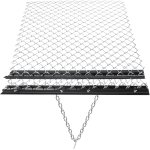
Lengthen your top link so that the blade is barely cutting and just pull ahead. I set a stop on the three point lift to bring the box blade up an inch above grade and let the contents just feather out under the back. When you get your grade about where you want it lengthen the top link even more so that the inside blade isn't cutting at all and the back blade is just smoothing. Finish with a drag harrow. The drag harrow can b something as simple as some chain-link fence material with the leading edge held flat and a chain or even a good rope to pull it with.
drag-harrow.jpg
 
   / Using Box blade With No Draft/Float Control #9  
A hydraulic toplink is the ideal mate to a boxblade. Minute adjustments to the angle of the blade(s) on the fly according to ground conditions is what you need to learn how to use a boxblade VERY effectively.
 
   / Using Box blade With No Draft/Float Control #10  
I believe that "draft control" is one of the most misunderstood features on a 3PH tractor. I don't think that it would have any application with a box blade. Draft control might be useful with a moldboard plow, for example, where it would tend to raise the plow when encountering hard soil or a rock.
Please explain why something that controls based on the amount of pressure applied to the toplink would have no application with a box blade. I have done a huge number of hours of grading with a box blade using draft control. I would hate to think I did it wrong and wasted my time.
 
   / Using Box blade With No Draft/Float Control #11  
Draft control is a great way to make a box blade - or anything - float at a pre-determined pull. You just have to adjust the draft control until putting the 3pt control to the right place that gets you the implement depth you want when pulling hard. Then if nothing changes, the draft control does all the work. Draft control is pretty good way to even out soil - whether plowing or gradng. It doesn't always help, it depends on the ground. But nice when it does.

The problem is not all tractors have draft control and not all owners use it or even understand it. Plus often the draft control itself is not as adjustable as it could be. Draft control is not a feature used much by home owners and maybe that is why it isn't well worked out on compact tractors. It works best on a big tractor pulling hard.

There are other ways to control an implement's ground egagement. Instead of controlling the draft by top link compression you can control how deeply it cuts into the ground by adding more surface area to the implement until it rides on the ground in 3pt float mode instead of digging in. Try bolting some 2x4 shoes to each side of the box blade. It will take more passes, but be smoother. That will get you started.
rScotty
 
Last edited:
   / Using Box blade With No Draft/Float Control #12  
One reason I decided to go with a land plane was to make it easier than trying to level with a box blade. But even a land plane will not level gentle undulations on a driveway...or at least on my driveway. I intend to do as rScotty suggested above and bolt 2x6 "shoes" to my land plane that are 8' long.

I do not see how draft control will help with levelling. So interested in what others have experienced. I have draft control but either I do not know how to use it, or it does not do what I need it to do.
 
   / Using Box blade With No Draft/Float Control #13  
How draft works for leveling is that in a perfect world the resistance of the implement - box blade or whatever - increases as it runs deeper and fuller. That increased load results in more compression on the top link which then activates the draft control to reduce the load by raising the lift arms. The draft control is adjustable to some degree.
Since the world is rarely that perfect, I started using 2x4 shoes on my box, and when that worked a little I saw the light and switched to trailing wheels on a grader blade - one at each corner.

Now I only use draft control for very crude initial work with the heavy box without wheels when doing initiial cuts through rocks. dips, and mounds. Pulling hard enough to almost stall an 6000 lb tractor before the draft kicks in.Otherwise use shoes and wheels. But all of that is on rough granite mountain land. Everyone's land is different. I wish ours was consistent enough to use a land plane and/or trailing wheels alone but no such luck.
it's all about rocks,
rScotty
 
   / Using Box blade With No Draft/Float Control #14  
Have no experience with draft control, but it seems like for leveling an uneven surface with a box blade it would not be helpful.

For example, lets assume the draft control is set and the box blade is being pulled through a hump, and the system is happy.

Then as the box blade breaks through the hump, pull back from the box would be reduced, and the box blade would be lowered in an attempt to increase the back pull on the box blade to where it was when cutting off the top of the hump.

So the box blade would lower into the dip that followed the hump, and tend to make the dip larger, rather than possibly filling the dip as might happen if the box blade did not drop, and some of the contents of the box fell into the dip.

Does this make any sense? Just the way my mind sees it, after having in a previous life many years experience troubleshooting industrial control systems.

BUT no experience whatsoever with draft control. :cry:
 
   / Using Box blade With No Draft/Float Control #15  
Please explain why something that controls based on the amount of pressure applied to the toplink would have no application with a box blade. I have done a huge number of hours of grading with a box blade using draft control. I would hate to think I did it wrong and wasted my time.
Perhaps I don't understand how draft control works when using a box blade. I would want the blade to stay at a constant depth when going thru various soil conditions such as hard and soft. The draft control would tend to raise the blade when the draft increases and lower it when draft reduces, would it not? Help me understand.

Edit: Didn't realize that I hadn't read all the posts above when posting this but I'm now more confused than usual. Seems to be a wide disparity on using draft control on a box blade. Are there different types of draft control or do they all work the same, that is, raise the 3PH when top link is in compression and vice versa?

Would be nice to get this resolved, in my mind at least.
 
Last edited:
   / Using Box blade With No Draft/Float Control #16  
Most all 3PH's on compact tractors have "float control" in the fact that there is no hydraulic down pressure. Placing the 3PH position lever in the full down position is "float control"
^^ This
 
  • Good Post
Reactions: LD1
   / Using Box blade With No Draft/Float Control #17  
Leveling with a box blade takes a quick hand on the lever or the undulations the tractor and box blade go over make the problem worse without constant height adjustment. A box blade with wheels behind it(farther the better) or a land plane perform much better and are easier to use.
 
   / Using Box blade With No Draft/Float Control #18  

Are there different types of draft control or do they all work the same, that is, raise the 3PH when top link is in compression and vice versa?

Would be nice to get this resolved, in my mind at least.

I don't know if there are different kinds of draft control. There may well be.
I'm also not sure what you mean by vice versa. It's not opposite because the lower position is set by the operator and the force to get there comes from gravity and ground engagement. But here goes.....

On mine the 3pt hitch holds the implement at whatever position I've set with the 3pt control lever. The implement can float higher than that, but it cannot drop any lower than that. All implements weigh enough so that their own weight or ground engagement will hold it down to that height for normal work. So normally the implement will not rise up....although in some circumstances or especially if adjusted wrong I guess it could rise up. There is no hydaulic force holding it down.

But normally we assume that the implement is adjusted correctly for ground engagement and also that it weighs enough so that small changes won't cause it to rise up. The implement just runs along at whatever depth of ground engagement the position adjustement (called a quadrant by some) allows it to run.

So you come to a tough spot in the ground that is enough to stall the tractor. Now the 3pt draft control takes over and rapidly raises the implement in successive very small increments. The tractor slows, the load response opens the throttle, and the draft control starts firing short rapid bursts of oil into the 3pt cylinder based on how much compressive force is on the top link. The noise it makes doing this is fairly loud. It sounds like the fast ratatattat of the automatic brake systems you hear on cars when one tire starts to slide. It does that until it has raised the implement out of the rough spot and the compression on the top link decreases. Then it lowers itself back down to the pre-determined depth.

Does this make sense?
rScotty
 
   / Using Box blade With No Draft/Float Control #19  
pbgd3

pbgd3

8 months ago
I had a few explanations but one finally made sense. Before there were tractors farmers plowed using animals (or humans) to pull the plow through the dirt. The farmer manhandled the plow using the handles and followed along and it was the farmer or was the draft control raising the plow up when it got hung up and forcing the plow down if it wasn't biting in. The draw bar or a chain is your lower arms by themselves they pull the plow. As the farmer you resist and control the draft. Top link and draft control do the same. Only a hydraulic circuit does the work instead of your body. Plow hangs up implement slows down this pivots around the lower pins and pushes the top link forwards. Compressing a spring loaded hydraulic valve that raises until the spring is under normal pressure and then it stops. Plow pulls free linkage extends spring pressure drops hydraulics lower till the spring pressure is again normal. Draft control lever sets how much pressure you want on the spring. This forms a feed back loop the same as a guy manhandling a plow would have done but far simpler. Where we used it most was plowing in rolly terrain. Going up a hill would bury a plow right as the tractor had the least grip. Run draft and it would raise up loading the rear wheels and keeping the plow on top. Over the top the plow would be pulled up shallow and draft would let it down. Then hang up on a bolder and it would yank the plow right up.
Show less


2


REPLY

This a video by "Tractor Mike" explaining draft control and the comments below make some good points. Not saying anyone is right or wrong, its just an interesting subject.

One issue that I don't remember reading recently is that draft control tends to increase traction when it is compensating for increased draft by gradually raising the implement. Lessening the depth reduces the required traction while, at the same time, increases traction by transferring some implement weight to the rear wheels of the tractor


derek evans

derek evans

4 years ago
Draft control should be used whenever you are working with an implement below the surface of the ground. Draft control is constantly sensing the depth you want to work. If you have a plough on the back and go uphill your plough will tend to go deeper if you down hill it will tend to come out of the ground. If the soil is more solid the plough will tend to bury itself due to the suction effect of the plough draft control overcomes these issues. When you lower a plough to the ground the plough will suck itself underground and if its not controlled it would just bury itself the draft control lets the plough go down to a given depth then gently lifts the plough but not enough to lift it up it just takes the weigh so the plough is ( floating ) under the soil, this lifting effect pulls the rear of the tractor down so you get better traction. This is the Furguson system. By just using just position control you are just dragging the implement along losing traction. Position control is for working above ground to keep a constant height above ground.


Another video that demonstrating draft control in a somewhat novel way. He doesn't explain, however, that he is raising the plow manually by compressing the top link letting the 3ph valve do the work and thus simulating increased draft.
 
Last edited:
   / Using Box blade With No Draft/Float Control #20  
Draft will shave off those humps that are caused by down force alone. If you don't use draft and aren't good at the controls those humps and valleys will get progressively worse. What I can tell you is that it works. It's all I sue when I pull a box or landplane.
 

Tractor & Equipment Auctions

Forklift (A56857)
Forklift (A56857)
2022 Vermeer 573 (A55973)
2022 Vermeer 573...
Pat's QH and hydraulic top-link.
Pat's QH and...
2014 Lamar Pipe Trailer (A60460)
2014 Lamar Pipe...
Adams 5T Spreader MHR (A56438)
Adams 5T Spreader...
John Deere 3025E (A53317)
John Deere 3025E...
 
Top