Welding it "tight" (no weep hole)

   / Welding it "tight" (no weep hole) #1  

Sodo

Elite Member
Joined
Apr 21, 2012
Messages
3,311
Location
Cascade Mtns of WA state
Tractor
Kubota B-series & Mini Excavator
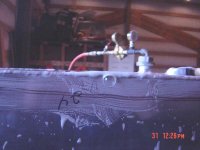
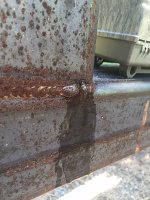
I was interested in the discussion about welding an item "tight" vs "weep hole". I was working on my gate yesterday and was looking at it, thinking about water and wondering if there was any inside it. My gate is welded "tight".

Drilled a hole and water poured out. It poured a lot more, that's how it looked by the time I dug the camera out. Recommend some folks drill drain holes in their "tight" implements and see what happens. Of course a little water in there might be more curiosity than problem (except near salt).

(EDIT: DELETED 2nd PIC with the large pee-stream BECAUSE i found where water can get in that one. The first one was welded tight, no nek'd eye visible entry points.
 

Attachments
  • water_welded_tight1.jpg
    water_welded_tight1.jpg
    318.3 KB · Views: 516
Last edited:
   / Welding it "tight" (no weep hole) #2  
Can you find where the water went in? Use a rubber tipped air gun to pressurize it and see if you can hear any air leaking out perhaps?
 
   / Welding it "tight" (no weep hole) #3  
IF you cannot weld well, then leave a hole. If you are confident you can weld air/water tight, weld it solid. If no water can enter, there is no issues. A weep hole is a place for moisture (humidity) to get in as well as air and cause rusting. But better than allowing it to fill with water and no way out. So I guess my take is this

Best: weld it tight
Better: weep hole
Worst: what you think is welded tight, but isnt, and allowed to fill part way with water
 
   / Welding it "tight" (no weep hole) #4  
I'm not so sure.

Water doesn't realy create rust, oxygen does. Water serves as a catalyst to help take oxygen from the air and give it up to the steel.
But water alone won't cause rusting.
If you have water inside, but no air circulation you shouldn't have much rusting at all.
Kind of like a cast iron radiator in your home. It's full of water all the time but it doesn't rust.
 
   / Welding it "tight" (no weep hole) #5  
Quick and easy test. 3 or 4 PSI, and some soapy water. :D
 

Attachments

  • Bubble 1.jpg
    Bubble 1.jpg
    67.5 KB · Views: 392
   / Welding it "tight" (no weep hole) #6  
I'm not so sure.

Water doesn't realy create rust, oxygen does. Water serves as a catalyst to help take oxygen from the air and give it up to the steel.
But water alone won't cause rusting.
If you have water inside, but no air circulation you shouldn't have much rusting at all.
Kind of like a cast iron radiator in your home. It's full of water all the time but it doesn't rust.

If water can get in, air can get in and you have rust.

Best not to let either in IMO.

Something designed for water, the water is added then the system is sealed. Yes, without air it wont rust. But unless you filled the tubes with water THEN welded them shut, air can get in the same way the water did
 
   / Welding it "tight" (no weep hole)
  • Thread Starter
#7  
(EDIT: DELETED 2nd PIC with the large pee-stream BECAUSE i found where water can get in that one. The first pic was surely "welded tight", no nek'd eye visible entry points.


Dan I'm real curious about this, but cant pressurize it as I hace cut other holes, which is come to think of it - is the real reason I thought it needed a drain hole. LD I could agree with what you wrote, until yesterday. Certainly it can be done, is done all the time. In 1981, I welded an aux fuel tank for a friend's pickup (MIG) out of 16ga sheet. It didn't have a single wet spot. It was "open" though. I wonder about the 'finish' when you weld up a closed cavity thats exhaling as you weld and starts inhaling the moment you stop.

I never would have imagined the volume of water, especially in 4 years. I paid a local $2,000 to build & install it as I could not do it at the time. Its 22 feet long and 100+ miles away. I doubt the fabricator gave more than normal effort to "weld tight", I suppose he could have if someone told him to.

Seeing how much water it held you can at least assume the lower welds were watertight (or became that way). Anyway thats why I suggested to folks to drill some holes and see if you find water too.
 
Last edited:
   / Welding it "tight" (no weep hole) #8  
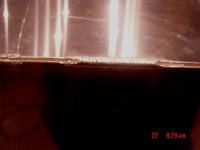
I think where the average guy makes a mistake when welding up something that is suppose to be air / water tight. Is not feathering his starts and stops.
 

Attachments

  • Tack weld 2.jpg
    Tack weld 2.jpg
    69.9 KB · Views: 388
   / Welding it "tight" (no weep hole)
  • Thread Starter
#9  
Gotcha, that would help. Great pic says it all!
 
   / Welding it "tight" (no weep hole) #10  
In the pipe fab shop I run we do a lot of structural support work. Anything that has a base plate on it gets a weep hole. Even condensation can build up inside of a capped pipe.

Sealing off a pipe or vessel is tricky. It always seems to want to poot just as you tie in. Sometimes it's apparent and sometimes you don't realize it. I always figured it was the hot expanding air blowing out.
 
   / Welding it "tight" (no weep hole) #11  
I would always put small drain holes in the bottom of gates because here in Oregon the rain gets into everything, especially if someone drills a hole for a latch in in after it leaves the shop. Also, the holes made it good to have hanging wires protruding so the powder coaters didn't have to wrap wires around the outside, leaving a blem.
I've seen a lot of OI railing come in for repair that had the bottom square tube rounded out from frozen water trapped inside, an exit path would have prevented this.
 
   / Welding it "tight" (no weep hole) #13  
Lots of times it isn't raw water that enters such an area, it is water vapor. When things get hot, they expand. This expansion also creates pressure inside. A sealed vessel can actually reach near 100PSI in direct sunlight with other variables "just right". Something not designed to hold those pressures is going to develop micro-fractures and cracks large enough to relieve the pressure. When things cool down and contract, those same cracks that expelled the additional pressure begin to create a vacuum and draw in the surrounding air. Generally at such a time things are very moist from dew and fog and whatnot, and that stuff gets sucked in with the surrounding air. Eventually it accumulates as most times a vessel will grow it's expansion leaks at the top where the most heat accumulates, leaving the bottom sealed to collect the water like a reservoir.

I try to leave all box and tube steel open on the ends. If I do anything I get plastic caps from McMaster-Carr to insert in them, they don't fit tight and don't allow the pressures inside the tube to vary from the outside atmospheric pressures very far, eliminating most of the collection of water vapor.

When I have built closed box tubes for strength, I cut the corners off the piece I'm welding in the end; making an octagon shaped part to fit the square hole; it still attaches to all four sides and holds the part square, it actually ends up being stronger than having the four corners filled...

Part of my cleaning routine is to always clear out any tube or box steel and spray rust inhibitor inside of it. Anything like that needs made with more than a simple weep hole. Weep holes are intended to be a maintenance free solution, but I prefer having a maintainable solution such as being able to spray the rust inhibitor inside. Maintained solutions generally last longer than maintenance-free.

My dump trailer came with weep holes in some parts. I enlarged the weep holes they had, and added some extras so I could spray some form of rust inhibitor inside during cleanings. The bottom edge of my tailgate had no weep holes and had over a pint of water inside it (probably nearer to two). This was within two months of the manufacturing date.
 
   / Welding it "tight" (no weep hole) #14  
Tons of condensation will fill the tubes with water too. No where to go and it freezes and splits. I hate weep holes but find them needed where ever humidity and or sharp temp changes cause condensation. Air in and air out at least gets a chance to dry. Condensation in and no way out is worse.
 
   / Welding it "tight" (no weep hole) #15  
If water can get in, air can get in and you have rust.

Best not to let either in IMO.

Something designed for water, the water is added then the system is sealed. Yes, without air it wont rust. But unless you filled the tubes with water THEN welded them shut, air can get in the same way the water did

True, but you won't have as much air circulation as if it was an open container. Daily heat and cool cycles will exchange some air though. It will rust, but not as fast as you might think.
 
   / Welding it "tight" (no weep hole) #16  
anychance it could just be condensation build up? hot/cold...hot/cold could cause moisture to be trapped and build up inside such a pipe? a weep hole is always a good thing in my books...
 
   / Welding it "tight" (no weep hole) #17  
Condensation comes from moisture in the air. When a part gets below the dewpoint, moisture from the air collects on the surface. There is only a limited amount of air inside "tight" area. Therefore only a limited amount of moisture. And not enough to cause any issues. A weep hole allows a place for air and moisture to enter. Again, it is better than filling with water, but with no way to paint the inside of the tube after welding, air and moisture will cause rust.

I dont think I am going to jump on drilling holes in my loader and backhoe booms to see if water comes out.
 
   / Welding it "tight" (no weep hole) #18  
If an item is for sure welded air /water tight, there might be a very small amount of condensation that might cycle between vapor and condensate due to temporary heat/cool cycles. As long as the piece doesn't set outside in the weather and fill with water prior to the sealing end, there will be very little water even if the ambient air is 99% humidity, there still wont be enough water in a item to collect a visible amount of water.
On a construction project once, we built a "dummy leg" (a piece of pipe that welds onto a larger pipe to support it) and it set outside for a while and collected a lot of rainwater. When it was put on the supporting pipe, a steam line, they didn't dump out the water before welding it tight. Later that line was put into service with 500F steam. It ran for over a week before finally building up enough pressure in the dummy leg to punch the center of the steam line (the part covered by the dummy leg) out. Engineers calculated that it developed about 15,000 PSI inside the pipe in order for it to cause the steam pipe to rupture. Everyone was surprised that the steam pipe gave way and not the dummy leg which had a flat plate on the bottom. The dummy leg was welded to a 90 ell so it was pressuring against a convex part which should have been much stronger than the flat plate.
We were lucky that it didn't explode the dummy leg pipe because people were working in the close vicinity of it. After that incident, all dummy legs had to have a minimum of 1/4" vent hole in the bottom.

If I am welding on a reinforcing plate, some call them scab plates, I always weld solid to prevent any moisture from getting under them and causing corrosion. When closing the weld, I weld up to the last 1/2" or so then let the weld cool, then finish the weld. This keeps the closure from developing a pinhole in the weld from high internal pressure from expanding gases under the plate.
 
   / Welding it "tight" (no weep hole)
  • Thread Starter
#19  
I dont think I am going to jump on drilling holes in my loader and backhoe booms to see if water comes out.

You're a wise man, I'm not drilling mine. Although it would be no detriment (or even visible) if done sensibly. Someone must have a scrap backhoe (?)

If anybody has items that have been outdoors for years (welded tight) that they are willing to drill in the name of science, this subject can go further but for now we have just ONE sample (the gate).
 
   / Welding it "tight" (no weep hole) #20  
Repads on large vessels usually have a threaded weep hole. Once the vessels is finished, they put a grease fitting in the weep hole and fill it with grease. The weep hole is there for several reasons but they fill it with grease to prevent any corrosion from moisture. Even something sealed tight can build up pressure and expand and contract. Look at what a jerry can does in the sun and then does when it gets cold. Somehow water got in one of the posts for the roll bar on my cat and expanding the tubing enough that it split one of the corners. This is a heavy wall tube and is quite noticeable.
 

Marketplace Items

2018 FREIGHTLINER CASCADIA TANDEM AXLE SLEEPER (A59904)
2018 FREIGHTLINER...
2022 Ram 2500 (A55973)
(2) UNUSED 31" X 8 MM EXCAVATOR TRACKS W/ PINS (A60432)
(2) UNUSED 31" X 8...
VOGELE VISION 5103-2 ASPHALT PAVER (A60429)
VOGELE VISION...
2018 Ford Explorer AWD SUV (A59231)
2018 Ford Explorer...
JLG SKYTRACK 10054 TELESCOPIC FORKLIFT (A60429)
JLG SKYTRACK 10054...
 
Top