Ballast Wheel Weights

/ Wheel Weights #1  

Pabco

Member
Joined
May 22, 2019
Messages
41
Location
Meadow Vista, CA
Tractor
Kubota B2650 / FEL LA534 / BH77 BH
Hello. I'm looking for some input from people who have added (rear) wheel weights to their Kubota. I have a B2650 and am lookng for folks who are pleased with the product they chose for their tractor. I have several acres which have some uncomfortable slopes I need to work. Just looking for a little extra stability, aside from 3" wheel spacers. Thanks.
 
/ Wheel Weights #2  
Hello. I'm looking for some input from people who have added (rear) wheel weights to their Kubota. I have a B2650 and am lookng for folks who are pleased with the product they chose for their tractor. I have several acres which have some uncomfortable slopes I need to work. Just looking for a little extra stability, aside from 3" wheel spacers. Thanks.

I always use cast iron weights rather than liquid ballast because I repair/change my own tires and have no equipment for handling liquid ballast.

That said, I do not have rear weights on my B3350 or B1750 because they are not needed for the purposes that I use these tractors.

I do not believe that Kubota offers wheel weights for the B2650/B3350 (not certain). I do not believe that there are mounting holes in the rims.

Of course, weights intended for other machines could be adapted.

SDT
 
/ Wheel Weights #3  
These folks have quite a few weights available.
Kubota Tractor Weights

The weights #4150 fit a lot of the smaller Kubotas
 
/ Wheel Weights #4  
I added rimguard to my Kubota L3400 and it made a world of difference. I also added steel wheel weights to my JD and they were not nearly as helpful as the 800lbs/tire of rimguard.
 
/ Wheel Weights #6  
I always use cast iron weights rather than liquid ballast because I repair/change my own tires and have no equipment for handling liquid ballast.

That said, I do not have rear weights on my B3350 or B1750 because they are not needed for the purposes that I use these tractors.

I do not believe that Kubota offers wheel weights for the B2650/B3350 (not certain). I do not believe that there are mounting holes in the rims.

Of course, weights intended for other machines could be adapted.

SDT

Very similar thoughts, I much prefer bolt on weight over liquid ballast, It performs better in my opinion and does not effect the ride as much.
It does cost more, about a buck per pound.
 
/ Wheel Weights #7  
Very similar thoughts, I much prefer bolt on weight over liquid ballast, It performs better in my opinion and does not effect the ride as much.
It does cost more, about a buck per pound.

Agreed, Lou, and they are "easily" removed when not needed.

I've F and R weights for both my L6060 and M9960 as well as front (only) weights for my B1750 and B3350.

For those who are interested, there are aftermarket weight suppliers who sell tractor weights for considerably less than do tractor manufacturers.

There are also ways to get free shipping (to the dealer) if one is not in a great hurry.

SDT
 
/ Wheel Weights #8  
Quote Originally Posted by LouNY said:
Very similar thoughts, I much prefer bolt on weight over liquid ballast, It performs better in my opinion and does not effect the ride as much.
It does cost more, about a buck per pound.

Agreed, Lou, and they are "easily" removed when not needed.

I've F and R weights for both my L6060 and M9960 as well as front (only) weights for my B1750 and B3350.

For those who are interested, there are aftermarket weight suppliers who sell tractor weights for considerably less than do tractor manufacturers.

There are also ways to get free shipping (to the dealer) if one is not in a great hurry.

SDT

I also prefer the bolt on weights. Our land is hilly and I use wheels set right out as wide as they will go, wide tires, and cast iron wheel weights. I've had luck setting the wheels out and not had to add spacers.

So I know it sounds too simple, but first do check that your rear wheels are set as wide as possible. Sometimes the ops manual is helpful there. Just the rears; fronts matter less. Methods of setting width vary a lot. Study yours. Tractor manufacturers seem to buy some wheels from specialty manufacturers, and wheel construction varies with price. Some wheels have centers that can be set in different positions or even reversed for width adjustment. In addition, there are wheels that have the rim adjustably bolted instead of welded to the centers.

I think that every tractor I've had has a different way to set rear width. Our old JD uses all these methods PLUS a rack and pinion to slide the wheel along the rear axle itself.

And I see others saying that there are aftermarket sources for wheel spacers and wheel weights for Kubotas that are high quality and also less expensive than OEM. You might want to search on some of the old discussion threads here.
rScotty
 
/ Wheel Weights #9  
I also prefer the bolt on weights. Our land is hilly and I use wheels set right out as wide as they will go, wide tires, and cast iron wheel weights. I've had luck setting the wheels out and not had to add spacers.

So I know it sounds too simple, but first do check that your rear wheels are set as wide as possible. Sometimes the ops manual is helpful there. Just the rears; fronts matter less. Methods of setting width vary a lot. Study yours. Tractor manufacturers seem to buy some wheels from specialty manufacturers, and wheel construction varies with price. Some wheels have centers that can be set in different positions or even reversed for width adjustment. In addition, there are wheels that have the rim adjustably bolted instead of welded to the centers.

I think that every tractor I've had has a different way to set rear width. Our old JD uses all these methods PLUS a rack and pinion to slide the wheel along the rear axle itself.


And I see others saying that there are aftermarket sources for wheel spacers and wheel weights for Kubotas that are high quality and also less expensive than OEM. You might want to search on some of the old discussion threads here.
rScotty

North States is a manufacturer of cast iron weights as well as other things.

They sell to manufacturers (including Kubota) as well as dealers but do not sell directly to consumers.

Your dealer can (if he chooses to) order from North States. Hint: North States ships to dealers without charge if the total order is 1,000 Lbs. or more. Ask your dealer to add your order to his next order so as to get the weight up to 1,000 Lbs., to avoid shipping charges.

SDT
 
/ Wheel Weights #10  
Very similar thoughts, I much prefer bolt on weight over liquid ballast, It performs better in my opinion and does not effect the ride as much.
It does cost more, about a buck per pound.

As you say, if they are the same weight, the bolt-on's do ride better and make things more stable.
I think that's because the weight is out farther from the centerline, no liquid means the tire can flex normally, plus there is better overall tire balance and less rotating momentum - all of which help the ride.

For a lot of new owners who are already stunned by the high price of what they just bought, the fact that the initial price of liquid ballast is half or less than the cost of adding the bolt-on style tire weights is persuasive. And it is not only just about the only affordable option but it stays a good idea until about the second time you have a flat or a need to remove a tire to do some work behind it.

My opinion is that if you plan to keep the tractor for a long time and can afford the outlay then you will be glad to have bought bolt-on wheel weights. Come to think of it, that's about the same story as anything else we buy. At least I've never heard anyone complain about the price they paid for quality tractor options ten or more years later.

So It's worth taking a look around at wheel weight manufacturers. Some wheel weights have slots and holes to make them nearly universal fit. Those type never wear or depreciate & are always worth what you paid in current dollars.

For universal wheel weights, There used to be a local iron foundary that at the end of the day's run would pour any extra molten steel into simple pre-prepared sand molds where crude castings could be sold at a slight profit or just stored & remelted. The quality of the molten metal dictated what they poured. They would pour machinable ingots for machine shops if the steel alloy was approriate, anvils if it was lesser, or if it was low quality iron they poured things like tractor wheel weights. I doubt they ever advertised anywhere. They had a pattern maker there who would make a wooden model of anything you wanted poured - like a wheel weight. From the wooden model they could quickly make as many sand molds as needed to pour into.

I wonder if the same sort of thing is still true for wheels?
At one time we could buy wheel/rim pairs that had even more adjustability built to them than a set of spacers would give. Are those type of adjustable wheel/rim sets still available? Anyone know?
rScotty
 
/ Wheel Weights #11  
I have used cast iron rear wheel weights and liquid filled rear wheel ballast but not both at the same time. I think bolt on weight wheel weights are great for traction and adds some side hill stability. However, I think liquid ballast in the rear wheels adds more stability on side hills than cast iron weights because most of the added weight is below the center of the axle and closer to the ground.
 
/ Wheel Weights #12  
Properly filled and properly inflated tires with liquid should not ride any different than empty tires. If your ride is bad, then there is either too much liquid or they are inflated too much.
 
/ Wheel Weights #13  
I have both liquid ballast and cast iron wheel weights on my International. The tractor will go 17 mph at wide open on the road but I do not feel comfortable driving it that fast because it handles poorly. My tire man says that one tire is filled (3/4 full is considered full) and the other tire is about half. I am guessing that is what is causing it to handle poorly.
 
/ Wheel Weights #14  
Properly filled and properly inflated tires with liquid should not ride any different than empty tires. If your ride is bad, then there is either too much liquid or they are inflated too much.

BAP, I've heard that too, but It doesn't seem that way to me,

Here's the way I see it....I figure it is that the quality of the ride is normally based on the elasticity of the tire material and on the pressure of the air inside the tire. But to make things equal so that we can compare between two tires, we also have make sure that the the bulk amount of air would be the same in each one. That is because air is compressible, and as a tire hits a bump we need the same amount of air in each tire to compress so that the pressure changes inside the tire will also be equal. What I'm saying is that when hitting a bump, the pressure change inside the tire is part of what what we feel as ride quality.

When we compare two tires - one filled with compressible air and one mostly with incompressible flud - we know that the fluid filled tire has less compressible air space in the tire. So now when we run over that bump in the road, the fluid-filled tire has less air to spread out the sudden change in air compression. Less air to compress means that the pressure change inside the tire is higher. And it is that sudden increase in tire pressure that I think we feel when riding on fluid filled tires on rough roads.

I'm guessing you have a different way of looking at it. Care to share?
rScotty
 
/ Wheel Weights #15  
Properly filled and properly inflated tires with liquid should not ride any different than empty tires. If your ride is bad, then there is either too much liquid or they are inflated too much.

I have run tires with liquid and wheel weights, I've run tires with just liquid and I've run tires with just iron and with no added weights.
There is a definite difference in the ride quality in fields and roading. An unloaded tractor will ride the best under most conditions.
Add a loader and the ride goes away in a hurry, add loaded tires and it gets even worse.
When hauling heavy loads on the road a tractor with no liquid in the tires will run faster and easier then a comparable one with liquid fill.
 
/ Wheel Weights #16  
I live on a hill as well. I use both liquid filled tires (RV antifreeze and water, can't get Rimguard) and I made my own lead, steel and concrete wheels weights:

qeziNTv.jpg


b1it7EO.jpg


cdwXNK4.jpg


~250 lbs each for a total of 500 lbs for the tractor rear tires, plus 47 gallons of RV antifreeze/water in each tire.
 
/ Wheel Weights #17  
I have run tires with liquid and wheel weights, I've run tires with just liquid and I've run tires with just iron and with no added weights.
There is a definite difference in the ride quality in fields and roading. An unloaded tractor will ride the best under most conditions.
Add a loader and the ride goes away in a hurry, add loaded tires and it gets even worse.
When hauling heavy loads on the road a tractor with no liquid in the tires will run faster and easier then a comparable one with liquid fill.

Bingo, Lou and Scotty.

Air filled tires ride and handle better than liquid filled tires, properly filled or otherwise.

This is not to say that there are no advantages to liquid ballast vis-à-vis cast iron, e.g., somewhat better CG, cost, etc., but the disadvantages far outweigh the advantages for me.

SDT
 
/ Wheel Weights #18  
Not too hijack thread but seems like a good place for a question.

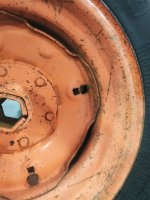
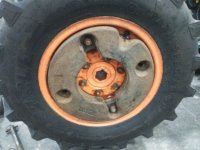
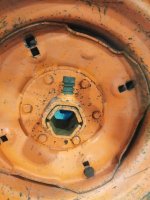
I removed my wheel weights, someone jury rigged them on there with wrong hardware, I tried using 5/8 carriage bolts but the heads to large, hits inside of rim, where can I get proper attaching bolts/hardware?

Ive tried dealer, no luck.

Tractor is a early 80s B6100E. Thanks

Also can someone tell me purpose of the large bolt with the spring in the center, maybe its to compress rim center so its tighter on axle? Still dont get why the spring? Lockwasher would have held tight
 

Attachments

  • 056.jpg
    056.jpg
    3.2 MB · Views: 178
  • 057.jpg
    057.jpg
    4.2 MB · Views: 173
  • 058.jpg
    058.jpg
    3.8 MB · Views: 164

Marketplace Items

2017 Toro Workman HDX-D Diesel Utility Cart (A59228)
2017 Toro Workman...
2008 TEXAS BRAGG GOOSENECK FLATBED (A58214)
2008 TEXAS BRAGG...
Rotating Brush Sweeper Tractor Attachment (A59228)
Rotating Brush...
BOMAG BW213 SMOOTH DRUM ROLLER (A58214)
BOMAG BW213 SMOOTH...
Bush Hog 72in Rotary Brush Cutter Tractor Attachment (A55852)
Bush Hog 72in...
2004 JOHN DEERE 650H LGP CRAWLER DOZER (A60429)
2004 JOHN DEERE...
 
Top