Who knows about stacked-block retaining walls?

   / Who knows about stacked-block retaining walls?
  • Thread Starter
#81  
Here's what my guy said.
On your hillside it's not going to be flooded behind the wall.
You will have water coming down from above at one or two places.
If you put holes down it will distribute water over the whole base.
If you put holes up it will carry that water out.
your going to have an extra 1 1/4 of water before your drain pipe starts evacuating.
If the holes are on top, the water level has to be at the top of the pipe to drain. I've always used drain pipe with holes all around.
Putting the holes at the top creates a pond at the bottom of your wall. Basically, you have created a dam that will allow the water to remain there and soak into the base of the retaining wall.
I set it holes-down and he turned it holes up.
I was tempted to tell him what I had read "on the internet....." but decided not to because thats all I had.
I've found fantastic info on the internet opposing what the experienced practitioner does,
.....and I bet we all have.
I understand the that the internet is wrong often.

Anyway I'm curious what you guys think of his POV.
He said the water is all coming from above the holes,
in the areas where it's coming to the pipe.
1.25 pipe daylight.jpg

Well anyway the pipe daylights.
If water is above the slots anywhere along the pipe, its a closed-bottom trough that will run any water out the visible end.
I suspect the gravel bed will be "open" for many years and by the time even one drip runs out of the pipe.... I will have long forgotten all about it.
 
Last edited:
   / Who knows about stacked-block retaining walls?
  • Thread Starter
#82  
upper wall done but no caps.jpg

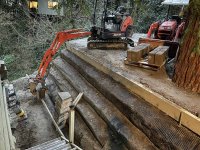
Upper wall is done, ready to remove that last form-board and add the topsoil embankment.
That form board is 4 x 12 x 22 ft long.
Note the gravel waterfall, you can see it in the next pic.

upper wall and gravel waterfall, lower wall started.jpg

In the coming weeks I'll cover that slope with dark topsoil which will grow stuff fast.

Lower wall is started.
They poured a concrete footing about 18" deep to support the left end.
This wall will be 11 blocks high, coming up to the level of the deck
at the bottom of the stairs.
They said it should probably have 3 drainpipes and should have tiebacks but didn't have any ideas.
that black pipe is temporarily accepting the driveway and downspout water outlet.
A tight PVC pipe will be attached there.

Its up to me to figure out a way to anchor tiebacks into the geotex lifts....
I have several days before the wall builders return.
 
Last edited:
   / Who knows about stacked-block retaining walls? #83  
Every picture you add to this thread shows much more layers of complexity to this project.

I disagree with the installer. Water tends to go to the lowest point in a trench, then fills the pipe to carry it away.

If you look at the pictures of how they are attempting to restore stability to the sections of I-40 in western NC that washed away during Hurricane Helene, they are installing helical anchors into the slope. That might be something for you to consider.
 
   / Who knows about stacked-block retaining walls?
  • Thread Starter
#84  
soft-jaws for blocks2.jpg
Clever. It would be cool if you could do a video
OK.....here's the difference between the engineer pre-planning with available tools...
and the experienced wall builders.
They didn't mind my soft-jaws method for the 1st wall,
I think because it was an opportunity to flog their phones while I did the 'work' with the mini-ex.

For the lower wall they just set a 2x12 at the proper angle and slid the blocks down the board.
The angle they set controls the speed.
It was much faster and safer than my mini-ex-soft-jaws method.
I think perhaps 3x or 4x faster. Maybe 5x.

============

Yeah the gravel bed below the blocks will carry the water for many years.
His theory won't amount to anything until the gravel bed plugs with silt (and rises an inch or so to get to the slots).
I'll probably never see a drip from the pipe and if I do, that means there's a significant amount of water coming "from somewhere" that should be dealt with.
I suppose it's like "an indicator".
 
   / Who knows about stacked-block retaining walls? #85  
Having a guy to feed the block and another guy to catch it at the end of the ramp is different than working solo. I’ve roped stones down a ramp before. Not fun.
 
   / Who knows about stacked-block retaining walls?
  • Thread Starter
#86  
Yeah solo.....no sh*t !💪🏽 Forgot I was preparing for solo...
SO glad I didn't even start building this wall solo.
I'm too old for this.
I can do it but it's just dumb.
I could put me under 6 months of bed-rest, and perhaps never fully recovering.

Compacting with a track machine next to not doing anything.
Agreed, but that's all I've got. Trackhoe seems to compress the moist sand about 2 inches deep. But it kinda vibrates under the track-rollers, and the track lugs "press in" on successive passes.
The geotex does get tight at the nose with several passes..
There is the successive SAND tonnage of each lift ontop of the one below.

On the 2 top lifts I used the B3030 tractor with a full bucket load, which is extended pretty far in front of the front wheels. The small wheels press a lot harder, and "roll into" the soft material, making much deeper ruts than the excav tracks.

I will record laser-level elevations to monitor what's happening over the years.
It doesn't have to support a cement truck, but I bet it will in a couple seasons.
Even so, it's a tight parking place for a small car. My F150 barely fits.
But fairly soon it will have some F450 sized dumpers backing in there when I start to push topsoil over the bank.

OK lets say I gained 400SF of level land..... at great effort.
It's essential because this little house has no "parking spot" and will be much more rentable with a parking space.

So,,,,,, does anyone have wild guesses how much this project would bid out "commercially"? Engineering, materials, and everything? I kinda think it's would be 5x the cost of a retaining wall rebuilt with existing rocks.....
 
   / Who knows about stacked-block retaining walls? #87  
View attachment 2643127

Perforated a 1 1/4 for the bottom course.
View attachment 2643128
Ok it’s started.

My guy said he needs to work with his experienced partner. He said there’s too much to learn and much too slow if I was his helper. So it’s gonna cost more per day but I’m sure, less overall.

Watching them set the first course I can see it would have been a crappy wall if I was doing it. Lots of setting, tamping, resetting the first course. Each block gets moves several times. Re-packed, re-set, re-leveled. Looks strenuous.
Best money I have ever spent paying someone to build my ~100 feet of walls, like you said, starter course has to be dead nuts on, or you will have a f’ed up wall in no time.

You may have saved yourself with that 1 1/4 drainage as long as it doesn’t plug up
 
   / Who knows about stacked-block retaining walls? #88  
View attachment 2651749
I made this image with photoshop from an install doc posted by airbiscuit.
I was real happy aircommuter asked for it - because then I had a diagram for the wall builders.
I was ready to do it all by armwaving.
A drawing is much better.

The height of the standing blocks is the final 42".
I have not purchased any top-caps.
I decided to "conserve gravel" a bit because I have a sand mine "on-site"😉.

View attachment 2651615
Here it is at the end of the 1st day.
5 blocks up.
You can see the plywood separator between the gravel and the (packed) sand.
No fabric between the gravel and sand.
I'll put a level fabric sheet ontop below the topsoil.

View attachment 2651746
I cannot believe the cost of gravel here.
The economics of scarcity makes sense,
but gravel pricing seems controlled by a local cartel.


Eddie can you explain why? I told the builders that the holes go down, but he said that doesn't make sense.
He turned them upward and I didn't protest because what he said made more sense than my foggy memory.
I remember your mention for sure.
Can you remember the reason?
I’ve learned the hard way, bad choices always bite me in the butt, now you will have almost a 2” layer of water that will not tend to drain…
 
   / Who knows about stacked-block retaining walls?
  • Thread Starter
#89  
they are installing helical anchors into the slope. That might be something for you to consider.

I ordered some small helical anchors.
I'll weld them to rebar to lengthen them,
and see how far they'll screw into the sand.
I'm guessing they screw right in.

I wonder how to 'qualify' them.
The blocks mfrs say beyond 7 rows (7x6=42"), anchors are needed.
This wall will be 4 rows past the limit, 11 rows.
But it's only about 8 feet long.

I'll pound a fence t-post in with my gas-powered post driver (see how it feels.
They're epoxy-coated and seem to hold fences up for awhile in the ground.
6ft post costs about the same as a helical anchor, but the helical anchor has a 3 inch 'deadman' on the end.
tiebacks anchor rows 6 thru 10.jpg

Here's a proposal for the helical anchors.
Put the anchors in and weld them together.
Then attach to the blocks somehow.

I need some tiebacks in place, ready to attach to some blocks by Wed feb12.

I'm thinking to attach to row 6 and row 10 (of 11 rows).
 
   / Who knows about stacked-block retaining walls? #90  
I hate to be a Debby downer, but you ask for advise from TBNers and then go ahead and ignore most of the advise offered up, and proceed mostly the way you had planned before most of the advise.

I hope you are luckier than I feel I would have been following the path you have taken!

Ive seen walls that have collapsed, and to be real honest, it’s never pretty
 
   / Who knows about stacked-block retaining walls?
  • Thread Starter
#91  
From my POV... I'm getting great input that is helping to move along.
What advice do you think I'm ignoring... that will doom my wall?

What I need is tiebacks,
The wall goes in tipped back at 1:6.
Would be nice to find a way to "qualify" that they'll keep the wall tipped back against the geotextile.

Also would be good to hear from someone who knows whether a geotextile layup can push a block wall out.
It's like a soil wall itself, 6 feet thick, and it's tipped "back" into the slope, perhaps 1:1 or 1:2.
 
Last edited:
   / Who knows about stacked-block retaining walls? #93  
I’ve checked a few times for Curly Dave and came up dry…

Nice to see you are among the living…

I miss your thought provoking tag line at the bottom of every post!

One for old times…

“The true delight is in the finding out rather than in the knowing”

Isaac Asimov
 
Last edited:
   / Who knows about stacked-block retaining walls? #94  
From my POV... I'm getting great input that is helping to move along.
What advice do you think I'm ignoring... that will doom my wall?

What I need is tiebacks,
The wall goes in tipped back at 1/6.
Would be nice to find a way to "qualify" that they'll keep the wall tipped back against the geotextile.

Also would be good to hear from someone who knows whether a geotextile layup can push a block wall out.
It's like a soil wall itself, 6 feet thick.
I really didn’t mean to start an argument with you, I just worry about things, such as retaining walls and such.
But since you ask, I’m going to say what I can remember I’m not gonna go back to the whole thread and try to point out every detail but to start off with most everybody mentioned sand is a bad backfill, common sense tells us that sand drains well, but it really doesn’t. You seem to completely blow that off.
People mentioned that you need a drain at the bottom of the wall well finally you gave into that but you went with an inch and a quarter pipe typically a minimum size pipe for a bottom drain would be 3 inches I guess inch and a quarter is better than nothing But will do the job who knows .
You ask why put holes in the pipe and where to put them so people told you where to put them rather than put them top and bottom you put them on one side and then when your guys orientated the pipe they put it at the top so now you’re going to have water standing for an inch and a half Above where it should be at that’s going to create a problem at the base of your wall. Rather than spend five minutes and go in and double check the orientation of that pipe or had you just put holes top and bottom then would’ve been solved, at least in some fashion .
I’m pretty sure people mentioned that the way you were doing the fabric was incorrect, but I didn’t pay that much attention to it because I’m on my phone and it’s hard for me to see how the fabric was laid out so I won’t swear to the fact about the fabric, but it seems to me there was mention of the fabric that it should be redone.
And then there was something else at the end of this whole conversation that tripped my triggered to make the negative contents that I posted above this one, but I don’t recall what it is, it’s midnight almost and I’m tired and I’m ready for bed.

Like I said, maybe I’m all wrong and you’ll have a perfect wall forever and ever but it’s taller than typically should be especially with the less than ideal engineering that you’ve done

When I was doing my walls, I was going to do them myself as well as I mentioned earlier in a post and I decided not to but I had done a lot of research and I spoke to a lot of experts one in particular, was the wall engineer that works for the company. My son-in-law works for he does a lot of commercial retaining walls in commercial and schools, and I’ve never forget a statement he made to me saying if the wall is over 3 foot tall there is almost 0 tolerance for error on retaining walls.
 
   / Who knows about stacked-block retaining walls? #95  
When building stacked walls my considerations are substrate, type of block and height.

The ground here is mostly serpentine rock that shatters when digging… made my job easier because I already had base material and backfill… 25 years without issue…

“A great many things are possible.” And to himself he added: But not practical“

Isaac Asimov
 
Last edited:
   / Who knows about stacked-block retaining walls?
  • Thread Starter
#96  
OK, it's hard enough for me to re-read the whole 10 pages myself.
lilranch.....i consider this a discussion, argument has not entered my mind.
ideas, solutions come from discussion.

....I'll recap some of your concerns.

Tree removal is recommended.
I've wanted to take them out before the wall was even an idea.
I got a bid 7 years ago, $5,000 and $2000. So 2025 will be...... what, $8,000 and $3000?
I'll take the trees out later, if ever........or let someone else do it.
Would have been nice if someone did it 30 years ago when it was easy, before all the tree protection laws etc.

I have free-draining gravel behind the wall, from bottom to the top row.
My wall-builders said it was required too.

I put a 1.25 pipe in clean gravel at the bottom, with its slots on the bottom.
Wall builders rotated it to slots on top. It's buried now.
The water has to be one inch deep to get into the pipe, but water that gets in..... drains all the way to the outlet,
Rather than charging up the ground a foot downstream of its entry point.
There are pluses/minuses to each configuration.
I don't see one inch as a wall-killer.

12 inches up (per the diagram) there is a 3" corrugated pipe (in clean gravel) that's perforated on the bottom (and all around).

It would have been nice to put geotextile tails coming out from between my lifts,
to clamp between the block rows as tiebacks
But that's 20/20 hindsight, not possible to re-do.
And unnecessary per block mfr recommendations, 7 rows, 42" high can be free-stack.
I'm real happy with the upper wall.

I'm "hopeful" that the geotextile layup is self-compacted enough, because it's "sand".
It's creating "level land" where it was un-usable slope.
This is just for parking a car and a little yard, it's not a building site.
=====================

The lower wall is only 8 feet long but it's 4 rows higher than mfr recommendations for free-standing (11 rows, 66 inches).
Here, some geo-textile tails would've been useful.

A lot of my land has been been leveled over the years. It's steep.
In one area that I was digging in some fill I found lots of rebar, concrete rubble in the fill-dirt. The garage was built in 1978 (47 years), which suggests the fill was done around then. The buried rebar (in fill-dirt) was rusty, but #5 was still solid. #3s were getting down to about #2 ;-) .
Other areas, I dig into the original sand (on the steep slope) and just a foot down or so, the sand is dry even in the winter.
Anyway I have some examples of underground steel onsite, that I think are usable to assume underground lifetime.
I bet they last almost forever in sand - if the sand drains.

I'm hoping to lock tiebacks into sand though.
Steel doesn't lock into sand like it does in soil.
Plusses/minuses....sand requires a deadman...but sand doesn't rust the steel so bad.

I see some challenges that would be nice to discuss with others who have seen similar.
I do appreciate the critical thought, it keeps me on my toes.
Some things could be better but I don't see imminent failure.

=====================

I currently need ideas for tieback methods - that can be done before wed Feb12.
 
Last edited:
   / Who knows about stacked-block retaining walls? #97  
Trees……..
I’m sure you have not even thought about the force those trees put on the whole structure, in a wind event……
2- 100 foot tall sails that transmit all those vibrations down to the root ball, as the root ball is becoming saturated at the same time.

You just have a whole lot of “maybe, ifs, hopefully that’s,” that if all work against you at once…….

All I can say is I hope you have Gods good Grace looking over your shoulder!
I know I have rarely temped God with so many challenges and got away with it
 
   / Who knows about stacked-block retaining walls? #98  
Can you put layers of geotextile behind your taller wall. Attach that to your anchors. If not put anchor in block with large washer to distribute load
 
   / Who knows about stacked-block retaining walls? #99  
This thread started with what at first looked to be a simple problem, but one of the last photos shows a very complicated and large project that is very far along. In a perfect world, the drain and tie backs would have been installed in courses as the base was built up.

I'm the one who mentioned helical ties, but I have strong reservations that they are the solution at this stage of completion of the project. I just don't know what else to suggest to try to salvage this situation.

Will say, I too, have missed Curley Dave and it's great to see him back on TBN.

upper wall and gravel waterfall, lower wall started.jpg
 
   / Who knows about stacked-block retaining walls?
  • Thread Starter
#100  
Can you put layers of geotextile behind your taller wall. Attach that to your anchors. If not put anchor in block with large washer to distribute load
The 11th block will be 3ft from the geotextile lift. I don't think my geotex fabric will do 'much' in 3 feet. The hard plastic type would be better for this, I think ___IF____ it was soil. But the backfill will be sand then gravel.

================

tiebacks anchor rows 6 thru 10 better proposal dwg.jpg

My current plan, is to have 3 "weldable" blocks on row 6
and 3 more on row 10.

Then weld 5/8 rebar 'ties' from row 6&10...
to the (steel) tieback structure (proposal) which is a welded rebar rectangle frame.
Welding the ties from the blocks to the frame structure, before the backfill.

Unless someone has a better idea.
Understood it's difficult to fully get into "someone else's project".
I do have a couple creative friends who can do this, but they're preoccupied currently.
Wall builders return on Wed Feb12.

Haven't done anything on this yet, other than ordered 12 helical ties, which I don't know at this point, untested (by me) if they are going to "satisfy". I will need to extend them, to drive in much deeper than their 18 inches, more like 3 feet. They are thin steel, how long can they last? If they were coated thick with zinc..... that would help but I bet they're not. I bet they last only 10 years, and with luck, 20. And hope is they lock into the sand (which was not mechanically compacted) that has umpteen tons of sand pressure from above. I'm not real happy with them either, except that they hold things together as the whole pile settles. Thoughts and prayers.....

I have more faith in the longevity of fence T-posts. T-Posts cost the same as the helical anchors (appx $6 each), but are 6 feet long, epoxy-coated and much thicker, much more hopeful. How long do fence T-Posts survive soil contact? Someone on TBN must have a "real old fence" dating back to the beginning of T-Posts. The internets say they appeared in the '30s, becoming more common in 1950s, 60s. Does anyone have 50+ years old T-Posts?
 
Last edited:

Marketplace Items

2017 Ford F-550 4x4 Ext. Cab Mason Dump Truck (A59230)
2017 Ford F-550...
Polaris Ranger (A56859)
Polaris Ranger...
YanMar SV40 Mini Excavator
YanMar SV40 Mini...
2019 F-550 Bucket Truck (A61306)
2019 F-550 Bucket...
2012 DRAGON 130BBL VAC TRAILER (A58214)
2012 DRAGON 130BBL...
2018 FREIGHTLINER CASCADIA TANDEM AXLE SLEEPER (A59905)
2018 FREIGHTLINER...
 
Top
