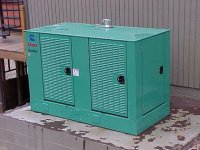
Whole House Generators

   / Whole House Generators #21  
Fuel, Speed & Size choices

Let's first start with the reality, THERE IS NO FREE LUNCH.
Natural gas is NOT an assured fuel supply for a generator, especially in a power outage situation. Natural gas pipelines are no longer pumped by the Cooper Bessimer class engines that once ran off the gas line, and boosted the pressure along the line. In today's world, most of that pumping is done electricly, and standby generators do not tend to exist at those pumping stations. The thinking of the pipelines is If the power is off, people won't be using much gas, because they won't have the electric to use the gas.
Propane, a generator uses more propane per hour than your house normally uses, so you need a tank that will vaporize sufficient propane to keep the engine running, or you are going to need a liquid propane fuel system on your generator.
You will also need to make sure your propane supplier keeps your tank sufficiently full to sustain a few days of generator operation. The biggest drawback to propane, 10 to 15% loss of tank content per year on stored propane is an industry KNOWN fact. No, they don't tell propane customers about that, but the industry knows it. That is why they will NOT install a gas meter on your propane tank, and charge you for the propane you acutally consume in the house.
Diesel, Higher initial cost, definitely, but we are talking about your house, and if youare going to live there for a while, diesel is one of the best ways to go with a generator. If you are making do in basic housing, Diesel is probably not a good investment, but, if you have a house with ceramic tile, hardwood floors, climate control, and all the fancy kitchen toys, you need to look at a Diesel. Noise is a Non Issue, a properly installed plant can't be heard from 25 feet away, and it will definitely be less noisy than the [censored] kid driving down the street with his booming stereo. Fuel storage is also a Non Issue, unless you are near either ocean or Salt Lake. Bacterial contamination is promarily a salt water operational area consideration. Diesels run very nicely on #2 home heating oil, and there are plenty of homes in this country with a heating oil tank in the basement or garage. There is also a treatment for Diesel fuel that works the way StaBil does on gasoline.
Gasoline, well, we all live and work with that every day, assuming you have a car and lawnmower. The same problems exist with a gas generator that exist with a car. Storage is an issue, but NOT an insurmountable issue. The biggest problem with gasoline machines that I see is people who store their generator and never give it a thought till the lights go out. They usually find the machine has a gummed up carb, or doesn't make electric even if it does run. Gas is still an excellent choice for small plants though.

Speed- 1800 rpm is better than 3600 rpm. 3600 machines wear out the engine twice as fast. 1800 rpm machines have more poles in the generator, 4 instead of 2, and can handle inrush loads better because of more rotating mass.
If you are only going to need the machine a few hours a year, go with cheap. Just remember to change the oil regularly every 8 to 10 hours.

Size - Well, we're talking generators, and here size is important. If you have a house that is heated by a heat pump and you also want to have the capability to run air conditioning during power outages, by all means, install a huge machine. For the rest of us, a real simple size calculation is your monthly electric bill and a calculator. Get an Amprobe, and see what your house currently draws, you'll find you can run on a very small machine. The biggest problems for a generator are well pumps and sump pumps, they aren't engineered to soft start like refridgerators and freezers are. Load calculation tables are a fun thing, and a nice place to start, but most of them are put together by generator manufacturers, to sell bigger machines. Amprobes are cheap on Ebay.
Transferr switching will be covered in the next issue of this thread. You can make your own for less than $25.00, and it works.
 
   / Whole House Generators #22  
I did a fair amount of research on generators before I installed one in my new house. It was a rather interesting experience and I ended up with some rather surprising results.

My house is rather large and has a pretty hefty electrical service. The heating system consists of several geothermal heat pumps, which require a fair amount of electrical power to run. I basically have 6 pumps, each with a 4hp motor. I was initially looking at putting in a 18-20KW generator, and was going to have some circuits on the generator, and some circuits not on the generator. This seems to be a typical way of doing it.

In my case, however, it turned out that it was substaintially less expensive to put in a larger generator. My electrician pointed this out rather early in the project. He had seen this phenomena several times in the past. I have several subpanels in the house because of the layout. The way the wiring was going to work out, I would end up with twice as many subpanels (half on generator, half not on generator). The difference on my house was the dual busses in the house would cost about $12,000 additional. Turns out that the jump from a 20kw generator to a 60kw generator was about $6500. It was cheaper to put everything on a larger genset than to install a more complicated wiring setup. Now I am not sure if it is because my house is rather atypical, but you might keep an eye on the price difference between having a second panel or a larger generator.

I looked into about 6 different genset makers. In the end, I would have been happy with either Onan or Kohler. I selected an Onan 60KW generator with a 600 amp transfer switch. It runs a standard Ford 460 V10 truck engine with a propane conversion. I also installed a 500 gallon propane tank for the generator.

Propane or natural gas is pretty much your safest bet. Diesel doesn't store well for this purpose, plus the engines are more expensive. Gasoline also doesn't store very well.

I installed a QuietSite II enclosure. It cost an extra $1400, and was worth every penny. The generator is quiet. Really quiet. With the genset service doors closed, you can have a normal conversation about 5 feet away. From 25 feet, you can hear a low hum, but thats about it. It is quite impressive. The neighbors also have generators. One is a Generac, the other a Dayton. The Generac is actually louder than my Onan, and it is 2100 feet away! The Dayton isn't too loud, but it is also a lot smaller.

The transfer switch has an onboard controller that exercises the unit every 3rd Wednesday (programmable). Note that your transfer switch needs to be sized large enough. It may be substainally larger than your generator. It depends on how your panel gets wired. A 60KW generator can supply about 235 amps. I have a 600 amp service to the house. Therefore, the transfer switch actually needed to handle 600 amps, since that is the potental power supply to the house. Something to consider.

The generator setup I have was a rather large chunk of change ($21,000 installed), but I end up having to use it more often than I should. It is rather nice to have the entire house system available even after a wind storm.
 
   / Whole House Generators #23  
MossRoad
I think but am not sure that these people I talked to said to throw them away because most people do not exercise their generators enough or they do it wrong.
They did say that most people do not run the generator under a LOAD when they exercise them, and that when they are truely needed, the engines run but the generators do not produce.
I have a coleman myself, and I am happy with it.
I run it for 30 minutes every 2 weeks with an electric heater plugged into both 110 outlets.
I use Briggs & Straton fuel treatment and rotate the fuel regularly with my lawn mowers or truck.
Change the oil twice a year.( Mobil 1)
Replace the Spark Plug and fuel filter every year.
It runs great
BUT
When I really really need it , It probably wont run. Ha Ha
 
   / Whole House Generators #24  
i usually excercise my generators about every 4 months, and change the oil about 1Xyr. the smaller generator is kept in the out building and i just run all the fuel out after i use it, i connect it up th the house/building and use it to power up the electricals while i am working for about an hour. this keeps them running well and i have had no problems for 14 years.

alex
 
   / Whole House Generators #25  
I agree about running them with a load several times a year. It is good for them. I'm thinking of making two panels of light sockets, maybe ten 100W bulbs on each, and using them to supply a load for each leg of the generator. The light sockets are only $2.00 each and I already have the romex and a couple of boards so I should get away pretty cheap.
 
   / Whole House Generators #26  
Just get a couple of those multi-bulb halogen worklights. They are useful in their own right and will load a generator and make it groan. Two lights with two 500W bulbs each is an easy 2kW.
 
   / Whole House Generators #28  
Ron, You 2hz off is not true. First, I know of no furnace that has a high percission internal time reference oscilator in it so that it would ever know if your 60hz line signal is off in the first place. Also keep in mind that the 60hz time base on your power line is a 60hz nominal. Over the course of a day it may go up and down based on load. It will however after 24hr be on average 60hz.
 
   / Whole House Generators #29  
well i just hook them to the transfer panel in the garage, and then let the house be the load, turn on a few lights, and let that heat the windings. i have read that moisture in the windings is a culprit along with dirt that causes early gen. failure. i also keep my generator coverd with a gas grill cover from wal-mart, fits well, is cheap , this will keep dirt and dust off the generator. and help from settling on the windings.

alex
 
   / Whole House Generators #30  
Have you met the new FRH Beckett oil burner yet, with the solid state flame sensing safety, and the solid state spark generator?
Those electronics do NOT allow the burner to start and run because 2hz off shortens the safety gate sufficiently that the cad cell doesn't see sufficient flame to hold the fire.
I might accept your theory, but I had the experience, and solved the problem.
 
   / Whole House Generators #31  
I keep mine in a grage with a cloth over it as well. It is not big enough to run the entire house, so it is kind of a pain to go and shut off all of the breakers. I end up resetting the clocks on all the electronic stuff. /w3tcompact/icons/smile.gif
 
   / Whole House Generators #33  
Yup, has all the characteristics of New, Improved, Energy efficient built right in.
[censored] AlGore, he just couldn't be satisfied with inventing the internet, he had to go IMPROVE oil burners too.
Relays work, so lets replace them with solid state.
 
   / Whole House Generators #34  
Here is my 2 cents worth.
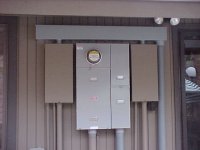
Last winter I went 7 days without power in Central Arkansas due to an ice storm. I had already been shopping whole house generators for 2 months or so after hearing my neighbors 20KW Cummins /Onan during previous outages, one as long as 24 hours. His is a 4 cyl Ford Industrial on a 500 gal propane tank. We each live on 10 acres which makes the noise not a problem. I can just hear a hum due to it being on the side of his house facing mine. I trusted his advise and the reputation of Cummins / Onan and purchased a 35 KW also on propane. This unit uses a 6 cyl Ford in line 6cyl 300 cu inch, new models come with V-6 Ford power plants. I got to use the Generator for 2 days on it's shipping pallet with my electric meter pulled to prevent feedback fed by a 420 lb (100 gallon) propane tank. It ran my whole with 2 heat pumps, well pump, and all other accessories pulling only 50 amps at the heaviest load I noticed. Over the next 3 months I poured a slab for permanent installation, and bought a matching Cummins / Onan 300 amp Auto Xfer switch for auto switching. If you are building new, try to locate your Gen Set as close as possible to your main service entrance and electrical panels, along a garage wall would be nice to isolate the noise from the rest of your house. My 35kw makes more fan noise than engine / exhaust noise. It is much quieter than the 8hp Briggs and Stratton generator I used the 3 previous days of the storm. Every Generator with an Auto Transfer switch requires a main disconnect for the service entrance wired in before the Xfer switch. This is required so the switch can be wired and gives a real life way to test under load by shutting off utility service. I had to replace my meter loop with a combination main breaker and meter socket combined. This puppy was not cheap, over $1500. I was lucky to find one that would fit between my existing panels. (see picture). I also added another remote panel for additional breakers for an ongoing project on the other side of the house. As others have mentioned, the panel must be sized to match or exceed your incoming electrical service amperage and your generator max load amperage. I mounted my transfer wwitch under the crawl space of my house which is high enough to walk under and used a Type 1 enclosure. If the switch is outside, you will need a Type 4R enclosure which adds cost. A Type 1 installed on an inside garage wall with the disconnect and panels on he same wall outside makes the cleanest installation. These switches can be rather large, mine is about 36 x 24 x 14 deep. They are computerized with all kinds of settings and delays you can set for start up time after utility failure, cool down after transfer back to utility, exercise cycles any day or time, and many others your dealer will set once and leave. I have had NO problems with my Cummins / Onan, I got great service from my dealer on initial start up when I made the permanent installation and they answer all my questions promptly. I highly suggest looking at this type of install as a part of your house which will be added value if you ever sell. Do it right and buy a quality product from Cummins / Onan or Kohler. (see pictures)
 

Attachments

  • 8-110934-MVC-013F.JPG
    8-110934-MVC-013F.JPG
    71.2 KB · Views: 271
   / Whole House Generators #35  
Meter Loop Picture

Here is the picture of the Combination meter socket and disconnect. It is a Milbank brand with 300 amp breaker / disconnect installed. These come in 260 amp but can be special ordered with the breaker to match your service entrance amperage.
 

Attachments

  • 8-110935-MVC-012F.JPG
    8-110935-MVC-012F.JPG
    43.6 KB · Views: 233
   / Whole House Generators #36  
Why did you need the combination meter socket and disconnect and why was it so expensive? I added a disconnect to my house between the existing meter and main service panel. The box was under $40.00. Just curious.
 
   / Whole House Generators #37  
Mainly because of where my underground service entrance was located. The disconnect would have had to be 2' off the ground. I looked at 300 amp disconnects, and they were way more than $40. This way I had a disconnect AND a whole house breaker in case of a major failure in the Transfer Switch. If you look at the picture, the 2 boxes on either side were existing and not able to be moved. The combo unit fit perfectly between them and hit the knockout for the 3" service entrance conduit perfectly. I got this one at cost through a friend. I was priced as much as $600 more for the same box at other electrical supply dealers. It pays to shop around.
 
   / Whole House Generators #38  
DocHeb,
I have installed many gen. sets from 8kw to 150kw in places from single family dwellings to health care facilities to natural gas compressor stations. All of which involved auto- transfer switches, I know of no major problems with any of these switches. I would strongly recommend that one be installed, they make the system just what the name implies automatic. They insure that generated power is not backfed into the utility wiring,they will exersize your generator as often as you would like, with or with out load. All of this is done during the initial startup of your unit, and can be changed when ever you like. I would say the most common brand would be Generac, and would consider it to be a dependable unit. Take careful considerations when deciding on the size, this should involve your electrical contractor considerably, if they are not familiar with these types of calculations, find someone who is. Let me know if you have any other questions, I'll be glad to help.

Sincerly,
JDIceman
 
   / Whole House Generators #39  
A friend of mine in up state new jersey has a natural gas generator on automatic switch. His claim is that in the 10 yrs he has had his, the power has failed countless times but the gas has never failed. His runs for 30 minutes every week, and his maintence guy comes either once or twice a year. Pretty cheap insurance I would think. I suppose it all depends on where you live.

People have a LOT of choice when they initially wire their house. Retrofiting a sub-panel with just the essential circuits and running them from a generator is difficult. Building your house so your hot tub and most outside lighting is off the main pannel and your primary indoor lighting, fridge, heater, microwave and other essentials are off the sub pannel is not so hard.

I have thought about converting my house to backup power but the main pannel is just outside the kitchen in plain sight to the street. The ideal location for the generator is on the other end of the house near the gas meter. Again, this would have been easy to solve when the house was built. I guess that the only way to handle it now is, as you plan, with a whole house generator. It just seems silly to buy a generator capable of running that electric dryer (1/2 of my electric bill) should the power fail when I am not home. I could cut the size of a generator in half by eliminating several very high consumption, non essential devices (washer, dryer, air compressor).

I can not recommend brands myself and would also like to hear advice. I would check with your neighbors and see how often they have to relight the pilot lights in their hot water heaters. If it is very rare, I think a NG unit might be a good choice for low maintence, high reliability.
 

Tractor & Equipment Auctions

2014 International Derrick Digger Truck (A55973)
2014 International...
2016 DRAGON SAND CONVEYOR (A58216)
2016 DRAGON SAND...
2017 Freightliner M2 106 AWD Terex Hi-Ranger 5TC55 55ft. Insulated Material Handling Bucket Truck (A60460)
2017 Freightliner...
2014 Ford F-250 Ext. Cab Service Truck (A59230)
2014 Ford F-250...
2020 Chevy Silverado (A56438)
2020 Chevy...
2014 Ford F-550 (A55973)
2014 Ford F-550...
 
Top