Why two levers for front-wheel drive and differential lock?

   / Why two levers for front-wheel drive and differential lock? #1  

billattractorbynet

New member
Joined
Jun 18, 2017
Messages
10
Location
Broad Run, VA
Tractor
Kubota RTV500
I've driven a few Kubota ATVs over the years, and all have had a single 2WD/4WD lever. I understand what's going on there.

My new RTV500 has one level for differential lock, and one for four-wheel drive. I believe that I understand the mechanics of the two levers. My default back wheel drive is one drive wheel, and the differential lock lever gives me two drive wheels in the back. The four-wheel drive lever gets the front wheels pulling.

So, I get that in snow plowing, I'm probably going to want both engaged to give me all the power I need. What I'm curious about is what scenarios, if any, would I want one lever or the other, but not both.

So:

  1. What scenario(s) would I want the differential locked on the back wheels but not four-wheel drive?
  2. What scenario(s) would I want the four-wheel drive on for the front wheels but not the differential locked in the back?

Thanks in advance for any replies! :)
 
   / Why two levers for front-wheel drive and differential lock? #2  
You don't want the diff lock on when turning. When you make a turn the wheels need to rotate at different speeds. 4WD on is OK since the front and rear differentials allow the wheels to turn at different speeds. When the diff lock is on both rear wheels are locked together and is mainly used for going in a straight line.
 
   / Why two levers for front-wheel drive and differential lock?
  • Thread Starter
#3  
Thanks, George. That's what I was looking for.

So, what I'm piecing together is that an ATV with only a four-wheel drive lever probably doesn't have the differential lock capability. Interesting.


You don't want the diff lock on when turning. When you make a turn the wheels need to rotate at different speeds. 4WD on is OK since the front and rear differentials allow the wheels to turn at different speeds. When the diff lock is on both rear wheels are locked together and is mainly used for going in a straight line.
 
   / Why two levers for front-wheel drive and differential lock? #4  
Thanks, George. That's what I was looking for.

So, what I'm piecing together is that an ATV with only a four-wheel drive lever probably doesn't have the differential lock capability. Interesting.

I believe most ATV's are permanent "limited slip" differential, few are permanent locked different, and some may be selectable. IMHO, at slow speeds, you should lean and put your weight on the outside tire in a sharp turn so that the inside tire can spin/slip without weight on it and lessen tearing up your lawn or laying rubber on your driveway.
 
   / Why two levers for front-wheel drive and differential lock? #5  
I've driven a few Kubota ATVs over the years, and all have had a single 2WD/4WD lever. I understand what's going on there.

My new RTV500 has one level for differential lock, and one for four-wheel drive. I believe that I understand the mechanics of the two levers. My default back wheel drive is one drive wheel, and the differential lock lever gives me two drive wheels in the back. The four-wheel drive lever gets the front wheels pulling.

So, I get that in snow plowing, I'm probably going to want both engaged to give me all the power I need. What I'm curious about is what scenarios, if any, would I want one lever or the other, but not both.

So:

  1. What scenario(s) would I want the differential locked on the back wheels but not four-wheel drive?
  2. What scenario(s) would I want the four-wheel drive on for the front wheels but not the differential locked in the back?

Thanks in advance for any replies! :)

Whoa! Stop the bus!!
People are on a tangent... and you do not understand your machine when you say:

My default back wheel drive is one drive wheel, and the differential lock lever gives me two drive wheels in the back.

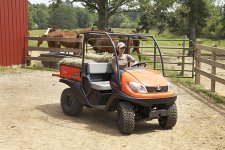
The RTV500 is a Rugged Terrain Vehicle (and not a Quad Bike where you sit astride the engine/fuel tank.)
Kubota rtv500_02.jpg

The Rear drive is the 2WD setting which gives you drive in T W O wheels with a differential. (Each wheel can rotate at differing speeds when cornering) No 'leaning needed' !!

Diff Lock "Locks" the diff and converts the rear drive into a 'solid' drive (Both rear wheels turn as one)

4WD adds the two front wheels as driving wheels eg. for muddy/soft ground. So you have F O U R wheels driving.

Never engage 4WD on hard ground such as concrete/asphalt.

Since the machine is 'new' to you go back to your dealer and get the Sales person to provide proper instruction of the various features.

:wrench:
 
   / Why two levers for front-wheel drive and differential lock? #6  
I will add a bit to this discussion and speak in generalities since I do not know your vehicles capabilities. There are lots of functional options for the term 2WD and 4WD.

- Typically, 2WD actually means 1WD since the standard axle is an "open differential" that delivers most of the power to the wheel with the least traction. This is useful for turning with minimal tire scrubbing on hard surfaces and nice grassy areas as the inside and outside tires will turn at different speeds. Actual 2 driven wheels would involve either a single axle shaft with no differential, a locking differential for the axle or a limited slip type of differential clutch using springs or hydraulics (for example) under manual or computer control.

- 4WD can be a large misnomer also as it can simply be 2WD x 2- meaning it can have 2 wheels driving (1 front and 1 rear) or 3WD or true 4WD, depending upon equipment used. See 2WD options above. Typically a manually locked front differential can be a difficult handler and needs to be used very judiciously and at slow speeds.

- AWD on a modern vehicle is typically computer controlled and closet to a true 4WD system, depending upon how it is applied/controlled and will vary the amount of wheels driven depending upon feedback from the wheels to the computer. My Jeep is AWD.

My 2016 Polaris Ranger 900 XP has three switch selectable modes of operation: 1- open rear differential (standard 2WD with one wheel driving), 2- locked rear differential (real 2WD) and 3- AWD where the computer selects which of the 4 wheels to drive depending upon feedback (slippage/wheel spin) and how much power to supply each wheel. I usually use it in open rear axle (1WD) or AWD. In AWD I have pulled my wife's stuck 2000 Toyota Tacoma 2WD out of the sandy area it was mired in with nary a wheel spin from the Polaris. In locked 2WD it was spinning the rear wheels and not making any headway.

My 2015 RAM 2500 diesel can be 3WD with a locked rear differential in 4WD mode. I need to investigate further but recall seeing something somewhere about the front axle having the capability of being locked also; I do have a 4WD locked option on a switch and this may do it. Or maybe not.

My tractor in 4WD in actually only driving 1 front and 1 rear wheel. I can lock the rear differential to effectively get 3WD or unlock the brake pedal combining lever and with judicious use of the brake pedal on the spinning rear wheel get additional traction without using differential lock.
 
   / Why two levers for front-wheel drive and differential lock?
  • Thread Starter
#7  
Thank you. That was extremely helpful. :thumbsup:

I will add a bit to this discussion and speak in generalities since I do not know your vehicles capabilities. There are lots of functional options for the term 2WD and 4WD....
 
   / Why two levers for front-wheel drive and differential lock? #8  
Thank you. That was extremely helpful. :thumbsup:


Extremely incorrect.

I will add a bit to this discussion and speak in generalities since I do not know your vehicles capabilities. There are lots of functional options for the term 2WD and 4WD.

- Typically, 2WD actually means 1WD since the standard axle is an "open differential" that delivers most of the power to the wheel with the least traction. This is useful for turning with minimal tire scrubbing on hard surfaces and nice grassy areas as the inside and outside tires will turn at different speeds. Actual 2 driven wheels would involve either a single axle shaft with no differential, a locking differential for the axle or a limited slip type of differential clutch using springs or hydraulics (for example) under manual or computer control.

- 4WD can be a large misnomer also as it can simply be 2WD x 2- meaning it can have 2 wheels driving (1 front and 1 rear) or 3WD or true 4WD, depending upon equipment used. See 2WD options above. Typically a manually locked front differential can be a difficult handler and needs to be used very judiciously and at slow speeds.

- AWD on a modern vehicle is typically computer controlled and closet to a true 4WD system, depending upon how it is applied/controlled and will vary the amount of wheels driven depending upon feedback from the wheels to the computer. My Jeep is AWD.

My 2016 Polaris Ranger 900 XP has three switch selectable modes of operation: 1- open rear differential (standard 2WD with one wheel driving), 2- locked rear differential (real 2WD) and 3- AWD where the computer selects which of the 4 wheels to drive depending upon feedback (slippage/wheel spin) and how much power to supply each wheel. I usually use it in open rear axle (1WD) or AWD. In AWD I have pulled my wife's stuck 2000 Toyota Tacoma 2WD out of the sandy area it was mired in with nary a wheel spin from the Polaris. In locked 2WD it was spinning the rear wheels and not making any headway.

My 2015 RAM 2500 diesel can be 3WD with a locked rear differential in 4WD mode. I need to investigate further but recall seeing something somewhere about the front axle having the capability of being locked also; I do have a 4WD locked option on a switch and this may do it. Or maybe not.

My tractor in 4WD in actually only driving 1 front and 1 rear wheel. I can lock the rear differential to effectively get 3WD or unlock the brake pedal combining lever and with judicious use of the brake pedal on the spinning rear wheel get additional traction without using differential lock.

2wd means just that. BOTH wheels are driving.

One wheel spinning and one not does NOT mean its a one wheel drive.

An open differential means that BOTH wheels will apply the exact same amount of torque to the ground.

Hypothetically, lets say it takes 20 ft-lbs of torque to move the vehicle. IF one wheel is in the air, on ice, in mud, etc it takes very little torque to make it spin. Say 5 ft lbs of torque. With an open differential, that means that only 5ft lbs is being applied to the wheel that is in the air, on ice, in mud, etc and doesnt get you the required 20 ft-lbs needed to move the vehicle and you are stuck.

An open differential quite simply is EQUAL torque, UNEQUAL speed.

Where as a locker makes it UNEQUAL torque, EQUAL speed. So with a locker, while one wheel may only get 5ft lbs before it wants to spin, you can keep applying torque til the one with good traction starts a rolling. So...if the tire with good traction can get above the hypothetical 20 ft-lbs and still have grip, you will move.

Get so sick of ill informed people claiming that a 2wd is really a 1wd without a locker or LS, or hearing people claim their 4wd truck is really only a 2wd truck.

Open differentials have their place. They are good on ice because you are less likely to fishtail. And they are good on a road vehicle because you arent constantly scrubbing tires, getting wheel hop in turns, and are generally easier on the drive line.

Now how it relates to the RTV with basically 4 options

1. 2wd UNLOCKED....use this most frequently running around where traction isnt a prime concern
2. 4wd UNLOCKED ....USe this is its snowy, or soft, or when you otherwise need more traction that you dont think 2wd will do
3. 2wd LOCKED in.....Only use I can think is if you want to do some donuts in the snow/ice or in the mud
4. 4wd LOCKED in.....Use if 4wd unlocked fails you. This is a last resort before getting something to pull/winch you out
 
   / Why two levers for front-wheel drive and differential lock? #9  
Extremely incorrect.


2wd means just that. BOTH wheels are driving.

One wheel spinning and one not does NOT mean its a one wheel drive.

An open differential means that BOTH wheels will apply the exact same amount of torque to the ground.

Hypothetically, lets say it takes 20 ft-lbs of torque to move the vehicle. IF one wheel is in the air, on ice, in mud, etc it takes very little torque to make it spin. Say 5 ft lbs of torque. With an open differential, that means that only 5ft lbs is being applied to the wheel that is in the air, on ice, in mud, etc and doesnt get you the required 20 ft-lbs needed to move the vehicle and you are stuck.

An open differential quite simply is EQUAL torque, UNEQUAL speed.

Where as a locker makes it UNEQUAL torque, EQUAL speed. So with a locker, while one wheel may only get 5ft lbs before it wants to spin, you can keep applying torque til the one with good traction starts a rolling. So...if the tire with good traction can get above the hypothetical 20 ft-lbs and still have grip, you will move.

Get so sick of ill informed people claiming that a 2wd is really a 1wd without a locker or LS, or hearing people claim their 4wd truck is really only a 2wd truck.

Open differentials have their place. They are good on ice because you are less likely to fishtail. And they are good on a road vehicle because you arent constantly scrubbing tires, getting wheel hop in turns, and are generally easier on the drive line.

Now how it relates to the RTV with basically 4 options

1. 2wd UNLOCKED....use this most frequently running around where traction isnt a prime concern
2. 4wd UNLOCKED ....USe this is its snowy, or soft, or when you otherwise need more traction that you dont think 2wd will do
3. 2wd LOCKED in.....Only use I can think is if you want to do some donuts in the snow/ice or in the mud
4. 4wd LOCKED in.....Use if 4wd unlocked fails you. This is a last resort before getting something to pull/winch you out

Thank goodness someone else also understands the principle of the automotive "Differential".

Referencing 1WD and 3WD is, indeed, incorrect.:irked:

Good post LD1 :thumbsup:

:wrench:
 
   / Why two levers for front-wheel drive and differential lock? #10  
Thank goodness someone else also understands the principle of the automotive "Differential".

Referencing 1WD and 3WD is, indeed, incorrect.:irked:

Good post LD1 :thumbsup:

:wrench:

This topic comes up every once in awhile. As does certain hydraulic principals. It astounds me the number of people who just don't understand.

All I can do is try my best to educate those that don't understand
 
   / Why two levers for front-wheel drive and differential lock? #11  
This topic comes up every once in awhile. As does certain hydraulic principals. It astounds me the number of people who just don't understand.

All I can do is try my best to educate those that don't understand

Well, I'm new here and that was the first time I'd heard of it.

Thanks for stopping in here for Bill.

:wrench:
 
   / Why two levers for front-wheel drive and differential lock? #12  
Extremely incorrect.

2wd means just that. BOTH wheels are driving.

One wheel spinning and one not does NOT mean its a one wheel drive.

An open differential means that BOTH wheels will apply the exact same amount of torque to the ground.

Get so sick of ill informed people claiming that a 2wd is really a 1wd without a locker or LS, or hearing people claim their 4wd truck is really only a 2wd truck.

"One wheel spinning and one not does NOT mean its a one wheel drive." - Well, uhmm, sorta.... but most people wouldn't say it's 2 wheel "drive" when one tire isn't moving.

Yes, the tire is applying torque, but not enough to "drive" it. If the vehicle isn't moving you can't say a stationary tire is "driving" it.

Then again, neither is the other tire that's just spinning......so....
... technically it's zero wheel drive at that point?

Perhaps it's more accurate, and clearer to non-technical folks if we just call it "1 wheel spin", or "2 wheel spin" when transfer case is engaged, or "3 wheel spin" with 1 locker, etc..

So, no 4WD is not 2WD, but if you're a redneck like me who says "Kick her into 4 wheel squeal", you really should be saying "2 wheel squeal".
 
   / Why two levers for front-wheel drive and differential lock? #13  
Logic like that is what muddies the water and gets confused.

I explained it very clearly. BOTH wheels in an open "try" to drive with the exact same amount of force. If one wheel is hanging off a cliff, or on ice, then that takes little effort to free wheel. By default, the tire with good traction becomes equally lazy and only tries with the exact same amount of force as the free-spinning wheel. That's a huge benefit of split brakes on a old tractor. You can require that free spinning wheel to require more torque(by applying it's brake). Thus making the other wheel receive equally more torque.

Just because the vehicle is stuck and not moving, doesn't change the number of wheels trying to drive it.

My 4wd truck is sitting in the driveway. If someone asks me if it's 4wd, I certainly don't reply "no it's 0wd because it's not moving".

If you have nearly equal traction (both tires in similar condition) there ain't much difference between open or a locker.

The more extreme the traction difference is between one wheel and the other, the more pronounced the effects of a locker will be.
 
   / Why two levers for front-wheel drive and differential lock? #14  
Just because the vehicle is stuck and not moving, doesn't change the number of wheels trying to drive it. - Ahh, 4WD means it's 4 wheels "trying to" drive. This is something different. Maybe we should call the vehicle a 4WTTD? The word "drive" (and you can look this up) means that there is actual movement, not just force or torque.

My 4wd truck is sitting in the driveway. If someone asks me if it's 4wd, I certainly don't reply "no it's 0wd because it's not moving". -And if the right side is stuck in the mud and the 2 left wheels on dry ground aren't turning, but are leaving you stuck in the mud, I certainly wouldn't call it 4WD.

Okay, okay. I understand. A differential is what it is. I'm just arguing for the sake of arguing (hee hee). I will now stop :stirthepot: Maybe I should go over to the Friendly Politics section of TBN.
:D :rolleyes:
 
   / Why two levers for front-wheel drive and differential lock? #15  
It's all good.

But some people truly believe that an open diff only permits one wheel to drive the vehicle, and what to argue til they are blue in the face even though they are dead wrong. Just a classic example of not understanding what is really going on, and regurgitating stuff they have heard or read elsewhere. Drives me nuts.

Don't get me wrong, I like lockers limited slips, etc. They certainly can get you out of a bind (or prevent you from getting into one) in certain conditions. But I am a realist an understand 100% how they work in comparison to open diffs
 
   / Why two levers for front-wheel drive and differential lock? #16  
As a previous owner of an RTV500 and current owner of an RTV1100 I'll say this...Never checked to see whether 1 or 2 wheels where spinning, (and didn't really care as long as the machine did the job) but since this is about snow plowing; I'll say that on light snow, I'd lock the diff lever and not much worry about 4wd,...In hard snow--I'd engage the diff lock and 4WD..Same as on my 1100. As long as there is something slippery on the ground I'd use the diff lock...I don't really want to get into the posi/Limited-slip/open diff here, since I don't see the issue--What does the machine do was the question as I read it.
 
   / Why two levers for front-wheel drive and differential lock? #17  
Thank God my 2018 ZR2 will have front and rear driver controlled electric lockers..... so I won't be confused as if I am in one wheel drive, two wheel drive, three wheel drive, or four. Or, heaven forbid, if I am limited slipping something at some point.... Yikes, I could even be in a non-posi-tracking mode.... !!!!! I don't see how you folks even sleep at night....... [[[[ :) ]]]]
 
   / Why two levers for front-wheel drive and differential lock? #19  
I believe most ATV's are permanent "limited slip" differential, few are permanent locked different, and some may be selectable. IMHO, at slow speeds, you should lean and put your weight on the outside tire in a sharp turn so that the inside tire can spin/slip without weight on it and lessen tearing up your lawn or laying rubber on your driveway.

Suzuki, yamaha, Arctic Cat and Honda have a full front diff lock button - engage lock to get out, then disengage. Kawi has a progressive front duif lock, you slide the cable to choose what you want, Polarus has AWD, engages full diff lock based on slippage, and the Can Am Visco QE is similar.

All rear axles are locked, with the exception of turf mode on polaris.

Many big AG tractors have electric front diff locks, they disengage when turning. You do not want the front diff locked all the time.
 
   / Why two levers for front-wheel drive and differential lock? #20  
Bless my soul, some people understand differentials, equal torque to each axle in an axle housing
4 x 2 = 4 axles two powered
4 x 4 = 4 axles 4 powered
6 x 4 = 6 axles 4 powered
6 x 6 = 6 axles all 6 powered
 

Marketplace Items

2019 KOMATSU PC210LC-11 EXCAVATOR (A60429)
2019 KOMATSU...
Cummins 6-Cylinder Diesel Engine with Transmission (A59230)
Cummins 6-Cylinder...
2018 Dodge Ram 3500 (A53317)
2018 Dodge Ram...
SCAN TO RECEIVE TEXT UPDATES (A60430)
SCAN TO RECEIVE...
2013 TEXAS PRIDE LAY FLAT HOSE TUGGER TRAILER (A58214)
2013 TEXAS PRIDE...
Tandem Axle Rear Truck Frame (A59230)
Tandem Axle Rear...
 
Top