will it take off?

/ will it take off? #561  
Tom -- when your single giant sand grain hits the bottom of the hourglass, the kinetic energy of the grain will momentarily register as an increase on any scale you have it on. Try jumping onto your bathroom scale and see it go over your stationary weight for a bit. In a real hourglass the weight lost by the sand losing contact with the upper chamber is compensated for by the increase in apparent weight caused by the force of the impacts with the lower chamber. The work done on the system to invert the hourglass originally will eventually leave the system in the form of an increase in enthalpy, but you won't observe a change in the weight of the hourglass in the real world.

We have wrestlers who are firmly convinced that if they are close to making weight, they can weigh a bit less if they stand on their head for 5 minutes immediately prior to stepping on the scales.

Moss Road -- think of a front wheel drive car with the rear wheels on a dynamometer. The dyno is wirelessly communicating with the car's computer. The front wheels are on the ground in the normal fashion. The dyno is programmed so that any motion of the car will result in an immediate, equal, and opposite motion of the dyno, causing the rear wheels to spin backward. If you put the car in gear, it will go forward, won't it? Of course it will since the retardation force on the rear wheels is negligible compared to forward force from the front ones. The two actions are totally independent. There is a correlation between the two, but the only thing the forces have in common is that they both act on the car. The size of the forces is nowhere near the same. Your line of reasoning would have the car sitting there burning the tread off the front tires while the rears were spinning backward.

The plane works the same way. Any force backwards on the wheels is negligible compared to the force forwards from the engine. The force on the wheels is not caused by the forward motion of the plane, but is an independent (and much smaller) consequence of it.
 
/ will it take off? #562  
Originally Posted by HTWT
I want to know how to find the three points of intersection of the 2 equations

1. Y= 2^x
2. Y= X^2

Two solutions are easy by inspection but what about the negative value for X.

Tom
the two solutions in the first quadrant are (2,4) as you stated and (4,16) but there is one other point in the fourth quadrant. The X-axis is the asympotate for the exponential equation but the parabols is symetrical with respect to the Y-axis. There is one more point of intersection very close to the origin.
 
/ will it take off? #563  
dateacha, Depends on which set of assumptions you use. If you assume the MCB equals (in the opposite directioin) the speed of the plane, the plane experiences a littel more drag from wheel frictioin and inertia and takes off pretty mormally.

If you assume the more fun version (NO-FLY) of the MCB then it accelerates at a rate required such that the inertia of the wheels and friction of the bearings is sufficient to generate a force equal to the thrust of the planes propulsion and the plane remains totally stationery with respect to the world although its wheels are accelerating with no upper bound to ever higher speeds.

I didn't really follw the applicability of the dyno thing but since the above two cases cover the two possibilities if the dyno thing disagrees with both of the abhove it is flawed.

Pat
 
/ will it take off? #564  
The dyno thing is like the rubber band thing I posted several pages back -- In the real world, the forward acting force from the engine is independent of the spinning of the wheels, therefore the plane will fly.

The more fun argument regarding the conveyor belt spinning fast enough to counteract any motion of the plane presumes (I think) motion is sensed through wheel rotation, not motion of the plane as a whole, and is therefore a moot argument. Besides, counteracting motion is not the same as moving at the same speed in the opposite direction. The problem stated motion of the plane, not its individual parts. If you want to start counting parts and not the whole plane, the conveyor should start running backwards (or sideways! or up and down!) as soon as the engine started turning over.

Point of information -- atomic sizes are generally in the range of 2 to 3 nanometers (10^-9 meters), which is billionths of a meter. This is for neutral atoms, not ions or molecules.
 
/ will it take off? #566  
HTWT said:
Tom
the two solutions in the first quadrant are (2,4) as you stated and (4,16) but there is one other point in the fourth quadrant. The X-axis is the asympotate for the exponential equation but the parabols is symetrical with respect to the Y-axis. There is one more point of intersection very close to the origin.

You are absolutely right. I quickly, and not too accurately, sketched the functions and totally missed the fact that the exponential cuts a shallow chord across the parabola between the (2,4) and (4,16) intersections.

The other point of intersection in the 4th quadrant is very near (-0.76666469596, 0.58777475603). This value doesn't change after about the 5th iteration of a Newtonian iteration process - if round-off error in my calculator didn't have too great an influence.

To show you how long it's been since I fooled with any of this stuff, I had to go back to the textbooks to get the derivative of 2^X.
 
/ will it take off? #567  
Tom, What did the math exercise relate to??? It was interesting and I like what you did with it but...

Oh, and you are a better man than I Gunga Din... I could see the other point (better sketch) but not give it values.

Somehow I am reminded of the friend who called me up and left a phone message for me to write down the following number.. 619-345-9876 and I dutifully did. He then informed me that if I ever need a wrong number to dial it as it was in fact a wrong number.

Pat ;)
 
/ will it take off? #568  
daTeacha said:
Tom -- when your single giant sand grain hits the bottom of the hourglass, the kinetic energy of the grain will momentarily register as an increase on any scale you have it on.
...

Mea culpa, I totally ignored start/stop transients. My excuse is that my time quanta are too large and all transients decayed between two ticks of the cosmic clock.:D
 
/ will it take off? #569  
Tom_Veatch said:
Mea culpa, I totally ignored start/stop transients. My excuse is that my time quanta are too large and all transients decayed between two ticks of the cosmic clock.:D


Either that or your inertial frame of reference is highly accelerated and your time is different.

As an undergrad physics student taking tests where you were required to show the units I found the answers to some problems to be in radians after taking a square root and wondered where the square radians were supposed to come from. Then I realized that when I squared radians in other problems the results did not contain units of square radians. I suppose there is some sort of conservation of square radians and they aren't really being created or destroyed!

Pat
 
/ will it take off? #570  
patrick_g said:
Tom, What did the math exercise relate to??? It was interesting and I like what you did with it but...

I really don't know what it relates to. It just kinda rolled in on the MCB and got tangled up in the plane's landing gear about post #551 of this thread.

I'm intrigued by the idea of coupling the conveyor and the airplane via the rotational inertia of the wheels. I'm getting really curious what kind of acceleration would be needed to balance the thrust. It'd be interesting to run some numbers but I'm still resisting the temptation.
 
/ will it take off? #571  
Pat, you'd really develop some tire friction if you shod the plane with square radians. Tough to compute the drag, too....
Jim
 
/ will it take off? #572  
Tom, maybe this plane is a BIG FOOT set up for exceptionally poor landing areas so its wheels and tires are fairly massive. This would keep the rotational speed from achieving such giant numbers and maybe sufficiently away from a significant need to consider relativistic effects.

Of course, over time, if the plane could maintain takeoff power long enough without seizing the engine (and the ground crew could refuel it with boom trucks or sky hooks) any finite acceleration would eventually (no matter how small) end up clearly in the relativistic domain.

Only the wheels and the MCB would be in that domain. The plane is at rest and the prop is too slow to worry about. Try to visualize the pancake effect as applied to the MCB and the rotating masses.

I wish we had an aerodynamicist on board. I'd like to have a fair feel for how much air the MCB would be pumping and how that would vary with height above the MCB (shear effects.) Then we could estimate when or if the plane could take off due to the air rushing by it as driven by the MCB.

Pat ;)
 
/ will it take off? #573  
jimmysisson said:
Pat, you'd really develop some tire friction if you shod the plane with square radians. Tough to compute the drag, too....
Jim

Aw shucks, Jim, the first few revolutions of the wheels would beat the squareness off of the edges of the square radians. ;)

Pat
 
/ will it take off? #574  
patrick_g said:
Folks just kept on focusing on friction, due to familiarity I suppose.

Pat,

You might be referring to me so I will argue that the major part of the equation is friction. Without friction the MCB cannot prevent the movement of the plane.

Tom_Veatch said:
I've been tempted to calculate the conveyor acceleration necessary to hold an airplane static relative to the tree sitter. But, so far, have successfully resisted that temptation.

Tom,

Well I wish you would have,:( but since you didn't here goes...

In my previous posts I showed how an airplane could be made to takeoff from the MCB. I still think this is possible, however after the following calculations it becomes apparent that a few more modifications would be necessary...

First I will redefine the question for clarity.

If an airplane were placed on a large conveyor belt of sufficient size to support its weight, could the conveyor prevent forward motion of the airplane if:

The conveyor is capable of accelerating in excess of 5000m/s^2

The conveyor surface experiences no deformation (its flat).

The conveyor surface is comparable to dry asphalt in its friction coefficient.

The airplane is a standard production aircraft with standard equipment and rubber tires.

The conveyor is fixed to the earth at sea level.

The earth is the reference point. All motion will be regarded in reference to fixed points on the earth.

The airplane will be placed upon the conveyor with its main landing gear (wheels) centered on the midpoint of the conveyor belt.

The airplane will use thrust and brakes such that there is no sliding of the tires prior to brake release. Note: During this static runup there will be some movement of the aircraft as forces stabilize. Once in equilibrium this will be the referenced starting point.

Since I used the numbers for a U-2R in my previous posts I will continue here.

The calculations presented will use simple physics and mechanics formulas witch will give an approximation of values sufficient to gain an understanding of the magnitude of the forces involved. Finite element analysis and further computational analysis is left to the reader.

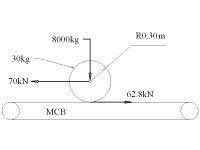
A/C weight = 8000 kg

Weight on each wheel = 2666.7 kg (assumed to be equal for all three wheels for simplification)

Normal force per wheel assembly = 20928 N

Wheel and tire weight = 50 kg

Wheel and tire diameter = 0.6 m

A/C thrust = 70 kN

Coefficient for rubber on asphalt = mu=0.8

Moment of inertia for the wheel and tire = I = 1/2mr^2 = 2.2 kgm^2

Force of static friction that the conveyor can exert on each tire = F = mN = 20.9 kN

Circumference of the wheels and tires = 2*pi*r = 1.885 m

Torque exerted on the tires by the conveyor = t = rFsin 90 = 6278.4 Nm

Angular acceleration = Aa = t/I = 2790.4 rad/s^2

Rotational acceleration = ARotational = Aa/2*pi = 444.1 revolutions/s^2

Conveyor acceleration = Ac = C*ARotational = 837 m/s2

This value represents the maximum linear acceleration of the conveyor to maintain a static contact with the wheel. Any faster and slippage occurs, any slower and its full potential in not utilized.

Velocity of the belt vs. time = VB =tAc

Centripetal Force (similar to the force on a string exerted by an object tied to that string and spun around in a circle) = FC = mv^2/r

Let’s assume 10 gram portions of the wheel and tire. So if the tire weighs 10 kg that breaks it up to 1,000 pieces for each tire and 4,000 pieces for each wheel with the following forces exerted over time. In reality (with actual testing) you would probably find that much larger portions of the tire/wheel assembly would be more realistic for calculation, yielding much larger forces.

Therefore we have the relationship between time in seconds, belt speed in m/s and mph, and Centripetal Force in Newtons and lbs

1 second, 837 m/s = 1872 mph, 23352 N = 5250 lbs

4 seconds, 3348 m/s = 7489 mph, 373636 N = 47250 lbs

7 seconds, 5859 m/s = 13106 mph, 1144236 N = 257253 lbs

10 seconds, 8370 m/s = 18723 mph, 2335230 N = 525006 lbs

This shows that there would be tire failure within a few seconds. At that point, depending on how catastrophic the failure, the wheels would drop to the conveyor and continue to accelerate at a slower rate (remember its all dependent on friction – steel wheels less friction slower acceleration of the conveyor).

So what about the airplane’s motion during these few seconds? Granted there is conservation of energy (transferred to the wheels) However there is a Net external force FNet External of 7216 N (see attached diagram). That gives us a net acceleration of 0.902 m/s2.

Velocity after 5 seconds = 4.5 m/s = 10.1 mph
Distance after 5 seconds = 11.2m

Velocity after 10 seconds = 9.2 m/s = 20.6 mph
Distance after 10 seconds = 45 m

The plane disintegrates before any appreciable lift is achieved, HOWEVER, there is forward motion.

Now if anyone is still with me at this point (and you thought Tom and Pat were long winded :D:D:D), here is how a plane could take off from this conveyor. The limitation of the airplane would have to be removed. Then you simply replace the tires and wheels with something with a very small coefficient of friction, small radius and large mass. Two rollers (something like giant steel rolling pins) would keep the acceleration of the conveyor belt very low and the Net external force very high. The airplane would accelerate and fly. The calculations are left to you to prove me wrong.

Pardon me, while I go split some wood… with my TRACTOR.
 

Attachments

  • Wheel1.jpg
    Wheel1.jpg
    33.6 KB · Views: 118
/ will it take off? #575  
patrick_g said:
...

I suppose there is some sort of conservation of square radians and they aren't really being created or destroyed!

Pat

Well, "radian" is simply the name of a unitless dimension, or is it dimensionless unit. It's a ratio like "Pi". Difference being radian can apply to a variable value where Pi is a constant. And Pi is NOT 3.0000.... no matter what the Alabama state legislature (may or may not) have said.

So, Pat, you can comfortably square it, divide it, multiply it, exponentiate it, take it's logarithm, or take it out to dinner and a movie without it ever screwing with your mind - unlike some women I've known:rolleyes:.

You know, now that I'm thinking about it, I guess you could consider the constant "Pi" actually has units of "radians". Just never thought of it like that, before.

Yeah, BIG FOOT! I can just see a Piper Cub with wheels so big they build clearance recesses in the bottom of the wings. (And for those who might not know, "Piper Cub" is a real airplane type - not a generic term of all airplanes smaller than a 747.)

Well, I'm an aeronautical engineer by degree, but I specialized in structural design and analysis so I'm not even tempted to try to calculate the boundary layer profile on that MCB.
 
/ will it take off? #576  
patrick_g said:
I'd like to have a fair feel for how much air the MCB would be pumping and how that would vary with height above the MCB (shear effects.) Then we could estimate when or if the plane could take off due to the air rushing by it as driven by the MCB.

Pat ;)

Pat,

That is a good question. It all comes down to friction :D, sorry, couldn't resist. Because the MCB doesn't really displace much air after its initial movement, aside from the air molocules in contact with it, I would guess that with the rapid accelleration and associated extremely high velocity, that it would mimic laminar flow. I would therefore further my guess to think that the boundary layer would be relatively narrow. What you would have would be a significant amount of heating close to the surface as the air molecules (and their friction) generate heat (think space shuttle entering the atmosphere). But, like Tom I don't think I want to begin to try and calculate the values (theoretical at that).
 
/ will it take off? #577  
Now I've got both socks off but still having trouble trying out all the calculations!:D

Have the Quarks been interfering with the neurons or do the tire electrons jump out of orbit as the square radians bump along or is it just square cold tires bumping along or has a black hole intervened and the air has turned solid? :D

Does anyone know if it fly's?
 
/ will it take off? #578  
Northwest, The friction I referred to was roling resistance of the tires and the friction of the wheel bearings. The inertia of the wheels, I thought, was a bigger thing for the MCB to leverage off of to generate a retarding force by its acceleration. If you are gonna keep on insisting on real world limits for tire contact patch resistance (traction) and other such components of this discussion when it degenerates to the mundane level of reality then I may sit in the corner and cry!

As soon as magic got involved I started thinking "IN THEORY" what could happen if we weren't fettered by too harsh a contraint due to realilty. All this is just good fun to me and goofing on some folks just a little was a bonus.

It ain't like I cain't read, ja know but a little leeway in interpretation of the problem statement opened up a lot more interesting line of reasoning/analysis. I was cincerely sorry it rankled so many folks when not everyone would instantly agree with them. I guess it is true that I am part leprechaun and am too mischievous to be let out alone too much at a time.

Besides, this was a terrific diversion from my mundane problems. Among my degrees are comp sci and software engineering and I am getting my but kicked trying to get a Sony High Definition 1080i Handycam to talk to a movie editing software (Pinnacle V 10.7 latest out.) It is so frustrating to have to work with such NON QUALITY CONTROLLED SOFTWARE as inflicted on the world under the MicroSoft banner. This is worse than being a master carpenter and being unable to drive a nail after a week of trying. I am not actually interested in trying to write a device driver for this thing. For the $ the darned junk should just work.

If we go back to the discussion regarding wheel chocks, I have this Sony handycam we could try to see if the plane could run over it.

Pat
 
/ will it take off? #579  
Egon said:
Does anyone know if it fly's?

I know but I ain't tellin. Oh, OK, the real answer is it depends.

I'm sure the yoi Egon and a raft of others here can remember in their introduction to calculus something on the order of an argument where a 4 sided figure becamne a 5 sided became a ... till you had a circle.

Here is a different take on that. If you had say a 12 sided wheel it would thump 12 times per revolution. A 5 sided wheel would only thump 5 times, way better! just follow that to the logical conclusion and ignore all those math profs.

Pat
 
/ will it take off? #580  
patrick_g said:
Northwest, The friction I referred to was roling resistance of the tires and the friction of the wheel bearings. The inertia of the wheels, I thought, was a bigger thing for the MCB to leverage off of to generate a retarding force by its acceleration. If you are gonna keep on insisting on real world limits for tire contact patch resistance (traction) and other such components of this discussion when it degenerates to the mundane level of reality then I may sit in the corner and cry!

As soon as magic got involved I started thinking "IN THEORY" what could happen if we weren't fettered by too harsh a contraint due to realilty. All this is just good fun to me and goofing on some folks just a little was a bonus.

It ain't like I cain't read, ja know but a little leeway in interpretation of the problem statement opened up a lot more interesting line of reasoning/analysis. I was cincerely sorry it rankled so many folks when not everyone would instantly agree with them. I guess it is true that I am part leprechaun and am too mischievous to be let out alone too much at a time.

Besides, this was a terrific diversion from my mundane problems. Among my degrees are comp sci and software engineering and I am getting my but kicked trying to get a Sony High Definition 1080i Handycam to talk to a movie editing software (Pinnacle V 10.7 latest out.) It is so frustrating to have to work with such NON QUALITY CONTROLLED SOFTWARE as inflicted on the world under the MicroSoft banner. This is worse than being a master carpenter and being unable to drive a nail after a week of trying. I am not actually interested in trying to write a device driver for this thing. For the $ the darned junk should just work.

If we go back to the discussion regarding wheel chocks, I have this Sony handycam we could try to see if the plane could run over it.

Pat

Pat,

Please don't cry. :( I am just enjoying the banter like everyone else. If my addition of real world data is boring everyone then I will cease and desist. I'm just a numbers guy. If you can't show me then at least show me the numbers. At least that's how I think. My goal was to show that with a defined barrier, there is a way around it, if the restrictions are minimal. Anyway, I have been enjoying the posts by you, Tom V., and Larry, among others, so don't let me put a damper on it.

Oh, and what do you think the coeffient of friction for that Handycam might be? :rolleyes::D
 

Marketplace Items

Mini Skid Steer (A60352)
Mini Skid Steer...
2006 John Deere 1790 Planter (A63109)
2006 John Deere...
2023 John Deere 8R 280 Tractor (A63109)
2023 John Deere 8R...
New/Unused Quick Attach Post Driver (A61166)
New/Unused Quick...
UNUSED RAYTREE RMPP680 HYD POST POUNDER (A62131)
UNUSED RAYTREE...
2016 Ford F-450 Utility Flatbed Dump Truck (A61568)
2016 Ford F-450...
 
Top