winch equipment

/ winch equipment #1  

Cord

Veteran Member
Joined
Mar 21, 2005
Messages
1,720
Location
Richfield, Wi
Tractor
Resident Architect
I have a 20,000 lb winch I'm installing on a small loader. I wanted some rigging gear so I bought a couple of clevis's off Ebay. They were rated 12 tons. Looking at the clevis's, I now realize they were rated for lifting, not pulling. They way too large for my application. Anybody know how much a clevis would be derated for pulling?
 
/ winch equipment #2  
Cord,

The clevis is rated for the load that is either stamped or embossed on the side of the thing. It doesn't matter whether the load exerted on the clevis is from pulling or lifting. The load exerted is the same no matter what.

What you have to be careful of in any instance is the impact loading of the clevis if the load is "jerked". That in itself will increase the fatigue factor of the clevis quickly leading to failure.

Craig
 
/ winch equipment #3  
I think a lifting clevis normally is rated 2-1/2 times the actual lift rating. Mainly because it is lifting overhead. I maybe wrong on this though!

Dan
 
/ winch equipment #4  
Here in Oz, lifting widgets like shackles etc are minimum design factor 5.

I use 3.2Tonne shackles for my 4WD recovery - which is naughty - using some of the 5x!

/Kevin
 
/ winch equipment
  • Thread Starter
#5  
Yep, that's what I found: a 5x safety factor for over head applicatons. A 3-4 ton rated shackle will have the capacity that I need and a little resever left over.
 
/ winch equipment #6  
I have a 20,000 lb winch I'm installing on a small loader. I wanted some rigging gear so I bought a couple of clevis's off Ebay. They were rated 12 tons. Looking at the clevis's, I now realize they were rated for lifting, not pulling. They way too large for my application. Anybody know how much a clevis would be derated for pulling?

I am curious how you can tell the clevis was rated for overhead lifting? Regardless, the working load limit (WLL) is the working load limit. It doesn't need to be derated. The clevises you use should have a WLL equal to or higher than the WLL of the cable on the winch. The actual breaking strength will be substantially higher.

Only buy from sources who state their rating in terms of working load limit. That is what the rating stamped into the clevis should be, but with world sourcing of this kind of stuff, the only way to be safe is to buy from reputable suppliers.
 
/ winch equipment
  • Thread Starter
#8  
Pray that you don't kill someone using 6,000 lb WLL rated hardware with a 20,000 lb WLL rated cable.


Not true. A rolling 20,000lb load has significantly less resitance than a lifting 20,000lb load. This is illustrated by the ultimate strength of this equipment. If you take the ultimate strength and divide it by 5 you will get the working load for a lifting application. That means the ultimate strength of the 12 ton clevis's that I bought is 120,000lbs! When you hold the 5/8" winch cable next to a clevis with a 1-1/4" pin that's the size of your hand you'll realize how much redundancy is built into lifting equipment. I am not and will not be using this equipment for lifting so the 5:1 saftey factor is unnessary. A 3 ton shackle rated for lifting will still have a safety factor of 1.5 and a 4 ton shackle will have a safety factor of 2:1. That's more than adequate for a winching application. T

his whole theory was reinforced when I was trying to research my question above. I was on a of the winch mfrs. website where they were talking about using a winch for over head lifting. The winch was capable of lifting overhead, provided two things were provided: one was a brake to hold the load, the second is a safety factor of 3:1. The winch mfr. already had a safty factor of 2:1 design into their winch, but that wasn't good enough for over head lifting. With a clevis rated for overhead lifting, we are simply applying the same theory, but in reverse.
 
/ winch equipment #9  
A 20,000 lb load is a 20,000 lb load, whether it is horizontal and rolling or hanging vertically off of a roller. You are confusing the weight of the object versus the load on the winch. A rolling 20,000 lb object will not present itself as a 20,000 lb load. It will be less.

But you are trying to equip a 20,000 lb winch, which means you need tackle that can meet or exceed its rating. It doesn't matter what the load is. If it hangs up, the winch will pull until it stalls -- or something breaks. The winch needs to be equipped with cable and tackle that will not break or be subjected to more than its rated working load limit before the winch stalls. The same thing goes for the winch's mount.

In other words, the winch itself must be the weakest link. Anything else is dangerous and can be deadly.
 
/ winch equipment #10  
A 20,000 lb load is a 20,000 lb load, whether it is horizontal and rolling or hanging vertically off of a roller. You are confusing the weight of the object versus the load on the winch. A rolling 20,000 lb object will not present itself as a 20,000 lb load. It will be less.

I don't think this is the issue; what is rated is the maximum line pull of the winch; the winch does not know what direction it is pulling in. What is the issue is RISK. Overhead lifting is what requires the extra factor of safety. If you are towing a log out of the bush and your system breaks (cable or whatever) then the worst that could happen is the loose end of the cable is flung towards whatever end is still attached (could be through the operator if he happens to be inline with it):eek:.

With vertical lifting the RISK is much higher if something breaks; gravity takes over and becomes velocity. ANYONE selling stuff for vertical lift (payload or people) will want to minimise liability and do so by increasing the FS.

Also remember that the winch is rated 20K for the first layer; significantly reduces as additional layers of cable are retrieved. You probably have only 8K on the last layer (where you do most pulling?).

Do you really want a 20K winch attached to your loader arms? I think the fuseable link would be something on your tractor.:(
 
/ winch equipment #11  
The OP wants to use parts and pieces without a high enough working load limit, apparently because he believes that it is safe to rerate them (he uses the term derate incorrectly) since they have a high overhead use safety factor.

Beyond the obvious question of how he knows the items in question have been approved for overhead lifting, it is never safe to try to outwit the design engineers and come up with your own ratings.

Tackle not designed for overhead lifting still has a large safety factor, if it is properly rated.

A 20,000 lb winch is huge. I assume he plans to mount it on something massive.
 
/ winch equipment
  • Thread Starter
#12  
The winch is mounted to the rear of a small wheel loader. The safety fuse is a hydraulic relief valve.
 
/ winch equipment #13  
I sure hope you people that think you can SAFELY use rigging equipment that is rated less then the winch can pull never design overhead cranes!

You have to remember something, if you have a large vehicle stuck in the mud up to the fenders how do you REALLY know how much tension you are applying with the winch? You can't really even tell how much tension is exerted if the winch stalls, because most winches are rated at their capacity with only 1 or 2 wraps of rope on the spool. So, if you are not spooled out the whole way then you are tugging at a somewhat less tension then full line pull.

I don't care what you say Cord, the Working Load Limit (WWL) is the Working Load Limit that the shackle can SAFELY lift, or pull. You NEVER take into account or use the safety factor to figure how much a piece of equipment can pull or lift. In essence, you never overload the rigging equipment where the safety factor is infringed upon and you always stay within the Working Load Limit of the equipment.

I'd like to hear some of you explain your line of thinking to OSHA........

Craig
 
/ winch equipment
  • Thread Starter
#14  
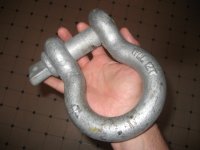
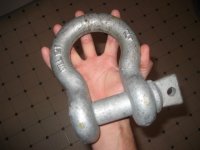
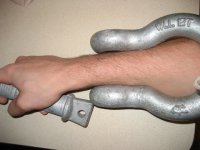
Ok, let me explain this very clearly. The hook that came with my winch does not fit the clevis! The hook's throat opening isn't big enough to fit over the pin! The only way I can use this clevis is if I pass the hook through it and then hook the cable back on it's self. You guys are a calling this without having any idea of just how BIG a 12 ton clevis really is! The clevis's throat is big enough that my wrist will pass through it! A 2:1 safety factor is still twice what my winch is capable of! That is more than adequate for a non lifting application. With a 2:1 safety factor the clevis will never fail. The failure point will be my relief valve.
 

Attachments

  • IMG_6015.JPG
    IMG_6015.JPG
    140 KB · Views: 153
  • IMG_6014.JPG
    IMG_6014.JPG
    135.6 KB · Views: 153
  • IMG_6016.JPG
    IMG_6016.JPG
    171.1 KB · Views: 153
/ winch equipment #15  
Cord,

I work in a Mill and can honestly say that a 12 ton clevis is one of the smaller units we use everyday, so I know the size well and also what I'm talking about here.

I understand your dilemma, do we use rigging that is always the same rating as the the crane, NO we don't. What you must understand from an industry, and SAFETY (OSHA) standpoint you are NEVER permitted to go into the safety factor of any lifting device.....period. The only time this is permitted is when you have an Engineered Lift with a crane and you can load it to 125%of the rated capacity MAX, even for an engineered lift. In doing that there are all kinds of redundant safety precautions that must be adhered to when doing something like this, but anything below the hook MUST be rated for the load being lifted. I know I am relating all this to cranes, lifting, and such, but honestly from a tension, or working load standpoint there is no difference between lifting and pulling, as 5 ton of tension is 5 ton, no matter if it's lifted or pulled.

Now to your winch issue.....

Would I use a smaller shackle, yes I would. Most likely you will never exert that much tension on the thing because most winches only work with the first 25 feet of rope, and the winch is pulling at far less then its rated line pull. When you are out and about playing in the mud, there are always trees within 25 feet of your vehicle. As for your winch hook, you can always replace it with something bigger, or just loop the end then you can use any shackle you want. Remember, never saddle a dead horse if you loop the end, meaning when installing cable clamps to create the loop, NEVER pinch the tension side of the line pull cable, always pinch the looped part of the cable with the u-bolt.

I take a very personal approach to lifting because just like bolts and fasteners it is the most LEAST understood part of basic mechanics and honestly if not done right mistakes can kill you or your buddy.

Take care and have fun tuggin!

Oh.......just one other thing.....

Cranes usually have a safety factor of 3:1
Lifting items (shackles, slings, chains) usually have a safety factor of 5:1, sometimes 8:1 if rated for severe duty.

Craig
 
/ winch equipment #17  
I have a 20,000 lb winch I'm installing on a small loader. I wanted some rigging gear so I bought a couple of clevis's off Ebay. They were rated 12 tons. Looking at the clevis's, I now realize they were rated for lifting, not pulling. They way too large for my application. Anybody know how much a clevis would be derated for pulling?

Cord,

why don't you just put the clevis back on ebay and buy the appropriate size clevis for you needs. If the clevis you have doesn't work for you, buy another one, but make sure the WLL is 20,000 lbs or greater. Clevises designed for pulling are not really that expensive.

Trying to outsmart engineers who design this stuff for a living is a pretty silly.

rodger
 
/ winch equipment #18  
Cord,
Listen to shmudda, as well as the other comments!

He brought up the same points I would have.

Items are de-rated for one reason - SAFETY!

Playing the game of figuring the breaking strength versus load rating is a dangerous game. Eventually it will get you into trouble.

I would not want to be around when a winch rated at 20K was pulling close to its rated load and the cable broke loose!
 
/ winch equipment #19  
At work we service the 15 ton wheel loaders for the army. They have a winch on the front frame between the lift arms, rated at 15 ton. When the bucket is placed in the dirt, with a snatch block on top of the bucket, the winch will pull all four wheels of the loader in the air. so it does a wee bit more than 15 ton: The army often doesnt even call in their recovery tanks, but pulls just anything with the loader which is at every camp anyways.
 
/ winch equipment #20  
Trying to outsmart engineers who design this stuff for a living is a pretty silly.

Thats exactly what competitor B is doing to stay competitive... And C.. and D...


Anyways, when installed on the back of a `small` loader, the winch strength is certainly not going to be the factor that decides the max line pull: He'll just move the loader, or pull the bucket dump cylinder through its relief valve.


The reason for the higher safety factors for lifting chains, is that you often put two cables on one object to form a triangle: this will increase the tension in the lifting chains quite a bit. With simple straight recovery winching you dont have this effect so personally i dont worry about using a 10 ton lifting chain with factor 5, for a 16.66 ton recovery winch so in this application you end up with factor 3
 
 
Top