Wood Splitting Question??

/ Wood Splitting Question?? #1  

jodebg

Platinum Member
Joined
Mar 4, 2012
Messages
671
Location
New Hartford, CT
Tractor
Kubota B-2650
I normally split my firewood during the cold months
with my 25 ton MTD wood splitter.

My splitter usually goes through all the wood without
much difficulty in the cold months.

I am now splitting some hickory that
has been stacked for 2 years.
This is my first time splitting hickory, and I am having trouble
splitting a lot of the hickory rings-won't push through.

Either the splitter is not running correctly, the hickory is
super tuff to split, or the warmer temperature is making
a difference???

One of the reasons I am asking is that I just had a new
head gasket installed along with a new valve seat and the
carb was cleaned and rebuilt.
 
/ Wood Splitting Question?? #2  
I cannot give details on hickory, but wood will split best when there is some frost in it. I split my winter wood with an axe and maul and wedge for quite a few years. If I could split in the morning after a cold night it would split far easier than in the afternoon after the temperatures warmed up the frost was out of the wood. I now have a splitfire wood splitter that runs off the tractor hydraulics and don't see much difference with how the wood splits regardless of temperature. If there is a lot of sap in it you don't have the wood spitting at you when the wedge hits it if it is frosty.
 
/ Wood Splitting Question?? #3  
Can you hear the relief valve open when the hickory block stops the pistons progress? If not then the trouble is in the engine or pump. If the relief valve is opening just like it should at the end of the pistons stroke then it is not the splitter but just tougher wood then you have piston and pump for. Also does the engine rev when it comes under load? If not the governor on the carburetor may not have been put right when you had it worked on.
 
/ Wood Splitting Question?? #4  
25 tons could be a bit misleading.

It could either be a 4" cylinder or 4.5" cylinder. Neither of which will actually make 25 tons. The 4" cylinders make ~19tons @ 3000psi and are usually rated ~22T. A 4.5" cylinder will make ~24 tons and are usually overrated in the 28ton range.

Either way, either one should have no issues with hickory if you are making 3000psi. Perhaps and occasional crotch piece could hang you up, but that would be rare. Winter or summer shouldnt matter on a modern splitter running right.

And I doubt the engine has anything to do with it. As long as it is running and not stalling, you should be making pressure.

It could be the pump isnt kicking into low. Or a pressure relief is stuck. OR just a worn out system. For ~$25 for a gauge, a tee, and a few fittings, I'd put a pressure gauge in the system and see whats going on.
 
/ Wood Splitting Question?? #5  
Hickory can be really realy tough. The pump generates the splitting pressure not the motor. So as long as your rebuilt motor is turning the pump then the motor is not your problem it is the tough wood.
Wood will split a lot easier with a maul in the winter because the shock of the blow has a shattering effect. With a splitter that applies steady pressure being frozen doesn't help as much
 
/ Wood Splitting Question?? #6  
Not familiar with the MTD specifices but have you changed the hydraulic oil and filter in a while? Doing that might get some results.
 
/ Wood Splitting Question?? #7  
Hickory and Elm in warmer weather is why I gave up on the maul and got a splitter. Still, you should be able to split straight grained wood in warm weather - it will probably require a longer stroke to separate all the stringy fibers.
 
/ Wood Splitting Question?? #8  
Hickory and Elm Are stringy and tuff splitting. Your axe handle may well have been made of hickory. Get the gauge and you can quickly tell if the pump is still putting out the pressure. That ten degree wood sure impresses the grandkids. Big ash splits great with a axe.
 
/ Wood Splitting Question??
  • Thread Starter
#9  
Spent some time on this yesterday and solved the problem.
Torqued the pressure adjusting screw a small amount and the wedge pushes right through.
Thanks for all of your help.
 
/ Wood Splitting Question?? #11  
You really should get a gauge on it. Now you have no idea where it is set, and can damage other thing.
 
/ Wood Splitting Question??
  • Thread Starter
#12  
I plan on it. Can you tell me how to install?

Where to mount-on the Feed Line?
Do I need to drain any fluid first?
Use Teflon tape on fittings?
etc.?
 
/ Wood Splitting Question?? #13  
A tee on the base end if the cylinder would be where i'd put it.

There are 3 common types of fittings for hydraulics. Jic, o-ring, and npt. Only npt needs sealer, but not tape. Don't use tape on hydraulics.

Not sure what your splitter and hoses are. And you cannot just go to the plumbing section of a hardware or box store and get a tee. You need to make sure its a steel tee rated for hydraulic pressure.
 
/ Wood Splitting Question?? #14  
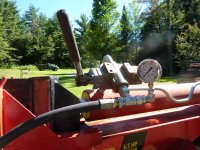
I mounted a guage like this photo. Mine is perminent. But all you need is a tee on the pressure line from the pump with a 1/4" port where you can attach the guage or a plug. Then you can use the guage as a test tool elsewhere.
I removed the 3/4" elbow and replaced it with a tee. Then added reducers to get down to 1/4" for the guage. On a splitter the fittings are typically NPT pipe threads.

SplitterPressureGauge.JPG
 
/ Wood Splitting Question?? #15  
On a splitter the fittings are typically NPT pipe threads.

Typically, yep.

Allthough you see alot of ORB fittings on the cylinders anymore.

My splitter I just made has NPT on the pump and valve, ORB on the cylinder, and all the hoses are JIC:confused2:

JIC fittings were the cheapest for the hoses. Thats typical. And since I needed elbows and reducers anyway for all the ports, Might as well make it so all the hoses were standard (and cheaper JIC)

Jodebg:thats a good picture on how to do the gauge. but you can really mount it anywhere on a pressure line if all you are doing is testing the pump. Just tee in wherever is convenient.
 
/ Wood Splitting Question??
  • Thread Starter
#16  
When you say add a tee to the press line...which line is this? I have 2 rubber hoses and one metal line that goes from the control valve to the cylinder.
Which line get the tee? Where do i buy the gauge and the fittings? Thanks.
 
/ Wood Splitting Question?? #17  
The metal line is a pressure line out of the valve but you probably don't want to change that. The rubber lines are flexable and easily moved enough to fit in a Tee. Your pump has two lines on it. One comes from the tank through a filter probably. It is the low pressure side feeding fluid to the pump. The other line from the pump is the pressure line and should go up to the valve.

Get the stuff you need online at SurplusCenter.com or DiscountHydraulicHose.com

DiscountHydraulicHose has a online tool that enables you to figure out what kind of fitting threads you have/need.
 
/ Wood Splitting Question??
  • Thread Starter
#18  
Thanks. If I understand this correctly, I don't cut the hose, but rather add a tee to the threaded end of the flexible hose?
 
/ Wood Splitting Question?? #19  
If you got a tee with barbed ends, so called, on the two straight thru ends and a threaded port on the tee port you could cut the hose. Barbed ends are for use with hose along with a clamp. But like everything else you need to get the right one for the hose you have. I have never used them so don't know more than that. I would get the number and mfg off the hose and call or email someone like Discount Hydraulic Hose and ask what fitting to use if you want to do it that way.
Or better still maybe someone right here on TBN can answer that question.
 
/ Wood Splitting Question?? #20  
Its hydraulic hose that likely runs 2500-3000psi. Dont cut it to insert a tee.

IF you did that, you would need to have fittings crimped back on the hose. OR by the threaded kind that are ~$25-$30 PER FITTING.

Pictures of your splitter would help a ton. And maybe someone else out there has a MTD25 ton splitter that knows what the fittings are and what the fitting size is. But either way, a picture of the splitter. In particular, the valve area. A picture like gordon posted in post #14 would help.
 
 
Top