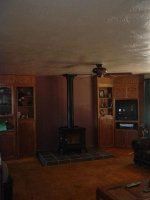
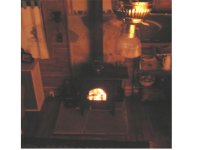
wood stove & ceiling fan

/ wood stove & ceiling fan #1  

coachgrd

Gold Member
Joined
Sep 7, 2003
Messages
353
Location
nw PA
Tractor
Kubota BX1870
Started up our new wood stove for the first time this weekend. I've been so impressed with the BTU's it puts out. We've not had the furnace kick on all weekend so we're pretty relieved about that (considering we just had the tank filled at $2.15/ gal.:()

Anyway, I'm getting conflicting ideas on how I should best circulate the air with the ceiling fan. Some folks have said that I should have the fan running in such a way that it draws the cooler air on the groud up and mixes it with the warm air that rises. Then again, I've been told that it should be set so that it pushes the warm air that rises, down to the floor.

Thoughts?
 
Last edited:
/ wood stove & ceiling fan #2  
We have forced hot water baseboard heat in our 3000 sq.ft. colonial and having the ceiling fan on so that it pulls the heat up really circulates the heat more efficiently in the winter. I have the fans blow the air down to the floor in the summer months because it tends to spread the A/C better.

Here is a little diagram to explain what I mean:
fan_install02.gif


This is from a ceiling fan manufacturers website, Signature Lighting
with a little explanation: " The third pull chain is for Forward/Reverse. This setting would usually be changed once per year .Downdraft for summer to create a wind chill to give a cooling effect. An Updraft in winter to circulate the hot stratified air off the ceiling and back down to the floor without creating a wind chill."
 
/ wood stove & ceiling fan #3  
I agree with Dmace. Not sure about the physics of it all but you can certainly tell if it's not pushing air in the correct direction.
 
/ wood stove & ceiling fan #4  
Ceiling fan on low blowing towards the ceiling as described above. Otherwise it blows cold air down on you while starting the fire on a cold morning. Really you just need to keep the room from stratifying into hot on top and cold on bottom so it doesn't really matter until you consider the wind chill effects of downward blowers.

I tried both ways. I run my energy star fan on low (6 watts) continuously through the winter.
 

Attachments

  • small8.JPG
    small8.JPG
    43.9 KB · Views: 412
/ wood stove & ceiling fan #5  
The warmest way is with the fan in reverse or blowing up. It will circulate the warm air accumulated at the ceiling to go down gently near the walls. If the fan is blowing down the effect is cooler because of the breeze.
 

Attachments

  • fireplacefan 001.jpg
    fireplacefan 001.jpg
    24 KB · Views: 365
/ wood stove & ceiling fan #6  
Txdon hit it right on the head for the correct reason. You don't want to feel the breeze, because it will actually make you feel colder. Breeze in the summer, no breeze in the winter.
 
/ wood stove & ceiling fan #7  
In my experience the standard answer applies: it depends ;)

I have a pellet stove in my main, 2 story, living room. If the pellet stove is running full-time I like the fan blowing down as it helps spread the air out on the first floor and keeps the upstairs from getting too hot. If the stove is running part time it feels to cold/drafty on the first floor to have it blowing down so I reverse it.

Charles
 
/ wood stove & ceiling fan #8  
I had the same question so I wrote a letter to one of those "Ask the Scientist" columns in the Houston Chronicle, and he said the same thing:
Blow down in the summer, and up in the winter"
Of course his answer was like that song "Alices Restaurant" with circles and arrows and .......pretty complicated.

Makes sense I guess:)


anthony
 
/ wood stove & ceiling fan #9  
Thanks for the information :). Right now I am doing an "experiment" with my subjective observations relative to feelings of warmth. For many years I have set my living room ceiling fan just the opposite as you guys recommend. I believe I got my original information from the Weather Channel and maybe my ceiling fan owners manual; but I am not always in agreement with their advise and their "forecasts" (mine are more "accurate" :rolleyes:). Jay
 
/ wood stove & ceiling fan #11  
I can heat my whole 2000sf house with our 34K BTU air-tight wood
stove. If I do not run the ceiling fan(s), our feet get cold, exacerbated
by the fact that the ceilings are 14-ft high at their peaks. High
ceilings make the fans necessary, rather than optional.
 
/ wood stove & ceiling fan #12  
I think this is one of those things that you have to try and see how/when it works for you.

Our ceilings are 10 feet tall. Turning the fans so the blow up to the ceilings does seem to add a degree or so to the "human" space. In the past I would still feel a breeze so we would turn off the fan. Because of this thread I tried the fans again. I think we where warmer but the stove was really burning so I can't tell if the temp went up because of the fan or not. We did not feel a breeze though.

So what that tells me is that there is a minimum temperature that the fan can be operated without the fan being negatively felt. I'm guessing in our house its about 80.

I'll still play with the fan off/on for grins and giggles but me thinks in our house with our stove it does not matter that much if it runs or not.

Later,
Dan
 
/ wood stove & ceiling fan #13  
Up in winter & summer in my case. Have log home with open lofts
on each end of open living, dining and kitchen area. This helps keep
the temperatre more even through-out the whole house during heating
or cooling. Forced air in winter; AC in summer. Works good for me.
Fans located in each of the 2 lofts. Lofts stay cooler this way.
 
/ wood stove & ceiling fan
  • Thread Starter
#14  
Another follow-up question with our new wood stove...

Last night we had a very noticable amount of smoke in the house from the wood stove. My suspicions are because of some extremely high winds here in northwestern PA. Would this make sense or should this never happen?

Thanks...
coachgrd
 
/ wood stove & ceiling fan #15  
Coachgrd,

Is the stove connected to a pipe that supplies outside air for combustion?

I have seen some information that this could cause drafting problems in high winds. The article might have mentioned problems with draft in high winds with a stove that was not connected to outside air but I don't remember for sure. Our stove is connected to a 6 inch pipe to supply combustion air.

Was the smoke coming from the chimney or from the stove?

I have seen a bit of smoke leaking from the stove when we where starting a fire and there where very few ashes in the stove. The smoke was leaking from the ash box under the stove. Not enough ashes in the stove to seal the plug to the ash box.

Later,
Dan
 
/ wood stove & ceiling fan #16  
When I had my stove it took a little to heat up the stovepipe when starting a fire. The pipe needs to be hot (or at least warm) to get the desired upflow to the colder outside air. When I started fires before it was too cold out (say ~40), I could easily get smoke in the house if I got the fire going too quickly. I didn't want a fire going until the outside temp was below 30, otherwise the house just got too warm.
 
/ wood stove & ceiling fan
  • Thread Starter
#17  
dmccarty said:
Coachgrd,

Is the stove connected to a pipe that supplies outside air for combustion?

I have seen some information that this could cause drafting problems in high winds. The article might have mentioned problems with draft in high winds with a stove that was not connected to outside air but I don't remember for sure. Our stove is connected to a 6 inch pipe to supply combustion air.

Was the smoke coming from the chimney or from the stove?

I have seen a bit of smoke leaking from the stove when we where starting a fire and there where very few ashes in the stove. The smoke was leaking from the ash box under the stove. Not enough ashes in the stove to seal the plug to the ash box.

Later,
Dan

Dan:
Other than the smoke pipe, there is no other vent pipe. I'm not quite certain where it gets it's fresh air to fuel the fire.

I just called the installer and was told that it is not uncommon for this to happen in extremely high winds, whicj is what I would characterize last night's as. They said they do sell a high wind cap for about $100.00

coachgrd
gd
 
/ wood stove & ceiling fan #18  
i "I'm not quite certain where it gets it's fresh air to fuel the fire."

It's drawn into the firebox through a vent on the bottom of the unit. The damper you adjust is what controls the size of the opening. It doesn't take much air to keep a fire smoldering red hot. The glowing coals are what produce the most heat, so if you want the best heat output get a good bed of red hot coals going. If want ambiance, well, that's where the flames come in...

In general: more air = more heat = quicker burn = more wood required.

Once the fire has a good bed of coals, close down that damper as much as you can to keep things smoldering, but not flaming. That will give you a good amount of heat while lasting a good long time. With mine, I could stoke it up before going to work and still have it blowing warm air when I got home 10-12 hrs later, with no interference from the wife during the day.
 
/ wood stove & ceiling fan #19  
Since you already have a forced air system in your house, why not just run the fan from your furnace to circulate the warm air from the wood stove through your house?
 
/ wood stove & ceiling fan
  • Thread Starter
#20  
Sigarms said:
Since you already have a forced air system in your house, why not just run the fan from your furnace to circulate the warm air from the wood stove through your house?

Hmmm, you might be onto something there...thanks.
 
 
Top