wood stoves

/ wood stoves #61  
The wood stove that home depot sells has a huge following and is a very well respected stove, even on hearth.com

Check out the englander NC30. It seems to compete if not surpass the big dollar stoves, and is built in North Carolina, USA.

Englander 2,200 sq. ft. Wood-Burning Stove-30-NCH at The Home Depot

This is what I have and it works just fine. I've owned 4 different brands including a nice regency. I think the only real difference in today's stoves are the finishes unless you get into electronic controlled models like a blaze king.
 
/ wood stoves #62  
Obama administration faces backlash on proposed wood stove regulations
Published April 05, 2014
FoxNews.com

FILE: March 8, 2014: A wood stove heats a home in Freeport, Maine.AP

A federal proposal requiring more efficiency from wood-burning stoves has ignited a debate between the Obama administration and lawmakers who oppose the new regulations, arguing the rules impose an unfair burden on people in remote areas.

The Environmental Protection Agency proposed a rule changes in January that would dramatically tighten emissions requirements on new wood-powered heaters, though does not impact ones already in homes.

The EPA estimates that as much as 13 percent of all soot pollution in the U.S. is a result of inefficient wood-fired stoves and boilers.

The dispute pits several mostly urban states, mainly in the northeast, against some rural states such as South Dakota, which says the rules would impose an unfair burden on people in remote areas. About one in four South Dakota homes has a fireplace or wood stove.

Among those opposed to new rules are South Dakota Republicans Sen. John Thune and Rep. Kristi Noem, who say the new requirements will have a big impact on South Dakotans who rely on wood stoves during the long winter.

"Leave it to the EPA to impose more regulations on an affordable and renewable fuel source after one of the coldest winters on record and a costly propane shortage," Noem said.

Last week, Thune wrote EPA Administrator Gina McCarthy asking her to abandon the proposed changes and work with Congress to find a more balanced approach.

"South Dakota and many other states are continuing to deal with a propane shortage, which has resulted in record-high propane prices," Thune wrote. "Many families turn to secondary sources of heat, such as wood stoves, when propane and heating fuel prices increase." Residential propane prices surged this winter to $4 a gallon, nearly double the typical rate.

The regulations the EPA has on the books date back to 1988, and don't take into account some wood-burning devices that weren't in use back then. The proposed rules would give manufacturers five years to make products that reduce emissions by approximately 80 percent.

It would apply to wood heaters, including outdoor and indoor wood-fired boilers, known as hydronic heaters. The changes would only apply to new stoves and rules would not impact outdoor fireplaces, fire pits or other types of outdoor fire containers.

In Missouri, more than three dozen lawmakers co-sponsored a bill declaring that "All Missourians have a right to heat their homes and businesses using wood-burning furnaces, stoves, fireplaces and heaters." Democratic and Republican members of Congress from Maine, Montana and Missouri have also expressed concerns about the EPA's proposal.

Long article A lot more here
Obama administration faces backlash on proposed wood stove regulations | Fox News
 
/ wood stoves
  • Thread Starter
#63  
We've got a lot less BS up here in the north EH!
I took the plunge and ordered the Pacific Energy T5 Alderlea with blower, fresh air kit and black porcelain finish. She's a sweet looking unit with a great warranty and good reviews. Even though the coldest winter here in 116 years has basically come to an end, we are excited about making this addition to the house. Too bad I didn't have the cash to do this last fall, oh well, at least we will be set up for next winter. I'll post pics hopefully soon, should take about 3 weeks for it to come in and then line up my installer when his schedule allows.
 
/ wood stoves #65  
Just don't forget the flue damper about 3ft above the stove (as high as you can reach). You will regret it later when the draft exceeds the stove requirements if you do not have a damper.

We've got a lot less BS up here in the north EH!
I took the plunge and ordered the Pacific Energy T5 Alderlea with blower, fresh air kit and black porcelain finish. She's a sweet looking unit with a great warranty and good reviews. Even though the coldest winter here in 116 years has basically come to an end, we are excited about making this addition to the house. Too bad I didn't have the cash to do this last fall, oh well, at least we will be set up for next winter. I'll post pics hopefully soon, should take about 3 weeks for it to come in and then line up my installer when his schedule allows.
 
/ wood stoves
  • Thread Starter
#66  
Figured I'd give an update.

Well well well whadda ya know the stove finally came, I was chatting with the place we are getting it from and apparently because of the time of year when we placed the order they had to make it. I hope it looks good considering the almost 3 months it took to get here. I'm stopping in to pay for it today and see if they can't do a free delivery because of the wait we had to go through. After that is the install and we will be good to go.
 
/ wood stoves #67  
Just don't forget the flue damper about 3ft above the stove (as high as you can reach). You will regret it later when the draft exceeds the stove requirements if you do not have a damper.

Flue Dampers are not required for air tight stoves. The inlet air can be shut off or reduced.
 
/ wood stoves #68  
No EPA certified stove is "air tight". Quite the contrary. They are very leaky indeed based on how the EPA has defined the test. Every certified EPA stove I have had will exceed 1000F flue temperature with the air control fully closed given my 20'+ of vertical indoor chimney. The flue damper is the only way to tame the chimney draft to the point that the air control on the stove is of any use at all. Now obviously I am talking about winter conditions with 20F or less temperature outside and 70+ inside which creates a strong stack effect.

Flue Dampers are not required for air tight stoves. The inlet air can be shut off or reduced.
 
/ wood stoves #69  
We have the Jotul F-100. We live in a 14 year old modular home that has a built-in fireplace. The F-100 was the only model that was short enough that I could use the existing flue. I would have liked to have a bigger model, but that was all I could get to work. Even though our house is just over 2000 square feet, the little stove does a great job. It really cuts down on our utility bill.
We have electric central heat, but love the wood fire. We just keep our thermostat set on about 62, and use the central heat as a backup to the wood stove. It usually only comes on if (a) it's really cold outside, or (b) I'm too lazy to get up and put more wood in the stove. :D
 
/ wood stoves #70  
No EPA certified stove is "air tight". Quite the contrary. They are very leaky indeed based on how the EPA has defined the test. Every certified EPA stove I have had will exceed 1000F flue temperature with the air control fully closed given my 20'+ of vertical indoor chimney. The flue damper is the only way to tame the chimney draft to the point that the air control on the stove is of any use at all. Now obviously I am talking about winter conditions with 20F or less temperature outside and 70+ inside which creates a strong stack effect.

My Osburne EPA stove instructions specifically say not to install a flue damper. Mine is installed in the basement of a two story house with a full height chimney and outside air intake. I use a stove pipe thermometer and can get the temperature pretty much any where I want with the intake air damper.
 
/ wood stoves #71  
I run a pellet stoveto heat my 1400 sq ft home in the winter. It keeps the the house at 70F most of the winter, down to about 10F outside. I do run a space eater in the bathroom just to make it a little warmer for showering, but that is about 20-30 minutes. You can buy a ton of pellets for about $200. The extra electric adds about $25-30 a month.

Just a thought....
 
/ wood stoves #72  
No EPA certified stove is "air tight". Quite the contrary. They are very leaky indeed based on how the EPA has defined the test. Every certified EPA stove I have had will exceed 1000F flue temperature with the air control fully closed given my 20'+ of vertical indoor chimney. The flue damper is the only way to tame the chimney draft to the point that the air control on the stove is of any use at all. Now obviously I am talking about winter conditions with 20F or less temperature outside and 70+ inside which creates a strong stack effect.

If you have a leaky air tight you could reduce it to a puddle by judicious use of the air inlet and flue damper.
 
/ wood stoves
  • Thread Starter
#73  
We get way colder than 20f her, try -40. Makes me cold thinking about it.
I know my in-laws don't have a pipe damper, just think so draft lever on the stove, no complaints about it. I will definitely ask the installer about it before he starts.
 
/ wood stoves #74  
Ours specifically says not to install a flue damper as well. I can close the air inlet and bring a full blaze down to 300 in about half an hour.
 
/ wood stoves #75  
Of course it says not to use a damper, since that would not be in compliance with how it was tested in the "Florida bungalow" test as dictated by the EPA.

It is always amazing how board members living in Canada, where EPA laws do not apply, want to tell us how things work with product we buy here in the USA and USE for multiple winter seasons.

Believe me, if it is cold outside, you have a straight 16+ foot chimney, most of which is in the heated home envelope, you are going to have an excessive draft problem with any certified EPA stove. The worst offenders will be the secondary air type stoves. Catalyst type stoves can burn clean at a lower temperature thanks to the platinum and palladium so they do not require the same amount of excess air.

The OP will discover the runaway behavior soon enough, come the next winter. I have experienced this behavior with a Morso and a Pacific Energy T5, both identical which is not surprising since the chimney was the same...
 
/ wood stoves #76  
Well it's just us Canahodians Hillbilly types eh . Many of us live in cold climates and use wood for heat.

My Regency with proper diameter twenty four foot stack has tendency to go out when the inlet air is shut off. Course if the door gets opened things can go "whoosh".

Installation instructions did not call for a stack damper. Not sure but a stack damper may not meet code. Not handled properly they make for chimney booms or feed smoke back into the house.

Yahoo! - 301 Moved Permanently

There are regulations in Canahodia by gar. You might like to check out some of the standards eh.
 
Last edited:
/ wood stoves #77  
Well, I live in SW Michigan and maybe our air is different from SE Michigan but I have two wood stoves, both EPA with outside air intake and no chimney dampers (only the combustion air dampers built into the stove). Both have stove pipe magnetic thermometers. The one in the house is in the basement and the top of the chimney is over 30 feet above the top of the stove. It stays right in the recommended operating range with only minor adjustments of the supply damper. The one in the pole barn has a vertical chimney about 18 feet above the top of the stove. It's a cheaper stove (single wall) and requires a little more tweaking but it will always shut down to below operating temperatures if I close the combustion damper.
 
/ wood stoves #78  
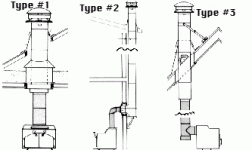
Kenny, what type of chimney do you have ? Type 1, 2 or 3 ? A type 2 chimney will never gain as much draft in cold conditions as a type 1. A type 3 will have less draft than a type 1 due to the extra bends in the system.

I have a damper about 18" above the stove in a type 1 flue and other than lighting the fire, it is otherwise fully closed all the time and I seldom have the air intake of the stove open more than 20% during an extended burn.

Egon, have you looked at the size of the intake air opening on an EPA stove when the control is fully closed ? Do you know that the intake for the secondary air system is a fixed orifice that is larger than a 5c piece ? Do you know that the fixed air intake for the air wash for the glass in the door is about 1/2" in diameter? Basically, if you add it up, if you have the air intake fully closed there is still an opening feeding the stove than is more than 3/4" in diameter which one has no control over at all.

This is a topic that has been beat to death on hearth.com There have been many articles written by very knowledgeable people on the subject, yet much ignorance remains....

Florida Bungalow Syndrome

inschimneys1.gif
 
/ wood stoves #79  
The link is an interesting read but it just doesn't match up to what I have experienced. In my house I have a clay lined masonry chimney. I have about 5 feet of sloped single wall pipe above the stove that goes into the masonry wall. It goes 2 or 3 feet horizontal and then turns vertical and goes up about 30 feet to clear the peak of a steep roofed 2 story house. I guess that would be the "Type 2". If I leave the combustion air wide open my Osburne will exceed the recommended operating temperature but won't get frighteningly hot.

In the pole barn I have about 9 or 10 feet of single wall pipe that then transitions to 9 feet of Class A double wall pipe through the attic space and above the roof. I suppose that would be a Type 1. It's a US Stove and it will run hotter than the Osburn if left wide open but it's easily controllable to stay in normal operating range.

Apparently some people have problems like this but I know a lot of people with wood stoves and I have never heard of the issue before. I have only had these two "airtight" stoves, one rather expensive and one about the cheapest one available and they both work perfectly for me with no control other than the stove control.
 
/ wood stoves #80  
I would install the damper wether it's used or not and this is why. gaskets on doors wear out and can leak a bit before they get replaced. One time a block of wood caught the door here and knocked a section of cord loose. having the draft as a back-up to shut the fire down to a manageable level is nice to have in a pinch.
 
 
Top