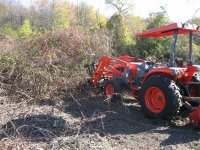
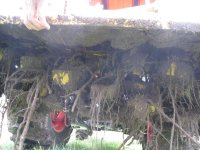
Root Grapple?

   / Root Grapple? #21  
Someone on here saw the $900 price at wildcat's and mentioned this site and they sold it to them at the $550 price.

I too have a wildcat 48" grapple. LOVE it. I have only found one reason thus far (2 months or so) to have gotten a 60" instead. I am putting in raised beds for growing veggies. I use the grapple as a way to skim under the grass and roll it out of the way. Works pretty good for this. When I come behind it with my bucket which is 60" its too wide and I can't cleanly surface it like I hoped.
 
   / Root Grapple? #22  
I have two skid steer soulutions grapple root rake 1 on the 5030 and one on the 9540 never had a single problem with either
 
   / Root Grapple? #23  
I agree regarding the digging under trees/roots. It is not only the angle of the lower tines but also the short length that makes it inefficient with a claw grapple. .
...

What is your basis for the above statement? I've never owned or operated either style grapple and I'm curious why you think the rake/claw grapple style is so inefficient. For a given loader, the breakout force increases as the distance to the pivot point decreases. Why is having the work closer to the pivot piont a bad thing?
 
   / Root Grapple? #24  
What is your basis for the above statement? I've never owned or operated either style grapple and I'm curious why you think the rake/claw grapple style is so inefficient. For a given loader, the breakout force increases as the distance to the pivot point decreases. Why is having the work closer to the pivot piont a bad thing?

Your point about being close to the pivot pin is correct, however, a grapple can work both with the loader force and also by inserting it under something and then driving forward using the tractor momentum/drive to exert force. A standard root grapple with long bottom tines does this second type of work easily: insert the tip under the object and drive forward. That pushes the grapple under the object and the object up or over. It means you can get the grapple underneath the root ball of a bush or small tree which loosens things up. A standard technique with these long bottom tine grapples is therefore to insert the grapple underneath the object, drive forward until the object is pushed against the back of the grapple, and then to curl/lift to uproot. The initial driving forward does a lot of the work of unrooting both by displacing the stump/rootball upwards and also by slicing through some of the supporting roots.

The claw style grapple bottom tines are just too short (less than a foot projection) to do this especially as the upper jaw protrudes about a foot from the pivot pins too so for practical purposes you cannot get the bottom tines under something effectively.
 
   / Root Grapple? #25  
can someone kindly post a link to this wildcat 48" grapple, i have drooled over islandtractors grapple since i first saw it a few years back and am finally ready to purchase one. anbo is a local company but too heavy for my tractor and cost is way too high but maybe now they have a model built more for my size tractor..
 
   / Root Grapple? #26  
HCJ You mentioned NOT to go wider than 48", can you elaborate?

Sorry for the delay, and I see that IslandTractor has already answered. I use my grapple mostly for clearing areas of saplings and small trees. I also use it to collect chain saw clippings from trimming roadsides and plot sides. As an analogy, I compare it to a shovel. When I dig under a rootball, it helps to have a narrower "bite" to really focus the pressure. You would not use a snow shovel to dig up a tree, but rather a spade, because it can be driven into the soil better. You may think the narrower width would limit the collection of debris, but it doesn't. What I do when I clear roads (all the stuff that grows in every year) is to walk aound with my Sthil Kombi polesaw. I drop all growth in the road, preferably perpendicular to the road. I never touch it with my hands, just let it fall. I may do a mile or so, on both sides. I then (with a box blade with scarifiers on the rear) lower the grapple with the tines skimming the surface angled slightly down and the box resting just lightly on the surface. I simply drive forward and each piece of debris is collected. It doesn't matter that the grapple is narrow, as the debris snags more debris way beyond the grapple width. Eventually a pile will collect that is too big to even see over. Any that may be missed is usually collected in another pile by the box blade. I then either push it off the road into a pile or pick it up and carry it to another pile. I raise my box, back up over the stuff it collected, and lower the grapple to push that debris into the pile also. Rarely do I have to make a second pass, and the road is clean.

I also will uproot the trees and bushes on the edges to widen the roads so that I don't have to cut the same trees every year. Better to uproot them than to cut them.

So a narrow grapple has the advantage of being a better digger, but does not in any way compromise its ability to collect debris. I simply could not dig with a wide one as effectively. Does that make sense??
 
   / Root Grapple? #27  
bigballer said:
can someone kindly post a link to this wildcat 48" grapple, i have drooled over islandtractors grapple since i first saw it a few years back and am finally ready to purchase one. anbo is a local company but too heavy for my tractor and cost is way too high but maybe now they have a model built more for my size tractor..

Just goggle Wild Kat grapple and call the number listed. They are very helpful folks.
 
   / Root Grapple? #28  
By the way, my grapple is a Markham and was a custom build. It is 48" wide but built with 1/2" tines rather that 3/8". I also had them add some extra "ribs" between my tines to make the spaces narrower so it holds things like rocks better. But for general use grabbing tree limbs, it probably doesn't matter. I wanted a little heavier duty one as my tractor is a 70 horse and I use it like a dozer.
 
   / Root Grapple? #29  
Your point about being close to the pivot pin is correct, however, a grapple can work both with the loader force and also by inserting it under something and then driving forward using the tractor momentum/drive to exert force. A standard root grapple with long bottom tines does this second type of work easily: insert the tip under the object and drive forward. That pushes the grapple under the object and the object up or over. It means you can get the grapple underneath the root ball of a bush or small tree which loosens things up. A standard technique with these long bottom tine grapples is therefore to insert the grapple underneath the object, drive forward until the object is pushed against the back of the grapple, and then to curl/lift to uproot. The initial driving forward does a lot of the work of unrooting both by displacing the stump/rootball upwards and also by slicing through some of the supporting roots.

The claw style grapple bottom tines are just too short (less than a foot projection) to do this especially as the upper jaw protrudes about a foot from the pivot pins too so for practical purposes you cannot get the bottom tines under something effectively.

Do you really need the tines completely under something? If you're trying to move a pile of logs or construction debris I can see where that would be the case. But if you're trying to remove something that's growing from the ground, I'm still not convinced that a root grapple is better than a rake/claw grapple.

I've seen a lot of brush clearing videos where root grapples were used and the bottom tines were perpendicular to the ground during most of the work. Here's one video that shows this:

[ame=http://www.youtube.com/watch?v=n89WIks1k6g&feature=related]Bobcat 864G with Root Grapple (Part 3), 864, 863, track loader - YouTube[/ame]

I can't see why it wouldn't be better to have a rake/claw grapple in this case.
 
   / Root Grapple? #30  
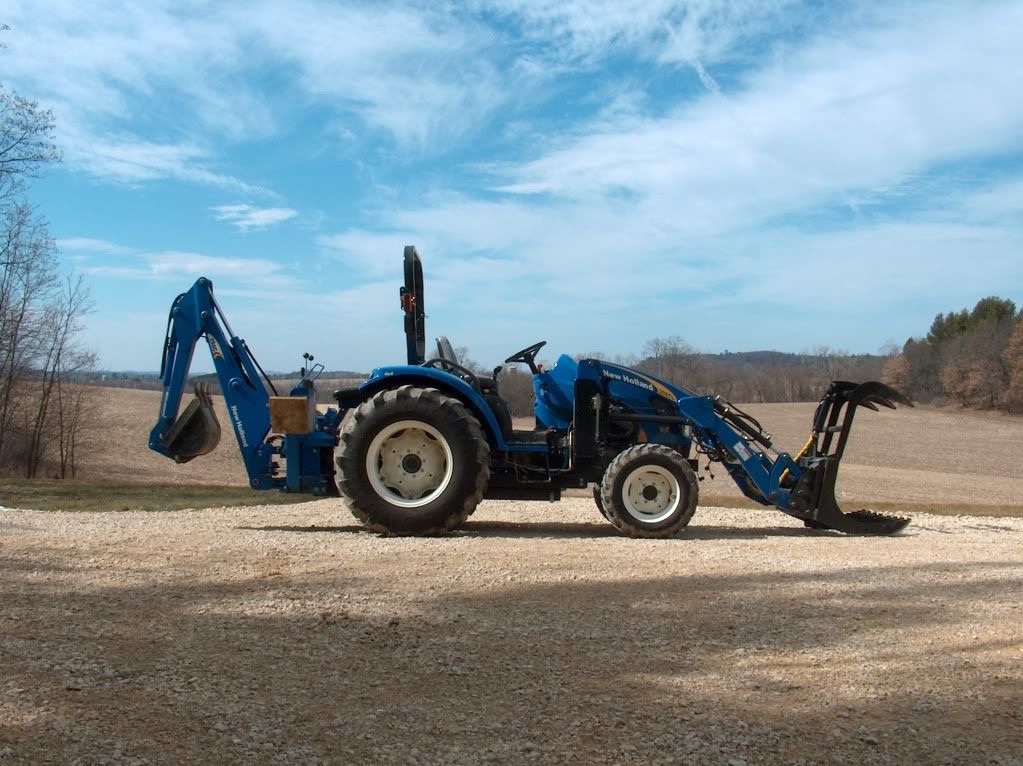
Here is my land clearing machine. I listened to everyones advice on here and bought the 48" Wildkat econo grapple. I've cleared briers, brush and small sapplings with it as well as up rooting small trees. On larger trees, I pop the roots with the backhoe then push it over with the grapple. I then pick up the whole tree and move it to where I can limb it and cut it into logs. Stack the logs and clean up the brush. It has made life so much easier. Thanks guys!

BTW, I paid $550 at the end of Dec for it.

HPIM1810.jpg
 
   / Root Grapple? #32  
Do you really need the tines completely under something? If you're trying to move a pile of logs or construction debris I can see where that would be the case. But if you're trying to remove something that's growing from the ground, I'm still not convinced that a root grapple is better than a rake/claw grapple.

I've seen a lot of brush clearing videos where root grapples were used and the bottom tines were perpendicular to the ground during most of the work. Here's one video that shows this:

Bobcat 864G with Root Grapple (Part 3), 864, 863, track loader - YouTube

I can't see why it wouldn't be better to have a rake/claw grapple in this case.

You don't "need" to be able to stick a grapple underneath something but it is an advantage. It allows you to exert force upwards by driving the tractor after inserting the grapple underneath. Of course you can also just put the grapple against something (rather than underneath) and pushing. The standard grapple allows you to do both, the claw only allows the pushing. I often find with a tree that is a little too big to easily push over that I can loosen it by alternately going underneath and then pushing when pushing alone doesn't work.

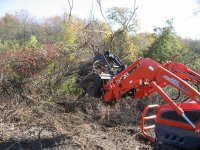
The video you posted didn't seem to show much more than just collecting very small trees and forest floor debris. Either style grapple would work for that task but the claw type is more expensive and heavier. He wasn't pushing over bigger trees but he could have with a tracked skidsteer. A CUT will have trouble pushing over trees that a skidsteer can easily bulldozer over. The way to do it with a CUT is to undermine the roots with the grapple and push from different sides. It will take longer with a CUT but it is not a function of the grapple it is related to the advantage a tracked large skidsteer has over a CUT.

I did note that on the skidsteer video they have a type of claw that is kind of a hybrid. The upper jaw is not a true claw jaw but more what you would see on a standard grapple. That is obviously to allow a larger load and to avoid the pinch phenomenon that I described earlier where one big log will prevent you from loading other smaller stuff.

The grapple in the video is probably 72# and weighs about 1200-1500lbs and costs about $3000. Those are really designed for skidsteers and excel doing small debris pickup like the guy in the video is doing. I can do the same work with my 48" standard grapple though so I don't see any advantage for a guy with a CUT. His $60000 skidsteer grapple combo would presumably be faster but I can get the ground looking just as clean as he can.
 

Attachments

  • IMG_4181smallfile.jpg
    IMG_4181smallfile.jpg
    96.4 KB · Views: 268
  • IMG_4382smallfile.jpg
    IMG_4382smallfile.jpg
    83.9 KB · Views: 267
  • IMG_5706smallfile.jpg
    IMG_5706smallfile.jpg
    75.5 KB · Views: 257
  • IMG_5701smallfile.jpg
    IMG_5701smallfile.jpg
    77.8 KB · Views: 257
   / Root Grapple? #33  
You don't "need" to be able to stick a grapple underneath something but it is an advantage. It allows you to exert force upwards by driving the tractor after inserting the grapple underneath. Of course you can also just put the grapple against something (rather than underneath) and pushing. The standard grapple allows you to do both, the claw only allows the pushing. I often find with a tree that is a little too big to easily push over that I can loosen it by alternately going underneath and then pushing when pushing alone doesn't work.

The video you posted didn't seem to show much more than just collecting very small trees and forest floor debris. Either style grapple would work for that task but the claw type is more expensive and heavier. He wasn't pushing over bigger trees but he could have with a tracked skidsteer. A CUT will have trouble pushing over trees that a skidsteer can easily bulldozer over. The way to do it with a CUT is to undermine the roots with the grapple and push from different sides. It will take longer with a CUT but it is not a function of the grapple it is related to the advantage a tracked large skidsteer has over a CUT.

I did note that on the skidsteer video they have a type of claw that is kind of a hybrid. The upper jaw is not a true claw jaw but more what you would see on a standard grapple. That is obviously to allow a larger load and to avoid the pinch phenomenon that I described earlier where one big log will prevent you from loading other smaller stuff.

The grapple in the video is probably 72# and weighs about 1200-1500lbs and costs about $3000. Those are really designed for skidsteers and excel doing small debris pickup like the guy in the video is doing. I can do the same work with my 48" standard grapple though so I don't see any advantage for a guy with a CUT. His $60000 skidsteer grapple combo would presumably be faster but I can get the ground looking just as clean as he can.

The grapple in the video looks to me like a typical root grapple, but the operator is using it with the bottom tines perpendicular to the ground, not parallel to the ground. The point I was trying to make, which I probably didn't do very effectively, is that if you're using a root grapple with the bottom tines perpendicular to the ground you are better off having a rake/claw grapple. If you are raking with a root grapple, similar to what the operator is doing in the video, both the lift and tilt cylinders are extended and the greatest force is on the tine tips, far from the pivot point. Doing the same thing with a rake/claw grapple, the lift and tilt cylinders are not extended and the force on the tine tips is closer to the pivot point.

A lot of what I need to do is similar to what is shown in the video. I think the Autumn Olives that I need to get rid of can be "raked". I don't think I'll need to tip them over and then pry them out of the ground, but I haven't tried yet. I'll find out soon how effective the rake/claw grapple is at clearing land. It should be here next week. Oh, BTW, it's 60" long, cost $1,375 delivered, and weighs 600lbs.
 
   / Root Grapple? #34  
The grapple in the video looks to me like a typical root grapple, but the operator is using it with the bottom tines perpendicular to the ground, not parallel to the ground. The point I was trying to make, which I probably didn't do very effectively, is that if you're using a root grapple with the bottom tines perpendicular to the ground you are better off having a rake/claw grapple. If you are raking with a root grapple, similar to what the operator is doing in the video, both the lift and tilt cylinders are extended and the greatest force is on the tine tips, far from the pivot point. Doing the same thing with a rake/claw grapple, the lift and tilt cylinders are not extended and the force on the tine tips is closer to the pivot point.

A lot of what I need to do is similar to what is shown in the video. I think the Autumn Olives that I need to get rid of can be "raked". I don't think I'll need to tip them over and then pry them out of the ground, but I haven't tried yet. I'll find out soon how effective the rake/claw grapple is at clearing land. It should be here next week. Oh, BTW, it's 60" long, cost $1,375 delivered, and weighs 600lbs.

For a classic clamshell, look at WRLong or Anbo. The top and bottom tines are very similar in shape and the bottom tines are perpendicular to the ground when the grapple is in a neutral position.

You are right that for raking along the ground the clamshell grapple is in a neutral position rather than the fully "dumped" position needed with a standard grapple to get the tines vertical. Most of us don't do that with a standard grapple but "rake" with the FEL slightly lifted and the bottom tines slightly dumped so the grapple is "raking" in contact with the ground about three feet in front of the mount. The cross support pipe between tines of a standard grapple serve as a depth limiter in this mode and keep the tines from sinking in more than four or five inches.

I'm not sure what Autumn Olives are but if the truncks are and inch or two in diameter you shouldn' t have any trouble just bowling them over with the tractor and picking them up with the grapple.

Good luck with your new grapple. Everyone loves whatever grapple they get and they are about the most effective work saver of any CUT implement short of a bush hog.
 
   / Root Grapple?
  • Thread Starter
#35  
Thanks everyone for the info. Sorry for not posting up more but I have been out of town. Island, I will check out the Wildcat, looks interesting.

THe Autum Olive bushes grow together to form stuff you can't drive a rabbit through. Mature bushes will go as high as 15 feet. The biggest will have trunks in the 3 to 4 inch range, with several of those all growning out of one root ball . The plus side of these nasty bushes is the roots aren't very deep and are pretty easy to root out all but the bigest ones, and even those will come out with just a little patience. They just create one big mess.

I am wanting to do some deep raking also. So I may opt for some thing a little wider. Again thanks for the help.
 
   / Root Grapple? #36  
Most of the Autumn Olive I have is around 7 feet high with 1-2" trunks. Yes, it is a mess. Where it is too steep for a tractor I was able to get rid of it by cutting it near the ground in late August or early September and spraying the stump with roundup. That worked really well.

Thanks for all of the info, photos, and discussion IslandTractor...and not just on this thread. I think I read most of your grapple posts before I purchased my grapple and they were very helpful. I plan on posting some photos and videos when I start clearing.
 
   / Root Grapple? #37  
Pardon my knowledge on attachments but when I read Root Grapple I thought this is just what I need to pull spruce tree roots out where I want to plant a food plot.Boy this would do the job but it would never fit my 448 Case.Thank You Stan
 
   / Root Grapple? #38  
Pardon my knowledge on attachments but when I read Root Grapple I thought this is just what I need to pull spruce tree roots out where I want to plant a food plot.Boy this would do the job but it would never fit my 448 Case.Thank You Stan

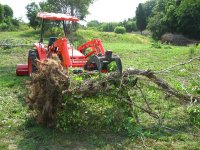
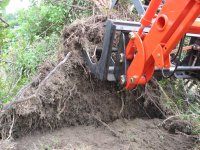
To pull roots out of a food plot I would be inclined to use a boxblade or even a subsoiler rather than a grapple. If the Spruce stumps are relatively few and large than a grapple might be better. I presume the area is clear of obstructions and will be plowed or tilled anyway. It would be a lot faster to use a 3PT implement to dig up the roots. A grapple might be nice to collect the debris but would be relatively slow work for essentially digging through an entire food plot in search of smaller roots. Sometimes you get lucky and when digging out a stump the majority of surface roots come up with the stump but often the process of digging out the main stump severs the smaller surface roots which remain behind. Not an issue if you are just clearing a field but if you are next going to be tilling it will create a challenge for the tiller. I learned that lesson the hard way when preparing a food plot that had been previously overgrown with wild grape vines. Cutting the grapes at the surface was no problem for a bush hog but trying to till the land afterwards (wet spring) was a nightmare as the small roots collected on the tiller and would need to be removed after every 100 yards or so (removal of the twisted roots would take 15-20 minutes with a battery powered sawzall!). I doubt spruce would be that nasty but it does point out that surface roots, not just the main stump roots are an issue that require a strategy when preparing a food plot.

NOTE: I should add that this tilling problem with roots wrapping around the tiller is a problem mostly in the spring when the soil and roots are wet. As the soil is wet the roots get sucked around the tiller and as the roots are wet they wrap rather than break. In the fall or summer when the soil and roots are dry the roots just get chopped up as you till rather than wrapping up on the tiller shaft. While I stated that I'd use a ripper to prepare a bed for tilling, that would be my second choice. First choice would be to till in the late summer or fall when the soil and roots are all dried out.
 

Attachments

  • IMG_0040_small.jpg
    IMG_0040_small.jpg
    529.6 KB · Views: 275
  • IMG_0042_small.jpg
    IMG_0042_small.jpg
    324.1 KB · Views: 247
  • IMG_0043_small.jpg
    IMG_0043_small.jpg
    488.4 KB · Views: 252
Last edited:
   / Root Grapple? #39  
A couple of comments:

One advantage of being able to dig under the roots and then roll back is to take advantage of the "breakout force" in the bigger machines. That typically is greater than just the lifting force on a loader. You also get a "lever effect" when you pry up which helps.

Realize also that most skid steers are built with stronger arms and hydraulics than most compact tractors. Most skid steers and tracked loaders are also more powerful (60 to 100+ hp) and heavier than any compact tractor.

I agree with Island Tractor that, especially for digging out roots, narrow is better than wide.

This has been an interesting and useful discussion.

Ken
 
   / Root Grapple? #40  
i am so close to placing an order with wildkat for the 48" econo, i was given a price of $650 (price less skidsteer ports) but the killer is freight - $400 to bring it to washington state. even at that price i can't find one locally that even comes close but still high. i also priced these with markham (now NAI) and shipping the same, in fact they are located in the same town! why can't there be someone on the left coast that makes these things as inexpensive?


Tractor & Equipment Auctions

2024 CATERPILLAR 255 SKID STEER (A52707)
2024 CATERPILLAR...
SDLD25 MINI DUMPER (A58214)
SDLD25 MINI DUMPER...
1999 WEST WIND 30FT PINDLE FLATBED DOVETAIL TRAILER (A58214)
1999 WEST WIND...
Tafe 45DI (A53317)
Tafe 45DI (A53317)
2017 Genie GTH-5519 (A53317)
2017 Genie...
2009 Mariah SC23 23ft. Cabin Cruiser with T/A Boat Trailer (A59231)
2009 Mariah SC23...
 
Top