Cultipacker design question.

   / Cultipacker design question. #1  

HCJtractor

Veteran Member
Joined
Jan 28, 2009
Messages
1,541
Location
upstate South Carolina, Greenville
Tractor
Kubota M6800, Massey Ferguson 240
I am designing and building a cultipacker using the packer wheels from Everything Attachments. It will be 88" wide using 22 wheels weighing 28 lbs. apiece for a total of 616 lbs. The shaft is cold rolled 2". It will be a lift style with hydraulic wheels to lift the whole assembly up off the ground for ease of transport. My question is whether I should add a center support and bearing to help support the weight when lifted to prevent bending or bowing of the shaft. It would add a gap in coverage, but that's no big deal as far as I can see. I just don't want to damage the shaft when it is bouncing during transporting. Would you add a third bearing or should 2" shaft be rigid enough??
 
   / Cultipacker design question. #2  
I am designing and building a cultipacker using the packer wheels from Everything Attachments. It will be 88" wide using 22 wheels weighing 28 lbs. apiece for a total of 616 lbs. The shaft is cold rolled 2". It will be a lift style with hydraulic wheels to lift the whole assembly up off the ground for ease of transport. My question is whether I should add a center support and bearing to help support the weight when lifted to prevent bending or bowing of the shaft. It would add a gap in coverage, but that's no big deal as far as I can see. I just don't want to damage the shaft when it is bouncing during transporting. Would you add a third bearing or should 2" shaft be rigid enough??

What's the wall thickness on the 2" dia shaft? I'd go 1/4" thick and not worry about bending with only 616 lb. But it's easy enough to added a central support bushing so do that if you're still worried.

Good luck.
 
   / Cultipacker design question. #3  
HCJtractor
I'm assuming the 2" is solid bar ? then with the 3 point in the air and the bar pulled o/c is supporting about 300 lbs on the tips? I think your ok ...say if you added more weight in the future to it.Then do your physics
ak9
 
   / Cultipacker design question. #4  
It would be easier to add the center bearing now than later.
Thats a big span unsupported and will flex quite a bit both transporting and in use.
 
   / Cultipacker design question.
  • Thread Starter
#5  
Yes, the shaft is a solid shaft. I don,t think I have ever seen a packer with a center bearing. Have you guys?
 
   / Cultipacker design question. #6  
I have always assumed that they are designed without a center support because they need to flex a little bit to conform to the ground contour? What do you all think?

Oldstuff
 
   / Cultipacker design question. #7  
If I were building a cultipacker, I would be sure the rollers were cast in the USA. I hear horror stories much too often about imported rollers cracking and busting after a short time. A new Brillion 18 inch USA cast roller should cost around $70 each.
 
   / Cultipacker design question.
  • Thread Starter
#8  
If I were building a cultipacker, I would be sure the rollers were cast in the USA. I hear horror stories much too often about imported rollers cracking and busting after a short time. A new Brillion 18 inch USA cast roller should cost around $70 each.

Herein lies the problem. At $70 each, a seven footer would be over 2 grand just in rollers. That's really not feasible for most of us. Even so, I don't know anyone in this area who could even get the Brillion, although I agree they are the mac-daddy cultipackers. The only other rollers I have seen are those little 9 inches from Agri Supply, and those appear to be the ones most use. These 15" ones from Everything Attachments appear to be pretty solid, but I have no idea where they are made. The only other source is to buy used, and they are very rare around here. I know you sell them and I actually bought a set of crow foot rollers from you last year, and frankly was rather disappointed, so they are still sitting in my shop unused. Because of that experience, I won't buy any more used rollers sight unseen.
 
   / Cultipacker design question. #9  
2" is a big shaft but you are right to question whether you should add a center bearing at 88" long. Quick calcs using a 10G shock load show that you should have no problem with the 2" solid shaft. It still seems like a long span though so I am wondering if my 10 G assumption is good. As for flex in the field under at 1G - don't expect any. If it were me I would still put in the center bearing.
 
   / Cultipacker design question. #10  
I would add the center support. It is easy to do it now while building the cultipacker. You might also want to buy a receiver hitch tube and weld it on the opposite side of the cultipacker. If you deceide later you want to pull the cultipacker rather than lift it with the 3 pt. Then you just slide in a 2x2 sq steel tube to make a trailer tounge and hitch.

something like this:
OMNI 60 Inch Cultipacker - OMNI Mfg LLC
 
   / Cultipacker design question. #11  
I never used a cultipacker, but even if there is a 2 or 3" gap in the center, after going over the same lawn a few times that should make the ridge disappear. I would put a bearing in the center. But that's just me.
 
   / Cultipacker design question. #12  
I have always assumed that they are designed without a center support because they need to flex a little bit to conform to the ground contour? What do you all think?

Oldstuff

The center shaft of a cultipacker is generally smaller in diameter that the holes in the rollers to allow the rollers to adjust to uneven ground contour. That's why some cultipackers make a god-awful loud racket when in use. I wear ear protection when using my 10-footer.
 
   / Cultipacker design question. #13  
2" diameter axle should be ok up to 7-8 ft. . Just be careful if mounted on three point hitch traveling down the bumpy road. That is where you will bend the shaft, not in the field. Ken Sweet
 
   / Cultipacker design question.
  • Thread Starter
#14  
sweettractors said:
2" diameter axle should be ok up to 7-8 ft. . Just be careful if mounted on three point hitch traveling down the bumpy road. That is where you will bend the shaft, not in the field. Ken Sweet

It's going to be a lift type, hydraulically lifted on 15" tires, when transported, if that makes a difference.
 
   / Cultipacker design question. #15  
It's going to be a lift type, hydraulically lifted on 15" tires, when transported, if that makes a difference.

If the packer rollers are off the ground, drive slow on rough terrain. Ken Sweet
 
   / Cultipacker design question.
  • Thread Starter
#16  
Thanks for the advice. I suppose it would be wise to add a center bearing. I am using 4 bolt flange bearings on the ends. I need to search for the narrowest center bearing I can find. I even thought about using a bronze bushing, but dont know much about them.
 
   / Cultipacker design question. #17  
I worked for a golf course and turf equipment manufacturer.

We had equipment at about 1 1/2 tons with a 5 ton pay load that that used a 7'6" axle of 2" diameter.

They key is to use a tougher steel. Not just 1018 cold rolled.
Maybe a little more money at first, but will last a life time.

Good luck
 
   / Cultipacker design question. #18  
My old 10'er had a center bearing. If you look a the old 'bearings' they were essentially 4 or 5" of wood with a hole drilled in it. That wood must have lasted 50 years. Nice long support area compared to the weight borne on the tip of a bearing ball. When I cut it in half and made two food plot 5'ers I made new 'bearings' using pipe and polypropylene w/ a zerk fitting.
 
   / Cultipacker design question. #19  
I made this one 1 3/4 shaft, transport with tractor pull with atv
finishedcultipacker2.jpg
 
   / Cultipacker design question. #20  
I made this one 1 3/4 shaft, transport with tractor pull with atv
finishedcultipacker2.jpg

Hey spo! They say "imitation is the sincerest form of flattery". Thanks for the big helping of flattery with your design. LOL Just having a little fun with ya.
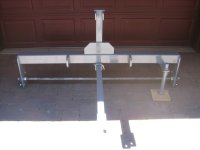
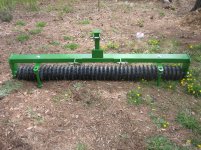
3 Point-Tow Behind Combo 001.jpg963pjd 007.jpg

Rock at OMNI Mfg.

BTW. I have seen comments by Ken at Sweet scaring the bejabbers out of people with the horror stories about imported cultipacker wheels exploding. Man you would think they were surplus claymore mines or something. I have over 300 cultipackers is the field without one failure of wheels or frame. I think we must be beating the odds. Even if one were to fail $13 to replace one wouldn't break the bank.

That brings up another controversial subject. Cultipacker weight some people (ahem) claim you need the antique 18" or 20" wheels to apply proper pressure for food plot seeding.

Here are some excerpts from a Whitetail Institute article that explains it better than I could.

What is a cultipacker? A cultipacker is an implement used to smooth, firm and eliminate cracks from a seedbed that has been disked or tilled. Its main components is a packing-cylinder assembly, which consists of a row of wheel-shaped “packer plates” mounted side-by-side on an axle. The outer edge of each packing plate is peaked, giving the packing cylinder a wavy, or “corrugated” packing surface when the plates are mounted side-by-side on the axle. The peak of each packing plate is either smooth or notched. The packing cylinder is mounted to a frame by bearings, which allow the cultipacker to roll as it is pulled across the ground.

Cultipackers come in a wide variety of lengths, weights, sizes and configurations. The smallest cultipackers have only one packing cylinder, while the largest may have multiple cylinders. Also, some are stand-alone implements, and others are included as cultipacking components of a variety of multi-task implements. (One of the most familiar multi-task implements to most hunters are food-plot planters that have a seeder, disks and harrows with a cultipacker mounted in the back.)

Food-Plot Cultipackers – Optimum Features. In this article, we’ll keep it simple and just talk about stand-alone cultipackers. The most versatile and efficient stand-alone cultipackers for most food plotters will have the following characteristics:
(A) A total length of 3 feet to 12 feet
(B) A single packing cylinder
(C) Packing plates with a diameter of about 8 inches to one foot
For simplicity, I’ll refer to these as “FPCs” (food-plot cultipackers). For comparison, I’ll refer to cultipackers longer than 12 feet, with larger diameter packing plates or both as “LHCs” (large, heavy cultipackers).

What Does a Cultipacker Do?

A cultipacker does quite a few things as it is pulled over soil. The most obvious are that it smoothes and firms soil that has been recently disked or tilled. Others, though, are not as obvious. One less obvious thing a cultipacker does is compact the soil to remove air, which can help reduce evaporation of soil moisture. Another is that the corrugated surface of a cultipacker’s packing cylinder leaves shallow valleys as it moves across the soil.

These functions are what make a cultipacker such a great tool for preparing seedbeds for small seeds. As we look at why, keep in mind that the goal is to make the seedbed optimum for small seeds, and that “optimum” means “just right – no more, and no less.”

“Optimum” Seedbed Firmness. Optimum seedbed firmness means that the seedbed should be firm enough, but not too firm. It should be firm enough for small seeds planted on or near the surface of the soil to stay where you put them and not be driven too deep or washed away by rain. It should not be so firm, though, that the seedlings won’t be able to easily penetrate the soil with their tiny roots once the seeds germinate. If the seedling’s roots can’t penetrate the soil, the roots may grow sideways instead of straight down, potentially reducing seedling survivability and drought tolerance.

“Optimum” Moisture Retention. The seedbed should be firmed enough to remove air from the soil, reducing the rate at which soil moisture evaporates. However, the seedbed should not be so firm that its ability to absorb moisture is reduced.

“Optimum” Moisture Availability to the Seedlings. The corrugated shape of a cultipacker’s packing cylinder leaves little valleys in the soil as the cultipacker moves across the seedbed. There is also an optimum depth for these valleys—they should be deep enough to help channel rainwater to the seeds and reduce evaporation by wind, but not so deep that water stands in them.

As we’ll see, if a seedbed has been properly prepared by disking or tilling, an FPC will leave the soil in optimum condition in all these areas for small seeds.

Why FPCs are so Versatile and Efficient for Food Plots

Versatility: Weight and Size. Lighter weight and smaller size make FPCs much easier to load, unload, store and transport. With regard to transport, some FPCs even come with riding wheels so that the cultipacker can be towed to the seedbed where it will be used.

Efficiency: Weight and Packing Plate Diameter. FPCs are also more efficient at using implement weight to generate pressure against the soil. Here’s how Matt Kunz of Kunz Engineering explains that.

“A common misconception is that how well a cultipacker can do its job depends entirely on how heavy it is. Actually, the important consideration is how much pressure the cultipacker is putting on the soil. That doesn’t just depend on the cultipacker’s weight. It also depends on how big an area of the soil’s surface the cultipacker’s packing plates are in contact with. The smaller the area of surface contact is, the more the cultipacker’s weight is focused onto it. Notched packing plates further concentrate the cultipacker’s weight at the notch points, much like the cleats of a mud tire do on rough ground.”

Obviously that does not mean that a smaller diameter cultipacker is automatically going to firm and smooth the soil better than a heavier cultipacker with larger diameter plates; Matt is not saying that, and neither am I. Instead, we’re just pointing out the efficiency of smaller cultipackers. Everything else being equal, a cultipacker with smaller diameter packing plates will require less weight than a cultipacker with larger diameter packing plates to achieve a similar soil pressure.

Also, realize that the larger a packing plate is, the more highly peaked it will be, and the deeper the valley it will leave in the soil. That’s why LHCs with packing plates larger than one foot in diameter leave deeper valleys than FPCs, everything else being equal.
Remember, our goal is to prepare an optimum seedbed (firm enough but not too firm, etc.) for small seeds. An FPC is the most versatile and efficient tool to do that.

Me again. The antique cultipackers were used for field prep after moldboard plowing and/or discing. Obviously a heavier packer would break down heavy clods of soil more efficiently. However most cultipackers sold today are used for seeding. How much weight do you need to press a rape seed 1/4" into a properly prepared seed bed? Get my point.

To sum it up. The newer generation of less expensive, easier handling and more efficient cultipackers are better suited for the modern sportsman/foodplotter. No worries about wooden bearings and excess weight to transport.

One final thought. If you still think you need additional weight add a suitcase or barbell weight rack that will allow you to add another 300-500lbs
 

Marketplace Items

5' MOWER (A52706)
5' MOWER (A52706)
2021 KOMATSU PC490LCI-11 EXCAVATOR (A60429)
2021 KOMATSU...
2022 Vermeer 573 (A55973)
2022 Vermeer 573...
2017 INTERNATIONAL PROSTAR TANDEM AXLE SLEEPER (A59905)
2017 INTERNATIONAL...
UNUSED RAYTREE RMRB72-72" HYD POWER RAKE BUCKET (A60432)
UNUSED RAYTREE...
2014 Ford F-250 Ext. Cab Service Truck (A59230)
2014 Ford F-250...
 
Top
