Does the weight of the FEL give you more stability??

   / Does the weight of the FEL give you more stability?? #41  
Perhaps a good way to help visualize is what someone mentioned - a three wheeled tractor (two rear wheels that are far apart, one front wheel in the middle.)

Park this three wheeled tractor sideways on a very steep hill. Start adding weights up on the tractor over the back wheels, let's say on the tractor seat, until it starts to tip the tractor. Now remove all the weights.

Take the weights and start adding them above the front center wheel at the same height as the tractor seat. You reach the tipping point with less of the weights - you don't have that wheel sticking way out down hill like you had on the back.

Remove all the weights. Put the loader on and park the three wheeled tractor in the exact same spot, leaving the loader slightly off the ground. Start adding the weights over the front wheel again. You will not have to add as many weights to get to the tipping point this time, due to the loader already adding weight to the front above that wheel.

On our tractors, with the front having two wheels a ways apart just like the back, it is easy to forget that it is still just like a single wheel in the middle. The fronts are on a pivot in the middle - think of the pivot as being that single front wheel. You will tip just as easily on the pivot as on a single wheel all the way up until you hit the pivot stop. Then you have to hope you don't have enough momentum built up or anything else to keep you from going right on over...
 
   / Does the weight of the FEL give you more stability?? #42  
PhilY said:
When you put the FEL on. It is put on equally on both sides of the tractor.

As a point of clarification, FELs with separate pumps often use the loader's riser as the tank. This might be mostly on retrofit or older loaders, but be particularly careful if you have all that fluid up that high, it makes the tractor more tippy.
 
   / Does the weight of the FEL give you more stability?? #43  
OK, last time I'm gonna try to explain why this does not work. With every ounce of my artistic being on display :) It's been 33 years since I took my statics & dynamics class, but I'm pretty confident of my analysis.
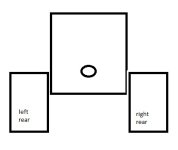
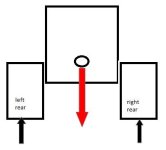
Again, I used the 2 extremes of only back end or only front end to illustrate. Anything else is in between these extremes. My assertion is also that if the FEL is heavy enough to lower the COG to any significance, then it is also heavy enough to cause weight transfer from the back to the front. So, let's get started.

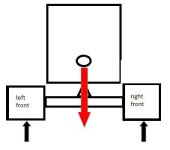
The first 2 pictures are of your tractor on level ground, front and back. This shows your basic wheels, body (rectangles), and most importantly, the front axle pivot (triangle) and COG (oval). All other images are derived from this incredible artwork base.
backbase.jpgfrontbase.jpg

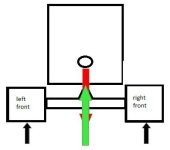
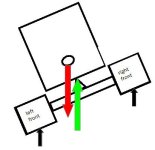
Now, let's look at where the forces are applied. The next 2 pictures show forces from all 4 wheels and how it holds the tractor up. The black arrows represent the ground holding up your tires. The red arrow shows the COG pushing down. The third picture adds a green arrow pushing back up on the red arrow, because that is where the up force is really applied on the front axle (the 2 front blacks combine to form the green). Again, obviously part of the red is on the front and part on the rear, but to prove the physics, I'm dealing in extremes.
backlevel.jpgfrontlevel.jpgfrontlevelapplied.jpg

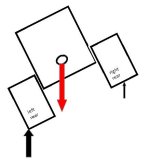
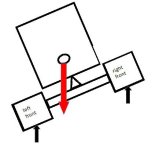
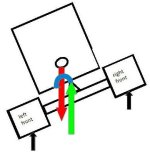
Next, let's tilt the tractor and see what happens to the forces as we do it. Notice that the COG stayed the same from the tractors point of view, but it moved closer (downhill) toward that outside rear wheel tipping point. It is still inside the tipping point though, so stability is maintained. The lifting force on the rear wheels changes and is demonstrated by the different sized black arrows. The upward force on the two front wheels remains reasonably constant, so the black arrows are the same size. BUT adding back in the upward force on the pivot point (green arrow) you can see the beginning of a problem on the front end: the COG is now downhill from the pivot point.
backtilted.jpgfronttilted.jpgfronttiltedreal.jpg

Going the next obvious step, let's look at the rotational force the COG is applying by pushing down where it is located. The nice big yellow arrow shows that the weight of the tractor is going to counteract the hillside and try to hold the tractor down (net effect of the larger black arrow pushing up and the red arrow pushing down). But on the front end, the small blue arrow shows the net effect of the red arrow attacking the green arrow. It enhances the tip caused by the hillside and is applied at a higher point on the tractor.
backexertion.jpgfrontexertion.jpg

So, the question is, do you want your tractor to demonstrate the yellow arrow or the blue arrow? When you mount the FEL, you are voting for a larger blue arrow and a smaller yellow arrow.

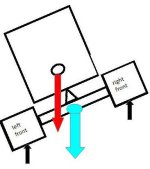
For academic completeness, the only way that adding the FEL can help stability is if it lowers the COG vertically on the tractor's center line to the point shown in this last picture. Once lowered this far, it could actually help stability because it has a (very short) lever arm uphill from the front axle pivot (total horizontal distance from the pivot point to the new COG) as illustrated by the large cyan arrow that would replace the red arrow. And as I stated before, I have yet to see a tractor with a FEL that I believe can lower the COG that far.
frontCOGlowered.jpg

If you still don't see it...well... keep your ROPS up and your seatbelt on! Happy tractoring, Fellas!
 
   / Does the weight of the FEL give you more stability?? #44  
Nice write up and illustrations Ray.:thumbsup:
 
   / Does the weight of the FEL give you more stability?? #45  
Try is both ways and do what works best for you.

I will not mow with my FEL on. I only put the FEL on when I need to use the FEL.

Takes 5 minutes tops to take it off, or put it on. :)
 
   / Does the weight of the FEL give you more stability?? #46  
Nice write up and illustrations Ray.:thumbsup:

Thanks Roger. I won't tell you how long it took me to draw them. :laughing:

And by all means, try what Bluegill2 suggests. Just remember, when you find out (and at least 2 of us on this thread have), now you'll know why.
 
   / Does the weight of the FEL give you more stability?? #47  
Nice diagrams!:D

Doesn't the FEL configuration add just a few more force vectors to the configuration?

And there is always the option of dropping the FEL when a situation arises.:)
 
   / Does the weight of the FEL give you more stability?? #48  
Nice diagrams!:D

Doesn't the FEL configuration add just a few more force vectors to the configuration?

And there is always the option of dropping the FEL when a situation arises.:)

Nope. As I noted before, the only thing the FEL does is make the yellow arrow smaller and the blue arrow bigger. It transfers the weight from the back to the front. Since it is not in contact with the ground, there are no vectors at all beyond the ones I illustrated. With the noted exception of the oil tank in the uprights, but that is probably not going to be dropped off the tractor with the rest of the FEL. So it shifts the COG to one side a little bit at the outset.

And yes, you can drop the FEL if you get in trouble. But what does that do? It shifts the weight off the rocking front end. It is arguable that it now provides a second (almost identical) lower side pivot point. So what? How did you get into trouble in the first place? Your choice in this situation is to drive with the FEL dragging on the ground and the front wheels in the air or lift the FEL back up and put yourself back into the situation for which you lowered it. Better to not have it at all rather than try to ride the razor's edge.
 
   / Does the weight of the FEL give you more stability?? #49  
And yes, you can drop the FEL if you get in trouble. But what does that do? It shifts the weight off the rocking front end. It is arguable that it now provides a second (almost identical) lower side pivot point. So what? How did you get into trouble in the first place? Your choice in this situation is to drive with the FEL dragging on the ground and the front wheels in the air or lift the FEL back up and put yourself back into the situation for which you lowered it. Better to not have it at all rather than try to ride the razor's edge.

Exactly. I was thinking along this same line. If you have to use the FEL to stop a roll, that is very good, but what are you going to do next? You're going to have to winch the tractor or something to get it out of the situation you got into in the first place! Maybe you could drive with it dragging in float mode? Eh. Seems pretty precarious. Better to just be more stable from the start.
 
   / Does the weight of the FEL give you more stability?? #50  
And yes, you can drop the FEL if you get in trouble. But what does that do? It shifts the weight off the rocking front end. It is arguable that it now provides a second (almost identical) lower side pivot point. So what? How did you get into trouble in the first place? Your choice in this situation is to drive with the FEL dragging on the ground and the front wheels in the air or lift the FEL back up and put yourself back into the situation for which you lowered it. Better to not have it at all rather than try to ride the razor's edge.

With a front end that pivots the tractor has three points of contact, each rear tire and the pivot, a triangle contact patch. The black arrows on the front mean nothing until you reach the pivot stop, by then it could be too late. When you drop the loader you eliminate the pivot and now have a square. That moves the side to side COG from the outside of the pivot point to the inside of the outer edge of the bucket. What you have done is make the front diagram look identical to the rear diagram.

All it takes is your dog deciding to dig a hole in the grass your mowing and have your back tire drop into it to find out that you are now going to roll (fel or not). Last week it felt fine and this week you are in real trouble. If you left the fel back at the house then you have nothing you can do to stop the tractor from going over. Besides if it's that tippy with the fel on then you should look at alternatives. I'll opt to play it safe.
 
   / Does the weight of the FEL give you more stability?? #51  
Exactly. I was thinking along this same line. If you have to use the FEL to stop a roll, that is very good, but what are you going to do next? You're going to have to winch the tractor or something to get it out of the situation you got into in the first place! Maybe you could drive with it dragging in float mode? Eh. Seems pretty precarious. Better to just be more stable from the start.

Hey Joshua, You can take some credit for this, you know. This is all just an extension of your excellent explanation of ballast.

An additional thought on this: It doesn't work very well to drag bucket on a sidehill. It tends to want to dive downhill. But having it on the ground will tend to make the tippy forces 100% on the lower wheel outside edge (and it's direct mirror, the outside edge of the bucket). So you can get to the ideal after all. :)
 
   / Does the weight of the FEL give you more stability?? #52  
When I do heavy pulling with my tractor I add weight to the bucket and keep the bucket low in order to maintain front wheel traction. Do I lose side to side stability? Probably, but I am careful never to get into a position where that is important. Still the fact is that I know of several neighbors who have rolled their older loader equipped tractors on fairly level ground and none of them had the loader raised high at the time of roll-over. They had low rear end ballast and ran into a dynamic condition that flipped them - rock, rut, mud. When doing something like moving our 1200 - 1500 pound round bales, the front bale is picked up last and dropped off first. I need that bale on the back to give the rears all the load and stability possible before thinking of messing with the loader. And with a soft bale on the back you do less damage to your pickup when you hit it than you do when you hit it with a box blade.
 
   / Does the weight of the FEL give you more stability?? #53  
With a front end that pivots the tractor has three points of contact, each rear tire and the pivot, a triangle contact patch. The black arrows on the front mean nothing until you reach the pivot stop, by then it could be too late. When you drop the loader you eliminate the pivot and now have a square. That moves the side to side COG from the outside of the pivot point to the inside of the outer edge of the bucket. What you have done is make the front diagram look identical to the rear diagram.

Yes, that is exactly right. Only now, while you have stopped the roll, you have your self statically positioned between a rock (driving downhill on the bucket) and a hard place (lifting the FEL to go back to the trouble).

The FEL does not add 0.000001% to the stability until it is planted on the ground and the front wheels are in the air. But until it is on the ground, it is 200% working against you (it's weight plus what it transferred from the rear end). That 200% is enough to remove a lot of pucker.

I've demonstrated this to myself by actually getting off my tractor on the hillside and being able to lift the uphill wheel w/ the FEL and not being able to lift it w/o the FEL, despite adding ballast within about 25 lbs of the weight of the FEL. It's only a BX, so it is easy to do this by hand. But the angles and effects are the same no matter how big the tractor is. Width, height, and weight only change the timing of the tipping effect, not how it works.
 
   / Does the weight of the FEL give you more stability?? #54  
Yes, that is exactly right. Only now, while you have stopped the roll, you have your self statically positioned between a rock (driving downhill on the bucket) and a hard place (lifting the FEL to go back to the trouble).

The FEL does not add 0.000001% to the stability until it is planted on the ground and the front wheels are in the air. But until it is on the ground, it is 200% working against you (it's weight plus what it transferred from the rear end). That 200% is enough to remove a lot of pucker.

I've demonstrated this to myself by actually getting off my tractor on the hillside and being able to lift the uphill wheel w/ the FEL and not being able to lift it w/o the FEL, despite adding ballast within about 25 lbs of the weight of the FEL. It's only a BX, so it is easy to do this by hand. But the angles and effects are the same no matter how big the tractor is. Width, height, and weight only change the timing of the tipping effect, not how it works.

I would rather be stuck in a hard place and still have the tractor on all four tires than test the ROPS. Plus, like you said, when you drop the bucket the front will want to slide down the hill, that's most likely a good thing. I would even use the rear brake to encourage it unless there's a reason why I can't drive down the hill.
 
   / Does the weight of the FEL give you more stability?? #55  
I would rather be stuck in a hard place and still have the tractor on all four tires than test the ROPS. Plus, like you said, when you drop the bucket the front will want to slide down the hill, that's most likely a good thing. I would even use the rear brake to encourage it unless there's a reason why I can't drive down the hill.

I won't disagree with anything there (except it isn't on 4 wheels. It is on 2 wheels and a steel plate!). But, getting back to the OP's question, is it more stable with the FEL or less?

The answer is it is less stable. And while you have put yourself in a more precarious position by having the FEL attached, you also are making the assumption that you will hit the FEL stick fast enough to prevent the roll. I know, we ride with our hand on the stick and go slow. But if you didn't have the FEL at all, you may not tip either.
 
   / Does the weight of the FEL give you more stability?? #56  
you also are making the assumption that you will hit the FEL stick fast enough to prevent the roll.

YES! And how many times have you heard somebody say how fast rollovers happen? "One second I was driving, and then I was upside down!"
 
   / Does the weight of the FEL give you more stability?? #57  
But, getting back to the OP's question, is it more stable with the FEL or less?

I dont really think anyone is disagreeing that it is less stable w/the FEL. But also keep in mind that it is less stable SIDEWAYS. The OP never specified.

Stability going UP a hill is FAR better with FEL ON. Stability going down is better with it OFF, BUT (and a big but) I leave it on going down. There has been more than once in slick/icy or muddy conditions with 4 tires sliding and the FEL is the only thing that stopped me.
 
   / Does the weight of the FEL give you more stability?? #58  
LD1 said:
I dont really think anyone is disagreeing that it is less stable w/the FEL. But also keep in mind that it is less stable SIDEWAYS. The OP never specified.

Stability going UP a hill is FAR better with FEL ON. Stability going down is better with it OFF, BUT (and a big but) I leave it on going down. There has been more than once in slick/icy or muddy conditions with 4 tires sliding and the FEL is the only thing that stopped me.

Oh absolutely! That big ol' emergency brake on the front is nice to have and I've used it myself more than once. But would the rear wheels have broken loose if it wasn't for the FEL in the first place? On a downhill slope, you've transferred more than 200% of the loader's weight to the front wheels. They have a smaller contact patch and now WAY more weight than they would have had w/o the FEL. I don't know what the weight transfer is w/o the FEL to just go downhill, but if my BX is any indication, the FEL weighs 400 lbs and so it will transfer over 800 lbs to the front end. On a base tractor weight of 1200, that's a LOT!

On my hill, I'll go into a free fall w/ the FEL on and only rear wheel drive. I can go down the same hill and not break loose w/o the FEL (or ballast). My hill is pretty safe place to do so, nothing at the bottom, it just levels out to meadow.

It would be interesting to do some controlled experiments on slopes w/ and w/o FEL. Use the same tractor and observe when / how it breaks loose under both configurations and in various conditions like dry dirt, grass, mud, ice and do it on varying degrees of slope.
 
   / Does the weight of the FEL give you more stability?? #59  
When sliding down an icy driveway on rubber tires, I dont think an extra 10000lbs on the rears would stop it. Kinda get into a situation where added weight would help traction...sure....but also added weight to help pull you down the hill.

And in 4wd, and braking, its not like the weight taken off the rears is totally lost. You loose some tractive braking it the rear but gain some up front.
 
   / Does the weight of the FEL give you more stability?? #60  
You dont account for the reduced proportion of the composite tractor/implement weight that rests on the rears. COG height may be slightly lower but is shifted much more forward. ... Also, yes the front pivot divides weight equally between the 2 fronts -- BUT only on level ground. On a slope a vertical line to the ground from the pivot shows the actual division point. Thus a lower front pivot would cause more equal sharing on a slope.
larry

In regards to an axle on a pivot, the two tires on it cannot be experiencing different forces unless it has hit a pivot stop.

Incorrect for the reason stated in post 24. Weight acts straight down - not straight toward the ground.
larry

I'm sorry guys but it looks like I can't convince you that the front tires do have equal force on them. Just put it to practice to verify what I have said. If the front axle can pivot while you are driving on a sidehill, then they are both experiencing equal forces. If it can pivot, the force must be "equal and opposite" on both wheels. In regards to stability, I also stand by claim that if the weight from the FEL COG is below the tractor's COG, then it can only help side roll. In regards to the rear sliding out. Depending on the weight of the FEL compared to your tractor the lightening of the rear end may have more of an affect for some then others, but I have not said that the rear end would not be lightened. Good luck!
Note that Rays post 43 shows pictorily why the center pivot does not divide wheel load evenly on a slope.
Thanks Ray. :star:
larry
 

Marketplace Items

2014 JOHN DEERE 35G EXCAVATOR (A60429)
2014 JOHN DEERE...
25 DUAL AXLE GOOSENECK TRAILER (A58214)
25 DUAL AXLE...
2018 Kia Soul SUV (A59231)
2018 Kia Soul SUV...
2020 DY TP90 TRAILER MOUNTER CONCRETE PUMP (A59905)
2020 DY TP90...
FORD 8770 TRACTOR (A60430)
FORD 8770 TRACTOR...
2024 CATERPILLAR D5 LGP HIGH TRACK CRAWLER DOZER (A60429)
2024 CATERPILLAR...
 
Top