New Home Begins

   / New Home Begins
  • Thread Starter
#221  
For the foundation drain pipe, did you orient the holes on the top of the drain pipe or the bottom? The holes need to be on the bottom. Otherwise no water will get into the pipes until the trench has 4 inches of water in it. That's a point that is not intuitive and a lot of people, even the pros, get wrong.

Obed

The stuff used around here is perforated all the way around, every 1.5" or so along the length. No need to worry about proper orientation.
 
   / New Home Begins #222  
For shallow trenches, I just use a handful of gravel to act as a paper weight to hold the fabric where I need it. Doesn't take but a few places to hold up the fabric, and there is always gravel right there...
 
   / New Home Begins
  • Thread Starter
#223  
Sill and french drain inspections tomorrow.

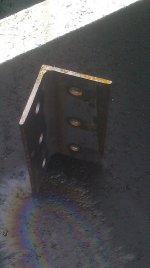
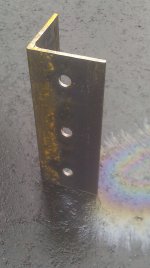
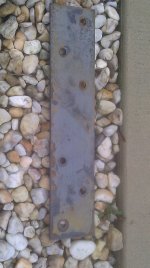
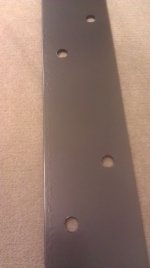
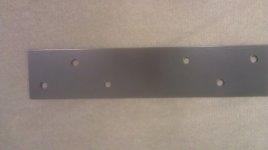
Got the collar ties and ridge plates back from being powder coated. Collar ties are 5" x 24" x 1/4" and the ridge plates are 4" x 4" x 10" x 1/4" angle. There are 20 of each and it only cost $185 to have them sandblasted, primed and powder coated. Sweet. :cool:

Before:

IMAG0616.jpg IMAG0617.jpg IMAG0618.jpg

After:

powder coated plates1.jpg powder coated plates2.jpg
 
   / New Home Begins #224  
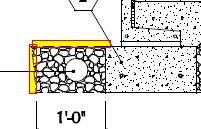
I'm interested in following your drain system but I'm confused about the placement of the filter fabric. Would it be like an upside down "L" on top of the pics that you posted?
 
   / New Home Begins
  • Thread Starter
#225  
I'm interested in following your drain system but I'm confused about the placement of the filter fabric. Would it be like an upside down "L" on top of the pics that you posted?

That is exactly the way it is. Here is a pic showing the placement. The upside down "L" as you say keeps the dirt from washing in from the sides and top.

franch drain detail.jpg
 
   / New Home Begins
  • Thread Starter
#226  
It appears to be Catch 22 Tuesday. Concrete guys and basement wall guys prefer (as in not a requirement, but a "best practice") to have the subfloor on first. Then after the floor is on, to come and do the basement slab. However; about 1/2 of the great room floor joists need to be supported by the load bearing stairwell wall which also carries a small beam. The subfloor needs the wall. The wall needs the hunch footing under it. To top that off, the columns need to be embedded in the concrete. So we will have to box/bucket the columns during the slab pour and pour them later around the columns.

So, now I am trying to change the schedule and have the floor done first and have the framers come back after that.
 
   / New Home Begins
  • Thread Starter
#227  
Small rant ... The french drain inspection was scheduled for today between 7:30 and 9:30. I get to the property at 7:10 and see a bright orange failed sticker. He came early. With the rain, I purposefully left the entire trench covered and was planning on exposing the Tees this morning before he got there. So much for a plan.

I exposed them and he will come back tomorrow.


:mur:
 
   / New Home Begins
  • Thread Starter
#228  
Catch 22 may be over. The framer was able to set the beams today with temporary support under them. Concrete guy will prep for basement Thursday afternoon for a slab inspection Friday. More good news. The columns may be in Thursday as well. In that case, they will be in before concrete and no box/bucket around them ... they will be done in one pour.

Keeping fingers crossed.
 
   / New Home Begins #229  
That is exactly the way it is. Here is a pic showing the placement. The upside down "L" as you say keeps the dirt from washing in from the sides and top.

View attachment 293404

I'm somewhat surprised your architect's detail doesn't have the filter fabric going partially up the foundation wall forming a "Z" shape. A treasure trove of architectural details can be found in a book commonly known as the Ramsey-Sleeper book; though I believe it has a different title now since Ramsay and Sleeper are long dead. I believe the book is published by the AIA (American Institute of Architects). A public library with a decent reference department should have a copy of it.
 
   / New Home Begins
  • Thread Starter
#230  
I'm somewhat surprised your architect's detail doesn't have the filter fabric going partially up the foundation wall forming a "Z" shape. A treasure trove of architectural details can be found in a book commonly known as the Ramsey-Sleeper book; though I believe it has a different title now since Ramsay and Sleeper are long dead. I believe the book is published by the AIA (American Institute of Architects). A public library with a decent reference department should have a copy of it.

Good idea. I have extra fabric and can tuck another layer under this one on top and run it up the wall some.
 
   / New Home Begins
  • Thread Starter
#231  
Drains were approved as expected. The concrete guys are on board with doing the floor first. Early tomorrow is the inspection to see the visqueen is in place and the 6x6 wire mesh is down. They expect to pour on the 26th. Columns will be in place in time to eliminate the need to box around them.

Well, this switch does not change things too much.
 
   / New Home Begins #232  
Not sure about your area but where I am from Radon gas is very prevalent. Reason I say this is because a passive system utilizes the rock located below the basement floor and is vented out the top of the house. Probably not an issue in your area but around here it is a major problem.
 
   / New Home Begins #233  
Drains were approved as expected. The concrete guys are on board with doing the floor first. Early tomorrow is the inspection to see the visqueen is in place and the 6x6 wire mesh is down. They expect to pour on the 26th. Columns will be in place in time to eliminate the need to box around them.

Well, this switch does not change things too much.

Are you useing the wire instead of rebar? Do you have it placed on chairs to keep it at the proper height during the pour?

I hate wire mesh with a passion. If done properly, it is better then rebar. What happens is that the guys spreading the concrete walk on the wire and force it to the bottom. They they pretend to pull it up as they go. There are even special tools to do this. Unfortunately, this is all for looks and the wire stays at the bottom of the pad because they just keep walking on it and forcing it down.

When the wire is in the middle of the pad, it is extremely effective. When it is at the bottom of the pad, it is useless.

In some extreme jobs, and those who really want it to be the very best, they will lay wire over rebar and tie them together. Wire is also fine for walkways and small jobs where you don't have to walk on it to spread, scree and float the concrete.

If it was my place and they had just put down wire, I would cancel the job until rebar was used. Nothing is as permanent as concrete. Take the time do do it right.

Eddie
 
   / New Home Begins #234  
4" of concrete is not thick enough for rebar to do any good. As far as wire or rebar, both provide additional strength only after a crack has formed. Personally, I would add poly-fiber mesh in the concrete mix. Everyone is entitled to their own beliefs but I would much rather have 4" concrete, un-reinforced, with sawed joints every 8' both directions then adding wire or rebar. All concrete will crack and if you give it a straight line to crack in, little future damage will occur. If you do not provide a weakened path (sawing) you will get random cracking and the possibility for future problems. Attack away (not you Eddie)!
 
   / New Home Begins
  • Thread Starter
#235  
Eddie, Rebar is not used around here for flat work. I do understand the uselessness of the wire if it is stepped on and left at the bottom of the pour.

Sdkubota, I will have to check, but I believe that the concrete guy is using fibermesh in addition to the wire. I will have to check.

Sorry for the short replies, but it is late and will be able to add more later. Here is a little taste of what I dealt with today. The local weather people did not predict HOW MUCH rain were to get last night. We had 6" of water inside and out.

.

Lets see - pump output is 150 gpm. 60 minutes in an hour, 4.5 hours to pump it dry = 40,500 gallons of water remioved
 
   / New Home Begins #236  
That sucks on the water. I sure hope that foam insulation is closed cell.

As for concrete reinforcing. I just toured a neighbor's house that has major damage in the floor from soil movement. The fiberglass didn't do diddly squat to minimize the damage. Granted, in my neighbor's case, the idiot builder didn't compact and prepare the soil beneath the basement floor properly, which added to the problem. I'd much rather have rebar any day with saw cut control joints.
 
   / New Home Begins #237  
Nothing will help concrete placed on a poorly prepared base. Fibermesh works to help stop crack while they are microscopic. In addition and more than anything it provides flexural strendth for concrete increasing its ability to slightly flex. If you have expansive soils, there is nothing that can be done short of installing a structural slab with a void placed below it.

The bright side of all the rain you received is moisture won't be sucked out of the bottom of the slab during placement. You need to also make sure the contractor doesn' add a lot of water while placing. Water = weakened concrete. There are chemicals (Plasticizers) that can be used to lower the slump without compromizing the strength.
 
   / New Home Begins #238  
I'm not a fan of fibers added to concrete. They do add some strength to the mix, but it's minimal and not code anywhere to replace rebar. Depending on what is used, some will stick out of the concrete when it's cured, which can be a pain to deal with. I understand that it's a cheap and easy thing to add to your concrete and it doesn't do any harm, but I would never rely on it to replace rebar.

As for not using rebar on flat work where you live, I would serious look into that and question your source. Since you are getting your home inspected and building to local code, you might be right. Or it might be that they just don't put any emphasis on flat work since it's not structural in your case and anything goes. In most areas of the country, rebar is required, along with size and spacing of it to pass your inspection.

It's your house and you only get one chance to build it as good as you can. Not using rebar and setting it on chairs is one of those things that I've seen done before and will never understand the benifit of saving a few hundred bucks when hundreds of thousands.

Eddie
 
   / New Home Begins #239  
As for not using rebar on flat work where you live, I would serious look into that and question your source. Since you are getting your home inspected and building to local code, you might be right. Or it might be that they just don't put any emphasis on flat work since it's not structural in your case and anything goes. In most areas of the country, rebar is required, along with size and spacing of it to pass your inspection.

Eddie

I've never heard of rebar being required around here. Wire mesh is the only thing I ever see used in residential. I like rebar too, somewhat for other reasons, but it is rare to see it used in slabs.
 
   / New Home Begins #240  
The minimum concerte cover for rebar is 3". That is to protect it from salt, water, etc. Also, the only time rebar does any good for structural strength is when it is placed in the bottom of the concrete slab as steel has great tensile strength where concrete has viturally none. Rebar only begins to take a load wonce the concrete actually cracks. In school we tested concrete beams 6"x6"x24" for flexural strength. Without fiber mesh they would break within a few cycles...with it they could continually take flexural forces indefinately. If you have a good base you will probably not have flexural forces. The number one problem with concrete failing is excessive water added on site...hands down. Concrete strength is solely dependent on the water to cement ratio.
 

Tractor & Equipment Auctions

207275 (A52708)
207275 (A52708)
2025 CFG Industrial QK18R Mini Excavator (A59228)
2025 CFG...
2003 FORD F150 HARLEY DAVIDSON TRUCK (A59575)
2003 FORD F150...
2018 Chevrolet Impala Premier Sedan (A59231)
2018 Chevrolet...
John Deere 5055E (A53317)
John Deere 5055E...
2014 Nissan Rgue SUV (A59231)
2014 Nissan Rgue...
 
Top