Grounding Rod For Portable Generators Necessary?

   / Grounding Rod For Portable Generators Necessary? #101  
1.The conductor is larger because the wire is sized according to the size of the service. If a fault would occur, the conductor needs to be sized for the maximum fault current. Yes the code says to size the grounding electrode conductor (to the ground rod) based on the size of the service (conductors). My question is: why? Fault current doesn't flow through the ground rod on it's way back to the neutral of the transformer, unless you are relying on the earth as a ground path, instead of your (green) equipment grounding conductor (EGC) Normally all fault current should travel back to the transformer neutral on the EGC, not through the earth, ground rod or the grounding electrode conductor attached to it .
2. The code never says not to trust the earth as a ground path conductor. NEC 250.4:"The earth shall not be considered as an effective fault-current path" "
If you drive a ground rod, you should always check that it has a reference to ground. Ou also need a second ground, ie.. Cold water pipe.
3. The fault current needs to go back to the grounded conductor. Remember it's a system. The grounded conductor is the return path for current. -To the neutral of the source (transformer or genny) The grounding electrode is strictly for fault current. It's a safety wire.

The only thing I can conclude is you have to vary the grounding electrode conductor size to the ground rod in case the earth does become the path back to the transformer's neutral, despite NEC 250.4 saying not to consider it an effective path it.
 
   / Grounding Rod For Portable Generators Necessary? #102  
The explanation that I have seen in the past was that the larger the service, the larger the amount of energy (transient voltage) that can come down the line in the case of a lightning strike on the power infrastructure, or the power company sending huge voltage spikes down the wire. Therefore the more ground protection needed to shunt off to whatever degree that it can, any transient voltage on neutral to the ground.
 
   / Grounding Rod For Portable Generators Necessary? #103  
The only thing I can conclude is you have to vary the grounding electrode conductor size to the ground rod in case the earth does become the path back to the transformer's neutral, despite NEC 250.4 saying not to consider it an effective path it.

You answered your own question. If you lose the neutral, 1. Your electrical system becomes a series circuit. 2. The grounding electrode system picks up where your neutral failed and clears the fault current.
 
   / Grounding Rod For Portable Generators Necessary? #104  
You answered your own question. If you lose the neutral, 1. Your electrical system becomes a series circuit. 2. The grounding electrode system picks up where your neutral failed and clears the fault current.

That's not right, at all.
A grounding electrode does not specifically "clear fault current" during a failed neutral conductor failure.
That's not the purpose, or the reality, of a ground electrode.
 
   / Grounding Rod For Portable Generators Necessary? #105  
That's not right, at all. A grounding electrode does not specifically "clear fault current" during a failed neutral conductor failure. That's not the purpose, or the reality, of a ground electrode.
Then what is in your opinion???
 
   / Grounding Rod For Portable Generators Necessary? #106  
opinion?? I didn't think when it came to electrical laws, there was an opinion:;)
 
   / Grounding Rod For Portable Generators Necessary? #108  
Fault currents, ground faults that is, are cleared by virtue of the bond between the neutral and the grounding system. The earth is not a good enough conductor to be of any use in this area. That is why all grounding systems need to be bonded together, then bonded back to the neutral.
The grounding electrode system is to disapate and equalize the various differences in potential that occur between different points of the earth, sky, buildings, water, whatever. The guys that say they are for lightening disapation, or electro static discharge are pretty much right, but it's not the whole story....close enough though.
 
   / Grounding Rod For Portable Generators Necessary? #109  
Fault currents, ground faults that is, are cleared by virtue of the bond between the neutral and the grounding system. The earth is not a good enough conductor to be of any use in this area. That is why all grounding systems need to be bonded together, then bonded back to the neutral.
The grounding electrode system is to disapate and equalize the various differences in potential that occur between different points of the earth, sky, buildings, water, whatever. The guys that say they are for lightening disapation, or electro static discharge are pretty much right, but it's not the whole story....close enough though.
Exactly right!
...so why does the grounding electrode conductor connecting the neutral to the grounding electrode system of a 400 amp service have to be a different size than a 100 amp service? (i.e. is there any logical reason?)
 
   / Grounding Rod For Portable Generators Necessary? #110  
This is my last post on this subject. There is accurate info here and some obviously erroneous. A lot of stabbing in the dark. Some of the info can get you killed. This subject is too technical for the handyman to consider themselves an expert. That is why electrician get paid the big bucks and inspectors are "supposed" to keep system safe before energized.

Go to the library and get Soares Book on Grounding and Bonding. It is one of the texts used in apprentice training for electricians, power linemen, and is supposed to be the grounding bible for electrical inspectors. Amazon has it for $50.00. Read it then, make an informed decision and establish a position on this subject. Goodbye.

Ron
 
   / Grounding Rod For Portable Generators Necessary? #111  
Exactly right!
...so why does the grounding electrode conductor connecting the neutral to the grounding electrode system of a 400 amp service have to be a different size than a 100 amp service? (i.e. is there any logical reason?)

Ground faults can occur anywhere in the system, so the grounding electrode conductor has to be sized to carry the fault current back to the main bonding jumper wherever the fault occurs so the overcurrent device will trip.
You will find that the code does not require a grounding electrode conductor larger than 6AWG to ever be connected to a ground rod, regardless of the size of service. This is because it is understood that the #6 wire will be able to carry all the current that a ground rod is capable of disapating. This only applies to driven electrodes, not the Ufer ground, or the water main, etc.
The SOARS book on grounding is considered the authority on grounding.
 
   / Grounding Rod For Portable Generators Necessary? #112  
Ground faults can occur anywhere in the system, so the grounding electrode conductor has to be sized to carry the fault current back to the main bonding jumper wherever the fault occurs so the overcurrent device will trip. You mean the equipment grounding conductor (EGC) (i.e. the green wire) you run with the circuit has to be sized to carry the fault current back to the main bonding jumper (usually at the service panel)
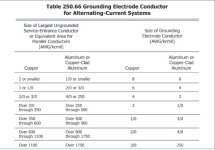
You will find that the code does not require a grounding electrode conductor (GEC) larger than 6AWG to ever be connected to a ground rod, regardless of the size of service. Maybe not to a single round rod, but from the bonded neutral/ground bus to the ground electrode system it's sized based on NEC table 250.66 This is because it is understood that the #6 wire will be able to carry all the current that a ground rod is capable of disapating. This only applies to driven electrodes, not the Ufer ground, or the water main, etc.
The SOARS book on grounding is considered the authority on grounding.
06cfitgerald_tb1_894040155.jpg

IMO, this is no logical reason, or I haven't figured it out anyways. Other than if you have a fault, AND your EGC (green wire) is compromised, so you are now relying on earth (or perhaps a better electrode system (e.g. building steel, ground ring, etc..)) as your fault path. It's a bit counter-intuitive, but the fault current would be flowing from the "ground" to the panel (panel's neutral). Whereas I think most people envision current flowing to ground.
 
Last edited:
   / Grounding Rod For Portable Generators Necessary? #113  
View attachment 364774

IMO, this is no logical reason, or I haven't figured it out anyways. Other than if you have a fault, AND your EGC (green wire) is compromised, so you are now relying on earth (or perhaps a better electrode system (e.g. building steel, ground ring, etc..)) as your fault path. It's a bit counter-intuitive, but the fault current would be flowing from the "ground" to the panel (panel's neutral). Whereas I think most people envision current flowing to ground.

All the building steel, piping systems, and other grounding systems are bonded together to the grounding electrode conductor. The grounding electrode conductor sees fault current all of the time. Imagine a conductor faulting to an interior water pipe...the fault current would travel back to the main bonding jumper, then to the neutral via the grounding electrode conductor.
If YOU were to write the code, how would you size the grounding elctrode conductor?
 
   / Grounding Rod For Portable Generators Necessary? #115  
You answered your own question. If you lose the neutral, 1. Your electrical system becomes a series circuit. 2. The grounding electrode system picks up where your neutral failed and clears the fault current.

That's not right, at all.
A grounding electrode does not specifically "clear fault current" during a failed neutral conductor failure.
That's not the purpose, or the reality, of a ground electrode.

If your saying I'm wrong, then post the right answer

I don't like typing a lot, The way you worded your impression of a ground system makes it hard for me to correct what you wrote without a lot of typing. I'll try to use examples to make it easier for both of us.

Ground circuits don't "clears the fault current". Thats kind of circular logic. If there's current on a ground wire, then you are having a fault.
Ground wires don't "picks up" where a neutral failed. That would require a parallel circuit and would result in current on the ground circuit all the time= wrong.
Example: Go disconnect the white wire from a house circuit ( failed neutral )- anywhere in the house, even the pole feed. Does the ground keep the current flowing?
Example: with neutral wire cut doesn't the device stop operating? What current would you be "clearing"?
 
   / Grounding Rod For Portable Generators Necessary? #116  
Ground circuits don't "clears the fault current".

Kinda.

Ground rods do not, where this discussion began.

"Ground circuits" is not really a standardized term, but the EGC (bottom/green/ground wire on a 3-wire outlet) IS for clearing fault current. If an internal short should energize a metal appliance case, power tool case that's steel (no longer in use really), etc... the ground wire (EGC) provides a path back to the point where the ground and neutral busses are bonded. This creates a short and should cause the breaker to blow.

Despite being connected, current does not flow through the ground rod of course, but gets back to the neutral as fast as it can - via the neutral/ground bonding between the two bus strips or wherever it is connected. (Sometimes it's in the meter can)
 
   / Grounding Rod For Portable Generators Necessary? #117  
Kinda.

Ground rods do not, where this discussion began.

"Ground circuits" is not really a standardized term, but the EGC (bottom/green/ground wire on a 3-wire outlet) IS for clearing fault current. If an internal short should energize a metal appliance case, power tool case that's steel (no longer in use really), etc... the ground wire (EGC) provides a path back to the point where the ground and neutral busses are bonded. This creates a short and should cause the breaker to blow.

Despite being connected, current does not flow through the ground rod of course, but gets back to the neutral as fast as it can - via the neutral/ground bonding between the two bus strips or wherever it is connected. (Sometimes it's in the meter can)

Give me a break. If your gonna try to get some satisfaction trying to debate 1 tiny fact out of my entire post, at least have the facts to back it up. Using an example "no longer in use" is a piss poor example.
 
   / Grounding Rod For Portable Generators Necessary? #118  
Give me a break. If your gonna try to get some satisfaction trying to debate 1 tiny fact out of my entire post, at least have the facts to back it up. Using an example "no longer in use" is a piss poor example.

Wow, relax. I was clarifying for people who didn't know the difference. I actually thought you did when I wrote that, I guess not. :) No satisfaction whatsoever and it wasn't my intention to debate, simply clarify the difference between the ground rods (which do not clear faults) and EGCs (grounds) (which do, and is their "primary" purposes)

I'm not sure what you mean "no longer in use", my other examples like metal appliance cases/frames clearly are. It's just not frequent you see a metal-cased drill or hand tool anymore. Stoves, dish washers, refrigerators, etc. all still do, metal surface-mount EMT receptacles, etc

The EGCs DO clear shorts/faults. The ground rods DO NOT. They are both connected together, as is the neutral.
 
   / Grounding Rod For Portable Generators Necessary? #119  
It's amazing how much of a passion people at TBN have for grounding... wow! :)
 
   / Grounding Rod For Portable Generators Necessary? #120  
Give me a break. If your gonna try to get some satisfaction trying to debate 1 tiny fact out of my entire post, at least have the facts to back it up. Using an example "no longer in use" is a piss poor example.

Dark, please read all the posts from beginning to end to understand the whole conversation. Your not an electrician, there's more theory than you understand. I believe soares grounding reference (the grounding bible) is a good reference to use regarding this matter. This comments I made were regarding a single phase 240v service.
 

Tractor & Equipment Auctions

GEARMATIC WINCH (A58214)
GEARMATIC WINCH...
Lone Star dump trailer (A55973)
Lone Star dump...
(APPROX. 20) 4' X 8' X 3/8" SHEETING (A52706)
(APPROX. 20) 4' X...
CAT 289D3 (A58214)
CAT 289D3 (A58214)
1979 Ford F-100 Ranger Pickup Truck (A59230)
1979 Ford F-100...
TANK MANIFOLD (A55745)
 
Top