16' opening Door header: on load bearing wall

   / 16' opening Door header: on load bearing wall #1  

LD1

Epic Contributor
Joined
Apr 30, 2008
Messages
22,822
Location
Central Ohio
Tractor
Kubota MX5100
I think I forewarned everyone that I would be asking lots of questions about my upcoming bard build.:laughing: This is just another...


I know we touched on this topic in one of the other threads, but would like to focus on JUST the header.

The building is going to be a 40x72 with 16' doors on the eave (load bearing) sides. With 8' OC posts, over the door will be omitting one post. So a 16' span, with a truss smack dab in the middle. All of the span tables and calculators I have came across all deal with distributed loads, and NOT point loads.

Further more, I am having a hard time finding any data on how much strength plywood or OSB add to a mulit-piece beam. I have up to 24" of depth to work with, as the walls will be 14' and the door only needs to be 12' high.

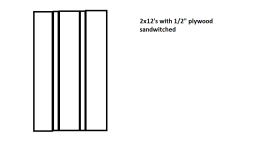
So I am looking for the most cost effective way to get the strength needed. From the reading I have done, several sites mention that adding plywood does NOT add as much strength as people believe.Several sources state that Using 3 2x12's with 2 ripped sections of plywood in between gets 5.5" wide (to match the post), but using an extra 2x12 would be stronger than the plywood. (and 0.5" wider too). Further they go on to say that the plywood is mainly just used to get the beam the same width as the wall.

And from further reading, the modulus of elasticity of several types of plywood all seem to be about the same as SYP lumber. (1.6 million). So that seems to confirm that.

Not really looking to go the route of layering in steel plate, cause that increases difficulty of construction. And if I was going steel, I would just size a beam and be done.

Given the building span, truss spacing, and snowload, I need a 16' header that can support 6000lbs right in the middle. (Thats 30 PSF total load plus 1000# just to be safe). I have got some ideas floating around in my head, I'll sketch them up and post. But looking for ideas as to what others with similar span and loading have in their buildings for a load bearing wall?
 
   / 16' opening Door header: on load bearing wall
  • Thread Starter
#2  
Here is what I am thinking right now.

option 1:

option 1.png

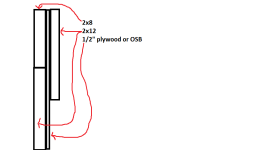
A 2x8 on top of a 2x12 joined with 1/2" plywood or OSB. Thus making a 2" wide and 18.5" deep beam. Adding a 2x12 behind it to add to lateral stability and overall strength. Doing the 2x12 behind is the reason for the 2x8 being on top...so they overlap.

The resulting 2x18.5" beam figuring the strength (Moment of inertia), using the formula (W x H^3)/12 I get an i^4 of 1055. And for the 2x12 it would be 178.

So the sum of the beam strength would be 1233

Option 2:
Using the more common method of 3 2x12's with 2 layers of plywood result in a 5" x 11.25" beam.

option 2.png

The relative strength of that beam would be 593. Or less than half of what the larger beam is, AND requiring more material, being heavier, and costing more. Only advantage of this is more strength in the y-axis.

Given that I have plenty of height, any reason no to use option 1? Or any better solutions that arent gonna break the bank?
 
   / 16' opening Door header: on load bearing wall
  • Thread Starter
#3  
Here is the bigger picture to help get a visual.

big picture.png

Again, I have plenty of height (depth of beam) to work with. And with a given amount of material, more strength is gain by depth than width. So my emphasis to go deeper instead of 3 or 4 plies wide to get the same end result.

Also considering adding some knee braces to further reduce the effective span of the header. But this is just for extra measures. I want a beam that the knee braces are not needed for strength, but rather a extra bonus if I decide to add them. Same with the metal siding. IT will add a bit of strength to the beam itself, but leave that be a bonus.

Final question before I wait for some responses........

With the load being right in the middle of the 16' span, how would you section the plywood? Would you use 2 8' lengths with the joint right where the load is? or would you go 4-8-4 and have an extra joint, but being farthest from the load?
 
   / 16' opening Door header: on load bearing wall #4  
ONE word .. LVL's . I would be using lvl's that is 18 ft long and get them 5 1/4 thick , i think its rated for 40 psf live load.
 
   / 16' opening Door header: on load bearing wall #5  
option 2 is what i have here one 2 buildings.

err i take that back...

two, 2x8's, with a 2x12 on the loof area (main building, then one side is extended out for a roof, use to be for cattle, to get up under for snow/rain and like. and spacing is 14' to 18'
the shed is guessing 40 plus years old. not sure if plywood was even known back then, but in either case the lumber is exposed to the elements. (rain splatter, wind/snow blowing up on it. i doubt plywood would last being outside.

as for the actual doors, they are on the "peaks" the ^ triangle ends. and one i want to say is two 2x8's, with either a 2x10 or 2x12, and the other is possibly two 2x10's, with a couple 2x6's.
both sheds have sliders. (doors slide like a sliding door many folks have on there homes), and the reason for one of the lumber being different size, is for the track.

i am not sure if i would trust plywood out here on this farm, more so over the years, due to all the mice, rats, ra-coons, cats, etc... they get in and pea and poo, then birds getting in some how and making nests.
leave door open by accident or on purpose. and a good wind and everything ends up wet.

===========
with above said, i would more trust plywood say in a home, were things are covered from the elements, and from all the little animals eating,chew, and making a mess of things if and when they do get in. or for say your trusses or like were they are out in the open. but being up next to a side, is acking for dark areas for critters and like to be crawling around.

*shrugs*, no builder by no means, just what i have seen and dealt with here on the farm over the years of what has and has not lasted.
 
   / 16' opening Door header: on load bearing wall #6  
Don't underestimate the utility of laminating galvanized sheet metal in layers with OSB or plywood. Plenty of through bolts, don't have to be large diameter but relatively close spaced. The idea is to keep the steel flat and when flat is very stiff. That is often done for 16 ft wide overhead door headers say when you have a garage in the side of a two story house and have to have a robust load bearing header. Concrete with ample correctly configured reinforcing steel is a another possibility. Glue lams (laminated beams) can be had in various sizes and can themselves be joined/laminated for greater strength. My 5000 sq ft plus house uses multiple glue lams as ridge beams atop the roof. My walkout basement has the walkout side mostly in glass and supporting two floors above it. The header beam above all the south side glass is steel reinforced concrete and was designed by a PE. Here we are a decade later with opening windows and sliding glass doors (6 footer) still working perfectly.

Best of luck to you however you choose to proceed.

Patrick
 
   / 16' opening Door header: on load bearing wall
  • Thread Starter
#7  
Trying to avoid the glue-lams or LVL's. Same with layering in steel and having to drill/ bolt etc.


The LVL or multiples required to attain the strength needed, by my figureing, would have to a pair of 16's or pair of 18" depth beams.

That puts the cost of each header ~$200

Option 1 that uses plywood contains $80 in material.

And a simple I-beam that weights ~350# would limit deflection to 1/4" with 6000# load and would cost roughly the same as the LVL's.

So dollar for dollar, I would just go with an I-beam over LVL.

But would prefer to stay with wood for cost reasons.
 
   / 16' opening Door header: on load bearing wall
  • Thread Starter
#8  
ONE word .. LVL's . I would be using lvl's that is 18 ft long and get them 5 1/4 thick , i think its rated for 40 psf live load.

Having a hard time finding anything that gives their strength in terms of mid-span point loads. EVERYTHING I am finding on anything wood related is in uniformly distributed loads.

And due to cost of LVL's, I would go steel first. See above post.
 
   / 16' opening Door header: on load bearing wall #9  
   / 16' opening Door header: on load bearing wall #10  
Not understanding why there is an issue? You are not the first person to put a 16' door in the side of a pole barn.

Mine has a 16' door in the side, with a second floor above it.

I have a wood header, with a 1/2" steel flitch pate in it.

There is no perceivable deflection over the span.

I would never use anything else but steel, for a span like that. Steel is the only thing I have not seen sag.
 
   / 16' opening Door header: on load bearing wall
  • Thread Starter
#11  
Sometimes it's better to spend the money and get what's designed to do the job. How much do you expect to save engineering and building something yourself? How long time are you willing to put into it versus just popping a glulam up there and being done with it?

3 1/2" x 11 7/8" x 16'9" for $190 is what I'd use.

https://shop.mccoys.com/building-materials/lumber/engineered-lumber-products/laminated-beams/p.1536

Eddie

For the same money, I'd rather go with a W10x22 I-beam. Which would have a max deflection of 1/4" under a full 6000# point load at mid span.

What would the deflection on that LVL be? I havent found anything relating to point loads at midspan when it comes to LVL's.

I am sure there are many thousands of buildings out there with a 16' door on a side that are/were built without fancy LVL's or I-beams. Just using conventional 2x lumber and/or plywood.

If height or width constraints were an issue, I could understand spending $200+ for steel or LVL stuff.

But neither is an issue. I can go as wide as 7" and as deep as 24". I am sure this can easily be accomplished. What would they have done before LVL's Is what I am asking I guess?

I am not opposed to spending the $200 for a proper beam. But would want some justification as to why/how That beam will be $120 better than some conventional 2x lumber and plywood. (and times two cause I am doing 2 doors).
 
   / 16' opening Door header: on load bearing wall
  • Thread Starter
#12  
Not understanding why there is an issue? You are not the first person to put a 16' door in the side of a pole barn.

Mine has a 16' door in the side, with a second floor above it.

I have a wood header, with a 1/2" steel flitch pate in it.

There is no perceivable deflection over the span.

I would never use anything else but steel, for a span like that. Steel is the only thing I have not seen sag.

A plate of 1/2" x 12" steel that is 16' long would cost (and weight) about the same as an I beam that can do the job by itself. IF steel is to be included, I would rather just go all steel via an i-beam.
 
   / 16' opening Door header: on load bearing wall #13  
A plate of 1/2" x 12" steel that is 16' long would cost (and weight) about the same as an I beam that can do the job by itself. IF steel is to be included, I would rather just go all steel via an i-beam.

Suit yourself. Incorporating a steel I beam inside a wood wall, creates its own problems. i.e. You can't attach it directly, or attach anything to it, without drilling holes in it. Which is a lot of work.
 
   / 16' opening Door header: on load bearing wall #14  
millions and millions of houses have 16 foot garage door openings all over the country and where built with two 2x12. Some with plywood, others with a 2x4 under them. While I don't know how many of them have to hold 6,000 pounds at the middle of their span, I do know that it's pretty rare for a header over a garage to have any issues.

Speaking of 6,000 pounds, where did that number come from?

Eddie
 
   / 16' opening Door header: on load bearing wall #15  
millions and millions of houses have 16 foot garage door openings all over the country and where built with two 2x12. Some with plywood, others with a 2x4 under them. While I don't know how many of them have to hold 6,000 pounds at the middle of their span, I do know that it's pretty rare for a header over a garage to have any issues. Eddie

True. It's also pretty rare for them to not have an inch, or more of sag in the center.
 
   / 16' opening Door header: on load bearing wall #16  
Here is what I have done (successfully) Two 2x12 pressure treated spruce planks layered with 3/4 " 5-ply fir plywood between them and. pre-stressed with a 2" crown facing UP and glued with Yellow Waterproof Resin glue from LePage, then NAILED, not bolted, on a close diamond pattern, with spiral zinc-coated 3 1/2 nails on a 16 foot span, resting on top of 4x4 PT square posts, with 1/4" thick mild steel cheek pieces bolted through the posts and then trough the beams above the posts against twisting. This header supports the outboard ends of my 2x4 "W" roof trusses 18" in from the eave. The trusses are 24" apart OC The roof is Steel on a 5 pitch slope. Snow load here maxes out at 50 Lbs per square foot, but the snow usually slides off several times per winter and hits the ground 12 feet below with a great thundering impact that makes the ground shake. I think that snow must weigh in at 12 tons or more. That laminated beam is a heck of a lot stronger that it looks, apparently, but I think it needs to be protected from the weather, hence the aluminum sheathing, plus I hate painting the trim on a ladder.

I am not an engineer. If I was, I would probably have specified a steel I beam. The carpenter disagreed with steel beams resting on wooden posts, because long steel beams have issues with thermal expansion, making the post and beam joint questionable over time. FWIW, he may have a point there. A 16-foot steel beam will expand and contract 5" over its length, he said. He made me a believer.

The devil is in the details,,and how you select and match up the planks, plus the glue and the nailing pattern.. WITH ARDOX nails. As you know they cannot be pulled out, even with a big wrecking bar.

The best argument is cost. The laminated beam cost 50 bucks for materials.. a 16'x 5" Mild steel I beam would cost about 800 bucks, from a scrap yard, if you could find one...and steel will bend and deflect over such a span anyways.

I have seen no deflection from tremendous roof snow weight for over ten years now, nor twisting torsion. I did choose the planks very carefully to be free of knots and adverse grain and arranged them with the assembly of the wood crowning up, and so that the opposing grain of the planks were not running coincidently parallel to one another and free of sap wood. I also ensured that the ends of the laminated beams were absolutely squared to the ends of the supporting posts so that there was no torsion introduced at the point where the beams rested on the posts. I drilled long 1/4 inch diameter holes at about a 30 degree angle to the vertical plane and placed 18" long galvanized lag screws into the the posts and beam ends inboard of the cheek pieces as a hedge against slipping of the beams off of the 4x4 PT support posts. The support posts are also sheathed with PVC siding clamshells.

The whole structure looks pleasing, too There are no interposing support posts to interfere with the view from my porch. Just how it should be.

This was done for me by a licensed carpenter. He said that the beam would support a ten-ton total span weight. He was correct, the beam is solid even with a snow load of three feet of frozen ice and snow on the roof at the eave.

I boxed-sheathed the laminated beam against the weather with aluminum metal..all in one length..and the metal sheathing does not deflect under the worst load. That beam is stronger than the headers for the stud wall beyond it, (doubled 2x6 on edge) supported on 16" centers by the stud wall.
 
   / 16' opening Door header: on load bearing wall #17  
Suit yourself. Incorporating a steel I beam inside a wood wall, creates its own problems. i.e. You can't attach it directly, or attach anything to it, without drilling holes in it. Which is a lot of work.
:thumbsup:
That's why steel flitch plates are more common...you can get them pre-drilled...
 
   / 16' opening Door header: on load bearing wall
  • Thread Starter
#18  
Take this a few at a time here....I do appreciate all the responses so far.

Suit yourself. Incorporating a steel I beam inside a wood wall, creates its own problems. i.e. You can't attach it directly, or attach anything to it, without drilling holes in it. Which is a lot of work.

Yes. An I beam creates other hurdles. And I certainly don't want to use a steel beam. But would rather deal with the hurdles vs spending similar money on an lvl. Cause this is in an unconditioned barn. And I still am skeptical of how an lvl will hold up over time. The just haven't been around long enough.

millions and millions of houses have 16 foot garage door openings all over the country and where built with two 2x12. Some with plywood, others with a 2x4 under them. While I don't know how many of them have to hold 6,000 pounds at the middle of their span, I do know that it's pretty rare for a header over a garage to have any issues.

Speaking of 6,000 pounds, where did that number come from?

Eddie
Most of the garage doors I "think" you are talking about is on the gable ends. Whereas the truss carries the roof load to the end walls.

On an eave end, all the snow load is on the header. Also a residential garage typically has closer spaced trusses, and shorter span. IE: on a 30' residential garage, wit 1' overhang and 2'oc trusses, each truss is carrying 32 sq ft of the roofs load. @30 PSF, that is 960# evenly every 2' on the header.

In my case, with a 40' building and 1' overhang and 8'oc trusses, each truss carries 168 sq ft of the roofs load. @30psf, that's a tad over 5000#. I added 1000# for a safety factor. Thus the midpoint load of 6k. And a triple 2x12 beam would sag a few inches under that weight.(I figured it but don't remember the exact deflection)
 
   / 16' opening Door header: on load bearing wall
  • Thread Starter
#19  
Jix: your post is too long to quote and edit on my phone.

But what do your trusses span? The header has to carry 1/2 of the span plus overhang. Remember, my building will be 40'. With the overhang, I have to suppore 21' of the roof. Your trusses are also 24" centers which also help reduce the beam size as the loading is more uniform.

I also have a very hard time believing that a 16' beam will expanded 5" in length. Maybe 0.5" I would believe, but not 5.

And I don't know what prices are up your way, but a w10x22 beam @16 ' would cost Mme about $200
 
   / 16' opening Door header: on load bearing wall
  • Thread Starter
#20  
Again, would like to avoid steel or engineered stuff. I have 24" of depth to work with. Certainly an all lumber beam would work. Even if I had to stack them vertically like I mention and ty together with plywood?
 

Tractor & Equipment Auctions

40' High Cube Multi-Door Container (A53314)
40' High Cube...
2006 Freightliner Auger Truck (A56438)
2006 Freightliner...
iDrive TDS-2010H ProJack M2 Electric Trailer Dolly (A59230)
iDrive TDS-2010H...
2015 Ford F-250 Crew Cab Pickup Truck (A59230)
2015 Ford F-250...
2006 INTERNATIONAL 7400 6X4 DUMP TRUCK (A52706)
2006 INTERNATIONAL...
2019 Harley Davidson FLHTP Electra Glide Motorcycle (A56859)
2019 Harley...
 
Top