Wash it

   / Wash it #1  

Capricious

Platinum Member
Joined
Jul 2, 2014
Messages
692
Location
Eastern Missouri
Tractor
Mitsubishi MT160D
DETROIT (AP) If you live where salt is used to clear the roads of snow and ice, U.S. safety regulators have a message for you: Wash the underside of your car.

The message came Wednesday from the National Highway Traffic Safety Administration, which closed a five-year investigation into rusting pipes that carry brake fluid in about 5 million older Chevrolet, Cadillac and GMC pickups and SUVs, without seeking a recall...

NHTSA's finding that the GM trucks weren't defective came even though it received 3,645 complaints of brake pipe rust in the General Motors vehicles from the 1999 to 2007 model years, including 107 crash reports and 40 reports of injuries. Seventy-five percent of the complaints came from trucks in the first four model years covered by the investigation, 1999-2003, the agency said....

US ends brake-line rust probe, urges people to wash vehicles - US News
 
   / Wash it #2  
Rock salt was bad; the liquid-brine they use on the roads here now is at least an order of magnitude worse. Maybe 2.

The brine is extremely aggressive, and penetrates everywhere. Short of dunking a vehicle in a vat of 20M acid, I don't know a better way to destroy a vehicle chemically.

Some of the things it is now taking out - Caliper Piston seals - late model vehicles with leaking calipers - the seal may be intact, but the piston has already eroded enough to pass fluid. The one that really gets me - certain CV halfshafts - if there is a harmonic balancer weight (big rubber doughnut) on it, the brine will sit in the groove for that weight and eat the shaft - saw a snapped axle on a recent Acura, and a few Caravans.

I could go on with plenty of examples, but I might run out of BP meds..... :rolleyes:

It's all about money. Govt likes brine because there is no sand cleanup later, on-road or from storm sewers.

They put brine on the road, our vehicles rot out fast. They don't care about govt vehicles, as those get replaced quickly anyway. Win-win for govt as brine gets vehicles off the road faster, and drives up repair and new vehicle sales.

If you can Make Your Problem, Somebody Else's Problem, then It's Not a Problem.

What are we supposed to do, wash our cars every other day for 6 months, and get them oil-sprayed 6 times a year ? That's about what it would take to hold-off the brine.

Forget the manufacturers, it's about time a class-action was started against the govts using the brine. The escalation of financial damage to drivers is well documented.

Sand works well, and is a heck of a lot more Green than flooding the roads with saline. At 10-15 years, having to repaint the front of a vehicle, and change a windshield due to sand erosion is a lot cheaper than buying a new vehicle...... and, therein lies the "problem" that brine solves well.

Rgds, D.
 
   / Wash it #3  
We had a mid 2000's Duramax go in the drink at the launch ramp last summer putting in a boat. When they pulled it we discovered the brake line failed over the fuel tank.

Brake line failure is a well known issue with GM trucks around her from the stuff they put on the roads.


Chris
 
   / Wash it #4  
My 99 Chev PU lost its brake lines in 07. We fixed it, but replaced the truck soon after. Around here you can't wash under your vehicle most of the winter cause it's too cold. We're stuck with the oiling or similar, and that's getting old along with me.
Jim
 
   / Wash it
  • Thread Starter
#5  
"..Short of dunking a vehicle in a vat of 20M acid..."


I suppose that dunking the "salted" vehicle in acid would neutralize the alkali, preventing further corrosion...?


EDITED TO ADD: I meant that as a joke, of course, but after thinking about it for a few minutes, maybe spaying the underside
of the vehicle with a mild vinegar solution might neutralize the salt?? Many many years ago I used to work around sodium hydroxide,
A.K.A "caustic soda", A.K.A lye, and we always had a bottle of vinegar around in case we got some on us (that is no longer considered proper PPE, of course).
 
   / Wash it #6  
"..Short of dunking a vehicle in a vat of 20M acid..."


I suppose that dunking the "salted" vehicle in acid would neutralize the alkali, preventing further corrosion...?

:D

Is it a Problem, or Opportunity ?

Dunk'em Dave's Salt Neutralizer Company !

Naahh, that strong an acid would create other problems.... that was just me getting verbose about the extent of damage this saline brine creates.

Rgds, D.
 
   / Wash it #7  
I have always made it a habit to run my 04 Suburban and 03 Trailblazer through the drive through wash and get the underbody wash option.
I still have visible signs of corrosion. One problem with the underbody wash is it blast pretty hard and some of the paint on the frame gets blasted off making the problem worst.
 
   / Wash it
  • Thread Starter
#8  
Vehicle manufacturers have done a good job or preventing body panel rust, but seem to have ignored everything else.

My 1974 Plymouth Duster and 1974 I.H. Scout II both started rusting @ the rear fenders @ (3) years of age; The body of my 1986 Toyota pickup was more-or less completely gone @ (9) years.

My 02 Ford Ranger doesn't have a spot of body rust, but couple years ago the shackles and hangers at the rear of the leaf springs were rusted paper-thin and had to be replaced, but at least the frame wasn't too rusty, a real common problem with Rangers.
 
   / Wash it #9  
I have always made it a habit to run my 04 Suburban and 03 Trailblazer through the drive through wash and get the underbody wash option.
I still have visible signs of corrosion. One problem with the underbody wash is it blast pretty hard and some of the paint on the frame gets blasted off making the problem worst.


Same here, but I always woner if that's enough. How many of you guys actually get under your vehicle with a pressure washer, or do the under-belly cleaning yourselves? I would love to hear some best practices from this group. I have to admit, I don't do it as often as I should... usually just rely on the commercial car wash "under carriage wash" option, but never know if that actually does much.

Despite doing that as often as I can, I can STILL see corrosion under my Tacoma and even under my old BMW. Funny, but my old BMW was a Florida car that I purchased through CarMax, and it had ZERO corrosion when I bought it... now, there are visible signs in a few spots even with meticulous cleaning and never driving it in the snow unless absolutely necessary.
 
   / Wash it #10  
Copper Nickel line:

Cupro Nickel Brake Lines On FMSI

Pricey, but highly corrosion resistant. Softer material, so I'm told it "feels" a bit different tightening fittings down.

It's what I'll be using on my next repair.

Rgds, D.
 
   / Wash it #11  
Same here, but I always woner if that's enough. How many of you guys actually get under your vehicle with a pressure washer, or do the under-belly cleaning yourselves? I would love to hear some best practices from this group. I have to admit, I don't do it as often as I should... usually just rely on the commercial car wash "under carriage wash" option, but never know if that actually does much.

Despite doing that as often as I can, I can STILL see corrosion under my Tacoma and even under my old BMW. Funny, but my old BMW was a Florida car that I purchased through CarMax, and it had ZERO corrosion when I bought it... now, there are visible signs in a few spots even with meticulous cleaning and never driving it in the snow unless absolutely necessary.

I'm not as diligent about this as I should be. One of my concerns with using really high pressure is driving salt/ water into areas you shouldn't (connectors, electronics....). Not to imply it's OK for mechanical stuff.

Olde-tyme guys here would use a lawn sprinkler (oscillating bar type), and move it around under the car. That seems like a safer pressure, to me. I guy I know was cleaning up a project car recently, said he found it took HOT water to dissolve the baked on brine crystals.

Rgds, D.
 
   / Wash it #12  
I've always heard that you should avoid driving through deep water because it could destroy bearings etc. However, with all the brine that is caught up on the underside of vehicles, is driving through deep water the lesser of two evils?
 
   / Wash it #13  
I've always heard that you should avoid driving through deep water because it could destroy bearings etc. However, with all the brine that is caught up on the underside of vehicles, is driving through deep water the lesser of two evils?


Ha! That's EXACTLY how I used to wash my truck when I was a teenager... I'd drive it into the creek and let it set for a bit to wash off the bottom before washing the rest of it off up at the house. :)
 
   / Wash it #14  
Years ago they never used salt- just sand. The brakes would last the life of the vehicle, calipers, lines included. They started salting and now I am replacing lines, calipers, etc around 50-60000 miles, way too early. My 2003 chevy pickup has galvanized panels that are not rusting, and the stainless steel muffler is in great shape. Everything else is.

advise to wash it- it is good, but you'd have to wash it after every time you went out!
 
   / Wash it #15  
That evil brine has also been the result of power outages! The mist gets onto power line equipment and shorts them out with spectacular fires.

I have seen the effect of this nasty sheit on my 08 Sierra. I never believed in undercoating but started four or so years after buying this 08. I wish I would have started from new!

Driver (human) education would go a long way toward reducing the amount of sand and salt required.
 
   / Wash it #16  
Ahem... You're all missing the biggest and best of this. It is ALL just another reason to own a tractor and get more seat time. :p

Hook to the back of your truck and lift it to a comfortable but not damaging level so you can easily access for cleaning!!!


(naturally this is said as a joke and I in no way advise doing such a thing, being a tractor site I couldn't resist...)
 
   / Wash it #17  
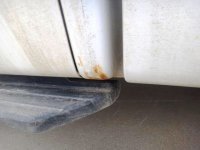
Noticed this 2010 F150 SuperCrew (74K miles) has rusty cab corners already. Do you think Ford would fix this under warranty?
 

Attachments

  • image-2247364291.jpg
    image-2247364291.jpg
    136.9 KB · Views: 141
   / Wash it #18  
I'm not as diligent about this as I should be. One of my concerns with using really high pressure is driving salt/ water into areas you shouldn't (connectors, electronics....). Not to imply it's OK for mechanical stuff.

Olde-tyme guys here would use a lawn sprinkler (oscillating bar type), and move it around under the car. That seems like a safer pressure, to me. I guy I know was cleaning up a project car recently, said he found it took HOT water to dissolve the baked on brine crystals.

Rgds, D.

All the electrical connectors I know about on the exterior of a vehicle have water seals.
 
   / Wash it #19  
All the electrical connectors I know about on the exterior of a vehicle have water seals.

Agreed, on modern vehicles.

What I was getting at is they're not spec'd to deal with 3,000+ psi water.

Rgds, D.
 
   / Wash it #20  
Noticed this 2010 F150 SuperCrew (74K miles) has rusty cab corners already. Do you think Ford would fix this under warranty?
They would have last year(ish)...

Ford's finish and corrosion warranty is for 5 years from the "in service date" with unlimited mileage. They can be picky about what is covered, but rust coming up from under the paint such as that they handle without question. I've had two vehicles repaired under this coverage, one I was even second owner.
 

Marketplace Items

2019 Dodge Grand Caravan Van (A59231)
2019 Dodge Grand...
2023 GREAT DANE FLP-0024-00053 53FT FLATBED TRAILER (A59905)
2023 GREAT DANE...
VOLVO ECR25 ELECTRIC EXCAVATOR (A60429)
VOLVO ECR25...
20FT X 12FT LIVESTOCK METAL SHED (A58214)
20FT X 12FT...
1999 WEST WIND 30FT PINDLE FLATBED DOVETAIL TRAILER (A58214)
1999 WEST WIND...
2017 FREIGHTLINER M2 26FT NON CDL BOX TRUCK (A59905)
2017 FREIGHTLINER...
 
Top