Flail Mower Let's talk flail mowers

   / Let's talk flail mowers #3,421  
Hey I got the + right. :thumbsup: That would explain the smooth running, the heavier the better. That would be a little more than I would want to drag around though. I thought my Mott was heavy at 530 lbs. I've heard folks say they weigh 800 lbs some say 900 lbs but I weighed mine with my overhead hoist scale and it said 530 lbs I don't think the scales are too far off ??

Does your JD cut good at slow rpms or do you run it at higher rpms. I wish mine had a 6:1 ratio gearbox so I could run at a lower engine speed. My ford reaches PTO speed at 1800 engine speed but I like to run it about 1600. The gearbox on the Mott is 4:1 ratio so the rotor is turning at 2160 rpm.

You can produce a smaller pulley on the rotor shaft, then you will have bigger ratio.
 
   / Let's talk flail mowers #3,422  
If you have a hollow drum rotor like most do, you can drill a hole in it and install about two pounds of Dyna Beads. Then plug the hole afterwards. A cheap alternative is glass beads (blasting media) and talcum powder. Start the rotor up slowly to distribute the beads and it will self-balance.

DynaBeads Tire Balancing Beads

Dyna Beads is used in many antique car tires all the time. Especially the wood spoke wheels where modern wheel weights aren't large enough or too obtrusive.

very interesting idea.:thumbsup:
 
   / Let's talk flail mowers #3,423  
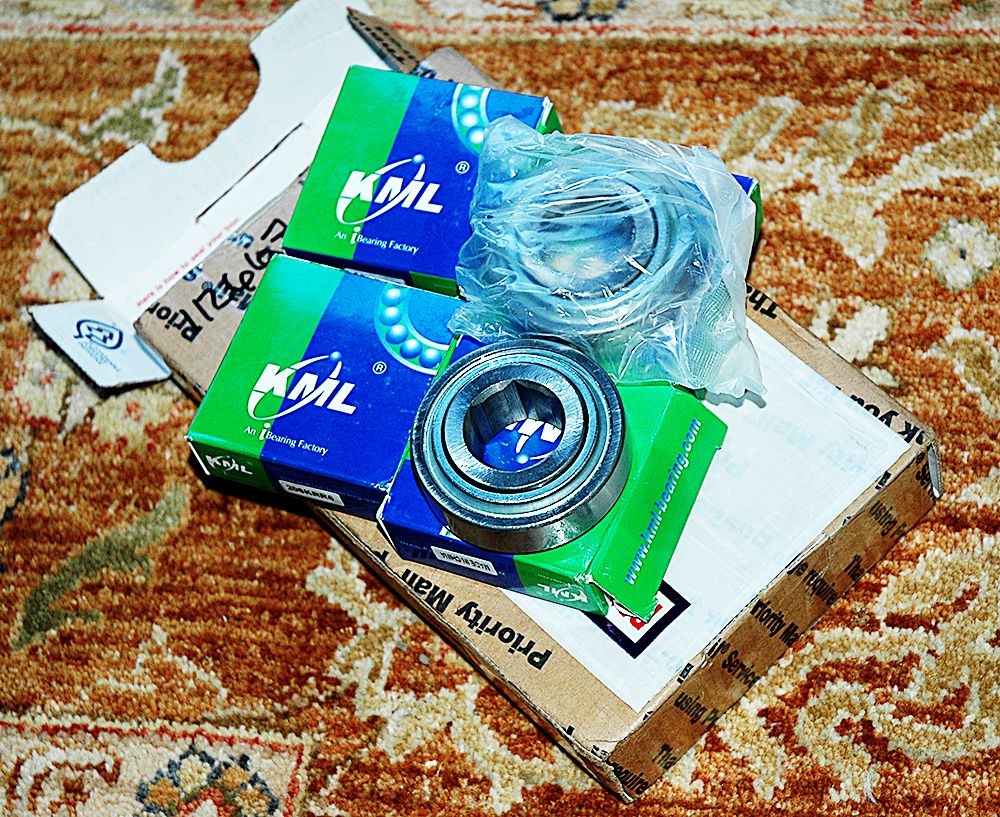
BTW: If you have a John Deere flail mower that has a roller with hex ends. You can get bearings that will fit the hex from your local bearing supply house for about 1/3 the price you will pay for bearings from JD. Just take one of your existing bearings with you. My local guy had to order the bearings but the price was worth the wait.
 
   / Let's talk flail mowers #3,424  
You can produce a smaller pulley on the rotor shaft, then you will have bigger ratio.

Hello Mister Yuan,

Reducing the flail mower rotor pulley shaft diameter to increase the speed ratio is a double edged sword so to speak for a number of reasons.

The blade tip speed will be increased and thusly increase the chance of impacting the forward knifes edge and damaging depending on the knife station hanger separation distance as relates strictly to the individual flail mower rotor diameter i.e. 2 row, 3 row or the 4 row knife station flail mower rotor.

The scoop knife/duckfoot-hate that/Cast Hammer flail knife would also be affected by this due to the increased tip speed in some cases affecting the knife cutting efficiency where it would simply bounce off the material.


2. plugging and wrapping of the flail mower rotor with heavy brush.

3. reduced bearing life on the drive pulley open flange bearing (B10 life).
a. reduced bearing life on driven pulley open flange bearing(B10 life).
b. reduced bearing life on the flail mower rotor bearings(B10 life).

4. increased belt wear/reduced V belt life.

There are other reasons but the above reasons are more than adequate to explain why one should not attempt to change the pulleys to change the speed ratio on the flail mower rotor.


The use of a larger flail mower rotor diameter pulley would allow the end user to make use of shorter side slicer lengths with tool less blade installation and removal and as a result save a lot of money on knife replacement if needed.

The added benefit of the above would allow the flail mower rotor to match the speed of the driven pulleys diameter to obtain the same high quality of cut.

The smaller flail mower rotor diameter using a steel tube is a compromise with the blade tip speed with the use of the longer knife being used to equal the combined radius of the larger pulley diameter and the shorter knife length.

Me I like not needing tools to change knives to sharpen them or install the thatching knives on my towed flail mower.

 
   / Let's talk flail mowers #3,425  
Hello Mister Yuan,

Reducing the flail mower rotor pulley shaft diameter to increase the speed ratio is a double edged sword so to speak for a number of reasons.

The blade tip speed will be increased and thusly increase the chance of impacting the forward knifes edge and damaging depending on the knife station hanger separation distance as relates strictly to the individual flail mower rotor diameter i.e. 2 row, 3 row or the 4 row knife station flail mower rotor.

The scoop knife/duckfoot-hate that/Cast Hammer flail knife would also be affected by this due to the increased tip speed in some cases affecting the knife cutting efficiency where it would simply bounce off the material.


2. plugging and wrapping of the flail mower rotor with heavy brush.

3. reduced bearing life on the drive pulley open flange bearing (B10 life).
a. reduced bearing life on driven pulley open flange bearing(B10 life).
b. reduced bearing life on the flail mower rotor bearings(B10 life).

4. increased belt wear/reduced V belt life.

There are other reasons but the above reasons are more than adequate to explain why one should not attempt to change the pulleys to change the speed ratio on the flail mower rotor.


The use of a larger flail mower rotor diameter pulley would allow the end user to make use of shorter side slicer lengths with tool less blade installation and removal and as a result save a lot of money on knife replacement if needed.

The added benefit of the above would allow the flail mower rotor to match the speed of the driven pulleys diameter to obtain the same high quality of cut.

The smaller flail mower rotor diameter using a steel tube is a compromise with the blade tip speed with the use of the longer knife being used to equal the combined radius of the larger pulley diameter and the shorter knife length.

Me I like not needing tools to change knives to sharpen them or install the thatching knives on my towed flail mower.

The reason I thought about the increased ratio wasn't to speed up the rotor as it cuts great now. The reason was to decrease the rpm of the mule engine. I know I would lose a bit of torque but I don't see that being a problem. If my mule were a new diesel I wouldn't even have thought about it but its an older gas burner and every rpm less it turns is a good thing.

Thanks for the info.
 
   / Let's talk flail mowers #3,426  
in spin balanceing a rotor shaft i would balance at lower speed at 2200rpm rotor, 600rpm would be a working shop speed on my machine .
 
   / Let's talk flail mowers #3,427  
To be honest, the static balancing which you are doing is totally unacceptable for industry. This way cannot check out many other issues which will affect rotor shaft balance, like hammer bracket condition, aligned holes for the bolts on hammer bracket, weight and centrifugal force difference of hammers, etc.

I agree that a static balance is not the best but that's all I can do unless I want to ship it off and it would just not be very economical to do that when I can get it to run pretty dang good by just the static balance I done.
This Rotor has two pieces of flat bar welded the entire length for the hangers to fit between and bolt up. Four runs of two if that makes since. Everything is aligned properly as far as bolting locations. I done the balance with no attachments on the rotor. Every attachment was weighed on a digital scale to weigh exactly the same.
I am thinking about adding some balancing beads but I'm just not sure if they would spread out in the horizontal shaft.
 
   / Let's talk flail mowers #3,428  
BTW: If you have a John Deere flail mower that has a roller with hex ends. You can get bearings that will fit the hex from your local bearing supply house for about 1/3 the price you will pay for bearings from JD. Just take one of your existing bearings with you. My local guy had to order the bearings but the price was worth the wait.

Last week I had to replace one of the hex shaft roller bearings on one of my 2 JD 25A flail mowers and in the process of finding a replacement I ran across this website.

JohnDeere AE2939 Bearing : MIBearings LLC

I went to my local New Holland dealer after trying a couple of local ag supply stores and purchase the New Holland Part #80121602.

This bearing worked although it was only the bearing and did not include the housing. It was $54 versus the $103 at John Deere not to mention the closest dealer with one in inventory was 100 miles away and it was going to take 3 days if I let them ship it to the local store.

The above website also shows other cross reference #s.
 
   / Let's talk flail mowers #3,429  
Catoosa can you share the part number and brand bearing you used?
I just repaced one and probably will need another next summer if not sooner.
I did rotor bearings on one mower last summer and got those from the local Napa parts store.
 
   / Let's talk flail mowers #3,430  
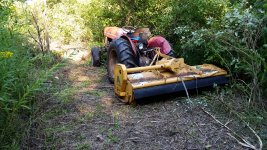
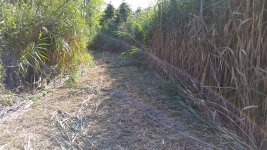
I've been bush-hogging with my Alamo SHD74 flail on my Massey Ferguson 135 diesel vineyard model. Been having a great time clearing out terrain that you really couldn't walk through without a machete. Having some trouble with some heavier brush. A rotary cutter would be better for some of it, but this is working well enough overall. Amazing how the tallest 12-15 foot tall brush is mulched into nothing. Biggest problems I've had are I hit some old wire fencing - took me an hour to cut it out of the mower with bolt cutters - and hitting rocks and pieces of concrete and cinder block. They get caught under the mower and sometimes I'm too busy dealing with tricky and dangerous terrain to get to the pto lever quickly. HORRIBLE noise! I checked when I was done today and found about 6 knives were missing after that fun time. I've also been losing cotter pins on the blade holders, and I'm wondering if I should go with the bolts with nyloc nuts instead. I see both in the Flailmaster catalog, and it looks like they should work just fine. Any thoughts on that?

2016-08-26 pic1.jpg

2016-08-26 pic2.jpg

2016-08-26 pic3.jpg

I also have a YouTube video of me cutting with it. I have to warn you that my camera work is pretty poor. I find when I was thinking about mowing, I'd point the camera more or less where I look, which is mostly down at the tractor, to keep my eye on the ground under the front wheels as much as possible. This doesn't make for great cinematography! Also, I thought I had some wood stuck in the mower, but a cotter pin had come out and the pair of knives were hitting the mower housing - wow, was that LOUD. Also, when I was worried more about cutting than filming, the camera would drift, and sometimes my finger would get in front of the lens. Oh well. The first 10 minutes or so are really what I wanted people to see anyway. REALLY tall brush, and the mower just tears it up, so amazing!

Clearing brush and weeds with the Massey Ferguson 135 diesel - YouTube
 
   / Let's talk flail mowers #3,431  
Last week I had to replace one of the hex shaft roller bearings on one of my 2 JD 25A flail mowers and in the process of finding a replacement I ran across this website.

I had to replace the hex bearings on my Gravely tiller,,, I wonder if they are the same??

I paid about $13 a piece,,,

BearingsCult_zps9087f50f.jpg


The housing is the expensive part,,,

The tiller picked up a rock,,, many times,,, it finally bent the shaft,,
I straightened it "close enough",,,, Sledge hammer close!! :laughing:

TillerShaft_zps681d4c29.jpg


I remember when looking for those bearings, prices varied a LOT!!

This is the housing that holds my hex bearing,,

LubeBearing_zps3fad623a.jpg
 
   / Let's talk flail mowers #3,432  
Catoosa can you share the part number and brand bearing you used?
I just repaced one and probably will need another next summer if not sooner.
I did rotor bearings on one mower last summer and got those from the local Napa parts store.

Wished I could but didn't keep any of the paperwork or box, only way I could get any numbers would be to take the mower apart. When I saw what a JD dealer wanted for the bearings I just took one of the old bearings into my local bearing supply and let them figure out what I needed. I did buy both bearings and housings, housings were not an exact match but don't remember a big ordeal making them fit the mower. Just type "bearing" plus your city into Google and you will find a local bearing supply house.
 
   / Let's talk flail mowers #3,433  
Hello Mister Yuan,

Reducing the flail mower rotor pulley shaft diameter to increase the speed ratio is a double edged sword so to speak for a number of reasons.

The blade tip speed will be increased and thusly increase the chance of impacting the forward knifes edge and damaging depending on the knife station hanger separation distance as relates strictly to the individual flail mower rotor diameter i.e. 2 row, 3 row or the 4 row knife station flail mower rotor.

The scoop knife/duckfoot-hate that/Cast Hammer flail knife would also be affected by this due to the increased tip speed in some cases affecting the knife cutting efficiency where it would simply bounce off the material.


2. plugging and wrapping of the flail mower rotor with heavy brush.

3. reduced bearing life on the drive pulley open flange bearing (B10 life).
a. reduced bearing life on driven pulley open flange bearing(B10 life).
b. reduced bearing life on the flail mower rotor bearings(B10 life).

4. increased belt wear/reduced V belt life.

There are other reasons but the above reasons are more than adequate to explain why one should not attempt to change the pulleys to change the speed ratio on the flail mower rotor.


The use of a larger flail mower rotor diameter pulley would allow the end user to make use of shorter side slicer lengths with tool less blade installation and removal and as a result save a lot of money on knife replacement if needed.

The added benefit of the above would allow the flail mower rotor to match the speed of the driven pulleys diameter to obtain the same high quality of cut.

The smaller flail mower rotor diameter using a steel tube is a compromise with the blade tip speed with the use of the longer knife being used to equal the combined radius of the larger pulley diameter and the shorter knife length.

Me I like not needing tools to change knives to sharpen them or install the thatching knives on my towed flail mower.

Hi Leonz,

Thank you for your analysis. You just taught me another lesson. :) I never try to produce mower which rotor rpm is more than 2200rpm.

What is "thatching knife" on flail mower? How it looks like? I don't know this.
 
   / Let's talk flail mowers #3,434  
in spin balanceing a rotor shaft i would balance at lower speed at 2200rpm rotor, 600rpm would be a working shop speed on my machine .

ok, this is what our Chinese factories doing now, 600rpm on balance testing machine. But someone told me foreign manufacturers test rotor at 2200rpm which is mower rotor real working rpm.

Is there anyone here know what rpm USA manufacturers when they test their mower rotor balance? I m curious about this.
 
   / Let's talk flail mowers #3,435  
Hi Leonz, Thank you for your analysis. You just taught me another lesson. :) I never try to produce mower which rotor rpm is more than 2200rpm. What is "thatching knife" on flail mower? How it looks like? I don't know this.
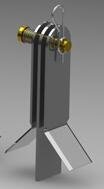
A thatching knife is straight and cuts into the turf without cutting much grass leaf. It is longer than a grass blade so it cuts through the turf into the soil and disrupts masses of old grass roots. If you can imagine straightening a Y blade that's pretty much a thatching blade. Longer and straight and generally without a sharpened edge. The purpose is to break up thick turf which promotes better lawn growth. Thatching is done only on mature lawns and typically done in early springtime. After dethatching a lawn looks like somebody dropped little clumps of grass roots all over it which is exactly what happens as the blades cut and pull up the old matted roots from prior seasons.
 
   / Let's talk flail mowers #3,436  
A thatching knife is straight and cuts into the turf without cutting much grass leaf. It is longer than a grass blade so it cuts through the turf into the soil and disrupts masses of old grass roots. If you can imagine straightening a Y blade that's pretty much a thatching blade. Longer and straight and generally without a sharpened edge. The purpose is to break up thick turf which promotes better lawn growth. Thatching is done only on mature lawns and typically done in early springtime. After dethatching a lawn looks like somebody dropped little clumps of grass roots all over it which is exactly what happens as the blades cut and pull up the old matted roots from prior seasons.

thank you, now I know USA people call it "thatching knife", QQ??20160828205215.jpg
 
   / Let's talk flail mowers #3,437  
thank you, now I know USA people call it "thatching knife", <img src="http://www.tractorbynet.com/forums/attachment.php?attachmentid=478910"/>
Yes. I think typically a thatching knife would just have one or two of the straight blades. That photo looks to me like a combination of thatching and cutting blades but I'm not a landscaper so perhaps blades like in your photo are used.
 
   / Let's talk flail mowers #3,438  
Good morning Island Tractor and good evening to you mister Yuan.


The image that Mr. Yuan has provided is one that shows a combination of the two side slicers and a de-thatching knife in a knife mounting station. the only difference in my case is that the mounting stations I have do not require the use of tools to change either type of knife.

The Mott Mowers show diagrams of the Flail Mower Rotor mounted only with the De-thatching Knife on the knife hanger that allows the juser to De-Thatching without mowing which is the normal operating procedure as the dead thatch is picked up a lawn sweeper in most cases in large lawn operations like golf courses.

With My Flail Mower and in my case The Lawn Genie Pick up mower I own and the one before can do two jobs at once if desired.

The flail mower rotor is kept at the desired mowing height and mows the lawn using the "Verticut" Method of mowing grass and brush.

When De-Thatching The Flail Mower Rotors cutting height is lowered and the De-Thatching blade engages the ground and penetrates the sod to cut and lift the dead thatch away from the ground. Grass Thatch that does not decompose and rot away chokes the good grass blade preventing the grass blade from allowing the tap root to dig further into the ground to anchor itself and grow much better.

When the work of De-Thatching is performed on the lawn or golf course the sod is De-Thatched at right angles to De-thatch the entire surface area of the sod being cleared of Dead Thatch within a 2 inch distance(plus or minus)
of each Thatching Knife if mounted in a Knife Mounting Station with a pair of side slicers or a single side slicer on the end of the knife row as is done with my Flail Mower Rotor.

When the end of the row is reached when De-Thatching the Implement is raised to prevent tearing up the turf and the tractor turns around and sets up for the next pass adjacent(next to) the sod that was just De-thatched.

In my case the engine speed is pushed back to "Low Idle" and the the slip clutch disconnects from the drive V belt pulley. when the mower stops rotating I move the tractor and flail mower and line up for the next pass.

The grass diverter door is opened and allows the cut grass and dead thatch to be lifted up and thrown into the collection basket with the two air paddles while De-Thatching and Mowing.

I continue this until all the sod is De-Thatched in this direction lets say "North to South" and then I begin traveling "East to West" to further De-Thatch the lawn to allow it to breath better and also allow me to reseed the lawn by providing the grass seed to sink into the slit created by the De-Thatching Blade.

The sod looks naked and almost white when the lawn is properly De-Thatched and the dead thatch and grass is picked up with the pick up mower and allows you to remove 99% of the material and cart it away to dispose of it or compost it.

This allows the sod to be exposed to sunlight and if grass seed, fertilizer, Lime and Gypsum is applied to the exposed sod the grass seed will sprout
and choke out the weed seeds.

I have not done this in a while as I need to purchase new De Tatching Blades but that is a project for spring 2017.

The slit in the existing sod created by act of Mechanical De-Thatching also allows the operator to spread more Grass Seed, Powdered or Pelleted Lime and Pelleted Fertilizer to feed the grass seed and Gypsum to dissolve the clay in the soil.


----------------------------------------------------------------------------------------------
Pronovost or not at all!!
Less than 15,400 rotary cutters to go before the flail mower dominates the mowing industry.
Still searching for a three point hitch Mott Flail Mower with the Wisconsin V-4 gas engine.
 
Last edited:
   / Let's talk flail mowers #3,439  
and I'm wondering if I should go with the bolts with nyloc nuts instead. I see both in the Flailmaster catalog, and it looks like they should work just fine. Any thoughts on that?

]

I switched to the bolts from flail master a long time ago for my SD88 and will never go back! Kept breaking cotter pins etc changing/replacing teeth. If you have rocky areas where you lose teeth frequently then the bolts are the only way to go IMO.

Mine didn't come with nyloc nuts, they were all metal just had slight indentations. I've removed/replace knives multiple times, never had issue with the bolts/nuts.

Also this year I bit the bullet and went with the heavy duty knives! Amazing difference! I lose a knife set occasionally when I hit a rock but rarely, so nice not to lose teeth! Usually if I lose a tooth now it's because the hanger U broke.
 
   / Let's talk flail mowers #3,440  
I switched to the bolts from flail master a long time ago for my SD88 and will never go back! Kept breaking cotter pins etc changing/replacing teeth. If you have rocky areas where you lose teeth frequently then the bolts are the only way to go IMO.

Mine didn't come with nyloc nuts, they were all metal just had slight indentations. I've removed/replace knives multiple times, never had issue with the bolts/nuts.

Also this year I bit the bullet and went with the heavy duty knives! Amazing difference! I lose a knife set occasionally when I hit a rock but rarely, so nice not to lose teeth! Usually if I lose a tooth now it's because the hanger U broke.

Are the heavy duty knives the same shape and size as the others and mount the same. I'm hoping to be at least a year away from needing new knives but not sure which way to go. My Mott 72 might not even accommodate other knives ?? Just trying to get a few ideas when I do have to replace them. Thanks. Oh yeah mine has the bolt and nut setup with the interference threads (not the Nylock) and so far so good. You have to loosen the nut with a wrench almost all the way off. That's easier than loosing them though.


Tractor & Equipment Auctions

JOHN DEERE 310K (A58214)
JOHN DEERE 310K...
HYDRAULIC THUMB CLAMP FOR MINI EXCAVATOR (A58214)
HYDRAULIC THUMB...
2010 Specialized Structure 1456 (A56858)
2010 Specialized...
2011 INTERNATIONAL DURASTAR 26FT NON CDL BOX TRUCK (A59904)
2011 INTERNATIONAL...
2019 Freightliner M2 106 AWD Altec DM47BTR Insulated Digger Derrick Truck (A60460)
2019 Freightliner...
2017 Ford F-550 4x4 Ext. Cab Mason Dump Truck (A59230)
2017 Ford F-550...
 
Top