Robotic Following Cart to Replace Light Duty Tractor Tasks?

   / Robotic Following Cart to Replace Light Duty Tractor Tasks? #21  
I understand Lean Startup methodology. I've read Steve Blank and while I absolutely agree with his belief, you have to be open to what you are being told as well.

I don't think you are dreaming, but I do believe you are looking for a cure without an illness.

A Gator, can haul you and more than 250lbs. While it can't return, given that it can haul significantly more, it can do in a single trip, what you are envisioning several trips with your machine.

The thing is, that in your instance of produce picking... there are already multiple alternatives which fill the role. This has been pointed out and videos linked.

When the Stanford Students built the 'weed killing robot', they paid attention to what the growers were saying.

Pivot or Proceed: How to Decide | Kauffman Entrepreneurs
 
   / Robotic Following Cart to Replace Light Duty Tractor Tasks?
  • Thread Starter
#22  
I understand Lean Startup methodology. I've read Steve Blank and while I absolutely agree with his belief, you have to be open to what you are being told as well.

I don't think you are dreaming, but I do believe you are looking for a cure without an illness.

A Gator, can haul you and more than 250lbs. While it can't return, given that it can haul significantly more, it can do in a single trip, what you are envisioning several trips with your machine.

The thing is, that in your instance of produce picking... there are already multiple alternatives which fill the role. This has been pointed out and videos linked.

When the Stanford Students built the 'weed killing robot', they paid attention to what the growers were saying.

Pivot or Proceed: How to Decide | Kauffman Entrepreneurs

Dadnatron, thanks for the feedback. We are looking for feedback and listening. I was just pointing out that our product doesn't look like a product you would buy yet because we are trying to establish proof of concept before we invest and build.

In the case of a Gator, you still have an operator doing a trip. With our idea, the operator could pick instead although there might need to be someone to unload the machine at the home point if the cargo could not be dumped.

Do you have any job where you are walking along picking or unloading smaller items, and could use a cart that could follow and then return to home/come back? Sounds like no. Is everyone doing a similar operation to you?

One other question, when you refer to Weed Killing Robot, do you mean Blue River Technologies or a different company? I was unaware that there was a weed killing robot available today that had had widespread commercial success which is why I ask.
 
Last edited:
   / Robotic Following Cart to Replace Light Duty Tractor Tasks? #23  
Aaron,

Thank you for the information - really helpful! Tracks are very do-able, albeit at a higher cost.

Have you ever seen how they are pruning the trees? In your area, do they typically remove the pruned pieces to avoid spreading disease etc.?

Do all of the operations that you know of have such large scale bin trailers for harvesting where workers pick directly into them? Conceivably, our robotic carts could make a 1-2 mile trip from picker to collection point and back which might replace some of that use. Best not to try to attack a mechanized solution however so if that usage is everywhere perhaps we are off base.
Small operations would just use a 3 point forklift mast, 3 point forks or a forklift mast on the front of the tractor. Anyone with multiple crews will probably be running some sort of bin trailer. From what I hear, a couple of 4-5 person crews can keep a bin trailer operator busy
Pruning trees, they will use a front mount brush rake to clean up the trimmings. Usually it looks something like:
Brush-Rake-11.gif
Source: http://edwards-equip.com/wp-content/uploads/29-brush-rake.pdf
Then they mulch whatever is left next time they mow the orchard.

Aaron Z
 
   / Robotic Following Cart to Replace Light Duty Tractor Tasks?
  • Thread Starter
#24  
Small operations would just use a 3 point forklift mast, 3 point forks or a forklift mast on the front of the tractor. Anyone with multiple crews will probably be running some sort of bin trailer. From what I hear, a couple of 4-5 person crews can keep a bin trailer operator busy
Pruning trees, they will use a front mount brush rake to clean up the trimmings. Usually it looks something like:
View attachment 498058
Source: http://edwards-equip.com/wp-content/uploads/29-brush-rake.pdf
Then they mulch whatever is left next time they mow the orchard.

Aaron Z

Aaron, good to know, thank you, so probably no utility on large scale apple picking operations as everything is being done so heavily with orchard tractors etc. It just seems so useful on a smaller scale operation like the one my family has (about 15 acres of apples) where we don't have those types of systems. Probably too tiny to justify though.

Do all Apple operations simply drop pruned materials to ground, and then windrow to center or capture in center of row with one of those rakes? I would think this would create disease issues as not all material could be removed, which I why I ask. With a system like ours, conceivably the pruning worker could prune into a bin, and have all of the material transported off site, reducing the risk of spreading fire blight etc..

What about grapes, hothouse tomatoes, mushrooms, and other environments like those where there are smaller lugs of material that people are picking into and have to transport back to central depots? Any thoughts on potential pain in moving materials there? (settings such as this: Wine-Harvest.jpg)
 
Last edited:
   / Robotic Following Cart to Replace Light Duty Tractor Tasks? #25  
Aaron, good to know, thank you, so probably no utility on large scale apple picking operations as everything is being done so heavily with orchard tractors etc. It just seems so useful on a smaller scale operation like the one my family has (about 15 acres of apples) where we don't have those types of systems. Probably too tiny to justify though.
Do all Apple operations simply drop pruned materials to ground, and then windrow to center or capture in center of row with one of those rakes? I would think this would create disease issues as not all material could be removed, which I why I ask. With a system like ours, conceivably the pruning worker could prune into a bin, and have all of the material transported off site, reducing the risk of spreading fire blight etc..
I don't know for sure. I suspect that your machine would be too small (ie: it couldn't hold many branches) for a lot of them as the branches would need more space.
What about grapes, hothouse tomatoes, mushrooms, and other environments like those where there are smaller lugs of material that people are picking into and have to transport back to central depots? Any thoughts on potential pain in moving materials there? (settings such as this: View attachment 498066)
I suspect that it would work, but I would ask someone in one of those fields.

Aaron Z
 
   / Robotic Following Cart to Replace Light Duty Tractor Tasks? #26  
I just drove by miles and miles of grape and apple orchards this weekend in SW lower Michigan. They have been pruning heavily. All of the prunings are on the ground between the rows. They'll come back and pick them up mechanically. They prune. Then move them to row. They pick up mechanically. No one stands there and picks up the prunings by hand.

Heck, I used to frequent a small orchard here. Neat OLD AS DIRT guy that ran it. It was probably 15 acres at most. Even he hired in a crew to prune in winter. He'd take care of mowing and spraying himself. Then he'd hire a crew to pick most of it, but he had a U-Pick that he ran himself. All he had was an old tractor or two to pull the sprayer and mow, and an old forklift to move empty bins in and full bins out of the orchard. That's it.
 
   / Robotic Following Cart to Replace Light Duty Tractor Tasks? #27  
I would look seriously at Lawncare.

They have many guy running back and forth with wheel barrows full of mulch. Short distance, repetitive action, high cost/hr. If you could set up a FAST robot that could move mulch from a trailer to the current 'master spreader' you might really have something. It could turn a HUGE business opportunity throughout the US into your customer. An owner could purchase 4 bots running mulch and have only 2 guys working the job. Typically, there would be 3-4 guys all at $10-12/hr. Wouldn't take long to make that $4K pay for itself and then some in that instance.

They would have to be reliable and extremely durable. And NOT run over the homeowner's petunias.

The more I think about it... the more I like it in this instance. The market for 'grunt' manual labor in this instance is massive.
 
   / Robotic Following Cart to Replace Light Duty Tractor Tasks?
  • Thread Starter
#28  
I would look seriously at Lawncare.

They have many guy running back and forth with wheel barrows full of mulch. Short distance, repetitive action, high cost/hr. If you could set up a FAST robot that could move mulch from a trailer to the current 'master spreader' you might really have something. It could turn a HUGE business opportunity throughout the US into your customer. An owner could purchase 4 bots running mulch and have only 2 guys working the job. Typically, there would be 3-4 guys all at $10-12/hr. Wouldn't take long to make that $4K pay for itself and then some in that instance.

They would have to be reliable and extremely durable. And NOT run over the homeowner's petunias.

The more I think about it... the more I like it in this instance. The market for 'grunt' manual labor in this instance is massive.

Dadnatron,

Thanks for the tip, I've posted several things to some of the more landscaping oriented forums with little to no response so we'll see (i.e. here: http://www.lawnsite.com/threads/robotic-following-cart-on-the-farm.464350/).

Our team is fabricating a more legitimate looking chassis and updating coding to get a more legitimate looking prototype up and running so perhaps in a few days/weeks with a better looking prototype we can get more interest.[video]www.agrbt.com/images/Chassis Build Day 3.mp4[/video]
 
   / Robotic Following Cart to Replace Light Duty Tractor Tasks? #29  
I would look seriously at Lawncare. They have many guy running back and forth with wheel barrows full of mulch. Short distance, repetitive action, high cost/hr. If you could set up a FAST robot that could move mulch from a trailer to the current 'master spreader' you might really have something. It could turn a HUGE business opportunity throughout the US into your customer. An owner could purchase 4 bots running mulch and have only 2 guys working the job. Typically, there would be 3-4 guys all at $10-12/hr. Wouldn't take long to make that $4K pay for itself and then some in that instance. They would have to be reliable and extremely durable. And NOT run over the homeowner's petunias. The more I think about it... the more I like it in this instance. The market for 'grunt' manual labor in this instance is massive.
The serious lawn crews here are running a compact skid steers. At about 3 times the cost of this robot they seem far more useful. I can't see how these robots are going to significantly reduce human labor. Now the local Hardie's installed robot ordering machines and give you a discount for using them. I'm betting one compact skid steer and 2 men could WAY outpace the crew with 2 men and 4 robots. And the skid steer is useful for a lot of other task. I don't see how the robot wagon is going to do anything a powered wheel barrow or compact or full sized tractor/ skid steer can't do. With a capacity of only 250 pounds a manual wheel barrow is more comparable. I'd rather see a welder that I drag along the path I want welded and then it welds it. Or a CNC mill that I can quickly hit a couple of buttons and come out faster on one part than on a manual mill.
 
   / Robotic Following Cart to Replace Light Duty Tractor Tasks? #30  
... There is no way we can compete with the overall capacity and capability of a $11K base price Powertrac PT425. ....

I've been thinking about this quite a bit pretty much all day off and on.... In all seriousness, if the $11K machine can outwork the $4500 machine 4:1 in the first trip, and make 10:1 trip ratio( I think it will be much higher than that), that's outworking it 40:1. If labor $$$ savings is the goal, put it to a spreadsheet. It doesn't pan out. You'd need many, many of those $4500 machines to keep up with one $11,000 machine (really $11,450 with the large light material bucket, plus shipping).

One person picking fruit as an example...

Let's say they can pick fruit and fill a cart sized container in 6 minutes. That's 10 containers per hour. They dump it in the box on the auto cart. It leaves to make the 1/4 mile round trip to the barn and back. The picker continues to pick while its gone. It comes back, he dumps his box on it, it takes off again, etc...

How fast does the auto cart travel? Lets say 3mph, as that's an average person's walking speed. There's 12 quarter miles in three miles, so it can make say 10 trips if you account for dump and load times. That works out well for our example, as the container on it is sized to keep up with one fruit picker person (if the distance averages out to 1/4 mile trips. Short distance works out better, longer distances, not so good).

As mentioned, it can only work for 5 miles. It'll be dead in 20 trips. That's about two hours of work. You'd need 4 auto carts to keep up with one person picking fruit for 8 hours, or 4 battery packs, or a quick charger that can charge it before the shift is over, etc... If you need 4, that's $18,000 for auto carts to keep up with one picker that gets paid only $300 per week working 40 hours for $7.50 an hour.

The picker could load crates in the field and deliver them to the barn himself much faster and cheaper with a tractor. Even if you had enough work to keep the picker busy for 4-5 weeks, that's only $1500 at most. Even if you had continuous crops and enough work to keep a guy busy all summer/fall, its not going to save enough labor to pay for itself because its small and slow.

And another thing to consider. Let's say the guy walks out from the barn to the first tree and the auto cart learns the route. It leaves and comes back to where? The guy has moved to another tree. He'll have to go and get it each time it comes back. That's the same distance spent walking as it would be to a crate set in the field every few trees. So no labor saving there at all.

Look, I'm being hyper critical of course. Just giving you some things to think about. I hope you can make a go of it. It sounds really interesting and poses a whole slew of problems to resolve. Keep working on it and keep updating us and good luck. :thumbsup:
 
   / Robotic Following Cart to Replace Light Duty Tractor Tasks? #31  
Here's a good read on apple picking...

Inside The Life Of An Apple Picker : The Salt : NPR

From the article, the average full container weighs about 1000#. The pickers get paid by the box. They pick not less than 12 boxes per day!

So 12,000 pounds of apples per person per day.

The auto cart with a capacity of 250 pounds would have to be able to make 48 trips per day to keep up with one picker.

Just some more stuff to think about.

Maybe apples isn't the best example... oranges? :laughing: Just kidding. Anyhow, we need to find a better example to justify the cost of the device.
 
   / Robotic Following Cart to Replace Light Duty Tractor Tasks? #32  
Hi candersen10

Just came across this thread. Haven't read all the posts but the cart that can follow you around would be so helpful for older farmers that have problems lifting/pushing a wheel barrow. Ace device and I hope it succeeds well.

Mike
 
   / Robotic Following Cart to Replace Light Duty Tractor Tasks? #33  
The serious lawn crews here are running a compact skid steers.

I wouldn't let a lawn crew run a skid loader over my lawn to spread mulch in the spring. But, a small tracked robot might not be too bad. It would depend on its impact on an established lawn.
 
   / Robotic Following Cart to Replace Light Duty Tractor Tasks? #34  
Here's a good read on apple picking...
Inside The Life Of An Apple Picker : The Salt : NPR
From the article, the average full container weighs about 1000#. The pickers get paid by the box. They pick not less than 12 boxes per day!
So 12,000 pounds of apples per person per day.
1000# is pretty close, we see 750# to 950# of apples per bin (the bin adds another 90# to 165# depending if its wood or plastic and the bin style).
I wouldn't let a lawn crew run a skid loader over my lawn to spread mulch in the spring. But, a small tracked robot might not be too bad. It would depend on its impact on an established lawn.
A large local outfit has a self unloading trailer (like: Products - SS8 Mulch Spreader - Littau Harvester but self powered, it has a unloading chain on the bottom like a manure spreader and a conveyor belt going across the front to load a wheelbarrow). It will load a wheelbarrow in under a minute. 3 guys running wheelbarrows from that to the bed and one guy raking the mulch out will get a lot of mulch spread in a hurry.

Aaron Z
 
   / Robotic Following Cart to Replace Light Duty Tractor Tasks?
  • Thread Starter
#35  
I've been thinking about this quite a bit pretty much all day off and on.... In all seriousness, if the $11K machine can outwork the $4500 machine 4:1 in the first trip, and make 10:1 trip ratio( I think it will be much higher than that), that's outworking it 40:1. If labor $$$ savings is the goal, put it to a spreadsheet. It doesn't pan out. You'd need many, many of those $4500 machines to keep up with one $11,000 machine (really $11,450 with the large light material bucket, plus shipping).

One person picking fruit as an example...

Let's say they can pick fruit and fill a cart sized container in 6 minutes. That's 10 containers per hour. They dump it in the box on the auto cart. It leaves to make the 1/4 mile round trip to the barn and back. The picker continues to pick while its gone. It comes back, he dumps his box on it, it takes off again, etc...

How fast does the auto cart travel? Lets say 3mph, as that's an average person's walking speed. There's 12 quarter miles in three miles, so it can make say 10 trips if you account for dump and load times. That works out well for our example, as the container on it is sized to keep up with one fruit picker person (if the distance averages out to 1/4 mile trips. Short distance works out better, longer distances, not so good).

As mentioned, it can only work for 5 miles. It'll be dead in 20 trips. That's about two hours of work. You'd need 4 auto carts to keep up with one person picking fruit for 8 hours, or 4 battery packs, or a quick charger that can charge it before the shift is over, etc... If you need 4, that's $18,000 for auto carts to keep up with one picker that gets paid only $300 per week working 40 hours for $7.50 an hour.

The picker could load crates in the field and deliver them to the barn himself much faster and cheaper with a tractor. Even if you had enough work to keep the picker busy for 4-5 weeks, that's only $1500 at most. Even if you had continuous crops and enough work to keep a guy busy all summer/fall, its not going to save enough labor to pay for itself because its small and slow.

And another thing to consider. Let's say the guy walks out from the barn to the first tree and the auto cart learns the route. It leaves and comes back to where? The guy has moved to another tree. He'll have to go and get it each time it comes back. That's the same distance spent walking as it would be to a crate set in the field every few trees. So no labor saving there at all.

Look, I'm being hyper critical of course. Just giving you some things to think about. I hope you can make a go of it. It sounds really interesting and poses a whole slew of problems to resolve. Keep working on it and keep updating us and good luck. :thumbsup:

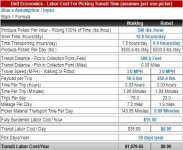
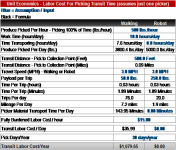
MossRoad, below are the unit economics I was thinking. Apples might be a bad use case, but in certain crops, if we assume the average worker can pick 500 pounds of produce an hour, and then has to travel 500 feet to a collection point over a 10 hour day, that equates to 76 500 foot trips over a 10 hour day, or about 143 minutes walking per day. Assuming 30 days picking per year, that's around $1,080 dollars in labor.

Are there any crops where those types of economics exist (thinking Lettuce, grapes, other items where there is a lot of picking and then shuttling stuff, but also not a ton of weight concentration like apples where you may thus go to big material handling equipment as mentioned by posters previously)? Thinking things like this perhaps:JERoss_Assignments16.jpg

Picture1.jpg
 

Attachments

  • unit economics.png
    unit economics.png
    25.7 KB · Views: 158
Last edited:
   / Robotic Following Cart to Replace Light Duty Tractor Tasks? #36  
I wouldn't let a lawn crew run a skid loader over my lawn to spread mulch in the spring. But, a small tracked robot might not be too bad. It would depend on its impact on an established lawn.

Here's what they use and grass fairs pretty well. Even if they couldn't use it on grass most of their commercial properties have asphalt to run them on. A few sheets of $7 OSB board would solve any turf damage problems.IMG_9177.JPG
 
Last edited:
   / Robotic Following Cart to Replace Light Duty Tractor Tasks? #37  
There are a lot of jobs where much of the job is materials handling, and anything that speeds the handling makes the people doing the job more productive. We've made great strides in the past 150 years or so at replacing the brute force in moving stuff around with machine power rather than human power, but people still spend a lot of time doing it. People are needed to guide the machines where to put stuff, and provide the brute force in places that machines can't go -- like carrying a bathtub up three flights of stairs.

So no doubt that there is a huge market for smarter material handling machines -- machines that can operate without human guidance, or can go places that other machines can't go.
Here's an example of a company that is using robots to move plants around in a greenhouse:
Metrolina Greenhouses: Spacing plants with Harvest Automation HV-1 robots - YouTube
A lot of human labor is being saved there.

Now, autonomous navigation is a hard problem in robotics. Right now, it's the hard problem in robotics. Every major automaker and several other large companies have large teams of smart people working on it-- for self-driving cars -- and whoever ends up solving it is going to be rich and famous. If you solve the problem of autonomous navigation, building general-purpose material-handling robots is straightforward. Conversely, without autonomous navigation -- if a person has to guide it -- a robot is just another material-handling device. And most people prefer a material-handling device that they can ride to one they have to walk with!

Nothing in your video indicates that you've done anything toward solving the problem of autonomous navigation. Following a target visually is not a hard problem -- my kids were doing that with Lego Mindstorms when they were in elementary school a decade ago. And it's not really an evolutionary step on the road to autonomous navigation.

Take a look at that greenhouse video. One of the things that makes navigation an easier problem is to have a controlled environment. If you are working in a greenhouse, where there are walls to limit your movement, the floor is concrete, and you can put navigation aids all over the place, it's much easier to get around than outdoors.

So I would work on navigation first. Start with finding controlled environments. Branch out from there.
 
   / Robotic Following Cart to Replace Light Duty Tractor Tasks?
  • Thread Starter
#38  
There are a lot of jobs where much of the job is materials handling, and anything that speeds the handling makes the people doing the job more productive. We've made great strides in the past 150 years or so at replacing the brute force in moving stuff around with machine power rather than human power, but people still spend a lot of time doing it. People are needed to guide the machines where to put stuff, and provide the brute force in places that machines can't go -- like carrying a bathtub up three flights of stairs.

So no doubt that there is a huge market for smarter material handling machines -- machines that can operate without human guidance, or can go places that other machines can't go.
Here's an example of a company that is using robots to move plants around in a greenhouse:
Metrolina Greenhouses: Spacing plants with Harvest Automation HV-1 robots - YouTube
A lot of human labor is being saved there.

Now, autonomous navigation is a hard problem in robotics. Right now, it's the hard problem in robotics. Every major automaker and several other large companies have large teams of smart people working on it-- for self-driving cars -- and whoever ends up solving it is going to be rich and famous. If you solve the problem of autonomous navigation, building general-purpose material-handling robots is straightforward. Conversely, without autonomous navigation -- if a person has to guide it -- a robot is just another material-handling device. And most people prefer a material-handling device that they can ride to one they have to walk with!

Nothing in your video indicates that you've done anything toward solving the problem of autonomous navigation. Following a target visually is not a hard problem -- my kids were doing that with Lego Mindstorms when they were in elementary school a decade ago. And it's not really an evolutionary step on the road to autonomous navigation.

Take a look at that greenhouse video. One of the things that makes navigation an easier problem is to have a controlled environment. If you are working in a greenhouse, where there are walls to limit your movement, the floor is concrete, and you can put navigation aids all over the place, it's much easier to get around than outdoors.

So I would work on navigation first. Start with finding controlled environments. Branch out from there.

Quicksandfarmer, thank you for the reply. The coding for the prototype you see was done in a day. We know it is not a fully developed product; the question we are trying to answer is not can we build it, but rather, would anyone buy it if we built it and it functioned perfectly as described?

The application I am imagining is walking up and down rows of stuff (grapes, lettuce, tomatoes, mushrooms, etc.) picking into a plastic bin, and then carrying that plastic bin back to a truck or tractor, which is then shuttling it back down to a collection point. With this concept, a picker turns on the Burro (potential name), hits a "home set" button, then walks up to pick; the Burro follows behind him/her with a few plastic bins. When all but the last bin are full, the worker removes the last bin to keep picking into it, and hits a button on the Burro which then retraces its path back home using odometry/GPS, and is emptied by someone packing produce at the collection point. Once emptied, that person hits a "return to Picker" button, and the Burro returns back to the picker ready to be filled again.

The technology is a tricky part; the commercial example you used is an example (I believe) of guys who developed technology for a problem that didn't really exist in a widespread area, and at a huge cost (about $30M raised). Thus, reducing a paint point at a reasonable cost is the biggest challenge. Is this the same type of thing (not a big pain point)? Or do we have a pain point?
 
Last edited:
   / Robotic Following Cart to Replace Light Duty Tractor Tasks? #39  
OK, normally you start with a need an design a solution for it, but sometimes it works to start with the solution and then find the problem it solves.

Think about jobs that have to be done by hand, because they are complicated. Then think about jobs that are typically done by an expert and a helper. Why does the expert have a helper instead of another expert? Because the job has a component of unskilled labor and there's no point in paying an expert for unskilled labor. What you are looking to do is replace the helper. Think of your target as what a 16-year-old boy would have to do to be helpful. If all he did was follow me around I'd send him home at lunchtime. A lot of helper jobs fall into one of two categories, either "keep feeding me materials as fast as I can use them" or "pick up what I create and carry it away for collection." Think of a bricklayer, he's got a helper whose job it is to give him a steady supply of bricks and mortar. That's the kind of job your machine has to be able to do.

You want to be looking at places where high-skill labor is used, where you can make someone with expensive skills more productive. I don't think harvesting agricultural products is going to be there, that's all about using the cheapest labor possible.
 
   / Robotic Following Cart to Replace Light Duty Tractor Tasks?
  • Thread Starter
#40  
OK, normally you start with a need an design a solution for it, but sometimes it works to start with the solution and then find the problem it solves.

Think about jobs that have to be done by hand, because they are complicated. Then think about jobs that are typically done by an expert and a helper. Why does the expert have a helper instead of another expert? Because the job has a component of unskilled labor and there's no point in paying an expert for unskilled labor. What you are looking to do is replace the helper. Think of your target as what a 16-year-old boy would have to do to be helpful. If all he did was follow me around I'd send him home at lunchtime. A lot of helper jobs fall into one of two categories, either "keep feeding me materials as fast as I can use them" or "pick up what I create and carry it away for collection." Think of a bricklayer, he's got a helper whose job it is to give him a steady supply of bricks and mortar. That's the kind of job your machine has to be able to do.

You want to be looking at places where high-skill labor is used, where you can make someone with expensive skills more productive. I don't think harvesting agricultural products is going to be there, that's all about using the cheapest labor possible.

Do you produce/harvest many vegetable/fruit products and not see a need then because the labor cost is so cheap to harvest?
 

Marketplace Items

Kubota LA525 Front Loader Tractor Arm Attachment (A59228)
Kubota LA525 Front...
CAT CB34 (A60462)
CAT CB34 (A60462)
2013 FREIGHTLINER CASCADIA SINGLE AXLE DAY CAB (A59904)
2013 FREIGHTLINER...
2009 CHEVROLET C8500 CREW CAB FLATBED TRUCK (A59823)
2009 CHEVROLET...
2001 International 4000 DT 466E (A60462)
2001 International...
17501-FL (A56857)
17501-FL (A56857)
 
Top