What would you do differently if you built a new shop

   / What would you do differently if you built a new shop #1  

woodlandfarms

Super Member
Joined
Jul 31, 2006
Messages
6,149
Location
Los Angeles / SW Washington
Tractor
PowerTrac 1850, Kubota RTV x900
OK, I am in the midst of my shop design. 80x80 with a modern look. There are a bunch of things I am working through (Liike how do I keep it clean, where do I pressure wash the muddy tractor, how do I deal with engine smoke and oil spills).

A bunch of you have built shops, and I believe firmly it is easier to learn from peoples failures than successes, so would love to hear what things you would change next time around and why.

Hopefully it will turn into a useful thread.
 
   / What would you do differently if you built a new shop #2  
I'd get a couple good, quality air hose reels and mount them catty-corner up towards the ceiling. Your 80x80 is large, so you may need 4. But my garage is less than half that size, so I'd only need 2. One in a back corner will take care of two walls and one in a front corner will take care of the other two walls, and the outdoors if needed.

I'd have a small room for the air compressor.... its loud. :eek:

I'd have a small restroom with toilet and WIDE sink. Wide enough to get my forearms into when washing grease up to my elbows. :confused3:

I'd have radiant floor heating!!!
I worked at airports with heated hangar floors.... oh man is that nice! :thumbsup:

Plenty of 110v quad boxes.
Just a few 220v boxes. I have no 220V equipment.

Arc welder outlet... I'd only have one. If I had to spend money on wiring in the garage to have two, I'd rather put the money towards longer leads for the welder instead. Locate it nearer to the front door in case you ever want to weld outdoors and make sure your leads are long enough to get to all sides of a project in the driveway.

I don't do woodworking, but a dust collection system would be nice sometimes. A good shopvac with some plumbing around the garage can suffice. Several sucker outlets on each wall plumbed back to a shop vac location will work. I've found swimming pool vacuum hose works pretty well for a vacuum hose for doing our cars in the driveway. Its 25' long! :thumbsup:

Small beverage fridge, of course! :licking: Its also handy to keep fresh fishing bait in the summer, if you're so inclined. :fishing:

Tool boxes. I hate peg board.

I'd make the large door and driveway face south. Why? Here we get snow and ice. North sides never melt due to low angle of sun. East and west are better than north. South is the best. If I lived in the south, I'd probably want the door in the shade.

A small, covered area outdoors on one side of the shop. Its nice to work on stuff outside sometimes, or put a picnic table there.

10' minimum ceilings. My current garage has this....:thumbsup:

Telephone used to be important. Cell phone may negate it, depending on location.
Internet, too.
TV... something for entertainment.
Computer for looking up TBN for help!!!

A vehicle lift. On my wish list.

I'll think of more, I'm sure. :laughing:
 
   / What would you do differently if you built a new shop #3  
Start with a good box! Most everybody here focuses on the nick nacks before they build and then complain about the building after it's done.
Proper concrete footings, proper structure, proper insulation and proper sized utilities to the building. Utilities include water, sewer, tv, internet/network and electrical.
Consider RV size or other special vehicle height requirements for doors.

You don't indicate whether or not the walls will be closed or open. If closed I'll add a bunch more to the list.

In my last few shops I run 12/3 romex. With that I have 2 20a circuits at every plug location. I also have a 240v and 120v circuit/outlets near the bay door/doors that lead to the entry. We all end up working on stuff outside.

Floor drain vs sloped floor vs gravel floor section is something you will need to decide based on climate and use and building type.
 
Last edited:
   / What would you do differently if you built a new shop #4  
One thing I have found with 2 shops I have had. When pouring the footings and foundation, make sure the concrete comes up at least 18" above finished grade. I found this the hard way when I had wood rot caused by the previous owner building walls directly on the slab. This allowed heavy water runoff to run between the slab and framing eventualy causing rot.

Put in lots of plugs, all at about 4ft off the floor, you never know where the work bench will end up. On a shop that is 80x80 put in a big electric service. On a shop this size, a minimum would be 100A 240V panel.

Get at least one table with wheels. Its nice to have a bench close to where you are working to lay tools/parts on.

Plumb the whole shop for air service. Why drag air hoses all over the shop.

Look at your HVAC. Will you need AC? Heating in winter? Since your listed as LA, I guess AC would be important. Will you need a separate room for painting, finishing?

Having water for toilet and a sink would be a must for me too. Keep as much dirt out of the house as possible would keep the other half happier.
 
   / What would you do differently if you built a new shop #5  
I don't get why people want to keep their shop floor as clean as their kitchen floor. It's a shop, when I walk out to mine I see the oil stains everywhere and the dirtiness of it and it makes me realize it's a shop and stuff gets worked on there. If it's spotless and the floor is super clean I may as well have a basement on the house and with a couch and TV and not come out of it. I walk in peoples shops and they're clean and I think they don't do anything. Mine does get blown out with the leaf blower if the door is open after mowing the yard, lol. I do know a guy who has a shop about the size of mine and you can't see the top of his work bench, you ask him for a tool he has to look for 5 minutes to find it because it's on the workbench and the floor is so cluttered with stuff you can't work on anything in it. I went by not long ago and he was putting a starter on his truck, outside on a piece of cardboard because he had no room to get it in the shop. There's a big difference between cleanliness and usability. Good luck with your new shop build!
 
   / What would you do differently if you built a new shop #6  
I don't get why people want to keep their shop floor as clean as their kitchen floor. It's a shop, when I walk out to mine I see the oil stains everywhere and the dirtiness of it and it makes me realize it's a shop and stuff gets worked on there. If it's spotless and the floor is super clean I may as well have a basement on the house and with a couch and TV and not come out of it. I walk in peoples shops and they're clean and I think they don't do anything. Mine does get blown out with the leaf blower if the door is open after mowing the yard, lol. I do know a guy who has a shop about the size of mine and you can't see the top of his work bench, you ask him for a tool he has to look for 5 minutes to find it because it's on the workbench and the floor is so cluttered with stuff you can't work on anything in it. I went by not long ago and he was putting a starter on his truck, outside on a piece of cardboard because he had no room to get it in the shop. There's a big difference between cleanliness and usability. Good luck with your new shop build!


I would use fibre reinforced concrete, and the heaviest gauge reinforcing mesh available, making certain that the concrete installers PULL THE MESH UP as they are pouring. Make certain that floor thickness is adequate for ANY future weight.
I would put plastic piping in concrete in floor for radiant heating (even if OP does not plan to install radiant heat right away).
Have concrete expansion joints CUT in floor within 16 hours of pouring.
Seal concrete (use garden sprayer).
Paint 2 coats of 2 part epoxy coating on floor, after concrete curing, but BEFORE putting ANYTHING in the building.
 
   / What would you do differently if you built a new shop #7  
Before pouring the floor I would have a couple floor anchors installed out of the way. Really wish I would have done that as they are great when bending or straightening stuff when you can anchor it to the world.
Floor heat, drains and plumbing. Anything under the concrete basically cuz the rest can be added later even if it is a bear.
 
   / What would you do differently if you built a new shop #8  
For power tools, 20 amp circuits with outlets 48" high.
All shop lighting on separate circuit from tool outlets.
\Multiple 220 VAC outlets'
Shop breaker panel fed from household main panel.
Air tool plumbing with drains at each outlet.
I hate tripping on electrical cords to I installed an overhead swinging arm that allows me to plug in power from overhead, also later added an airline connection.
This allows me to have a work or assembly table free of air and electric lines to trip over.*
Wall mounted air line reel and outdoor air connection.
Last and most important, much bigger shop!
Annex that houses compressor and central shop vac system.
Baseboard vacuum sweeping collection point.
Metal or PVC cladding on lower 4' of shop walls to allow vehicle washing.
Thru the wall smoke and fume extractor for that dust, paint and welding fume extraction.

*I often will have 2-3 power tools and even a couple of air tools all in use on the same project!
 
   / What would you do differently if you built a new shop #9  
OK, I am in the midst of my shop design. 80x80 with a modern look. There are a bunch of things I am working through (Liike how do I keep it clean, where do I pressure wash the muddy tractor, how do I deal with engine smoke and oil spills).

A bunch of you have built shops, and I believe firmly it is easier to learn from peoples failures than successes, so would love to hear what things you would change next time around and why.

Hopefully it will turn into a useful thread.
OP - Do you have a timeline?
This discussion could go on for years.
Have you visited Garage Journal?
There can be a lot of "finer" points like putting in strategically placed floor drains, optimum lighting, etc. etc. etc.

I never had a shop of my own before buying over 5,000 sq feet of shop with my future retirement home.

But I've noticed some critical things:
PLAN on change. Make it flexible. Oversize the utilities a bit. Get high.
I didn't have any 240V tools, now I've a shop full.
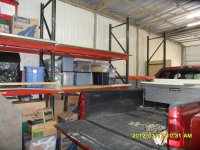
By get high I mean give yourself PLENTY of ceiling height. I've one shop with 14 foot to the crossbeams. I hope to put in a 4 post lift to accommodate my F350.

I don't get why people want to keep their shop floor as clean as their kitchen floor. It's a shop, when I walk out to mine I see the oil stains everywhere and the dirtiness of it and it makes me realize it's a shop and stuff gets worked on there.
I view the stains as badges of work done. I try to contain spills but life happens.
If it's spotless and the floor is super clean I may as well have a basement on the house and with a couch and TV and not come out of it. I walk in peoples shops and they're clean and I think they don't do anything. Mine does get blown out with the leaf blower if the door is open after mowing the yard, lol.
That is one of my delights being able to use a leaf blower for indoor cleaning :)

I do know a guy who has a shop about the size of mine and you can't see the top of his work bench, you ask him for a tool he has to look for 5 minutes to find it because it's on the workbench and the floor is so cluttered with stuff you can't work on anything in it. I went by not long ago and he was putting a starter on his truck, outside on a piece of cardboard because he had no room to get it in the shop. There's a big difference between cleanliness and usability. Good luck with your new shop build!
Many of the TBN'ers are what I consider "vertically challenged" for storage.
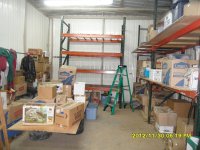
I rant and rave about the wonderful utility of pallet racks.
With sufficient pallet racking and smart storage practices one can quadruple the storage and work area. Get everything off the floor so you can use a leaf blower to clean it!
 

Attachments

  • 8x6SAM_0768.jpg
    8x6SAM_0768.jpg
    407.3 KB · Views: 537
  • 8x6ford-in-rv2.JPG
    8x6ford-in-rv2.JPG
    305.7 KB · Views: 394
   / What would you do differently if you built a new shop #10  
Ridge ventilation.
Ball washer... Well, if you're going to have a central vac system so you don't have to drag a dust pan out, might as well wash your balls with all that spare time.
 
   / What would you do differently if you built a new shop #11  
My shop was built in 2005 (24 x 42 ft, 12 ft walls, two 10x10 ft rollup doors, 1 entry door, 1 window, galvanized steel frame).
Now I'd build a 40x40 ft red iron building with 15 ft walls, two 15x15 ft entries on opposite ends with split sliding doors, two entry doors, two windows, and a few translucent roof panels.

Good luck on your project
 
   / What would you do differently if you built a new shop #12  
I'm only on my second shop, but I have been playing around with plans for my third, and final shop/barn build. Concrete floors regardless of what they cost. I went with gravel on my first shop, and concrete on my current one. It's night and day worthwhile!!! I prefer rebar over mesh. In 100 percent of every slab I've seen done with wire mesh in person and pictures on here, it gets stepped on and ends up resting below the concrete. You cannot pull it up and walk on it and expect it to stay in the middle of the slab.

Insulation is going to be a priority next time. In the summer, it's an oven in there. In winter, it can be painfully cold and even with a heater going, it barely makes it comfortable.

Water spickets all around the outside, but especially next to the roll up doors.

Wider roll up doors. I went ten by ten on this shop, and it's tight. I can get my truck in there and back up my trailer into there, but I know it's just a matter of time until I hit something. Ten feet high seems to be a good height for doors, 12 feet wide would be the minimum. I also really like roll up doors and will use them next time. I've seen where some guys have a drive through shop with a roll up door on either side. I really like that idea!!!

At least one walk through door, with more being better.

No florescent lights!!!! They are a pain and always need replacing.

Counter space next to my sink. I have a shelf over it now and a bar stool sitting next to it that is always loaded with stuff.

More shelving. No matter how many shelves you have, you never have enough.

Air hose connections outside your shop. If possible, at more then one location.

12 foot side walls seem to be about perfect. I need a ladder to get to my higher shelves, but I have plenty of room for handling plywood or anything else I'm working on without hitting the ceiling.

I covered all my walls in OSB and really like how easy it is to hang stuff. I'll probably do the same on the next shop, but prime and paint it as soon as I install it.
 
   / What would you do differently if you built a new shop #13  
This sounds like an interesting thread.

Build a lean to along one side for cold storage. You don't need to keep everything in the shop. Again lots of outlets. Both air and electrical.

Insulation always makes a work shop more comfortable. Summer and winter.
 
   / What would you do differently if you built a new shop #14  
Hello,
An 80' x80' is a big building. I guess it's going to be only 1 floor. I recently built a 36' x40' 2 story garage workshop combination so I can appreciate the size of your building. I don't know exactly what you intend to do in there, but it is sure big enough to be able to cut it up into different areas. I like a lot of windows so there is plenty of natural light and ventilation. If you are worried about security with a lot of windows, install a security system.....that cures that problem. If you are putting in individual garage doors, use 10' wide, nothing smaller. I think one of the most important things to consider is lighting. I put 3 separate lighting circuits in the downstairs garage part of my building. That way I could turn on only the lights in the bay I was working. I didn't think there was any need to have all the lights on at once......I have 12 4 bulb T8 fixtures, each one using 128 watts. That's 1536 watts being used when all the lights are on....it's like running a 1500 watt heater. I also did it the same way in my upstairs woodworking shop.....it has worked out great! If you ever intend to put a 2 post lift in your building, you could beef up the concrete floor area when you pour the floor. Ceiling fans might be good in a building that big, so when you do the electric, don't forget to allow for them. These are just some of my ideas......hope they might give you something to ponder. Good luck !
MFWD
 
   / What would you do differently if you built a new shop #15  
Insulation and cross ventilation is the best thing I did with my shop.
 
   / What would you do differently if you built a new shop #16  
, making certain that the concrete installers PULL THE MESH UP as they are pouring.

This is a common mistake made by most concrete installers. You cant "Pull the mesh up" while standing on it. Sure they hook it up and maybe get a rock under it if lucky, but the mesh remains on the bottom 1" of the concrete because the workers are constantly walking on it when laying the concrete.
Always make the reinforcing contractor lay the rebar or mesh on a concrete block or plastic coated steel chairs designed for the task , otherwise you are pretty much wasting your time putting in reinforcement.
 
   / What would you do differently if you built a new shop #17  
What I did at my small shop (30x30) was have the contractor lay a 2 tier CMU block wall around the perimeter. ( I would go 3 tier if done again so as to increase ceiling height). The CMU blocks are filled with concrete and tied to the slab with rebar. The walls are built on this block wall. This does 3 things- 1)It raises the height of the ceiling 2) I keeps the rain from spattering up on the outside wall and staining it or rotting it out 3) It allows me to pressure wash the inside without spaying water all over the walls.

My shop is totally wooden structure with 9 foot studs for the walls so with the 2 courses of block it is 10'4" inside height which is high enough for my B26 to enter but not my LS. I might have made it high enough for the LS if I had owned it when building the shop.
 
   / What would you do differently if you built a new shop #18  
Having had both, I really like a square building versus long rectangular. Much better use of space.

12ft wide minimum on the rollups.

Windows, windows, windows. My 42x50 has six windows, walkin door with window, three 12ft wide rollups with one glass panel. Only reason I turn on the lights during the day is because my air compressor is relayed into the light circuit. Ensures compressor is turned off when I leave.

Bathroom with room for the air compressor for above mentioned noise control.

HIGH QUALITY concrete pour. 6" depth minimum. Solid grade. Power troweled for easy sweep. Drains, slopes, etc., all are dependent on use. I have no drains, poured flat. I use my floor to mock builds. Flat floor makes it easy to get the vertical pieces upright. Make sure to form recesses for your doors to close on so water can't blow in under the doors.

Insulate, insulate, insulate.

Lights, lights, lights.

110V plugs every 10ft or less.

Welder plugs every 25ft of less (depending on your use of such a thing).

Compressed air outlets every 25ft (depending on your use of such a thing).

Trying to just stick with design issues. How you arrange things after you move in is on you. :)

What's your primary use?

P.S. I'd never, ever wash a muddy vehicle in my shop. If you often have a need to do that pour yourself a pad outside.
 
   / What would you do differently if you built a new shop #19  
In 2009 I had a 50' wide by 40' deep custom designed Conner Homes brand barn built with part of the width enclosing a bay for my boat, with that area having insulation at the interior wall where the boat bay joins the 'garage' section, (2, 40' deep bays}. The ceiling in the boat bay is 14' height, and the bay roll up door is 12' high and 12' wide. It does not currently have an electric opener, but could at any time. I put in a floor drain that breaks to daylight at a small stream outside the building, and also installed a shower pad and utility sink at the back corner adjacent to the electric/mechanical room. The pad for the shower was poured and has non-slip tile. It is for use to clean off the dog or cat! as needed, etc.
Inside the first garage bay via a 3.0' man door from the boat bay is a concrete floor with radiant heat throughout the entire shop floor, which connects to a Buderus gas boiler that heats the garage bays, but not the boat bay. The boiler also heats the upstairs apartment with a side exterior stairway, so to not take up valuable interior floor space.
The rear of the barn, 50' wide, has a ramped driveway apron and man door entry at grade, in case future need for wheelchair access were ever warranted. There is a bay door 9' x9' on a chaindrive opener. The man door allows entry to a back shop where I keep old stereo equipment and other stuff I may want to work with/on. Th is area is insulated, but NOT heated, unless I fire up the Renai, (sp?) propane heater. As one passes through the work area, another man door allows entry into the apartment area, which can be isolated by separate key locks from the outside stairwell entry at one end of the kitchen. The rest of the area over the shop/garage is living room, bathroom, and bedroom. Above the back workshop area is a hatchway to the attic storage area. Adjacent to the workshop is a slanted roof storage area that is over the boat bay, and runs the depth of the building.
I forgot to mention I designed a boat lift system into the ceiling of the boat bay, which allows me to use two hand operated chain hoists. I had nylon slings and two steel 'beams' made to create a 'cradle' for the boat to sit in when I haul it off its trailer to service either boat or trailer or both.
To anchor the chain hoists to the two, entire span of the width of the ceiling, glue-lams I had a crane fabrication company make me to screw eye/swivel end bolts that I drilled through the glue-lams to attach the chain hoists to.
This system took some careful calculations to get everything right/safe/and working properly. BTW, electric hoists were way too much money! I have 2, 2 ton capacity hoists, and they move quickly by hand, no big delay in hoist time or lowering.

Back to the barn garage/shop bays. I also included, next to the elect/machanical room a second room which houses a 3/4 bath with utility sink, stall shower and toilet. This is very handy, and at times it I'm really dirty from working on stuff I will shower there before entry into 'her' castle!:confused3:
So mech/elect room, then alongside, bath, then at end of that wall which is at the back of the two bays with entry on the front side of the barn, is a section where I have a skid mounted 330 gallon diesel tank, with spray foam insulation on the outside, since the foam guy was spraying other area of the barn walls, etc. It is vented to outside and runs off 110V outlet. The upstairs apartment has radiant heat attached to the underside of the ceiling joists in the barn bays. I use Flourex lights which are very bright, almost instant on lighting, supplemented by task lighting from Home Depot's 4' LED shop lights, which can be interconnected up to 9 units. I have numerous 4' height duplex outlets and some ceiling mount quads too. So far, no mounted air line reels etc., because I don't use air that much and have several pancake compressors for point of use. I did install Swiss Trax brand floor tiles over the concrete floors, in all bays except the boat bay. They are excellent, expensive, and CAN"T be used where tractor chains with bars on the chains are in use. I solved that issue by buying a bunch of rubber mats with holes in them for drainage of snow, etc. to put over the Swiss Trax in the area of the tractor's rear tires. They provide a comfortable floor surface, excellent drainage to the floor drains in the center of each bay, and can be removed fairly easily if need to clean under some area arises. I can use a leaf blower to get rid of wind blown leaves in the Fall.

Recently I contracted my local solar guy who installed 30 PV collectors on my roof and tied into my house's main panel in conjunction with a 16kW German made Sonnen battery storage system, to allow for near grid free electric use. This entire system ties in with my 20kW propane generator to work as a self sufficient supply of electric to my entire property. First is PV solar generation, which is fed into a DC to AC inverter, then backfed through my utility providers meter for credits on my account, amounting to 5.3 cents OVER what I would otherwise pay, IF I were to buy those kWs from them. Then the same kWs I have generated at my collectors go to the storage batteries for consumption when I have electric demand at the house/barn and sheds 1.0 and 2.0.
As the battery storage drains down to a preset low limit the batteries seek power and look to the PV, then the g grid and finally to my propane generator.
If the grid is down due to storm or whatever, there is no PV available, and the batteries are drained, then the system trips a relay and the generator provides power to the house, and eventually to the storage system if the grid is down for an extended timeframe. An essential loads panel is used to feed the barn, when there is
enough PV or stored kWs in the battery system. This is the ONLY drawback to the batteries. They have a 16kW rating for STORAGE, but cannot deal with my existing 20 kW generator, and my hot tub large mp draw because the OUTPUT capacity is only 8kW, which I did not know until AFTER the solar guy and electrician were already way into the hookup. This part was a complete NIGHTMARE and took weeks of going back and forth with all parties to find an eventual resolution, at HUGE expense to me in the process.
Am I glad I did the entire project - jury's out, it's too soon to tell. BUT I did get a 30% tax credit off any taxes I owe, so a $60,000 initial investment NOT including the electric hookup costs, ends up costing me $40,000+++
Enough for now, hope it's of use to you in your planning. Feel free to ask any question you might have.
Next installment, Shed 2.0, for implements and other overage that won't fit, no matter how big you build, you will ALWAYS need more space!:thumbsup::confused3:
 
   / What would you do differently if you built a new shop #20  
Put porches over every door. Both walk through doors, and roll up doors. I'm in the process of doing that to my current shop and will include it in my next one.
 

Tractor & Equipment Auctions

Willmar 4550 Wrangler Articulating Loader (A56438)
Willmar 4550...
2017 CATERPILLAR 120M2 MOTORGRADER (A52709)
2017 CATERPILLAR...
2025 CFG Industrial QK18R Mini Excavator (A59228)
2025 CFG...
2018 Kubota U17 (A53317)
2018 Kubota U17...
KBH Tender (A56438)
KBH Tender (A56438)
2006 INTERNATIONAL 7400 6X4 DUMP TRUCK (A52706)
2006 INTERNATIONAL...
 
Top