Still in the research process for a new tractor for our mountain, farm, & client properties. Are Ag or Industrial tires tougher / stronger? When do you recommend filling them vs. not filling them? Pros/cons? Thanks!
You are using an out of date browser. It may not display this or other websites correctly.
You should upgrade or use an alternative browser.
You should upgrade or use an alternative browser.
Ag vs. Industrial tire strengths
- Thread starter coolbrze
- Start date
- Views: 21016
More options
Who Replied?
/ Ag vs. Industrial tire strengths
#1

check
Elite Member
- Joined
- Sep 26, 2008
- Messages
- 4,164
- Tractor
- 2009 Kubota BX25
Still in the research process for a new tractor for our mountain, farm, & client properties. Are Ag or Industrial tires tougher / stronger? When do you recommend filling them vs. not filling them? Pros/cons? Thanks!
Industrial ties are far, far stronger, and you can fill both. Fill them if you want to improve stability and or keep the back end down when using the FEL. I don't fill mine on my Kabota BX 25. Don't need to. Always have something on the back to serve as a counterweight.

jbrumberg
Elite Member
- Joined
- Jan 22, 2006
- Messages
- 4,903
- Location
- Cummington, MA
- Tractor
- New Holland TC29DA, John Deere D130
Weighted tires help increase traction and add stability. Mine are filled with CaCl2. I now wish that they were filled with beet juice.
R1's (Ag) for field/dirt and mud operations. They will not load up as quickly as R4's. R1's have better traction on slopes = they will really tear up the lawn. R1's will "goo" forward in deep mud much better than they can "goo" in reverse. Once R1's really start loading up going forward one should start worrying about going in reverse.
R4's are a compromise. They have less traction and load up with mud and snow quicker. They do less lawn damage and with the stiffer/thicker tire with higher load ratings so they are more puncture proof and the front tires wear better than R1's for FEL operation.
There are many, many old threads comparing R1's to R4's. And many, many different/differing opinions by different owner/operators.
I am sure someone will imply that I am posting from where the sun does not shine, and that's OK with me.
R1's (Ag) for field/dirt and mud operations. They will not load up as quickly as R4's. R1's have better traction on slopes = they will really tear up the lawn. R1's will "goo" forward in deep mud much better than they can "goo" in reverse. Once R1's really start loading up going forward one should start worrying about going in reverse.
R4's are a compromise. They have less traction and load up with mud and snow quicker. They do less lawn damage and with the stiffer/thicker tire with higher load ratings so they are more puncture proof and the front tires wear better than R1's for FEL operation.
There are many, many old threads comparing R1's to R4's. And many, many different/differing opinions by different owner/operators.
I am sure someone will imply that I am posting from where the sun does not shine, and that's OK with me.

airbiscuit
Super Member
- Joined
- Aug 28, 2004
- Messages
- 7,626
- Location
- NW Wisconsin
- Tractor
- New Holland T2310 (40hp), Kubota L3010 GST, New Holland TC21DA *** Previously - Farmall H, 1941 John Deere B, Shibaura SD1500, John Deere 850, Bobcat 642, New Holland 1925
Weighted tires help increase traction and add stability. Mine are filled with CaCl2. I now wish that they were filled with beet juice.
R1's (Ag) for field/dirt and mud operations. They will not load up as quickly as R4's. R1's have better traction on slopes = they will really tear up the lawn. R1's will "goo" forward in deep mud much better than they can "goo" in reverse. Once R1's really start loading up going forward one should start worrying about going in reverse.
R4's are a compromise. They have less traction and load up with mud and snow quicker. They do less lawn damage and with the stiffer/thicker tire with higher load ratings so they are more puncture proof and the front tires wear better than R1's for FEL operation.
There are many, many old threads comparing R1's to R4's. And many, many different/differing opinions by different owner/operators.
I am sure someone will imply that I am posting from where the sun does not shine, and that's OK with me.
I have had both R4s and R1s, and I pretty much agree with all of the above. I would add that I think R4s are perhaps more puncture resistant in the woods. They also seem a little more robust with the weight of a full loader bucket (I cringe when I see my front R1s bulging as I lift a big load of dirt).
That said, for my needs I prefer the R1s for the TRACTION. They just plain pull better, and in wet snow, the R4s would load up with snow and turn into racing slicks. Chains are an antidote to this.
jbrumberg
Elite Member
- Joined
- Jan 22, 2006
- Messages
- 4,903
- Location
- Cummington, MA
- Tractor
- New Holland TC29DA, John Deere D130
My R1 front tires are tubed and only 6 ply. I do not think that they make a higher ply tire in my size tire. They really do bulge with heavy FEL loads.

CobyRupert
Super Member
Has OP also decided which is better, a gear tractor or a hydro?  :stirthepot:
:stirthepot:
airbiscuit
Super Member
- Joined
- Aug 28, 2004
- Messages
- 7,626
- Location
- NW Wisconsin
- Tractor
- New Holland T2310 (40hp), Kubota L3010 GST, New Holland TC21DA *** Previously - Farmall H, 1941 John Deere B, Shibaura SD1500, John Deere 850, Bobcat 642, New Holland 1925
Has OP also decided which is better, a gear tractor or a hydro?
Or what color they like best?
Oldoak
Veteran Member
- Joined
- Feb 20, 2013
- Messages
- 1,817
- Tractor
- Kubota L5060GST, J D X758 GT, J D 855D XUV
Has OP also decided which is better, a gear tractor or a hydro?
My personal preference, R1s, at least 6 ply and loaded for any farm or ranch work. R4s, at least to me, are like having worn down R1s as far as for traction. :confused3:

Gary Fowler
Super Star Member
- Joined
- Jun 23, 2008
- Messages
- 11,998
- Location
- Bismarck Arkansas
- Tractor
- 2009 Kubota RTV 900, 2009 Kubota B26 TLB & 2010 model LS P7010
If you use R4 then never remove the FEL because if you get into any mud, you will need the FEL to push yourself out of it. R4 tires are not much better than racing slicks for traction in the wet. In dry conditions, I think they may tie or even surpass R1 tires since they are usually much wider tires.
As for puncture resistance, if the object will puncture a R1 in 6 Ply then it likely will also puncture the 8 ply in the R4 also. A new R4 have very low tread compared to a new R1 and an object that might penetrate a R4 with its low tread might not even reach the tire on a R1 due to the high bar lugs.
The only flat tire I have ever had has been on my R4 tires. Never had a flat with my R1 tires. I have had to retrieve tractors with R4's from the mud several times using my R1 tired tractor which just plowed right thru the spot that had stalled the R4 tires.
As for puncture resistance, if the object will puncture a R1 in 6 Ply then it likely will also puncture the 8 ply in the R4 also. A new R4 have very low tread compared to a new R1 and an object that might penetrate a R4 with its low tread might not even reach the tire on a R1 due to the high bar lugs.
The only flat tire I have ever had has been on my R4 tires. Never had a flat with my R1 tires. I have had to retrieve tractors with R4's from the mud several times using my R1 tired tractor which just plowed right thru the spot that had stalled the R4 tires.

oosik
Epic Contributor
My M6040 has R-1 tires with the rears filled with 774# of Rimguard per tire. Total weight with grapple and rear blade installed - 10,100#.
I own 80 acres with a mile long gravel driveway - R-4 tires simply would not provide the traction I need to get around my property.
I've been on the property for 36+ years. Owned a tractor with R-1 tires all that time. Never had a flat or reason to wish I had any other type of tires. My front tires are inflated to the max because I DO carry heavy loads with the grapple.
I own 80 acres with a mile long gravel driveway - R-4 tires simply would not provide the traction I need to get around my property.
I've been on the property for 36+ years. Owned a tractor with R-1 tires all that time. Never had a flat or reason to wish I had any other type of tires. My front tires are inflated to the max because I DO carry heavy loads with the grapple.

Still in the research process for a new tractor for our mountain, farm, & client properties. Are Ag or Industrial tires tougher / stronger? When do you recommend filling them vs. not filling them? Pros/cons? Thanks!
As someone that just went from a utility tractor (NH WM55) with R1s to a compact (Kubota L6060HSTC) with R4s in the past two months I can tell you my opinion thus far.
I haven’t picked up any super heavy loads with my R4s yet other than buckets of rain soaked mud earlier this week, but I have not noticed any bulging like I would with the R1 tires I had on my last tractor. When lifting to loader max on my last tractor, which was about 1400# with my clamp on forks, the front tires would bulge bad. I filled them to max air to be able to lift heavy loads. I had the same issue in my tractor before that as it had R1s as well but was smaller with much less lift. I would say likely if you got better R1s they might not bulge as bad.
I can’t speak to stability much because I haven’t had my R4s on the hillside yet due to the mud and snow this year. But the stiffer tire feels more stable on the inclines I have had it on. It doesn’t bounce as much on uneven ground. It also rides much smoother on hard ground like the road and my driveway.
Snow traction the R4s have been much better than I would have guessed. I have yet to have an issue on my driveway clearing snow and it’s rather steep. My R1s I got to where I did not trust them on my driveway because sometimes it would lose traction on icy spots.
Mud traction on the R4 tires is pathetic compared to the R1s. It’s like nascar tire spinning on ice. As others mentioned the bucket is a necessity to move the tractor when finding yourself in that condition. The R1 tires had their issues with mud too, I’ve gotten in positions where I could not push into dirt/mud to lift it or unable to pull the box blade forward. However, they would always go without help in the thickest mud. The R4 tires don’t steer well in the mud, and the R1 tires did not usually have that issue.
Damage to my yard during soft winter conditions of the thaw season still happens with the R4 tires. The ruts are not quite as deep and the water does not pool in the ruts allowing the water to drain better from them. Damage to my gravel driveway is far less with the R4 tires versus my previous R1 tires especially when turning in a tight radius.
I got the R4 tires based on my usage and damage to my yard and driveway. I hope I don’t regret it when mowing on the hillside.
I never had issues with punctures on my last R1s. We had a house built and they were very careless with nails along with other materials. Plus I did a lot of brush clearing in wooded areas and took out a couple barb wire fence lines. Now my smaller tractor before I did manage to get a hole in one of the fronts and I discovered it already had a tube. I just put another one in it.
If you want maximum traction on dirt and mud no doubt get the R1 tires, especially for ground moving implements. If you’re lifting and doing more construction oriented things, or lots of snow removal, then R4s.
Also, I have always had my rear tires loaded. My last tractor also had the fronts loaded which I think helped for turning.
Matt
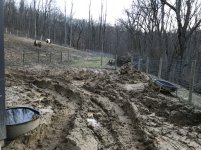
Ps: This is what I was into earlier this week preparing for the flooding we are getting now. I used the loader to make that big pile after I reduced the elevation to promote drainage in this area until I can fix the mess come dry weather. The mud was about 6-8” deep, just below the top of my mud boots in some places.

Wolfy
Veteran Member
I have tractors with R1s, R3s, and R4s, and none of them are worth a Dxxx in the snow without tire chains. Loaded tires are very important, especially with the huge lifting power of today's FELs. However, I would skip the juice and get cast iron wheel weights. Pay more up front, but never having to fight a 500lb tire or worrying about fluid leaks/repairs is priceless.

jeff9366
Super Star Member
- Joined
- Jan 14, 2011
- Messages
- 12,787
- Tractor
- Kubota Tractor Loader L3560 HST+ ~~~~~~~~~~~~~ 3,700 pounds bare tractor, 5,400 pounds operating weight, 37 horsepower
Still in the research process for a new tractor for our mountain, farm, & client properties.
R1/ag tires provide better tractive power. Especially important working on hillsides, where wheel slip can potentially result in tractor rollover.
R1s can be special ordered with 6-ply and 8-ply rather than standard 4-ply, possibly more. As ply count increases, rigidity increases and traction very slightly decreases.
R1s with bar tread are prone to marking lawns where R4s do not.
Last edited:
Turbys_1700
Elite Member
I ran Ag tires my whole life until my last tractor purchase. I prefer Ag's. If I could get a 12 or 14 ply tubeless in a R1 tire I would jump all over it. My current 8 ply R4's mounted on my Workmaster 50 are more puncture resistant than the 4 ply Ag tires currently mounted on my Ford 4610 SU. Makes sense since they are thicker. That is about the only advantage I see in them on the rear. On the front R4's are better for FEL's that have high lift capacities. I always load the rears.
I'm getting ready to mount a pair of 12 ply R4's on my Ford 4610 SU. I use it to brush hog and hope for increased thorn resistance. I mounted 18 ply aircraft tires on the front from Gensco. They are the cats meow.
I'm getting ready to mount a pair of 12 ply R4's on my Ford 4610 SU. I use it to brush hog and hope for increased thorn resistance. I mounted 18 ply aircraft tires on the front from Gensco. They are the cats meow.

BrokeFarmerJohn
Veteran Member
- Joined
- Oct 7, 2016
- Messages
- 2,235
- Location
- Columbus Ohio
- Tractor
- 2017 Mahindra 5555, John Blue G-1000, Massey Ferguson 98, John Deere GP
I have R4s, I have to have the tractor in 4wd to push 6in of snow without chains and the tractor is 5300lbs.
If buying new I would go turfs and only the Multi Trac tread, they are better in snow, as good as R4s in mud and better on the lawn.
Lots of guys on here skid logs in the woods with turfs.
If buying new I would go turfs and only the Multi Trac tread, they are better in snow, as good as R4s in mud and better on the lawn.
Lots of guys on here skid logs in the woods with turfs.
Gale Hawkins
Super Star Member
- Joined
- Sep 20, 2009
- Messages
- 12,426
- Location
- Murray, KY
- Tractor
- 1948 Allis Chambers Model B 1976 265 MF / 1983 JD 310B Backhoe / 1966 Ford 3000 Diesel / 1980 3600 Diesel
Still in the research process for a new tractor for our mountain, farm, & client properties. Are Ag or Industrial tires tougher / stronger? When do you recommend filling them vs. not filling them? Pros/cons? Thanks!
When we put new tires on the 265 MF Ag 12 ply were just about $50 more that the 6 ply version but they were dirty and jobber may have just wanted to get rid of them. I already had prices on the 6 ply and went back to see if the dealer could get a stronger version because I have been known to use the heavy duty bush hog to the max.
BrokenTrack
Veteran Member
- Joined
- Jan 13, 2018
- Messages
- 1,551
- Location
- Maine
- Tractor
- Tractors, Skidders, Bulldozers, Forestry Equipment
I have got tire punctures on my Ag Tires while logging and other places, but it always happened when my tires were worn down. When the lugs are thick, it typically is enough to keep the weaker parts of the tires from getting into trouble. They were just plain worn out and broken down tire wise. It got to the point where I could change a front tire and patch it (or replace with new tube) and have it back on in 20 minutes. Now that I got new tires, I have yet to have a single puncture; tread makes the difference.
I have no opinion per se over R1 vs R4 as I have a farm and I need ag tires because I do ag work.
I have no opinion per se over R1 vs R4 as I have a farm and I need ag tires because I do ag work.
buickanddeere
Super Member
Tubless dry tires can usually have the leak plugged in the spot without removing the tire from the rim. Bonous points for not being sprayed with liquid ballast .
Last edited:
BrokenTrack
Veteran Member
- Joined
- Jan 13, 2018
- Messages
- 1,551
- Location
- Maine
- Tractor
- Tractors, Skidders, Bulldozers, Forestry Equipment
If you want maximum traction (without the use of tire chains) go with R1 radial ply tires. Just don't look at the sidewall bulge.
I agree, and anything to eliminate tire chains is a very good thing. They are a pain to put on, and often keep on.
I never understood the tire bulge thing: just wind 60 PSI into the tires and the problem goes away.
Here are some similar links:


- Replies
- 27
- Views
- 11K