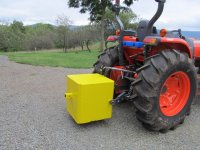
Ballast Block

   / Ballast Block #1  

DownFromDaDam

New member
Joined
Nov 26, 2018
Messages
1
Location
Northeast Wisconsin
Tractor
John Deere 1025R
I plan on pouring a concrete ballast block with a 2-point hitch inside of it as well as rebar and fiberglass for strength. Has anybody done this and if so, did the fiberglass keep the corners from crumbling off?
 
Last edited:
   / Ballast Block #2  
View attachment 580876 This is my "weight blob" - around 480#. I use that center chain to lift and place it on implements - mainly my disk harrow. See how the corner has crumbled off. I know that rebar and fiberglass will add strength but I don't know if it would protect the corners. Mine have lost corners because I bump the blob into stuff moving/loading/unloading.

If you really need to protect the ballast block - you should consider an outer steel container - a steel drum or similar container.

Also - being outside in the winter weather hasn't helped either. But its just a weight blob and life for a blob is pretty tough around these parts.


By the way - Welcome to TBN and the forum. It will be helpful for future posts if you would update your profile with your location.
 
   / Ballast Block #3  
Different question; anything need to ensure the wood forms come off OK? I am thinking of using the OSB with the slick side in. Reinforced with 2x4s.
 
   / Ballast Block #4  
Different question; anything need to ensure the wood forms come off OK? I am thinking of using the OSB with the slick side in. Reinforced with 2x4s.

Use diesel fuel or oil and the forms will pop right off.

For the OP;
I did not use fiberglass for the corners. I did make them all 45 degree's and no problems with them crumbling apart.


20170521_170648.jpg
 
   / Ballast Block #5  
Use diesel fuel or oil and the forms will pop right off.

For the OP;
I did not use fiberglass for the corners. I did make them all 45 degree's and no problems with them crumbling apart.
That is exactly the way I formed the corners on my counter weight block. By beveling the corners like that, not only will it prevent crumbling but also will not chip away should you hit something while making a sharp turn or backing into an object. And possibly hurt less than a sharp corner (like when hitting your shin against it).

I lined the interior of the box form with left over 6 mil plastic sheeting that I had left over instead using oil or grease as a release agent. Used a staple gun to fasten the plastic sheeting.
 

Attachments

  • Counter Weight.JPG
    Counter Weight.JPG
    149.2 KB · Views: 554
Last edited:
   / Ballast Block #6  
I just welded up a 2x2x1 ft steel frame from angle iron bed frames and cut panels from a remnant piece of 16 (maybe 12) gauge plate and filled it with 8 60 lb bags Sacrete... Total cost about $36 ... Probably weighs in at about 500 pounds...

Dale
 
   / Ballast Block #7  
It also seems the paint helps keep it from breaking apart over time. Keeps the water out of the small cracks.
 
   / Ballast Block #8  
I made one once out of an old steel water tank. Cut the tank off at the height I wanted and left the concrete down from the top a few inches, handy to throw a chain in etc.
 
   / Ballast Block #9  
Man -you two guys, Oldoak & cat fever, have weight blocks that are show quality. Mine sits out in the weather slowly disintegrating. But then - I only use mine when I use the disk harrow. Maybe once every three to five years. I always have my Rhino 950 @ 1100 pounds on the 3-point.
 
   / Ballast Block #10  
Use diesel fuel or oil and the forms will pop right off.

For the OP;
I did not use fiberglass for the corners. I did make them all 45 degree's and no problems with them crumbling apart.


View attachment 580880

Not to get off topic but how much does this block weigh? Or a 50 gal barrel? I have a Kubota 2850 and I have been thinking about making one.
 
   / Ballast Block #11  
Dave - concrete weight is determined by the cubic foot. Figure - X inches wide times X inches high times X inches deep. Divide that number by 1728 = cubic feet. This is the cubic feet of a square or rectangle.

A cubic foot of concrete "normally" weighs - - 150 pounds.

For a barrel - take the radius of the barrel, in inches, times the radius of the barrel in inches, again - times 3.14. That number times the height of the concrete in the barrel, in inches. Divide that number by 1728 = cubic feet.

Example for a barrel - radius of the barrel is 10" 10 x 10 = 100. 100 x 3.14 = 314 Height of the concrete in the barrel is 26". So - 314 x 26 = 8164 cubic inches. Now divide 8164 by 1728 = 4.72 cubic feet. Take 4.72 x 150 = 708 pounds plus whatever the barrel weighs.

The formulas - all figured in inches

For a square or rectangle - - Length x width x height - divided by 1728 = cubic feet. (1728 = cu in in a cu ft)

For a cylinder or barrel - - PIE x radius squared x height divided by 1728 = cubic feet ( PIE = 3.14 )
 
Last edited:
   / Ballast Block #12  
And if you are making it yourself take into account what you want for storage. You can "mold" in a place for a toolbox, put in PVC pipes to store long handled tools etc.
Many creative ideas here.
 
   / Ballast Block #13  
Yes - as Newbury indicates - there are some really fantastic ballast block designs shown on various threads here on TBN. Upper right corner of this page - Google Custom Search. Enter "ballast box" into Google as a start to a search on TBN.
 
   / Ballast Block #14  
Not to get off topic but how much does this block weigh? Or a 50 gal barrel? I have a Kubota 2850 and I have been thinking about making one.

It has 1600 pounds of concrete and about 100 pounds of steel. I actually wish I had gone with a full ton.
 
   / Ballast Block #15  
In rounded numbers:

One cubic foot is about 7.5 gallons.

Concrete is about 150 pounds per cubic foot, or about 20 pounds per gallon.

Bruce
 
   / Ballast Block #16  
I have a feeling that my weight blob deteriorates because it sit out in the weather - water soaks into the cracks - freezes and expands. Putting a good heavy coat of paint on a ballast block - like cat fever - probably goes a long way towards keeping them intact.

A standard 55 gallon drum is 22.5 inches in diameter by 33.5 inches high. It has 7.70 cubic feet in volume and will weigh 1155 pounds +/- when full of concrete.
 
   / Ballast Block #17  
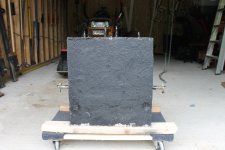
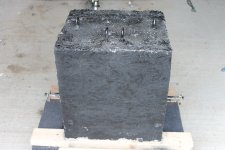
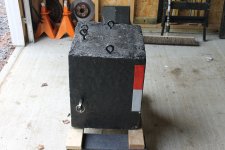
I made mine out of 4000 psi concrete when I has a slab poured.
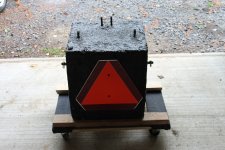
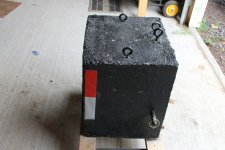
Made a form out of OSB put a draw bar in and welded 2 large eyelet bolts for the top link all together with rebar inside. The middle eyelet bolts are centered so I can lift it with the
loader if needed.
Is measures 20" tall, 19" wide and 16" deep
I set it on a moving dolly.

IMG_0776.JPGIMG_0777.JPGIMG_0778.JPGIMG_0779.JPGIMG_0780.JPG
 
Last edited:

Tractor & Equipment Auctions

500 BBL FRAC TANK (A58214)
500 BBL FRAC TANK...
84" HYD ROCK GRAPPLE (A52706)
84" HYD ROCK...
JCB 2145 (A47477)
JCB 2145 (A47477)
Cat CB24B (A60462)
Cat CB24B (A60462)
BOMAG BW213 SMOOTH DRUM ROLLER (A58214)
BOMAG BW213 SMOOTH...
2013 Ford F-450 4x4 Crew Cab Little Beaver LS300 Drill Rig Truck (A59230)
2013 Ford F-450...
 
Top