Which tractor for 40 acre homestead

/ Which tractor for 40 acre homestead #21  
My situation is similar to the OP with some differences. Rather than start a new thread, I'm going to post here to see if I should consider something other than what was recommended to the OP.

First, I'm new to tractors. I'm moving to a 60 acres in Arkansas. It will need to be fenced, so an auger would be needed. Many 10-20' trees need to come down and be chipped. I would like to clear some of the underbrush in the woods. Mobility is more important than brute force in the woods, I think. Keeping paths clear. May consider a log splitter. Trunks may need to be removed.

We will be improving pasture for sheep by broadcasting seeds. I may, but don't have to, move a few round bales in the barn, as bedding, not for feed. We hope rotational grazing will supply most of the sheeps' needs. May be moving manure from piles provided by alpaca/llamas to the garden in a dump-trailer.

There may be a gravel driveway to maintain. Perhaps it will be asphalt. I may be missing something that is needed, but I don't plan on major earthworks performed by me with this machine (like ponds or swales).

So far, I've only looked at Kubota. I'm thinking used, not new to save money. I'm aware of the basic differences from B, L, L-Grand, Mx and M. I will have a Kubota dealership about an hour and 15 minutes from me. I suspect I don't need B or M, but am probably in the L to Mx range. I don't want to get Mx just because of the occasional 1000 lb bale. Because I am new, I was thinking HST. I' expect I'll be in and out more than driving for long periods.

Any ideas, criticisms or help would be appreciated. Thanks.

Not having lived on this property and never having owned a tractor means I can't be more specific.
 
/ Which tractor for 40 acre homestead #22  
Please add ARKANSAS to your T-B-N PROFILE so your location shows in every post your author. Arkansas varies more than most states. A city would help your respondents understand your conditions.

How many of your 60 acres will you farm and how many will be woodland?


The fundamental importance of TRACTOR WEIGHT eludes many tractor shoppers. Heavier tractor weight is more important for most tractor applications than increased tractor horsepower. Bare tractor weight is a tractor specification easily found in sales brochures and web sites, readily comparable across tractor brands and tractor models, new and used.

Within subcompact and compact tractor categories, a significant tractor capability increase requires a bare tractor weight increase of 50%. It takes a 100% increase in bare tractor weight to elicit MY-OH-MY!

Shop your weight range within tractor brands. Budget will eliminate some choices. Collect a dealer brochure for each tractor model in your weight range. I spreadsheet tractor and implement specs, often a revealing exercise. I have a column for cost per pound.

Most tractors under 3,000 pounds bare weight operate in residential or hobby farm applications on one to ten flat acres.

Selling a used tractor is easy. Selling multiple light implements in order to buy heavier, wider implements for a new, heavier tractor requires a lot of time. Depreciation on implements is generally greater than depreciation on a tractor.

Heavier tractors are constructed on larger frames and longer wheelbases. Heavier tractors are built with thicker steel to withstand greater stress. Heavier tractors have larger diameter wheels/tires, increasing ground clearance. Heavier tractors with large diameter wheels/tires have more tractive power pulling ground contact implements, pushing a loader bucket into dirt and pushing snow. Larger wheels and tires permit heavier tractors to bridge holes, ruts and tree debris with less operator perturbation.


First, I'm new to tractors. I'm moving to a 60 acres in Arkansas.

1) Many 10-20' trees need to come down and be chipped. May consider a log splitter.

2) I would like to clear underbrush in the woods. Keep paths clear. Trunks may need to be moved.

So far, I've only looked at Kubota. I'm thinking used, not new to save money. I'm aware of the basic differences from B, L, L-Grand, Mx and M. I will have a Kubota dealership about an hour and 15 minutes from me.

3) I suspect I don't need B or M, but am probably in the L to Mx range. I don't want to get Mx just because of the occasional 1000 lb bale.

4) Because I am new, I was thinking HST. I expect I'll be in and out more than driving for long periods.

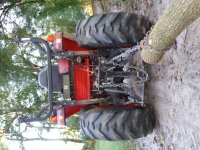
1) Chipping brush on sixty acres is an impossible aspiration. You will need several burn piles. Producing firewood makes some sense but it is not very economically rewarding considering the time it takes. Tractor hydraulic log splitters are complicated and slow. I suggest a 220 volt electric log splitter on wheels, which can be moved in and out of your garage or barn and used in the driveway. Trees 10' to 20' tall should not required much splitting, mostly cutting into billets with a quality chainsaw. PHOTO #1

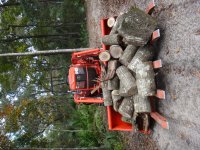
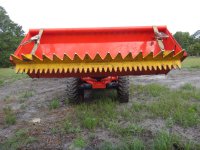
2) Trail maintenance requires tractor weight. I recommend a bare tractor weight of at least 3,700 pounds. A Ratchet Rake bucket attachment is a basic trail maintenance attachment. PHOTO #2.
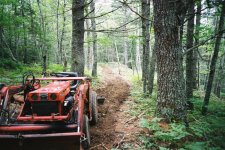
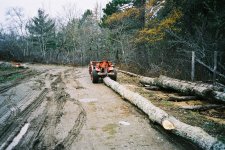
Tractors are designed to pull. Any tractor of 3,700 pounds or more will pull several 10' to 20' tree trunks at one time using chains connected to a rear/center drawbar or cross/drawbar. PHOTO #3 ~ Cross Drawbar with optional "hanging tree".

3) Kubota Grand Ls and MX series overlap in weight at 3,700 to 4,500 pounds, bare tractor weight. They have very similar capabilities with similar weight. The Grand Ls are de luxe tractors. The MX series are economy tractors. There are far, far more MX tractors sold, new and used, than Grand Ls. Loaders on new Grand L and MX tractors can lift more than 2,000 pounds.

About 90% of compact tractors are sold with HST transmissions. I encourage you toward HST, especially if you will operate your tractor on slopes.


A quality dealer, reasonably close, available for coaching, is important for tractor neophytes. Most new tractors are delivered with a glitch or two requiring correction. My Kubota dealer is six miles away. I feel my local dealer continues to add value to my equipment after seven years. Dealer proximity is less important for those experienced with tractors and qualified to perform their own maintenance.


May be moving manure from piles provided by alpaca/llamas to the garden in a dump-trailer.

There may be a gravel driveway to maintain. I don't plan on major earthworks.

Forget the trailer. Use the tractor Loader.
A 3,700 to 4,500 pound bare weight tractor will maintain gravel roads with ease. Ratchet Rake is excellent for light grading.


IMPLEMENTS: https://www.lsuagcenter.com/~/media...aa214276e14dacb/pub2917tractorimplements1.pdf

everything attachments videos - YouTube

Iowa Farm Equipment
 

Attachments

  • DSC00451.JPG
    DSC00451.JPG
    3.4 MB · Views: 166
  • DSC00133.JPG
    DSC00133.JPG
    7.7 MB · Views: 199
  • DSC00535.JPG
    DSC00535.JPG
    4.7 MB · Views: 193
Last edited:
/ Which tractor for 40 acre homestead #23  
Outside of Leslie Ar in the Ozarks. Plan to reclaim 20 acres to forest pasture mix. Will not be much farming, per se. Only chipping and logging will be to create trails and clearings. Do not plan to chip the whole thing, as you said, impossible. It sound like you would recommend the smallest used MX I can find. Would there be limits on age and hours? I know to look for a well-maintained used Mx.
 
/ Which tractor for 40 acre homestead #24  
It sound like you would recommend the smallest used MX I can find. Would there be limits on age and hours? I know to look for a well-maintained used Mx.

I recommend a tractor with a bare weight of 3,700 pounds to 4,500 pounds. There are many good tractor brands out there. Kubota is perhaps the best built today but you pay a 20% premium for the quality. I feel the premium is worth paying. Others differ.

MX Series are all the same weight, +/- 5%. Engine power is the key variable. Some MX are 2-WD, some 4-WD. You want 4-WD and a Loader.


Safe hillside operation demands more tractor weight than level land operation. Heavier tractors have adjustable rear wheel spreads; wide rear wheel spreads improve tractor stability more than any other variable.

Four wheel drive is essential on hillsides. Four wheel drive supplies increased traction and braking. When descending slopes 4-WD augments rear brakes as tractor weight shifts forward, decreasing rear tire grip.

Compact tractors optimized for hill work have liquid installed in the rear tires rather than air. "Loaded" tires are filled 50% to 75% with liquid, which lowers the tractor's center-of-gravity, increasing rollover resistance. "Loading" two compact tractor rear tires increases tractor weight 300 pounds to 800 pounds over weight of identical two tires inflated with air. Some prefer to ballast rear wheels with iron wheel weights rather than tire liquids.

When considering a tractor purchase, bare tractor weight first, tractor horsepower second and (narrowly) rear wheel ballast third.


VIDEO: How To Evaluate A Used Tractor - YouTube

Kubota Grand L Series VS. Kubota MX Series - YouTube

Kubota MX series walk around and features by Messicks. | MX48 MX52 MX58 - YouTube


Here are tractors for sale on eBay within 200 miles of zip code 72645:
https://www.ebay.com/sch/Business-I...c=1&_salic=1&_sop=12&_dmd=1&_ipg=200&_fosrp=1
 
Last edited:
/ Which tractor for 40 acre homestead #25  
<snip> Many 10-20' trees need to come down and be chipped. I would like to clear some of the underbrush in the woods. Mobility is more important than brute force in the woods, I think. Keeping paths clear. May consider a log splitter. Trunks may need to be removed.<snip>
Any ideas, criticisms or help would be appreciated. Thanks.

Not having lived on this property and never having owned a tractor means I can't be more specific.
First of all seriously consider burning and rotting versus chipping. I bought a 8" Jinma chipper about 2015 because AT THE TIME I was clearing a half acre 30 year overgrown lot of small trees and bamboo which would have required many weekends of renting a chipper. Burning was not an option in the city and paying for trash hauling was exorbitant. Plus I thought I might use it in the future. I feel it about paid for itself in the first 6 months, I've used it for about 10 or 20 hours since.

If I had it to do over again I'd probably do the same if I could find a good 8" chipper for $1600.

It's none of your business whether or not the poster puts his location in his profile.

I thought you were finally past this garbage, <snip>
David please excuse this ongoing fight. Most of TBN is not this bad.
 
/ Which tractor for 40 acre homestead #26  
I have 80 acres. A mile long gravel road, snow, logs & rocks to move, private landfill to maintain....... I did all the work, in the beginning, with a 26hp Ford 1700 4WD. Twenty seven years later, 2009, I traded the Ford in and got a Kubota M6040. Everything goes quicker and I can now move logs & rocks the size I want. I can actually move large logs now - I don't have to move them as firewood.

The M6040 is big enough to handle a really heavy duty grapple and very heavy duty rear blade. I'm FINALLY rid of the 3-point snow blower. I CAN now do summer maintenance on my driveway after it dries and turns to concrete.

Life is good.
 
/ Which tractor for 40 acre homestead #27  
Tractor for 40 acres:

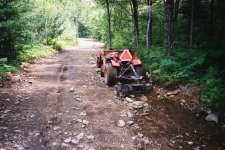
As I take it there may be a budget involved and suggestions of a used tractor. The following pictures are from a few years ago of my Kubota B7100 working on our 68 acres of land in Nova Scotia. Access road, trails, trees removed and stones and logs dragged and snow removal. The little 16 HP tractor was put through its paces. The bucket bottom and cutting edges had to be rebuilt/replaced twice. At times there were chains on all four wheels. It spent about 2000 hours doing this type of work before being traded for a JD 4200.

F1000014.JPGF1000023.JPGF1000022 - Copy.JPG
 
Last edited:
/ Which tractor for 40 acre homestead #28  
id get two tractors a smaller one and larger one, 20 to 25hp and 60hp minimum with some weight to it. there are tons of reasons why but one tractor will drive you crazy as it will be good for one thing but not great for the other stuff - you can do it with on but not as efficient and not w/out more frustration because of the limitations and size required for some tasks
 
/ Which tractor for 40 acre homestead #30  
Thread pruned. Please continue the original discussion.

David 72645, welcome to TBN. :rolleyes:

:)
 
/ Which tractor for 40 acre homestead #31  
I'm not getting two tractors, at least not right now, understanding that one might not do all the jobs I want done. Yes budget is an issue, that's why I'm getting used, not new. Would like a big tractor but there also may be access considerations; getting between trees or into pass-through duck coop for cleaning. I don't live there yet, but will need fencing up first. Rather than hiring fence contractor, tractor may let me do some of that job myself. Animal quarters won't be built for a year. I'll have to build them with the tractor I end up with in mind. Does everyone agree that I should get an Mx rather than an L; It does not sound like it. If I got an L, would there be any reason to get a smaller one? I think B is too small. Maybe I just need to get something, so I'll have a reference point, then expect to trade up or down from there. If I get a bunch of implements, does it make trading to a different PTO size more costly?
 
/ Which tractor for 40 acre homestead #32  
I'm older now, and a LOT wiser than I was when I got my 40 acres. Not all property is equal, for sure, so what any particular individual is facing, and thus tractor requirements, is going to vary widely.

I did tons of work with my B7800 Kubota. I could probably make this tractor operate to full potential as well as anyone could get any tractor to operate to full potential. I've put about 1,000 hrs on it. Not sure if there's much that I haven't done with it. Anyway...

I had "grand plans" in the beginning. Problem is, when you can't see your property, as mine was covered in brush, you really don't know what you're facing. A smaller tractor works well for "exploring." And, which is almost certain to happen, when you get it stuck it's a LOT easier to get unstuck than a larger tractor. And for "real" fun get an excavator stuck and then try to get it unstuck!

You will ALWAYS find a need to have more/bigger power. Don't buy for it. Rent! (I've rented skid steers and excavators- specialized tools for special jobs.)

You state, and I think that it's smart thinking, "Maybe I just need to get something, so I'll have a reference point." This is a sane way to approach things.

Bucket teeth and ballast in the rear tires were the best things I ever did for my B7800. Life would have been WAY better had I started out with them.

Breaking stuff on a larger piece of equipment can be quite a bit more costly: maintenance too- I have a LOT more hydraulic fluid to change in my Kioti and in my Kubota. I've been pretty lucky that in the 400 hrs I've got on my Kioti that I've "only" managed to bust one loader bucket cylinder. (surprisingly, the repair cost was about the same for a new loader arm cylinder on my Kubota)
 
/ Which tractor for 40 acre homestead #33  
If a post hole auger is used the sizing must be tall enough to allow clearance with the ground. The B tractors will likely be to large. Perhaps look at some used agricultural tractors that fit the price range and will be larger??
 
/ Which tractor for 40 acre homestead #34  
Maybe I just need to get something, so I'll have a reference point, then expect to trade up or down from there.
If I get a bunch of implements, does it make trading to a different PTO size more costly?


Compact tractors all have a single rear PTO size, revolving at 540 rpm.

"Big Ag" tractors have larger rear PTOs, revolving at 1,000 rpm.


New compact tractors, from 1,700 to 3,600 pounds bare tractor weight have a Category I size Three Point Hitch.

New compact tractors from 3,800 pounds to 6,000 pounds bare tractor have a Category II size Three Point Hitch.

The manufacturers decide which Three Point Hitch will go on a given tractor so there is some variation around 4,000 pounds bare tractor weight, some having a Category I hitch, some Category II.


Category I implements can be used on a Category II Three Point Hitch by adding readily available shims to the Category I hitch pins, to fatten them up. Multiple shims to fatten pins to fit Category II Three Point Hitch < $10 total.

Quite often Category I implements are not wide enough to cover the rear tire width of Category II tractors. There are exceptions. Few tolerate tire imprints in a field.

Light Category I implements pulled imprudently behind a heavy, powerful Category II hitch tractor can be pulled apart at the welds or bent if snagged.

Selling a used tractor is easy. Selling multiple light implements in order to buy heavier, wider implements for a new, heavier tractor requires a lot of time. Depreciation on implements is generally greater than depreciation on a tractor. (Ask me how I know.)

DIMENSIONS: TractorData.com - Three-Point Hitch
 
Last edited:
/ Which tractor for 40 acre homestead #35  
First, I'm new to tractors.
I'm moving to 60 acres in Arkansas.

Plan to reclaim 20 acres to forest pasture mix. Will not be much farming, per se. Chipping and logging will be to create trails and clearings.

Is there a consensus that I should get an MX rather than an L? It does not sound like it.
If I got an L, would there be any reason to get a smaller one? I think B is too small.

The fundamental importance of TRACTOR WEIGHT eludes many tractor shoppers. Bare tractor weight is a tractor specification easily found in sales brochures and web sites, readily comparable across tractor brands and tractor models, new and used.

Tractor weight will help keep you safe as you learn how to operate an unstable tractor with small front wheels, large rear wheels and loads you cannot imagine until you are operating.

I recommend a compact tractor with a bare weight of 3,700 pounds to 4,500 pounds. There are many good tractor brands out there. Kubota is perhaps the best built today but you pay a 20% premium for the quality. I feel the premium is worth paying. Others differ. Kubota has ~~50%~~ market share in compact tractors. All the other brands you read about here compete for the other 50%. That said, I have shopped Kioti and LS tractor brands from Korea and I will give these brands serious consideration if I buy a third new tractor.

VIDEO: Kubota Standard L-Series. L251 L331 L391 L471 features and operation. - YouTube
 
Last edited:
/ Which tractor for 40 acre homestead #36  
I added my location. Thanks

WHOOPS... this thread popped up as new and read the whole thing before I realized it was 5 years old..:)


Since you are looking for a tractor for 60 acres? on a budget ,

the tractor like the OP ended up with would work well for you also (3930 Ford MFWD.)


Ford built a Strong capable tractor in the 3930.


If money is not a big deal one of the M series Kubota's would be Real Nice. with 60 acres to take care of
 
Last edited:
/ Which tractor for 40 acre homestead #37  
I have 80 acres. A mile long gravel road, snow, logs & rocks to move, private landfill to maintain....... I did all the work, in the beginning, with a 26hp Ford 1700 4WD. Twenty seven years later, 2009, I traded the Ford in and got a Kubota M6040. Everything goes quicker and I can now move logs & rocks the size I want. I can actually move large logs now - I don't have to move them as firewood.

The M6040 is big enough to handle a really heavy duty grapple and very heavy duty rear blade. I'm FINALLY rid of the 3-point snow blower. I CAN now do summer maintenance on my driveway after it dries and turns to concrete.

Life is good.

:thumbsup: . . . . can't get better than that . . .
 
/ Which tractor for 40 acre homestead #38  
Got a ton done over the weekend. While I worked away outside, the old women were busy clucking and gossiping inside having their quilting bee and tending their knitting. Fun was had on all sides I guess.

Got my ditches mowed, dropped a couple of trees that the utility company topped. Got them cut, split and stacked so they can dry out for next summer's camp fires. Burned the small stuff in a pile, and the neighbor wants the ashes for his garden, so I'll probably take them over this week sometime.

Grateful to have some good weather, and for the ground to finally be dry and hard enough I could drive across the lawn. Good weekend tractoring, beats sitting inside listening to old women whining and gossiping all weekend.

David,

20 acres is a lot to clear. If this is "one and done", consider hiring it out. A couple of guys with an excavator and a logging tractor or heavy skidder could make short work of that 20 acres. Are you wanting/needing the firewood? Maybe see if a lumber co would be interested in buying it all and clearing cutting it.

Or if time is not urgent, take it a piece at a time. A chainsaw, a gas fired splitter and a tractor with FEL can do it, but it will take a while.
 
/ Which tractor for 40 acre homestead #39  
I'm not getting two tractors, at least not right now, understanding that one might not do all the jobs I want done. Yes budget is an issue, that's why I'm getting used, not new. Would like a big tractor but there also may be access considerations; getting between trees or into pass-through duck coop for cleaning. I don't live there yet, but will need fencing up first. Rather than hiring fence contractor, tractor may let me do some of that job myself. Animal quarters won't be built for a year. I'll have to build them with the tractor I end up with in mind. Does everyone agree that I should get an Mx rather than an L; It does not sound like it. If I got an L, would there be any reason to get a smaller one? I think B is too small. Maybe I just need to get something, so I'll have a reference point, then expect to trade up or down from there. If I get a bunch of implements, does it make trading to a different PTO size more costly?

Most of the work can still be done with a "small" (relative) tractor. It will just take more time. Digging out stumps however, that just takes brute force. Maybe rent the equipment for that, or hire it out. But putting up fence, you don't need a "big" tractor for that. I personally wouldn't have gone any smaller in tractor than the one I have, unless I had 2 separate tractors. There are some things a small (think 2400H) would still be handy for here. But I can get pretty much everywhere I need to with the one I have. It weighs 7100 lbs with the FEL and box blade on it, and I can pick up round bales with it. I did have to wait longer for the lawn area to dry out and harden up, so I could drive on it to get some trees down. But my buddy's JD 1025 sized tractor would have no problem going over the same ground and not leaving ruts.

I don't drive mine across the actual "lawn" area much at all, just every once in a while, but it's something I have to consider before I do.
 
/ Which tractor for 40 acre homestead #40  
Probably don't want the fire wood. Its 6" pine. I want a combination of woods and pasture with a lot of "edge". I doubt a logging company would be interested. Some of the 20 acres is already clear. It would be cleaning up the glades and throughways at first. We don't know yet how many sheep the land can support as it is now, but as we improve the pasture with seeding and rotational grazing fencing, it should support more.

I started a separate thread about fencing: https://www.tractorbynet.com/forums/attachments/413285-fencing-60-acres.html
 

Marketplace Items

2018 Ford Explorer AWD SUV (A59231)
2018 Ford Explorer...
2000 FORD F550 SUPER DUTY SERVICE TRUCK (A60430)
2000 FORD F550...
PowerBoss Admiral Plus 38C Ride-On Floor Scrubber/Sweeper (A59228)
PowerBoss Admiral...
UNUSED SDLANCH SDLC2030FT-20'X30' CARPORT (A60432)
UNUSED SDLANCH...
43018CFL (A59228)
43018CFL (A59228)
2016 Chevrolet Tahoe SUV (A59231)
2016 Chevrolet...
 
Top