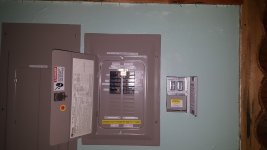
How to generator power pass through to inside the house.

   / How to generator power pass through to inside the house. #21  
Lenny: That shouldn't happen.
The neutral, from the utility transformer, is bonded to ground (the earth, "0" volts, ground rods, etc.. ) at the first disconnect from the utility service point (usually by bonding neutral bus and ground bus in your main panel and connecting to ground rod). The neutral might also be grounded (with a ground rod) at the utility's transformer (especially if it's pad mounted). Only if your ground system and/or neutral bonding goes bad (neutral is "lifted") could neutral become energized.

The overwhelming majority of commercial residential transfer switches sold do not switch the neutral. When you plug the genny in, it uses the same ground and neutral system, and bonding point between the two, that your house does when on utility power.
(If you do have a rare transfer switch that switches the neutral your generator is now a "Separately derived system" and need ground rods, jumper bond at genny between neutral and ground, etc...etc..basically things get more complicated)

The reason why Fried's (-that's NOT a good name for someone doing electrical work!) method is "dangerous" (but often done) is because it relies on a human to remember the correct procedure when another human's safety depends on it, rather than a mechanical interlock. And that's not fair to the Lineman.

In reality if you try to energize the utility line:
- The lineman has probably grounded or shorted the lines he's working on so only smoke will come out of your genny (or breaker will hopefully trip)
- There's little chance your 10kW genny is going to backfeed through the ((say) pole mounted 13.2kv-120/240) transformer, power up the 13.2kv line and power all your neighbors on that line without instantly tripping out. - Though this depends on where the utility fault is and how many neighbors you're trying to power. Though I suppose theoretically, Lineman could still get a shock in that instant.
- When utility power comes back on and you (or someone else) messes up and turn on utility breaker into panel still supplied by active genny (or vice-versa)....you also may get some "magic smoke" escaping out of your genny.
 
   / How to generator power pass through to inside the house. #22  
Thank you! I know what generator to shop for now! On 7200 watts, I should be able to limp through outages. Only my well pump is 220v and it's artesian, so it doesn't have to work hard. Otherwise, my priorities would be the controller on my Propane heat system and the refrigerator. Any left over would be to light up my gas stove and a couple lights. I can manually keep all breakers off that I don't need. Plus, I will disconnect at the meter, just so I sleep better.
 
   / How to generator power pass through to inside the house. #23  
Thank you! I know what generator to shop for now! On 7200 watts, I should be able to limp through outages. Only my well pump is 220v and it's artesian, so it doesn't have to work hard. Otherwise, my priorities would be the controller on my Propane heat system and the refrigerator. Any left over would be to light up my gas stove and a couple lights. I can manually keep all breakers off that I don't need. Plus, I will disconnect at the meter, just so I sleep better.

I have a similar set up to you. My gen is 6900 watt running with 8k watt surge. The electrician who set things up said plenty of power for well, fridge, pumps to run boiler and a few lights.

I tend to switch boiler off if I need water.

Also I have not completely converted to led yet
 
   / How to generator power pass through to inside the house. #24  
Remember when on genny and flipping on breakers and tryng to squeeze out every Watt from genny:

Start motor loads first. Genny can better stay under it's "trip out rating" and handle the motor inrush currents if your not adding the inrush ON TOP OF other loads.
Add those other loads after in rush has past and your only adding them to the RUNNING load.
Of course, this is very hard when you have a well pump or something that cycles. ...but you can predict.
 
   / How to generator power pass through to inside the house. #25  
Cody,
I’m going to disagree. Then I’m going to be quiet.
If that neutral line is opened or powered for any reason, there exists a possibility of a difference of potential between neutral and ground. You specifically don’t bind ground and neutral within auxiliary sub panels.

With multiple bonding points and between. There is a possibility to cause both the neutral and ground to carry current. This also energizes every metallic object touching the ground wire. No one will ever know the fault is there. Until grounded.

I’m not going in depth farther on this thread. But backfeeding a receptacle is a dangerous practice that leaves room for human error to unknowingly get someone hurt.
 
   / How to generator power pass through to inside the house. #26  
Cody,
I’m going to disagree. Then I’m going to be quiet.
If that neutral line is opened or powered for any reason, there exists a possibility of a difference of potential between neutral and ground. You specifically don’t bind ground and neutral within auxiliary sub panels.

With multiple bonding points and between. There is a possibility to cause both the neutral and ground to carry current. This also energizes every metallic object touching the ground wire. No one will ever know the fault is there. Until grounded.

I’m not going in depth farther on this thread. But backfeeding a receptacle is a dangerous practice that leaves room for human error to unknowingly get someone hurt.
Does this mean that the generator interlocks that are sold by the electrical service box manufacturers are inherently dangerous? As cautious as they are, it seems like they'd not sell them nor would they be approved by codes or testing certification labs. Just asking..........
 
   / How to generator power pass through to inside the house. #27  
Cody,
I’m going to disagree. Then I’m going to be quiet.
If that neutral line is opened or powered for any reason, there exists a possibility of a difference of potential between neutral and ground. You specifically don’t bind ground and neutral within auxiliary sub panels.

With multiple bonding points and between. There is a possibility to cause both the neutral and ground to carry current. This also energizes every metallic object touching the ground wire. No one will ever know the fault is there. Until grounded.

I’m not going in depth farther on this thread. But backfeeding a receptacle is a dangerous practice that leaves room for human error to unknowingly get someone hurt.

The two lines that I underlined are correct.

Sub panels do not have the neutral and ground bonded,
However your main panel does have them bonded and in all cases that I am aware of they also go to a ground rod,
On top of that your meter box neutral is bonded to a ground rod.
So you have at least two locations were the neutral is bonded to an earth ground.

Back feeding a receptacle is a dangerous practice, it is done even though it shouldn't be.
Very few home generators have the power to backfeed a transformer,
if they don't instantly go up in smoke they will stall from the inrush current demand.
 
   / How to generator power pass through to inside the house. #28  
I did a lot of research on the subject of bonding the ground and neutral and the common answer was it should be bonded at the main panel only and not in any subsequent panels. I'm not going to pretend to understand how a second bonding can result in stray voltage but it was a common concern. With that said if you are back feeding a generator you want to make sure it doesn't have the ground and neutral bonded at the generator. I'm not sure if any portable generators do or not. You could check for that with the generator not running by connecting an ohm meter between ground and neutral. If it has continuity then it will have the ground and neutral bonded and those should be separated before back feeding into a house panel. Most or all will have a ground connection you should drive a ground rod for and connect to. My Military surplus diesel HAS a bonding strap I had to remove when connecting to my house.

You are not limited to a 30 amp load to back feed. If you have a larger generator they make back feed inlets in 50 amp. https://www.homedepot.com/p/Reliance-Controls-50-Amp-Non-Metallic-Power-Inlet-Box-PBN50/205337810

I used a breaker interlock with 50 amp wiring and connectors. My house is all electric and for the most part I can run all my 120V stuff and any two of my 240V circuits. Part of back feeding is understanding how much load your generator and circuit can handle and doing the load management required to prevent overloading the generator. My generator will run steady with a 13,500 watt resistive load applied. It will start and run my 3.5 ton AC and my 1.5HP well pump. It won't do either in conjunction with the hot water heater or stove in use so I leave those breakers off. If I need to heat water or cook I turn the AC breaker off and turn on the water heater or stove.

This is how the Square D interlock looks.
breaker-panel.jpg
 
   / How to generator power pass through to inside the house. #29  
I did a lot of research on the subject of bonding the ground and neutral and the common answer was it should be bonded at the main panel only and not in any subsequent panels. I'm not going to pretend to understand how a second bonding can result in stray voltage but it was a common concern.
As I understand it, the concern is that if the neutral to your sub panel gets disconnected (and the ground is bonded to the neutral in the sub panel as well as in the main panel), now anything connected to the sub panel has whatever voltage is supposed to be on the neutral on the ground which could energize the metal case of an appliance.
If they are not bonded in the sub panel, you may fry things because you could have voltage way too high on one side but not on the other (ie: 80v on one leg and 160v on the other vs 120v on both legs), but no one should be injured because the ground is still connected properly.

Aaron Z
 
   / How to generator power pass through to inside the house. #30  
And once you have your "outside generator plug" (male end) wired up to your "generator transfer switch panel", then you may want to add a "meter box" to balance each 110 volt leg of the generator to insure one 110 volt leg does not have the majority of the (Wattage) load used while the other 110 volt leg has very little (Wattage) load use.

KC

20191118_192647.jpg 20191118_192711.jpg
 
   / How to generator power pass through to inside the house. #31  
YES

The neutral is a direct connection out to the line with no protection. No breakers, switches, or disconnects.
If anything failed and or was shorted from the 1 (or 2 for 220) hot lines that your generator is providing, the generator breaker may not trip since it doesn't see a overcurrent due to no load on the neutral.

Mr Lineman verifys the line is dead by checking the voltage lines to ground and to neutral. Yes. the hots ARE dead. you shut off the breakers. So no reading is present. The neutral is just sitting there hot with no path for it to go.

Mr Lineman grabs a handful of wires. One of which is Neutral and presumed safe and dead. This completes a path through him from the generator Hot>through the neutral> into his body> out to the nearest grounding point. The generator doesn't trip until the current flow gets higher than the circuit breaker rating. 30 Amp?

.1 to .2 amps is lethal.

Electrical Safety: The Fatal Current


"The neutral is just sitting there hot"

I still don't understand.
How does the neutral get "hot"
It is a single wire!
I have always been under the impression that it takes TWO wires to complete a circuit.
A single wire can supply power??.......same for a car battery powered electrical system too ???
 
   / How to generator power pass through to inside the house. #32  
And once you have your "outside generator plug" (male end) wired up to your "generator transfer switch panel", then you may want to add a "meter box" to balance each 110 volt leg of the generator to insure one 110 volt leg does not have the majority of the (Wattage) load used while the other 110 volt leg has very little (Wattage) load use.

KC

View attachment 629199 View attachment 629200

MF

maybe i am missing something here, but your labeling is wrong? most panels alternate between l1 and l2 per slot, you have left side loads and right side loads, but you also have a well pump which is 240 running on "left side" when in reality its running on both sides, along with every other breaker????
 
   / How to generator power pass through to inside the house. #33  
"The neutral is just sitting there hot"

I still don't understand.
How does the neutral get "hot"
It is a single wire!
I have always been under the impression that it takes TWO wires to complete a circuit.
A single wire can supply power??.......same for a car battery powered electrical system too ???

you have it right, its also why transfer switches don't switch the neutral, most people get tripped up because ground IS bonded to neutral with main electric service, also the transformers etc are all grounded.

most people don't ground a generator, thus even if you took the hot line and connected it straight to a ground rod and drove it right into the ground, you still wouldn't get electrocuted because yes you need 2 wires to make a circuit, if the hot is disconnected and not touching neutral or some form of a ground, then no there is no electrocution risk, think about birds on a wire, do they die?
 
   / How to generator power pass through to inside the house. #34  
I installed a new load-center and sub-panel a couple years back as well as a 30A generator feed and the load meters listed above. My panel is GE and I was able to install a mechanical interlock similar to the ones shown above. My main and sub panels are properly grounded and bonded per code. The nice thing about my setup is that it allows me to power anything circuit I please (although not all at once), without having to decide when wiring the panels.

Regarding bonding the neutral and ground in sub-panels...


Frequently Asked Question: Why do the grounds and neutrals need to be separated in a subpanel? What happens if they aren't?

Answer: Though the neutral doesn't have significant voltage, it does carry current. Remember, it's current that kills, not voltage. In a 2-wire circuit, the neutral carries just as much current as the hot conductor. If the neutral and ground are connected in a subpanel, that current will travel on other paths, such as bare ground wires, equipment enclosures, and metal piping systems, on its way back to the service panel. One problem created by this condition is possible shock hazards, the severity of which depends on the locations of the equipment and the person touching the enclosure or piping system. Another problem is magnetic fields that do not cancel themselves out. Since the return current has multiple paths, the current remaining in the neutral will not counterbalance the current in the hot wire. The resulting imbalance creates a magnetic field that can interfere with sensitive electronic equipment. In a metal conduit system, the imbalance will induce current into the conduit, which could cause the conduit to overheat.

Q: Given that this is a fairly common condition, why don't we hear about problems, and why do some electricians not understand the problem?

A: For the feeder from one panel to another, the neutral only carries the imbalanced load between the two hot legs. Most of the time, the amount of current on the neutral is very low. However, in a situation where a single 120-volt appliance is in use, and there are few other loads in operation, the current on the equipment grounding conductors and other paths could be quite high, resulting in the problems noted above. Other conditions could cause the load imbalance to be quite high, if for example, all the lights in use at a given time just happened to be originating from the same phase conductor.

The National Electrical Code (NEC) has prohibited re-grounding the neutral after the service since the 1923 edition. Exceptions have been made for dryers and ranges that use the neutral as a grounding means, and for separate buildings. However, those loopholes have been effectively closed in the 1996 and 1999 editions of the NEC. The references in the 1999 edition of the NEC are found in 250-24(a)(5), 250-142(b), and 384-20.
 
   / How to generator power pass through to inside the house. #35  
you have it right, its also why transfer switches don't switch the neutral, most people get tripped up because ground IS bonded to neutral with main electric service, also the transformers etc are all grounded.

most people don't ground a generator, thus even if you took the hot line and connected it straight to a ground rod and drove it right into the ground, you still wouldn't get electrocuted because yes you need 2 wires to make a circuit, if the hot is disconnected and not touching neutral or some form of a ground, then no there is no electrocution risk, think about birds on a wire, do they die?

In theory we think of there being no ground fault current for an "ungrounded system" that has a short to ground fault (i.e. there's no circular path to complete the circuit.) I wouldn't want to test it. There's likely "capacitive coupling" between the ground and the generator or transformer that provides a path for some current. (i.e. think of how AC current can be conducted across 2 capacitor plates that aren't touching).


I installed a new load-center and sub-panel a couple years back as well as a 30A generator feed and the load meters listed above. My panel is GE and I was able to install a mechanical interlock similar to the ones shown above. My main and sub panels are properly grounded and bonded per code. The nice thing about my setup is that it allows me to power anything circuit I please (although not all at once), without having to decide when wiring the panels.

Regarding bonding the neutral and ground in sub-panels...


Frequently Asked Question: Why do the grounds and neutrals need to be separated in a subpanel? What happens if they aren't?

Answer: Though the neutral doesn't have significant voltage, it does carry current. Remember, it's current that kills, not voltage. In a 2-wire circuit, the neutral carries just as much current as the hot conductor. If the neutral and ground are connected in a subpanel, that current will travel on other paths, such as bare ground wires, equipment enclosures, and metal piping systems, on its way back to the service panel. One problem created by this condition is possible shock hazards, the severity of which depends on the locations of the equipment and the person touching the enclosure or piping system. Another problem is magnetic fields that do not cancel themselves out. Since the return current has multiple paths, the current remaining in the neutral will not counterbalance the current in the hot wire. The resulting imbalance creates a magnetic field that can interfere with sensitive electronic equipment. In a metal conduit system, the imbalance will induce current into the conduit, which could cause the conduit to overheat.

Q: Given that this is a fairly common condition, why don't we hear about problems, and why do some electricians not understand the problem?

A: For the feeder from one panel to another, the neutral only carries the imbalanced load between the two hot legs. Most of the time, the amount of current on the neutral is very low. However, in a situation where a single 120-volt appliance is in use, and there are few other loads in operation, the current on the equipment grounding conductors and other paths could be quite high, resulting in the problems noted above. Other conditions could cause the load imbalance to be quite high, if for example, all the lights in use at a given time just happened to be originating from the same phase conductor.

The National Electrical Code (NEC) has prohibited re-grounding the neutral after the service since the 1923 edition. Exceptions have been made for dryers and ranges that use the neutral as a grounding means, and for separate buildings. However, those loopholes have been effectively closed in the 1996 and 1999 editions of the NEC. The references in the 1999 edition of the NEC are found in 250-24(a)(5), 250-142(b), and 384-20.

:thumbsup:
True! Neutral current running through (green) ground wires creates a voltage rise (ohms law) on anything connected to those wires ....but has anybody ever got a shock off the metal of a (3-wire) dryer or oven? I guess the neutral current is so small, the voltage drop/rise across the neutral cable back to the panel doesn't raise the sheet metal voltage enough.
 
   / How to generator power pass through to inside the house. #36  
It looks like the mechanical interlocks on those breakers force you to turn off the panel's Main 200A breaker (utility power supply) before you can turn on the genny's 30A backfeed breaker.
This is a MUST! (so genny doesn't feed back into utility line).

The receptacle and the 30A breaker (and most likely the cable in between the two) limit the genny supply power to 30 amps at 240V, or (240V x 30A =) 7200 Watts, no matter if Genny is bigger. You must manage your loads being run so loads don't exceed 7200W.

Typically, people want a breaker to trip before the genny stalls, although most genny's will have their own breaker that trips before it stalls.

You may want a generator bigger than 7200Watts to start motor loads that have a high inrush, but you'll be limited to around 7200 Watts running load by your panel's 30A genny breaker even if you go bigger than a 7200W generator.
If you go smaller than 7200W, the breaker at the genny might be <30amps, so that would trip first.

This guy nailed it.

I have a similar set up to yours 30 amp breakers. I recently purchased a Champion duel fuel 7500 watt unit so I can operate on propane or gas. It has electric start so the fiancé can easily restore power if I am away.

I also have a 5000 watt unit as a back up (20 years old and still works but does not have electric start)

They both provide plenty of power to cover the whole house by being smart about our operation. But we do not have an electric dryer or hot water heater. We do not use our electric stove during a power outage but that is not much of a hardship as we have a propane burner on the barbeque and a Coleman propane stove.
 
   / How to generator power pass through to inside the house. #37  
MF

maybe i am missing something here, but your labeling is wrong? most panels alternate between l1 and l2 per slot, you have left side loads and right side loads, but you also have a well pump which is 240 running on "left side" when in reality its running on both sides, along with every other breaker????

You are right, I did my labeling late one night and have not yet completed the balancing out of the loads, so:

if I now see it correctly, my well pump shares an equal load for the left and right side meter (even though it is located on the left side);

and at this time I only have in addition for the left side load is the kitchen and refrigerator;

and also at this time I have the remaining breakers for the right side load, the freezer, receptacles, upstairs (all), and some lights downstairs.

If I can remember correctly, I think the left side meter had very little wattage being used (just don't remember, it could be the right side meter)...

Too many projects in the works...

KC
 
   / How to generator power pass through to inside the house. #38  
you have it right, its also why transfer switches don't switch the neutral, most people get tripped up because ground IS bonded to neutral with main electric service, also the transformers etc are all grounded.

most people don't ground a generator, thus even if you took the hot line and connected it straight to a ground rod and drove it right into the ground, you still wouldn't get electrocuted because yes you need 2 wires to make a circuit, if the hot is disconnected and not touching neutral or some form of a ground, then no there is no electrocution risk, think about birds on a wire, do they die?

Well, I think as you do......but there seem to be lots of folks who disagree with us.
 
   / How to generator power pass through to inside the house. #39  
You are right, I did my labeling late one night and have not yet completed the balancing out of the loads, so:

if I now see it correctly, my well pump shares an equal load for the left and right side meter (even though it is located on the left side);

and at this time I only have in addition for the left side load is the kitchen and refrigerator;

and also at this time I have the remaining breakers for the right side load, the freezer, receptacles, upstairs (all), and some lights downstairs.

If I can remember correctly, I think the left side meter had very little wattage being used (just don't remember, it could be the right side meter)...

Too many projects in the works...

KC

The 2 hots or phases (call them L1 & L2) in a 120/240V panel aren’t split onto the left and right side.
L1 will be first row of breakers #1 & #2
L2 will be second row of breaker #3 & #4
L1 will be third row of breakers #5 & #6
L2 will be forth row of breakers #7 & #8
etc...

That’s why a double pole breaker that’s on the left or right side of the panel can span poles 1&3, 3&5, 2&4, 4&6, 6&8, etc.. and get 240v from L1 & L2.
You want to balance the load between L1 & L2 , not left and right side of the panels.
 
Last edited:
   / How to generator power pass through to inside the house. #40  
If power cuts happen on a regular basis, why not have a 12v DC standby wired as a separate system.
 

Marketplace Items

Margaritaville Miniature Decorative Truck (A59231)
Margaritaville...
2006 Lufkin 45ft. 40 Ton T/A Flatbed Trailer (A59230)
2006 Lufkin 45ft...
Deere 333E (A60462)
Deere 333E (A60462)
2023 Bobcat T770 (A53317)
2023 Bobcat T770...
2004 John Deere 4720 (A60462)
2004 John Deere...
2010 Dodge Ram 4x4 Crew Cab Pickup Truck (A59230)
2010 Dodge Ram 4x4...
 
Top