Chains vs straps

   / Chains vs straps #1  

99ls1tj

New member
Joined
Apr 25, 2014
Messages
8
Location
Cumming, Ga.
Tractor
I don't
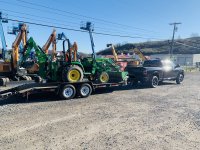
Greetings. I was hauling a John Deere 3039R for a friend recently on a 550 mile trip. All we had to tie down with was 2" ratchet straps. I had a mix of Macs and Husky straps. We put 8 straps on the tractor. It seemed like overkill, but we had them and I wanted to use them. About half way through the trip, we hit some really bumpy roads so we decided to stop and check the straps. The webbing had broken on one of the Husky straps. Needless to say, this somewhat broke our confidence in the straps. All I ever hauled heavy has been Jeeps. Are straps even considered safe for hauling a tractor like this, or should I have used chains? Asking in case I ever need to haul it again. Thanks!
IMG_4105.jpg
 
   / Chains vs straps #2  
I'm not a CDL holder, lawyer or anything else just a guy trying to do the right thing.

From what I understand your tiedowns need to secure 1 g of forward force (total weight), .5 g forward and side to side.

So the 3039 weighs about 4k? A quick google around says a 2" ratchet strap is rated at 3-3,700# so right there one strap from the rear is not sufficient as I understand it. I'm not smart enough to argue all the math so I just focus on one tie down covering each requirement.

At a minimum for that tractor I would do a chain at the rear, 2" ratchet strap for each side to prevent lateral shifts, and a chain for the front. Ideally two chains rear and two chains front covers all your bases.

Again, just this guys opinions on how I understand the requirements.
 
Last edited:
   / Chains vs straps
  • Thread Starter
#3  
I'm not a CDL holder, lawyer or anything else just a guy trying to do the right thing.

From what I understand your tiedowns need to secure 1 g of forward force (to total weight), .5 g forward and side to side.

So the 3039 weighs about 4k? A quick google around says a 2" ratchet strap is rated at 3-3,700# so right there one strap from the rear is not sufficient as I understand it. I'm not smart enough to argue all the math so I just focus on one tie down covering each requirement.

At a minimum for that tractor I would do a chain at the rear, 2" ratchet strap for each side to prevent lateral shifts, and a chain for the front. Ideally two chains rear and two chains front covers all your bases.

Again, just this guys opinions on how I understand the requirements.

We had it figured at about 5700lbs with the attachments. Thanks for the reply.
 
   / Chains vs straps #4  
My guess is you had the straps hooked across something and they got cut. The load rating of straps is pretty good but the abrasion resistance is zero.
 
   / Chains vs straps #5  
My guess is you had the straps hooked across something and they got cut. The load rating of straps is pretty good but the abrasion resistance is zero.

I also use straps but I like to protect them from friction cutting.

I use 12 inch or so lengths of old fire hose as protection sleeves that I position anywhere my straps make contact with sharp edges, even wood.
Works and so far never trashed a strap.
I am lucky in that I have a some HD 2" straps from aviation cargo tiedowns.
 
   / Chains vs straps #6  
My guess is you had the straps hooked across something and they got cut. The load rating of straps is pretty good but the abrasion resistance is zero.

Going to agree here. I've had straps come unhooked and super loose. But biggest thing is they will chafe bad.

That being said I hate/have no developed skills to chain and bind. Takes me FOREVER to properly bind. But I find they usually stay good.

I use straps when I can. My SCUT is fine with 2 of your husky straps but when I move an ag tractor I jump to chains or multiple straps as you. But you have to watch their contact points.
 
   / Chains vs straps #7  
Straps are fine as a type of tie down. They do get cut and will abrade and break if they rub on anything. They will do so easier than you might suspect. Chains are more forgiving on the wear and tear part. Chain hooks need to be attached in such a way to keep in mind that they do not come loose if the chain gets slack in its somehow. Same for straps for that matter.

Personally we tie down are equipment on each corner. Probably over kill but it easier that way and for sure stronger. Implements get at least one separate tie down each.

Stoping and checking tie downs a short distance after starting and then regularly on the trip is a very good idea. The chance to stretch your legs while doing so is just a added bonus.
 
   / Chains vs straps #9  
For what it's worth. I usually try and keep straps straight, but in fact a twisted strap is much less likely to flap. Maybe more important for lighter loads.
 
   / Chains vs straps
  • Thread Starter
#10  
My guess is you had the straps hooked across something and they got cut. The load rating of straps is pretty good but the abrasion resistance is zero.

I know what you're saying, but I don't think that was the case. Truth be told though, my buddy had removed the broken strap by the time I saw it and I'm going by what he told me. I was busy putting on another strap and didn't realize he had discarded the broken one, so I didn't actually see it. I was just going by where he told me it had broken in the webbing and that part of the strap would not have been touching anything.
 
   / Chains vs straps #11  
I haul my tractors quite a bit , i use chains on the tractor and straps on any implement.
 
   / Chains vs straps #12  
I use chains on tractors and steel, Straps on wood and other easy damaged items...
 
   / Chains vs straps #13  
Going to agree here. I've had straps come unhooked and super loose. But biggest thing is they will chafe bad.

That being said I hate/have no developed skills to chain and bind. Takes me FOREVER to properly bind. But I find they usually stay good.

I use straps when I can. My SCUT is fine with 2 of your husky straps but when I move an ag tractor I jump to chains or multiple straps as you. But you have to watch their contact points.

If you have a good setup of short chains and lever binders with a cheater pipe it’s quick and easy. I could have my machine chained on and done faster than you got the straps untangled.
 
   / Chains vs straps #15  
Straps are fine IF rated high enough, in good condition, there are no abrasion points and the angles are right. You don't want to strap any thing that can compress (springs, air filled tires, etc) vertically. When you hit a bump and the item compresses and then rebounds up, it can likely snap or stretch the strap (Same can happen to chains as well) plus it won't provide any lateral load stability. I've hauled Jeeps and ATV's for decades on or in multiple trailers and I've learned a lot about how to properly secure loads. The tractor I've only hauled 6 or 7 times and I use chains on front due to abrasion points and no way to attach a strap cleanly but I do use ratchet straps on the back.

I have ratchet straps and chains, depending on what I am securing. I can have the straps on and tight much faster than chains and binders for most things.
 
   / Chains vs straps #16  
Straps are fine IF rated high enough, in good condition, there are no abrasion points and the angles are right. You don't want to strap any thing that can compress (springs, air filled tires, etc) vertically. When you hit a bump and the item compresses and then rebounds up, it can likely snap or stretch the strap (Same can happen to chains as well) plus it won't provide any lateral load stability. I've hauled Jeeps and ATV's for decades on or in multiple trailers and I've learned a lot about how to properly secure loads. The tractor I've only hauled 6 or 7 times and I use chains on front due to abrasion points and no way to attach a strap cleanly but I do use ratchet straps on the back.

I have ratchet straps and chains, depending on what I am securing. I can have the straps on and tight much faster than chains and binders for most things.

If you’re hauling something with a lot of bounce like an ATV putting blocks under it and pulling it down tight eliminates that problem.
 
   / Chains vs straps #17  
I learned in the Navy about loading and tying down cargo including vehicles/equipment. Cardinal rule: The cargo has to be braced and/or tied down so it becomes solid to the surrounding deck and/or bulkheads. Blocking between wheeled equipment frames and the deck. If it can shift even a fraction soon it is moving around. Moving cargo can create a disaster. I have seen enclosed cargo trucks that had loosely tied down/stowed cargo with a gaping hole in the side and the cargo on the ground. The forces generated can be exponential to the weight of the item. I always use chains and binders on vehicles and equipment. Straps on solid cargo, wood dunnage between metal items, and as tight as you can get it. Check every couple hundred miles and more often on rough roads. Better safe than sorry. The guy behind will appreciate that.

Ron
 
   / Chains vs straps #18  
I learned in the Navy about loading and tying down cargo including vehicles/equipment. Cardinal rule: The cargo has to be braced and/or tied down so it becomes solid to the surrounding deck and/or bulkheads. Blocking between wheeled equipment frames and the deck. If it can shift even a fraction soon it is moving around. Moving cargo can create a disaster. I have seen enclosed cargo trucks that had loosely tied down/stowed cargo with a gaping hole in the side and the cargo on the ground. The forces generated can be exponential to the weight of the item. I always use chains and binders on vehicles and equipment. Straps on solid cargo, wood dunnage between metal items, and as tight as you can get it. Check every couple hundred miles and more often on rough roads. Better safe than sorry. The guy behind will appreciate that.

Ron

My dad was in the Army. When I was a kid that is pretty much the same as what he taught me.

We didn't have trailers back then and our tractors and equipment were driven onto trucks to be transported between farms.
 
   / Chains vs straps #20  
Try using a rachet chain binder?
I gave up on lever binders years ago

A cheater pipe is a must have feature of lever binders but for chaining wheeled equipment a lever binder is way faster. A ratchet binder is a pain in the butt even when they work right. Leave them on the trailer deck in the rain and let the screw rust and the ratchet lever seize and they’re a real treat. I’ve had to use a chain hook or a rock to beat the ratchet lever more times than I can count. Oil helps for a while but it’s right back to the same thing.
 
Last edited:

Tractor & Equipment Auctions

2001 CATERPILLAR CB-634C SMOOTH DBL DRUM ROLLER (A60429)
2001 CATERPILLAR...
2023 Caterpillar 259D3 Two Speed Compact Track Loader Skid Steer (A56857)
2023 Caterpillar...
2004 JOHN DEERE 160C LC EXCAVATOR (A59823)
2004 JOHN DEERE...
Husqvarna Riding Mower (A56857)
Husqvarna Riding...
For Sale, Shrink Wrap Kit for implements, tractors, boats etc.
For Sale, Shrink...
2001 WELLS CARGO 8' X 32' TOY HAULER DBL AXLE TRL (A57192)
2001 WELLS CARGO...
 
Top
