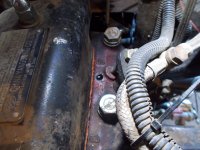
Glow Plugs

   / Glow Plugs #21  
Did you remove the buss bar when you checked resistance? If not you were measuring a parallel circuit and not the individual glow plugs.
My glow plugs died one at a time, and I watched it happen as the amp draw decreased as each one went open. It is quite possible that you had the same think and it didn't become obvious until the last one burned out.
Since you have battery voltage to the buss bar, there are no issues in the circuit to that point. If it were me, here is what I would do.
Measure resistance from the negative battery terminal to a good ground point on the engine block. A good clean bold head will do or remove any paint on a spot on the block itself. Bad grounds are the number one cause of electrical issues on any vehicle. As a general maintenance issue it would be a good idea to remove the battery ground cable and clean both ends down to shiny metal as well as the spot on the tractor where it attaches. That way you are sure the problem is not there.
Once you have established a good clean no resistance connection from the battery to the engine test the individual glow plugs for resistance values between the end that attaches to the buss bar and the known good ground point on the engine. Remember, testing from buss bar to ground won't tell you about individual plugs only the total circuit.
I think I have a new glow plug. I will go measure the resistance and get back in a little while.
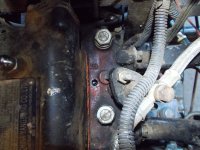
 
   / Glow Plugs #22  
New glow plugs part number 10.12.73 measure 2 ohms each.
Applying ohms law at 12.8 battery voltage shows a power draw of 6.4 amps each generating 81.82 watts of heat (not the proper unit but you get the idea)
If you measure resistance of all three plugs at the same time you will get .667 ohms assuming all plugs have the same value.
If all three plugs are working at the given resistance then the power draw will be 19.2 amps producing 245.76 watts of power consumed.

On my tractor when all glow plugs are working and starting with a good charged battery, I easily see the 20 amps power drain (this is really too much for the switch and wires to handle for much more than a few seconds). As the plugs heat up several things are happening at once. The resistance is increasing, which reduces the power drain and the battery is discharging which also reduces the power draw so you can watch the amp meter slowly reduce to a reading of 10 or 12 amps. When one or more of the plugs are open (burned out) the initial draw will be lower and the rate of discharge will reduce at a slower pace as well.

When you saw .5 ohms of resistance was that from the buss bar or from the individual plugs?

I will make another post or two to this thread describing the issues I had replacing the glow plugs.
 
   / Glow Plugs #23  
When compared to a modern gas engine my 284 has always been "hard to start". This is just a perception and not really the truth. The proper procedure will help a lot.
On first start up at temps above 70 I just set the throttle forward enough that it starts to move the foot pedal and then hit the starter. Usually fires in 5 to 10 seconds. If not, I give it 10 seconds of glow then hit it again.
As the outside temps get lower, I will start to hit the glow plugs at increasing amounts of time as needed. Up to 10 to 20 seconds at around freezing.
From freezing down to 0 I will hold the decompression lever as I hit the starter letting it get the crankcase up to speed a couple of revolutions before dropping the lever for full compression. This aids the starter and adds just a squirt or two of fuel to "prime" the cylinder. If the engine catches but is not running evenly on all 3 I will go back to the glow plugs for a few seconds until it evens out.
Below 0 down to -20 I use a 1000 watt tank heater on the coolant until the head is warm enough to melt snow before beginning a start procedure.
Clean battery connections (both ends) and a battery in good condition are essential. Regular maintenance of the started (clean and lube) also makes for happy starting.
 
   / Glow Plugs #24  
When all 3 glow plugs died I had no choice but to replace them before winter. The front one came right out. The middle one came right out. The back one (hardest to get to) had to be cranked out with torque all the way to the ends of the threads. What I didn't know at the time was the heat end of the center electrode was stuck in the head and the external threads of the outer plug actually jacked the plug apart. Oh-oh, now what?
 

Attachments

  • DSCN3906.JPG
    DSCN3906.JPG
    2.3 MB · Views: 204
   / Glow Plugs #25  
Here is a plug that came out properly on the left and the one from the back hole that jacked itself apart on the right. The third piece was still stuck in the head when this picture was taken.
On the left plug the part that gets hot is the blackened end near the bottom. This actually protrudes into the pre-chamber and is sealed to the head by a copper washer that seats between the head and the outer body which is seen in the center piece. The threads have nothing to do with sealing and are only there to hold the plug in place. In my case I recovered one washer on the plug, one was down to a tiny sliver of copper. Probably a victim of over-tightening in the first place.

Next up what happens when you get lucky.
 

Attachments

  • DSCN3915.JPG
    DSCN3915.JPG
    2.8 MB · Views: 174
   / Glow Plugs #26  
You can see where the inner core of the plug broke off just below the surface of the head. I could get needle nose pliers or needle nose vise-grips on the stem, but just barely. It was stuck tight and any turning motion resulted in the feel of the core just twisting in place. Not something that would stand up to very many cycles before it broke off out of reach.
I tried every solvent solution I had in the shop. Even my old go to homemade ATF/Acetone mixture wouldn't touch it. Fill the hole let it soak. Blow it out and test. Many repeated cycles including heating with a propane torch as hot as I could get it. As many different combinations and approaches as I could think of for over a week and no progress.
Then I started thinking about exactly what it was that I was trying to de-solve to release the core from the head. Carbon on the element and a copper ring. I had observed no evidence of rust in the other two holes. Thinking about the chemistry I realized that gun bore scrubber is designed to cut through carbon and copper deposits. I soaked the core for a couple of days using several different products, blowing out the leftover liquid between applications. After a couple of days I was able to feel the core turn in the hole! The seal was broken so the next treatments could get in and do the job. Twisting and pulling eventually got it out! Whew! I was dreading pulling the head just to replace a glow plug. The copper washer had been reduced to a smear of green on the rag. Should have bought a lotto ticket that day.

I used bore scrubber on a pipe-cleaner to swab out all three holes before installing new plugs. I also put a dab of anti-seize on the plug threads to ward off any corrosion/rusting that might happen in the future.

I wouldn't wish this situation on the unfriendly neighbor, but if you found this post because you have the same problem, perhaps it will help.
 

Attachments

  • DSCN3904.JPG
    DSCN3904.JPG
    2.6 MB · Views: 177
   / Glow Plugs #27  
When I first got our 254 it needed something like 30 seconds of glow plug and a lot of cranking. I found that about half the voltage was being lost in the wiring, the actual voltage at the glow plugs was only just over 6V. I installed a heavier lead and a relay and it's made all the difference. This winter it started up OK in minus 8.

 
   / Glow Plugs #28  
A very good solution for the undersized wiring. Very similar to what I did using a starter relay for an older model Ford. Takes the load off of the switch and lightweight wires and puts full battery voltage to the glow plug buss bar. I did that as an upgrade before the original stuff failed. All I did was take the wire off of the buss bar and move it to the S terminal on the relay. Ran a heavy wire from the battery terminal on the starter to the relay and then from the relay to the buss bar. Very easy to do.

I didn't do any research on it but I suspect that you could get more powerful (hotter) glow plugs with the same dimensions and threads that would work too. However, it would require more battery power.

In the case of this OP's issues, he is getting battery voltage to the buss bar (at least under a no-load condition). I suspect that 2 or maybe all 3 of his plugs are burned out. Hopefully he will remove the bar and take individual plug resistance readings and report back.

The addition of a relay in the glow plug circuit is a good idea for all tractors (IMHO).
 
   / Glow Plugs
  • Thread Starter
#29  
When I first got our 254 it needed something like 30 seconds of glow plug and a lot of cranking. I found that about half the voltage was being lost in the wiring, the actual voltage at the glow plugs was only just over 6V. I installed a heavier lead and a relay and it's made all the difference. This winter it started up OK in minus 8.

Hi aesmith, It was warm today so I pulled the glow plugs. I tested them by using a 12V batt. Neg. lead went to the threads on the unit. (-) and the pos. lead went to the electrode (+). held the leads for about 30 sec. The plug never lite up and never even got warm to the touch. So I think they are bad, unless I am doing something wrong. What do you think? I also noticed that the glow plugs are 10.5V. Do think that I might have blown them by testing them in this way?
 
   / Glow Plugs
  • Thread Starter
#30  
Did you remove the buss bar when you checked resistance? If not you were measuring a parallel circuit and not the individual glow plugs.
My glow plugs died one at a time, and I watched it happen as the amp draw decreased as each one went open. It is quite possible that you had the same think and it didn't become obvious until the last one burned out.
Since you have battery voltage to the buss bar, there are no issues in the circuit to that point. If it were me, here is what I would do.
Measure resistance from the negative battery terminal to a good ground point on the engine block. A good clean bold head will do or remove any paint on a spot on the block itself. Bad grounds are the number one cause of electrical issues on any vehicle. As a general maintenance issue it would be a good idea to remove the battery ground cable and clean both ends down to shiny metal as well as the spot on the tractor where it attaches. That way you are sure the problem is not there.
Once you have established a good clean no resistance connection from the battery to the engine test the individual glow plugs for resistance values between the end that attaches to the buss bar and the known good ground point on the engine. Remember, testing from buss bar to ground won't tell you about individual plugs only the total circuit.
I think I have a new glow plug. I will go measure the resistance and get back in a little while.
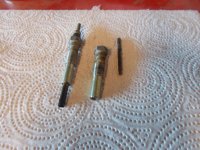
Yes, I did remove the bus bar. I even removed the glow plugs from the engine. Results each plug measures less than 1 ohm. #1 measures .2 ohms #2 measures .3 ohms. and #3 measures .5 ohms which means they should be good, right? Now the kicker, when I test with a 12V batt. They will not glow and they never get warm to the touch. The batt. I used is at 12.6V. I rechecked the voltage to the bus bar I am still getting 12.6V
 
   / Glow Plugs #31  
Yes, I did remove the bus bar. I even removed the glow plugs from the engine. Results each plug measures less than 1 ohm. #1 measures .2 ohms #2 measures .3 ohms. and #3 measures .5 ohms which means they should be good, right? Now the kicker, when I test with a 12V batt. They will not glow and they never get warm to the touch. The batt. I used is at 12.6V. I rechecked the voltage to the bus bar I am still getting 12.6V
Sounds like you are on the right track.
BUT how about grounds?
A weak ground often can conduct voltage at low amperage and fail to carry high amps.

Another test would have been to power each plug individually outside of the engine.
For that even less than 12 volt source should warm them up.
Momentary powering @12 volts should make each one glow or at worst warm/hot to touch.

A glow plug is nothing but a fancy resistor designed for momentary usage.

Easier still is to create a good ground from battery immediately adjacent to the plugs and then apply power to each plug and feel for heat.
 
   / Glow Plugs #32  
I tested them by using a 12V batt. Neg. lead went to the threads on the unit. (-) and the pos. lead went to the electrode (+). held the leads for about 30 sec. The plug never lite up and never even got warm to the touch. So I think they are bad, unless I am doing something wrong. What do you think?
I think you found your problem. The glow plug is shot. As long as you know you had a good connection on each end, it seems the plugs are shot. Get some new ones.
I also noticed that the glow plugs are 10.5V. Do think that I might have blown them by testing them in this way?
What do you mean the plugs are 10.5V? Is that the rating marked on the plug?

I doubt they would fail with a 30sec test at 12v...

I don't think you should have to wait 30 seconds on a good plug. I'd expect that in a few seconds you would have a hard time holding on to it!
 
   / Glow Plugs
  • Thread Starter
#33  
Sounds like you are on the right track.
BUT how about grounds?
A weak ground often can conduct voltage at low amperage and fail to carry high amps.

Another test would have been to power each plug individually outside of the engine.
For that even less than 12 volt source should warm them up.
Momentary powering @12 volts should make each one glow or at worst warm/hot to touch.

A glow plug is nothing but a fancy resistor designed for momentary usage.

Easier still is to create a good ground from battery immediately adjacent to the plugs and then apply power to each plug and feel for heat.
I tested the plugs out of the engine with a 12V batt. and they would not even get warm. I plan on replace the plugs. Thanks for your input.
 
   / Glow Plugs
  • Thread Starter
#34  
Sounds like you are on the right track.
BUT how about grounds?
A weak ground often can conduct voltage at low amperage and fail to carry high amps.

Another test would have been to power each plug individually outside of the engine.
For that even less than 12 volt source should warm them up.
Momentary powering @12 volts should make each one glow or at worst warm/hot to touch.

A glow plug is nothing but a fancy resistor designed for momentary usage.

Easier still is to create a good ground from battery immediately adjacent to the plugs and then apply power to each plug and feel for heat.
Pulled all the plugs and tested them using a 12V batt. and didn't even get warm. I am going to replace the plugs, thanks for your input
 
   / Glow Plugs #35  
It sure sounds like your plugs are shot. The .2 ohms reading is a little confusing it should be an open reading. It should not change when you touch the tester terminals to the plug. I suppose there is a slim chance that when they burned out the shorted internally but for you to get any reading on a burned out plug is highly unlikely.
When you get your new plugs, test them with your ohmmeter before installing them, just to check and see. If you decide to test with a 12V source, be sure you are not touching the plug when you do. Remember a 12W soldering iron will melt metal and these plugs should be putting out about 80W!
 
   / Glow Plugs
  • Thread Starter
#36  
It sure sounds like your plugs are shot. The .2 ohms reading is a little confusing it should be an open reading. It should not change when you touch the tester terminals to the plug. I suppose there is a slim chance that when they burned out the shorted internally but for you to get any reading on a burned out plug is highly unlikely.
When you get your new plugs, test them with your ohmmeter before installing them, just to check and see. If you decide to test with a 12V source, be sure you are not touching the plug when you do. Remember a 12W soldering iron will melt metal and these plugs should be putting out about 80W!
Got my new plugs today. Checked them with the ohm meter. they test the same as the old ones. 0.5-0.9 ohms. Have not tested them with a batt. yet. It has turned cold here so I will wait a couple of days, it should warm up by then. I am really confused, when I watch the internet on how to check them with a ohm meter, It tells me to set the meter at 200 ohms (which is the lowest setting) and test them. When I do that, I get nothing. 0 reading. both the new and the old test that way. don't know what is going on.
 
   / Glow Plugs
  • Thread Starter
#38  
Hi Bob, Good video. I Watched the video and done what he did. I have a Fluke 175 true RMS Multimeter I used to test them. It turns out that all the old compared to the new ones where very different. The old ones were wide open and the new ones run about 0.2 ohms. So I am glad that I bought new ones. Have not glow tested them yet however. PS Just got home from town. Tested the glow plugs using a 12V batt. They took about 30 sec. to start glowing. I installed them and checked my amp meter, it was drawing around 30 amps. I started the tractor. I was disappointed because the tractor did not seem to start much better. Thanks for your come back.
 
Last edited:
   / Glow Plugs
  • Thread Starter
#39  
Hi People, Replace all three glow plugs. They were bad, would not glow. The new ones takes about 30 sec. to glow. Thanks for all your feed back.
 

Tractor & Equipment Auctions

2004 CATERPILLAR 320C L EXCAVATOR (A60429)
2004 CATERPILLAR...
2021 CATERPILLAR 299D3 SKID STEER (A60429)
2021 CATERPILLAR...
2021 TAKEUCHI  TB260 (A58214)
2021 TAKEUCHI...
CASE IH MX220 MAGNUM TRACTOR (A57192)
CASE IH MX220...
MORBARK WOOD HOG 6400 XT HORIZONTAL GRINDER (A60429)
MORBARK WOOD HOG...
ELECTRIC GOLF CART (A58214)
ELECTRIC GOLF CART...
 
Top