Starting a tractor in extreme cold temperatures

   / Starting a tractor in extreme cold temperatures #61  
Thanks. I'll look for a block heater. That one came with the tractor when I bought it last year. Regarding the oil, the owner manual doesn't mention anything below 10 grade. For below freezing, they only recommend 10W, 10W30 or 10W40. That's why I went with the 10W30.

I'll check if the pan is made of steel or aluminum and get a magnetic one if made of steel. Seems like the easiest route. BTW, my car is a Tesla so nope, no block heater there ;-)
Thinking some more on your hard start in the cold. You say that you cycle the glo plugs multiple times and no fire at all. Have you checked out if your glow plugs are working correctly? Your machine is 10 years old. The glow plugs could all be weak/not working at all at this age. There is a way to test the resistance in each pretty simple test I think. There will be a relay or two involved too and they could be weak or not working
 
   / Starting a tractor in extreme cold temperatures #62  
Disagree Slim. With all due respect, you are wrong. In-line coolant engine heaters in fact DO circulate coolant. What ever made you think they don't ? The ones I have owned have an internal check valve arrangement. When the coil heats a quantity of coolant in the cannister it burps out a burst of hot coolant under some pressure and ingests the next batch for heating. This process can be heard and felt. That is why there is a flow arrow on the units of course. The net effect is that they absolutely DO move coolant and the warmer it gets the faster the process. If you watch the system, the hoses all get warm with the output from the heater being the hottest of course. In my experience the 1000w or 1200w units work very well. Very well matched to your typical 120v homeowner circuits. I had never heard of weak ones of only 300w until reading this thread.

Rather obviously they would not be selling the things by the hundreds of thousands over the years otherwise. I bought my first one in 1979 and they had been on the market for years before that. [Mine was from Sears and Roebuck, remember them?]

And by the way, the freeze plug substitute "block heater" type does not have any means to move coolant other than slow convection. That convection has little chance of reaching the heads where it is most needed for starting, though if you leave it on long enough the warming process does work. The advantage of the in-line radiator hose installation is that the heads and entire system get warmed via the liquid flow in the coolant passages.
This:

Radiator Hose Heater 1-1/4" 600 Watt

Is the style of lower radiator hose heater I was referring to. There is no "circulation" happening inside the heater unit. It is only a heater element that "wraps" around the coolant passage.

I think THIS:

Circulating Coolant Heater 1000 Watt 120 Volt

This must be the type of heater you are referring to? I have never seen one of these in the field. Never knew THIS style existed until I just now searched for it.

What the OP (and I) have been referring to is the first one. The heater that goes in the line of the lower radiator hose. My description of how this type heater works stands.
 
   / Starting a tractor in extreme cold temperatures
  • Thread Starter
#63  
Yes, this is the type of heater I think the tractor has. I don't think it recirculates the cooling fluid. I hear no sound from it.

Regarding the fuel, I use winter diesel. I can see grey smoke coming off the muffler so I think it does make its way to the combustion chamber.

I'll also check the Glow plugs for their resistance.
 
   / Starting a tractor in extreme cold temperatures #64  
The cheapest thing to do is build a 1500 sf well insulated and heated shop and park the tractor inside it 💵
 
   / Starting a tractor in extreme cold temperatures #65  
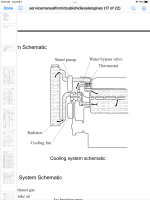
Just two comments, on many diesels mine included there is a flow path with the thermostat closed. 7BD76AAD-105F-459B-9D7C-4F8C6B4F849F.png5B6EE028-F7FB-4A20-83B1-B2BC39DC89C0.png

Second the water will circulate with both types of heaters. Called natural circulation. Happens because of the density difference, ie heat rises cold sinks. Same principle some large boilers or powerplants work on, at least that’s what I was taught as a power plant engineer. Block heater probably better because typically higher wattage and better location.
 
   / Starting a tractor in extreme cold temperatures #66  
So I buy stick on ones off of Amazon. 250 watt for roughly $20.
At -35 the
No.

Not even close. The "heater" that you install in your lower radiator hose will NOT circulate ANY coolant. It is a closed system. There is no circulation until you start the engine and the water pump starts circulating coolant through the system.

A block heater heats the coolant that's sitting stationary in the block. That warms the block. That is what you're after. A warm engine block, and some of that heat does transfer to the cylinder head through the castings.

A radiator hose heater only heats the coolant that is sitting stationary inside the rubber radiator hose. The only way to circulate that warm coolant is to crank the engine, which will circulate the warm coolant a little bit (depending on if or how much "bypass" is plumbed into your coolant system, because remember, your thermostat is CLOSED, so only the small bypass passage (if you have one) will flow any coolant at the far end of the cooling system). So the warm coolant in the hose is replaced with -35 F coolant that came out of the radiator in about 5 seconds and you stop cranking and start the whole process over again of heating the cold coolant sitting in the hose again.

Not quite "worthless" but close enough to it to call it so.

Remember, there is NO "flowing" coolant unless the engine is running, or cranking, to rotate the water pump at the front of the engine.

In line heaters are just as effective as a block heater. the cooling fluid will circulate and heat the block.
 
   / Starting a tractor in extreme cold temperatures #67  
Just two comments, on many diesels mine included there is a flow path with the thermostat closed. View attachment 731876View attachment 731877

Second the water will circulate with both types of heaters. Called natural circulation. Happens because of the density difference, ie heat rises cold sinks. Same principle some large boilers or powerplants work on, at least that’s what I was taught as a power plant engineer. Block heater probably better because typically higher wattage and better location.

Right you are. There are lots of misconceptions about coolant heaters and how they operate floating around.
 
   / Starting a tractor in extreme cold temperatures #68  
This:

Radiator Hose Heater 1-1/4" 600 Watt

Is the style of lower radiator hose heater I was referring to. There is no "circulation" happening inside the heater unit. It is only a heater element that "wraps" around the coolant passage.

What the OP (and I) have been referring to is the first one. The heater that goes in the line of the lower radiator hose. My description of how this type heater works stands.
Hate to break it to ya but old Farmall A's and some other tractors, have no water pump to cool them and using that first style of heater is no different. Hot water rises and the cold settles, natural circulation same as when the engine is running.
 
   / Starting a tractor in extreme cold temperatures #69  
Yes, this is the type of heater I think the tractor has. I don't think it recirculates the cooling fluid. I hear no sound from it.

Regarding the fuel, I use winter diesel. I can see grey smoke coming off the muffler so I think it does make its way to the combustion chamber.

I'll also check the Glow plugs for their resistance.
Thought I would include this link so you can visualize what could happen in extreme cold. All oils - engine and hydraulic - will have very high viscosity. Just because the engine starts does not mean your hydraulic system will be good to go. The warmer everything is, the better for the tractor and pocketbook.

 
   / Starting a tractor in extreme cold temperatures #70  
Just two comments, on many diesels mine included there is a flow path with the thermostat closed. View attachment 731876
A question or two: The arrow in the pic shows flow from the top radiator hose into the radiator as if the water pump is turning and the thermostat is open to allow circulation by any means, but it's shown closed. How does that work when the engine is cold??

The bypass also circulates to the pump, not the radiator. I suggest the 'loop' shown by arrows could be misleading as to a low temp coolant 'circuit', however typical it is. Will a hose heater open the thermostat? If not, for liquid to rise/convect to the block some also has to descend along the same hose to be heated. IMO that could slow 'circulation' down a bit.

A picture may be worth a thousand words, but not every observer sees the same thing. Asking for a friend.
 
   / Starting a tractor in extreme cold temperatures #71  
When the thermostat is closed water flows from below the tstat through the pump into the block. When it opens its from tstat outlet through radiator into pump to the block some may still flow though by pass. This design assures flow to the pump to prevent cavitation.

I believe there’s also a design without the bypass that bleeds some coolant through/around the tstat to the radiator to the pump also to prevent cavitation. The advantage of the bypass would be quicker warm ups
 
   / Starting a tractor in extreme cold temperatures #72  
So for two weekends in a row, I was unable to start the tractor with temperature around -35C. Had to wait for the temperature to be a 'mild' -20C for it to start.

I have a 300W heater on the cooling line and installed last weekend a battery tender. The heater is turned on for about two to three hours prior to the attempts at starting it. The tender stays 24/7.

What I do is 4 cycles of 8 seconds glow plug and try to start it. At first, because of the battery tender, it turns pretty good but fails to start. Grey smoke comes out but that's it. I do a few more cycles of the glow plugs and it still fails to start. I crank for about 5 seconds each time. After about 5 or 6 attempts, battery is having difficulty turning the engine so I stop and let the temperature warm up. At -20C, after about 3 cycles of the glow plugs, the engine fires no problem.

What's the trick to start a diesel engine in such extreme temperatures?

Thanks
Once winter hits my tractor's block heater and battery blanket is plugged-in 24/7. A little higher power bill? Yes, but the tractor always starts. I use it for snow removal mostly in the winter and we do get below "0" temps often.
 
   / Starting a tractor in extreme cold temperatures #73  
In line heaters are just as effective as a block heater. the cooling fluid will circulate and heat the block.

With an engine that is not running the only circulation of heat is caused by convection, hot liquid rising and cool liquid falling. You will get the best performance from the heater that is lowest in the liquid.

The heater that is higher will cause no convection to occur because the heated coolant is already at the top. Yes, the heat will eventually move down, but it will take a longer time.

This is why your house water heater has two elements. The element at the top is usually set at a higher temperature than the lower element. The cold water flows into the bottom of the tank and your faucets are supplied from the top of the tank.

So, which is more efficient really depends on where it is installed in relation to the top/bottom of the fluid volume. The lower one will heat more liquid faster.
 
   / Starting a tractor in extreme cold temperatures
  • Thread Starter
#74  
Thought I would include this link so you can visualize what could happen in extreme cold. All oils - engine and hydraulic - will have very high viscosity. Just because the engine starts does not mean your hydraulic system will be good to go. The warmer everything is, the better for the tractor and pocketbook.

Yeah, once started, I leave it running for about half an hour at those temperature to let the fluids warm up.
 
   / Starting a tractor in extreme cold temperatures #75  
Yes, this is the type of heater I think the tractor has. I don't think it recirculates the cooling fluid. I hear no sound from it.

Regarding the fuel, I use winter diesel. I can see grey smoke coming off the muffler so I think it does make its way to the combustion chamber.

I'll also check the Glow plugs for their resistance.
Is the heater orientated the way the instructions show?

Yes, there is a proper way.
 
   / Starting a tractor in extreme cold temperatures
  • Thread Starter
#76  
I have no clue. It was already installed when I bought it. Now that I know there is a direction, I'll see if I can see a marking. Although if it's oriented wrongly, nothing will be done until spring. No way I'm working with cooling fluid in these temperatures we're having lately!
 
   / Starting a tractor in extreme cold temperatures #77  
1643765684781.png
 
   / Starting a tractor in extreme cold temperatures #78  
getting rid of excess oil
 
   / Starting a tractor in extreme cold temperatures #79  
Check engine.
 
   / Starting a tractor in extreme cold temperatures #80  
Yeah, pretty sure that is the CHECK ENGINE light......
 

Marketplace Items

2016 Ford F-150 Pickup Truck (A59230)
2016 Ford F-150...
2005 Jeep Patriot SUV (A59231)
2005 Jeep Patriot...
gps trailers (A56859)
2014 Freightliner 105' Bucket Truck (A61306)
2014 Freightliner...
Deere 50D (A60462)
Deere 50D (A60462)
2007 Ford E350 (A55973)
2007 Ford E350...
 
Top