M4D-071 Maximum Operating Weight

   / M4D-071 Maximum Operating Weight #21  
I'm on some pretty serious slopes, so I really want the ballast for extra stability. As long as the tire's psi is the same shouldn't compaction be the same ballasted or not?

Not right. Yes, surface compaction will be the same as tire pressure - Pascal’s Principle. But mass on a tire is transmitted into the soil until everything stabilizes = compaction at depth. An example is trucks. Heavy loads are transmitted deeper into the roadbed than light loads despite tire pressure remaining relatively constant. Keep the tire pressure as low as load/inflation tables allow remembering the planter on the 3 point must be considered.
 
   / M4D-071 Maximum Operating Weight #22  
I'm on some pretty serious slopes, so I really want the ballast for extra stability. As long as the tire's psi is the same shouldn't compaction be the same ballasted or not?
Think about that for just a minute :ROFLMAO:
 
   / M4D-071 Maximum Operating Weight
  • Thread Starter
#23  
NO. The heavier the tire and rim are, the more compaction you have. I do slopes too. I just shift into FWA.

OK, I guess I don't understand compaction as well as I should. I thought it was all based on ground pressure, so that if a tire has 15 psi in it, it would cause less compaction than a tire with 30 psi even if the 15 psi was on a 30000lb machine and the 30 psi tire was on a 10000lb machine. o_O What am I not getting? :unsure:
 
   / M4D-071 Maximum Operating Weight #24  
Not right. Yes, surface compaction will be the same as tire pressure - Pascal’s Principle. But mass on a tire is transmitted into the soil until everything stabilizes = compaction at depth. An example is trucks. Heavy loads are transmitted deeper into the roadbed than light loads despite tire pressure remaining relatively constant. Keep the tire pressure as low as load/inflation tables allow remembering the planter on the 3 point must be considered.
For us simple folks: The surface pressure per square inch will remain the same but there will be more square inches touching and more weight carried by the soil=more compaction.

ETA not sure about the truck example. A Tacoma uses 50 PSI, a F-250 80 psi, an F800 100-110 PSI.
 
   / M4D-071 Maximum Operating Weight #25  
OK, I guess I don't understand compaction as well as I should. I thought it was all based on ground pressure, so that if a tire has 15 psi in it, it would cause less compaction than a tire with 30 psi even if the 15 psi was on a 30000lb machine and the 30 psi tire was on a 10000lb machine. o_O What am I not getting? :unsure:
You’re thinking that your driving on a hard surface which only weighs that specific point. Soil is more like a fluid that wants to get out of the way, until it can not (compacted).
 
   / M4D-071 Maximum Operating Weight
  • Thread Starter
#26  
surface compaction will be the same as tire pressure - Pascal’s Principle. But mass on a tire is transmitted into the soil until everything stabilizes = compaction at depth.

Does that mean if I dual a tractor to reduce tire pressure, I'm actually increasing compaction because I'm making the tractor heavier?
 
   / M4D-071 Maximum Operating Weight #27  
Does that mean if I dual a tractor to reduce tire pressure, I'm actually increasing compaction because I'm making the tractor heavier?
Depends on the soil composition. If you spread it out enough the weight is better destributed and less compaction. But commonly duals are for more traction not less compaction.
 
   / M4D-071 Maximum Operating Weight
  • Thread Starter
#28  
You’re thinking that your driving on a hard surface which only weighs that specific point. Soil is more like a fluid that wants to get out of the way, until it can not (compacted).

I guess that makes sense. I never thought about it in those terms.
 
   / M4D-071 Maximum Operating Weight #29  
Actually the best bet is a tracked tractor. Kubota made one a few years back, not sure of they still do.
 
   / M4D-071 Maximum Operating Weight
  • Thread Starter
#30  
Actually the best bet is a tracked tractor. Kubota made one a few years back, not sure of they still do.

I used to know some rice farmers who swore by the old CAT rubber tracked tractors. They got around real nicely in the fields, but those were big and flat and didn't require much turning around.
 
   / M4D-071 Maximum Operating Weight #31  
Lots of farmers here are going to the JD tracked machines just for the compaction issue. Been told they ride like crap on hard packed dirt roads however. Having never ran one, I can only tell you what I was told.
 
   / M4D-071 Maximum Operating Weight
  • Thread Starter
#32  
Lots of farmers here are going to the JD tracked machines just for the compaction issue. Been told they ride like crap on hard packed dirt roads however. Having never ran one, I can only tell you what I was told.

I've never driven a tracked tractor either, but I can see the reasons behind them. New Holland has a small tracked tractor, but its got a weird steering system and I don't think it would be right for me, but if I were a richer man I bet it would be fun to own one. :)
 
   / M4D-071 Maximum Operating Weight #33  
I think you are gonna find the tractor a bit light for that much weight out back.

3307# lift capacity.....it wont get close to that witout getting VERY light up front. So unless you plan on stacking a bunch of suitcase weights or leaving a loader on....it wont be fun every time you have to raise the drill.

But I gotta wonder if the specs are a little off? Because landprides website shows them using it behind a GLxx40 series tractor, which is a bit smaller than the M4

Have you considered a tow-behind model?

Also with regards to pressure and compaction....think about a bicycle with 30psi tires and a pickup with 30psi tires and a ATV with 30psi tires. Think all 3 result in the same field compaction?
 
   / M4D-071 Maximum Operating Weight #34  
Does anyone know the maximum operating weight for a Kubota M4D-071? I'm guessing its in the operators manual, but unfortunately I can't find a free download for it. :(

1652121024787.png
 
   / M4D-071 Maximum Operating Weight #36  
I would also be looking for a tow behind, not 3pt. Same principle for me with bush hogs. I prefer a pull behind 90% of the time. Much less wear and tear due to stresses on the tractor connections in my opinion.
 
   / M4D-071 Maximum Operating Weight #38  
I don't own an M4D-071. I'm trying to compare it to other tractors to decide which one best fits my needs to decide which one to purchase. I've been able to get free downloads of the manuals for two others, which I have read, but not for the M4D-071. I'd rather not purchase the owners manual without owning the tractor especially when I might buy a model from a different manufacturer.
1) You will never regret buying the pull behind version of this drill. Fast turning with a 3 point drill simply tears up the disks on the drill and this drill is heavy when fully loaded especially when using weights on the drill for hard soil conditions.
2) Look at the Nebraska test site and they have the Kubota manuals for any tractor that they have tested. I was looking for the M5 & M6, but the M4 is very similar to the M5.
 
   / M4D-071 Maximum Operating Weight #39  
2) Look at the Nebraska test site and they have the Kubota manuals for any tractor that they have tested. I was looking for the M5 & M6, but the M4 is very similar to the M5.
They probably have something on the M7060. The M4 is the M7060 besides some updated components. It should almost be a 1 to 1 comparison. The M5 is a the next size up in weight and everything else.
 
   / M4D-071 Maximum Operating Weight #40  
I'm on some pretty serious slopes, so I really want the ballast for extra stability. As long as the tire's psi is the same shouldn't compaction be the same ballasted or not?
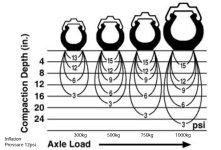
Here is an illustration from testing different tractor sizes, tires all inflated to 12 psi, small tractor to large tractor, tire size changing with tractor size to match load capacity. In the past, I had the opportunity to visit a facility where they tested soil compaction profiles like this, primarily for evaluating materials and methods for road construction but also for agricultural purposes. Concrete channel 2 meters deep and 5 meters wide so compaction would not be affected by the base. Soil type to be tested trucked in (massive amounts) controlling soil moisture, other parameters. Drive across, then measure compaction profile using nuclear reflection. Quite impressive if you want to construct a road or building but overkill for ag, except easily identifying advantage of large track tractors over wheeled versions when it comes to compaction. Also why we are seeing farmers spend big $$$ for track type grain carts so as to not destroy next year's yield by compacting it like concrete toting out this year's harvest.
 

Attachments

  • Compaction.jpg
    Compaction.jpg
    373.8 KB · Views: 173

Tractor & Equipment Auctions

UNUSED FUTURE FT-CL100C HYD CLAMP GRABBER (A52706)
UNUSED FUTURE...
2016 Dodge Grand Caravan Van (A59231)
2016 Dodge Grand...
2001 Pierce Spartan Model Tilt Pumper Fire Truck (A59230)
2001 Pierce...
2007 Ford F-350 9ft. Stakebody Flatbed Truck (A55852)
2007 Ford F-350...
2018 Ford F-350 (A55973)
2018 Ford F-350...
Chemical Containers Tank (A57148)
Chemical...
 
Top