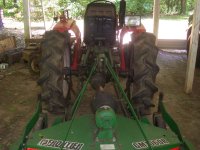
I posed this question to a Massey rep and was told there was no published incline limitations because it wouldn't be easy to test every possible configuration of the machine. I can see where it could be a liability to put something in black and white because you can never accurately estimate the idiot factor.We all know that (pucker) feeling when driving a tractor sideways on an incline. Is there any information on how to determine a safe angle of tilt? Do wheel weights and loaded tires make any difference on turn over? When going from smaller tractor to a larger one with a wider wheel base how much does the rollover decrease? Would having a bush hog attached low to the ground help or just be neutral? I wonder if one had a simple inclinometer, would this be of any help?
Just don't do it.We all know that (pucker) feeling when driving a tractor sideways on an incline. Is there any information on how to determine a safe angle of tilt? Do wheel weights and loaded tires make any difference on turn over? When going from smaller tractor to a larger one with a wider wheel base how much does the rollover decrease? Would having a bush hog attached low to the ground help or just be neutral? I wonder if one had a simple inclinometer, would this be of any help?
I just swapped the rear tires side to side. The dish of each tire is now out and literally made a difference of almost 2 ft. In width.
Most or all loader manuals I've read specify both swapping rear tires to "offset in" (i.e. "wide stance") position and filling the rear tires with ballast. Swapping the wheels around usually reduces max load the rear axle can handle, and wheel spacers make that infinitely worse, but usually rear axle load bearing is not the primary constraint on a loader operation.Filled tires might help lower the center of gravity?
Speed + dips, holes, rocks, bumps, and slipperiness are your nemesis when operating anywhere near rollover point. You can go from doing just fine to looking at tractor and sky over you in seconds. And CG can change simply based on how much fuel you have in the tractor. My recommendation is get a tilt meter, find out what the manufacturer says is the rollover angle, and then subtract 20% of the angle for your operating to red zone.We all know that (pucker) feeling when driving a tractor sideways on an incline. Is there any information on how to determine a safe angle of tilt? Do wheel weights and loaded tires make any difference on turn over? When going from smaller tractor to a larger one with a wider wheel base how much does the rollover decrease? Would having a bush hog attached low to the ground help or just be neutral? I wonder if one had a simple inclinometer, would this be of any help?
Yes general rule is dont drive on side hills unless you have your paperwork in order and have spelt my name correctlyWe all know that (pucker) feeling when driving a tractor sideways on an incline. Is there any information on how to determine a safe angle of tilt? Do wheel weights and loaded tires make any difference on turn over? When going from smaller tractor to a larger one with a wider wheel base how much does the rollover decrease? Would having a bush hog attached low to the ground help or just be neutral? I wonder if one had a simple inclinometer, would this be of any help?
No FEL. or antifreeze loaded rear tires I keep this as light as possible. I have that on a Ford. loaded rears and a FEL. The Org. lugs are still huge!! And in my Ga. clay I don't leave any tracks. If it's wet I can dig and tear up the soil.Most or all loader manuals I've read specify both swapping rear tires to "offset in" position and filling the rear tires with ballast. Swapping the wheels around usually reduces max load the rear axle can handle, and wheel spacers make that infinitely worse, but usually rear axle load bearing is not the primary constraint on a loader operation.
Just be mindeful of these deratings next time you're loading up the 3 point hitch to max capacity, esp. for those going the wheel spacer route.![]()
The thing to bear in mind is that on a side hill part of the problem is you are at the mercy of a wet spot, chuck hole, whatever.We all know that (pucker) feeling when driving a tractor sideways on an incline. Is there any information on how to determine a safe angle of tilt? Do wheel weights and loaded tires make any difference on turn over? When going from smaller tractor to a larger one with a wider wheel base how much does the rollover decrease? Would having a bush hog attached low to the ground help or just be neutral? I wonder if one had a simple inclinometer, would this be of any help?