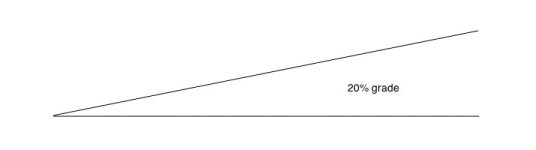
20% grade

/ 20% grade #1  

Ridew

New member
Joined
Sep 30, 2012
Messages
3
Location
Iselin, nj
Tractor
None
My wife and I purchased a small farm that has a lot of grades. Most fields have less than 15% grade but some of the lower fields have 20% grade. The farm was plowed by a horse and plow. I am looking for suggestions on what type of tractor would be the best to buy in order to plow safely.
Any suggestions would be greatly appreciated
 
/ 20% grade #2  
:welcome:

Just about any "normal" farm tractor should be fine. To feel comfortable, you may have to extend the track (width between the tires) to the widest setting. If you've ever paid attention to the tractors mowing the highway right-of-way, you may have noticed that the tires are set way apart. That's what determines the stability on a slope. Typical ROW slopes are cut to a 3:1 (33% slope). Also, filling (or ballasting) the tires will help a little.
 
/ 20% grade #6  
Plow that kind of slope and I don't see how you avoid extreme erosion:thumbdown:

You sure you need to plow it??
 
/ 20% grade #7  
fill the rear tires up with a liquid to add more ballast weight. and get that extra weight closer to the ground. can help reduce COG (center of gravity) for a tractor.

going SLOW, with plowing, ya going to be in and out of the furrow made from last pass of a plow. and if you hit the furrow wrong ya going to be tipping over. the faster you go, less chance you might be able to steer to keep things going. along with faster you go more likely hitting a bump on high side or going into a hole low side and suddenly tipping over.

many tractors, you can either swap rear wheels (one side for other side) to keep tread in correct direction. and gain a inch or 2. (it is all in the rims) and were things bolt up to the hubs. to get a wider stance.

some tractors ya have to buy spacers. to get a wider stance for the wheels.

they do sale "tilt meters" that mount on tractor. to help "give you an idea" of what angle you are at. it is by no means lets ya drive tractor right up to max degrees before tractor rolls over. but helps give you a better idea of things.

having ROPS (roll over protection system) is always good. (of course wear seat belt when ROPS is up)
do not be confused with FOPS or sunshades. they will not give you any protection in a roll over.

=============
and of everything, do things in your own limits. if ya do not feel safe. then stop.

=============
and with texasjohn, has stated do you really need to put in a field at that steep of an angle? it might be better area for a pasture for live stock. than actually growing a crop. erosion can be a killer.
 
/ 20% grade #9  
Been there, short visits. 20% is the outer limit of the tiltmeter I have, and my pucker factor goes sooner than that. I've had my tractor on 3 wheels numerous times...not pleasant...so I been on slopes...am here to tell you that at those kind of angles any small hole/bump you hit throwing you in the wrong direction can be a rollover. I fear that regular plowing/planting/harvesting on such a slope not only gives extreme erosion, but will end up, sooner rather than later, in an unfortunate event.

OP seems to be new to farming and going immediately into a dicey situation..... Hope all works out for him. Land is already purchased but I advise avoiding the extreme slopes since they cannot be plowed up/down but across, at least until experience is gained. There is a whole lot to learn about how the center of gravity moves around a result of FEL weight/height, vehicle velocity, angle of front wheels, implement being pulled and how it is attached to tractor, weight in tires/on wheels/on front/on rear, etc. It happens so fast and there is very little the vehicle operator can do to stop a roll over once it is in progress.

If there is a TBN member who has numerous years experience of safely and successfully plowing and harvesting 20+ degree slopes, I'm hoping they will post information about the implements, tractor and practices they use to do it.
 
/ 20% grade #10  
he could always purchase another horse team
:)
 
/ 20% grade #11  
You could plow going up and down if you till after and pull the dirt back up the hill. You need to dig a big ditch across the top and depending on how tall it is maybe another ditch near the middle after you till. Put landscaping fabric on the middle ditch to hold it together in a big rain if necessary. I live in west virginia and have seen it done. You will always be fighting erosion but it will work.
 
/ 20% grade #12  
20percentGrade.jpg
 
/ 20% grade #13  
Since it's a small farm, you'll probably want a larger compact tractor or a smaller utility tractor. Although you might desire a cab, they add weight well above the center of gravity.
Definitely increase the track as Bigfoot wrote...and fill those rear tires.
It'll be expensive, but you may even want to install duals on the rear axle.

Now, since you don't have a tractor yet, you should consider a used machine that has duals installed...even if it is a bigger machine then you want.
 
/ 20% grade #14  
This is not strictly on point but illustrates the importance of knowing the terrain where you operate a tractor or a mower, especially on a slope, especially where there are or might be holes or depressions on the downhill side or bumps, etc., on the uphill side. A man we knew was mowing around his pond with a zero-turn mower--the commercial kind that has two levers, one operating each hydraulic-drive system for each wheel, that you push or pull to cause the wheel on that side to go forward or reverse. Muskrats had undermined the edge of the pond. The ground gave way on the side of the mower near the water, the mower and this man went into the water, and his belt got caught on the handle of one of the levers. The result was the he could not get free of the mower, even though it had a ROPS, and he drowned. I have been mowing around our pond with a zero-turn mower, but I try to make absolutely sure I know where the muskrats have caused damage, and where in doubt I avoid the suspect area. And we just decided to plant weeping willows on the dam and stop mowing within six feet or so of the water there.
 
/ 20% grade #15  
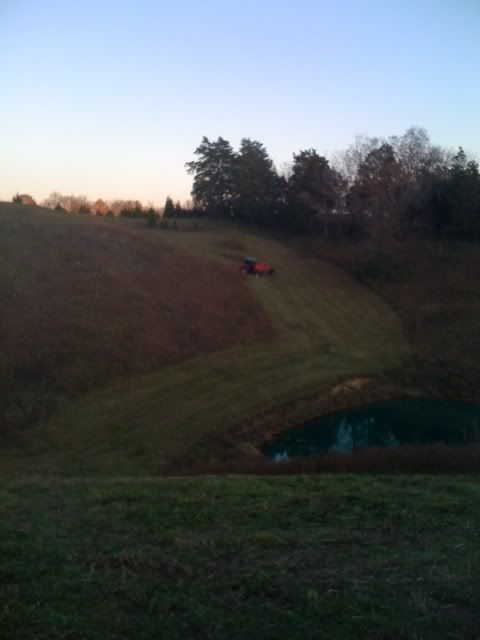
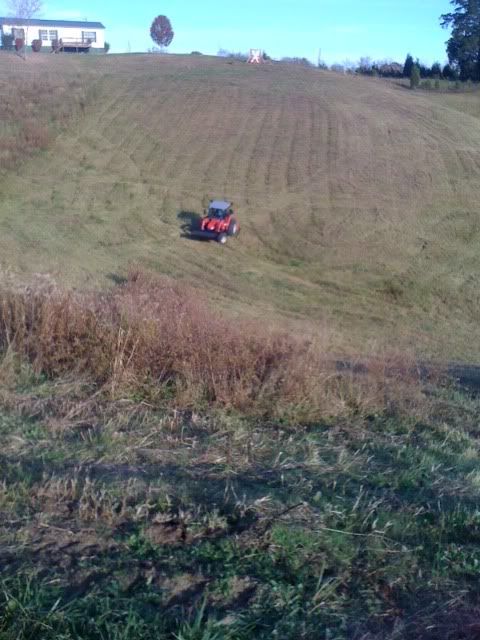
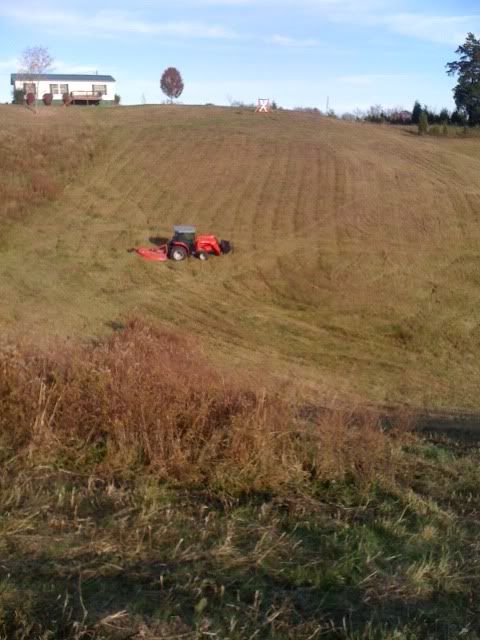
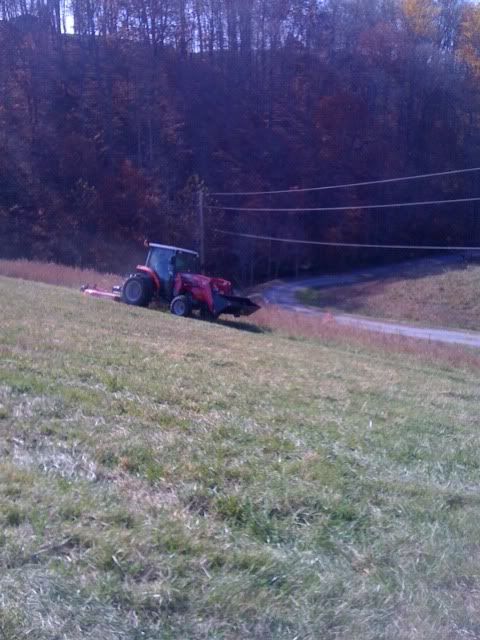
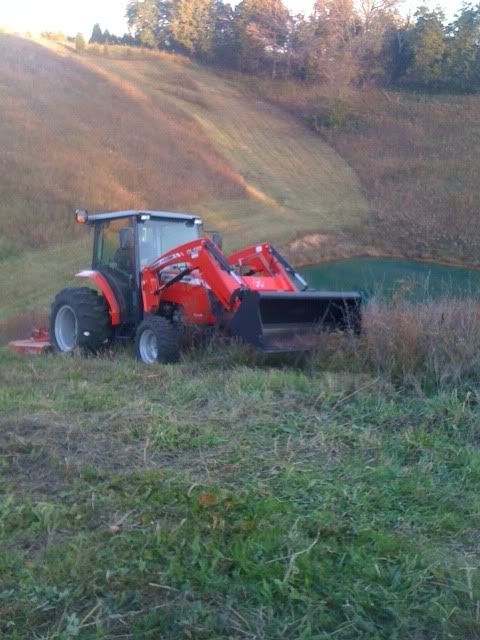
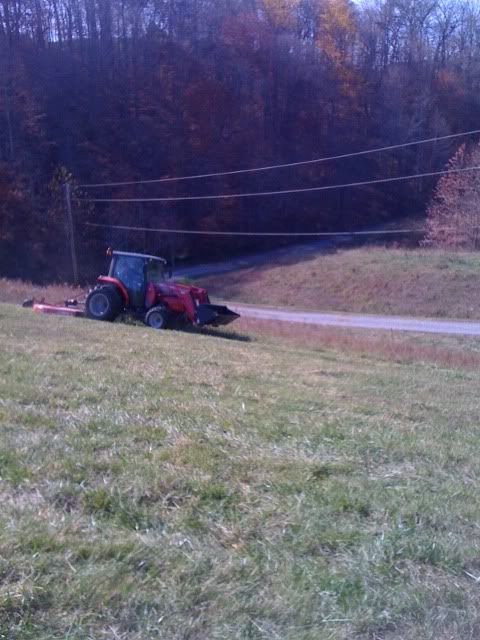
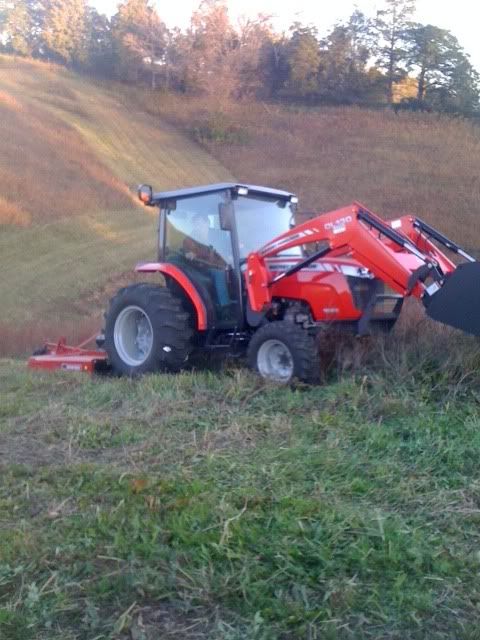
I don't know what the grade on my hills are but I can tell you that I only bush hog them and would never consider plowing them. I'll attach some pictures....

23.jpg

24.jpg

25.jpg

26.jpg

19.jpg

27.jpg

20.jpg
 
/ 20% grade #17  
Thank you for your comments. East Tennessee is a beautifull place. Hawkins County is a beautifull area. The 4th of July fireworks show in Rogersville is the best.
 
/ 20% grade #18  
I want to retire to east TN
Also viewing those pics invoked the PUCKER response to my....... well you know
:p
 
/ 20% grade #19  
Just eyeballing that cross cut...that looks very steep! Have you ever checked it with an inclinometer? Do you cut the rest of that hill going up and down? Add in the pond at the bottom - this is a worst case scenario. It is beautiful country!
 
/ 20% grade #20  
A compact tractor might be different but most ag tractors as long as you go slow will usually start sliding down a hill before they will roll. As long as you don't hit a hole or something on the down hill side. A 20% slope is not too much at all. I have one 1/4 of land where the average slope is close to 25% and the steepest is somewhere around 50%. Been in the family since 1944 and no one as of yet has rolled a tractor but you do have to know what you are doing on the hills.
 

Marketplace Items

Trimble Guidance System (A60462)
Trimble Guidance...
2011 Ford F-350 Service Truck, VIN # 1FDRF3GT8BEA38908 (A61165)
2011 Ford F-350...
UNKNOWN 500BBL WHEELED FRAC TANK (A58214)
UNKNOWN 500BBL...
Cushman Hauler 1200X Golf Cart (A57148)
Cushman Hauler...
2015 CATERPILLAR 140M3 MOTOR GRADER (A58214)
2015 CATERPILLAR...
KJ K1119 11'x19' Carport (A60463)
KJ K1119 11'x19'...
 
Top