Air compressor lines for stationary air compressor.

/ Air compressor lines for stationary air compressor. #1  

sixdogs

Super Star Member
Joined
Dec 8, 2007
Messages
15,729
Location
Ohio
Tractor
Kubota M7040, Kubota MX5100, Deere 790 TLB, Farmall Super C
I used to have air lines run in my shop because I painted and needed the moisture removed. At the compressor I had a flex line to a vertical line that crossed over and dropped down to my moisture filter for painting. It looked something like this
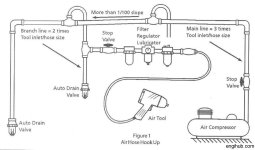
Image 4.jpeg
It worked great but I just finished insulating my barn and had to take the lines down. I don't paint as much and don't want to run lines again. I have a two stage 100 gallon 180? psi compressor.

Can I just run a short rubber hose off the tank to a moisture filter, possibly right on the tank, and then run my air hose off of that? This would keep it easy for me and I only paint again equipment no that isn't very fussy. I mostly pump up tires.

I'd like to keep it simple. What do others do and how do you run your lines off the compressor to remove moisture?
 
/ Air compressor lines for stationary air compressor. #2  
There are different types of "moisture filters", but what most have is a separator. This is essentially a fine mesh screen that collects condensing moisture droplets from the air as it passes thru, and drips them into a bowl.

To work, these require that the air coming out of the compressor has cooled enough for the water suspended in the air to condense when it hits the mesh. Those mounting it directly to the compressor usually end up with water in their lines, because the compressor tank gets hot and thus the air passing thru the separator is too hot to allow for condensation.

Even just 10 feet of copper or iron line running to the separator, connected to the compressor with a short length of flexible hose, would work much better than having the separator mounted directly to the compressor tank outlet.
 
/ Air compressor lines for stationary air compressor. #3  
My shop has a 7 1/2 hp Cambell Hossfeld compressor. Over the past ten years, my requirements for compressed air has dwindled to be much like you describe. I find that the TANK takes care of the lions share of the water removal. I don't run any water filter at all. When I do have the need, I set the filter /separator near the point of use. Everything run by rubber hose and quick disconnects.

This is in the North East, I might reconsider if in Florida. If in AZ, even the water trap might be un needed.
 
/ Air compressor lines for stationary air compressor. #4  
My shop has a 7 1/2 hp Cambell Hossfeld compressor. Over the past ten years, my requirements for compressed air has dwindled to be much like you describe. I find that the TANK takes care of the lions share of the water removal. I don't run any water filter at all. When I do have the need, I set the filter /separator near the point of use. Everything run by rubber hose and quick disconnects.

This is in the North East, I might reconsider if in Florida. If in AZ, even the water trap might be un needed.
It all depends on duty cycle. If you only ever use a small volume of air at a time, this can work fine. But the first time you do a job that keeps the compressor running long enough for the tank to heat up, this method stops working.

Side note on draining tanks: I probably have the same compressor as you, a 7-1/2 HP x 70 gallon "Extreme Duty" from CH, purchased probably late 1990's or ca.2000. Other than a few blown motor capacitors over the years, it's been a great little workhorse, but draining the tank was always a PITA. More importantly, since I'd use it hard on weekends and mostly let it sit during the week, the thing was always left cooling and condensing unattended. So, there was basically always a quart or half gallon of water left in the tank all week... for 20 years.

I had looked at the "old school" auto drains years ago, operated by the unloader valve puffing against an air-operated solenoid, and the whole rig seemed impractical to rig on that compressor type. But then a year or two ago, someone here (I think @5030 ?) mentioned these little timer relay operated solenoid valves that you can plumb in as an auto drain, and I picked one up cheap on ebay or Amazon. Now the thing does a 5 second piss every hour, or thereabouts, which is more than enough to keep the tank always dry, given my usage and air-conditioned shop environment.

The timer is adjustable in both frequency and duration of drain cycles, and I'd recommend this to anyone with a stationary compressor. We've all seen tanks rusted thru from the bottom, and the amount of stored energy in a 70 gallon bottle at 140 psi is absolutely devastating, should one ever rupture.
 
/ Air compressor lines for stationary air compressor. #5  
It all depends on duty cycle. If you only ever use a small volume of air at a time, this can work fine. But the first time you do a job that keeps the compressor running long enough for the tank to heat up, this method stops working.

Side note on draining tanks: I probably have the same compressor as you, a 7-1/2 HP x 70 gallon "Extreme Duty" from CH, purchased probably late 1990's or ca.2000. Other than a few blown motor capacitors over the years, it's been a great little workhorse, but draining the tank was always a PITA. More importantly, since I'd use it hard on weekends and mostly let it sit during the week, the thing was always left cooling and condensing unattended. So, there was basically always a quart or half gallon of water left in the tank all week... for 20 years.

I had looked at the "old school" auto drains years ago, operated by the unloader valve puffing against an air-operated solenoid, and the whole rig seemed impractical to rig on that compressor type. But then a year or two ago, someone here (I think @5030 ?) mentioned these little timer relay operated solenoid valves that you can plumb in as an auto drain, and I picked one up cheap on ebay or Amazon. Now the thing does a 5 second piss every hour, or thereabouts, which is more than enough to keep the tank always dry, given my usage and air-conditioned shop environment.

The timer is adjustable in both frequency and duration of drain cycles, and I'd recommend this to anyone with a stationary compressor. We've all seen tanks rusted thru from the bottom, and the amount of stored energy in a 70 gallon bottle at 140 psi is absolutely devastating, should one ever rupture.
Got a link for one of these drains?
 
/ Air compressor lines for stationary air compressor. #6  
I run my 60 gallon Devlbiss (?) From outside the wall with rubber joined to the internal infrastructure. The inside I have four "U"s that are about 5' long with a petcock at the bottom of each. Catches most water before it goes the the multiple drops. Each drop has a reg/air or oil regulator to hook to. Works well for me but I did it with the forbidden PVC. Haven't had a problem at this house yet. When it does I will go to copper or black pipe.
 
/ Air compressor lines for stationary air compressor. #7  
Got a link for one of these drains?
Compressors Direct (use your search engine to look them up). They not only sell new compressors but replacement parts and filters as well but more importantly, sell the Suburban Manufacturing timed auto drains (I have 2 of them, one each on each compressor).

They sell both the Tsunami condensate drain which works via pressure differential as well as the timed unit (that I use). They are on Amascon as well but the ones on Amascon are Chinese. The ones on their website (Compressors Direct) are American made which I prefer.
 
/ Air compressor lines for stationary air compressor. #9  
I'm in a similar situation. I took down my hard lines and water filters when I sold my Illinois home, and brought the compressor and all the piping, etc with my to Iowa. After I built my shop (finished early last year), the compressor is in but I still have the piping sitting here in a corner - waiting. Haven't got that part of the shop build yet. Decision time...
 
/ Air compressor lines for stationary air compressor. #10  
I'm in a similar situation. I took down my hard lines and water filters when I sold my Illinois home, and brought the compressor and all the piping, etc with my to Iowa. After I built my shop (finished early last year), the compressor is in but I still have the piping sitting here in a corner - waiting. Haven't got that part of the shop build yet. Decision time...
I moved in 2011, and found myself in the same situation. I finished building the new shop in 2015, operating out of an unfinished barn for the 4 years in-between, but it took me until 2023 to find time between other projects to actually put up new hard line.

I made do by putting about 10 feet of 1/2" copper line on input to separator, and then connecting that to compressor with another 100 feet of 1/2" hose. Direct 1/2" NPT connections, no quick-disconnects, to minimize the pressure drop of an already-bad system. It wasn't great, but thanks to my compressor residing in an air-conditioned shop, I got by.

Now it's all hard-plumbed in copper, 3/4" line into three long parallel runs in 1/2" copper, before collecting back into a single 3/4" feed into the separators on each floor. All painted flat black, it works very nicely as a radiator, ensuring air going into the separator is as cool as possible, for maximum moisture extraction. Auto drain on compressor, my only possible point of failure is if I forget to drain the separators.

Usually doing in-home repair work on copper, where there's always that last bit of water in your line ruining a solder joint, it was so nice to work on clean, new, and dry copper line for a change. Probably 100+ solder joints, and not a single leaker among them. All done in K & L type, avoid the type M if using copper for air pressure.
 
/ Air compressor lines for stationary air compressor. #11  
To work, these require that the air coming out of the compressor has cooled enough for the water suspended in the air to condense when it hits the mesh. Those mounting it directly to the compressor usually end up with water in their lines, because the compressor tank gets hot and thus the air passing thru the separator is too hot to allow for condensation.
^^^^ This right there.
Unless you have a cooler/dryer, you want those inline separators away from the tank to allow the air to cool and condense the moisture. This is also why iron pipe is a bad choice for lines--They rust from the inside out.

I have a forced-air cooler right after the tank and above it. It turns on when I turn on the compressor. The cooler runs all the time while the compressor cycles as needed. Condensate drains back into the tank and out the bottom drain--Basically, a metering valve. It bleeds all the time. My inline filters and separators are always dry. And that means dry air.
 
/ Air compressor lines for stationary air compressor. #12  
My set up is as u described sixdog.. a 3/4” hose (Zorro) coming off the compressor WITH A LOOP & going into a water separator/pressure regulator. (Northern Tool)

Last weekend was THE 1st TIME I drained the tank in 5 years.!!
(Long story)
I noticed that with a brief use of the air to blow off a part, the compressor would kick on..
So I got down on all 4’s and figured it out..
lol.. THAT will never happen again.!! Lotsa water to say the least..
But what astonished me was, I never got any signs of water thru my line.. & with the occasional burp of the water separator, I still never got any water..
Now I’m wondering if having a “loop” coming off the outlet allowed for any condensation to drop back down into the tank.??
I’m not gonna think to hard about it, all I know is it worked..& I had no water in my line..
 
/ Air compressor lines for stationary air compressor. #13  
My set up is as u described sixdog.. a 3/4” hose (Zorro) coming off the compressor WITH A LOOP & going into a water separator/pressure regulator. (Northern Tool)

Last weekend was THE 1st TIME I drained the tank in 5 years.!!
(Long story)
I noticed that with a brief use of the air to blow off a part, the compressor would kick on..
So I got down on all 4’s and figured it out..
lol.. THAT will never happen again.!! Lotsa water to say the least..
But what astonished me was, I never got any signs of water thru my line.. & with the occasional burp of the water separator, I still never got any water..
Now I’m wondering if having a “loop” coming off the outlet allowed for any condensation to drop back down into the tank.??
I’m not gonna think to hard about it, all I know is it worked..& I had no water in my line..
Install the auto drain I linked above, and you'll never have that problem, again.
 
/ Air compressor lines for stationary air compressor. #14  
@sixdogs while you could run rubber to the filter (and regulator?) and a hose from there on, I wouldn't. I would run copper to the filter and regulator first. Just on safety grounds, I don't think that you really need to be around hoses with 180psi in them, but that's me.

I have a 3' braided stainless flex line from my IR compressor to the wall mounted coalescing filter and water separator with a float drain. I was leery of using a rubber line at the compressor due to the heat and oil, and concerned about the hose blowing out.

After a few years I added an intercooler that I built with a coalescing filter with an auto drain that removes 99% of the water before it gets to the main air tank. I still cycle the bottom drain of the tank after using it, but there hasn't been water or spray for years.

All the best,

Peter
 
/ Air compressor lines for stationary air compressor. #15  
Just a thought on the topic.

What is the Relative Humidity INSIDE an air compressor tank with just 1 drop of standing liquid water?

What is the RH if the tank is half full of condensate water?

What is the RH in the airstream at the nozzle of a blow gun in use?

I bet we can all figure out the answers......
 
/ Air compressor lines for stationary air compressor. #16  
Me, im a firm believer in refrigerated air dryer, but i have a plasma cutter bench in my shop. If it wasnt for this, id proboibly just use a system like your describing.
 
/ Air compressor lines for stationary air compressor. #17  
To have dry air at the business end, there has to be some place on the line where the temps get below the dew point.
 
/ Air compressor lines for stationary air compressor. #18  
I was real skeptical about the quality of the harbor freight refrigerated air dryer, but its worked flawlessly for many, many years. I have a secondary paper water trap after dryer, and ive never had to change it since installing the dryer. That thing removes 100% of the water.
 
/ Air compressor lines for stationary air compressor. #19  
Your set up was a good start at having dry air.

However, water vapor can travel through any water trap, or water filter.

A Motor Guard M-100-KIT filter right before your air hose, is as good a trap as you can get. It uses a roll of toilet paper, to filter out moisture, on a limited basis.

As others have suggested, you can add piping that will help that vapor to condense out of the air, so the traps can catch it.

But, the only way to be certain of clean, dry air, is to have a drier.

You have two options: A refrigerated drier. Or, a desiccant drier.

Depending on your budget, there are options that can supply you with a limited amount of dry air, at an affordable price.
 
/ Air compressor lines for stationary air compressor. #20  
Put an auto-drain on the tank and dryer if you can, just a few less frequent maintenance items. We needed dry air for the sandblasting cabinet we use for sand-carved glass and stained-glass projects. I bought a new compressor from Home Depot with auto drains for the tank and dryers. The sandblasting cabinet has a moister filter on the incoming airline. It hasn't shown any moisture yet. We just use rubber hoses on the ground to supply air where we need it.

1744820491720.png
20240519_185418.jpg


20240519_185401.jpg
 

Marketplace Items

Lone Star dump trailer (A55973)
Lone Star dump...
YANMAR VIO17-A EXCAVATOR (A60429)
YANMAR VIO17-A...
JOHN DEERE 772GP MOTOR GRADER (A58214)
JOHN DEERE 772GP...
2008 KOMATSU PC138USLC-8 EXCAVATOR (A60429)
2008 KOMATSU...
Crown RM6025-45 4,500 LB Stand-On Electric Forklift (A59228)
Crown RM6025-45...
2012 VOLVO VNL (A55745)
2012 VOLVO VNL...
 
Top
