Air Compressor WARNING!

   / Air Compressor WARNING!
  • Thread Starter
#81  
Says sign in to confirm age WTF.
 
   / Air Compressor WARNING!
  • Thread Starter
#82  
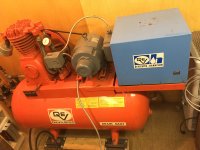
IMG_6790.JPG

My compressor that came with a dryer doesn't dry the air going into the receiver, but only going out. Kind of suggests that moisure going into receiver isn't as big an issue as moisture going out to your tools.

The guy who spoke of making a cooler, or coil, before going into the tank. Thought about that. So where does the water go? Still goes into the tank.

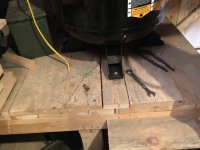
As I took this picture, I noticed the DRAIN DAILY sticker and tried to do that. As often happens with me, the valve won't work. Plugged up!


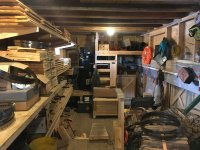
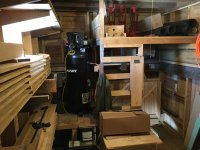
Compressor lives in a small second story, very tight, heated room with two tiny windows. Would be UGLY if it ruptured.
 
   / Air Compressor WARNING! #83  
All this compressor talk made me go check mine, haven't drained the tank since last July and bout a quart of water came out. So checked mine today, first drained the air, then loosen petcock up and I was shocked, not one drop of water came out, thought it might be plugged I took out the whole petcock then ran a piece of wire up through the hole, still no water came out.

Its usually running about couple hours a week, I dont get it there should've been least a teaspoon full come out. In summer I've seen water come out of a cheap HF water separator but this time no water came out of that either, maybe only get water in summer time...
3/8 In. Air Filter with Regulator

IMG-9247.JPG IMG-9246.JPG IMG-9263.JPG
 
   / Air Compressor WARNING!
  • Thread Starter
#84  
Curious what the excellent photo was taken with. My old cibershot has just bit the dust and am thinking about a replacement.
 
   / Air Compressor WARNING! #85  
I'm using an 3 year old iphone se, newer smart phones take lot better pics. Choose one that has a longer lasting battery, mine was never good on that.
 
   / Air Compressor WARNING! #86  
Says sign in to confirm age WTF.

I think they stuck the label on it because the tank did explode and severely injured the grandfather.

At the distance the video camera was recording the resolution is low enough not to show any real detail.
At the end of the video the poster says granddad spent over 3 months in a hospital and would never be the same.

weird I hit the link video plays... I advanced to almost the end and the guidelines page shows Up??

Started video again and it played thru no warning page???

Over 1.1 million views
 
   / Air Compressor WARNING! #87  
I didn't see no confirm age sign but I'm starting to see a pattern with these horizontal compressors, that explosion was approx@1:29 and 7 years ago. So how old is old on a air tank, I bought a Sears 5hp 15 gal air compressor back around 1993, used it alot for the next 20 years, inside and outside.........
 
   / Air Compressor WARNING! #88  
My dad still has his Sears horizontal compressor from the 70s......yikes.
 
   / Air Compressor WARNING! #89  
I am sorry, but in reality this video only shows the cylinder being subjected to over-pressure, not hydro testing! I am no expert, but my understanding of a "hydro test" is to subject the pressure vessel to pressure to which the tank is certified (which he did in a way!) However, the part that he left off and didn't do is the part that tells you if the tank is good or not!! Basically, a tank is submerged in a liquid, filled to the rated capacity and the liquid surrounding the tank is what is measured. If you over pressure a tank to it's rated capacity, it is allowed to "swell", as metal is going to stretch (think of a balloon!) Once the pressure is released back to atmospheric pressure, the tank should return back to it's normal state. There is a certain allowance for just how far it will stretch and not return back which is measured by the displaced liquid OUTSIDE the tank!!
So if you blow up a balloon under water, say in a bathtub, you mark the water line before you start, and again when you reach full pressure, and then let the air back out of it. The amount that the water did not return to it's original level is the amount that concerns you (the amount is figured out by some formula). Everyone who has ever blown up a balloon can see that there is a difference in the appearance of a balloon before and after it is been blown up the first time. You can't see it with a steel pressure vessel, but that is basically what you are measuring. The elasticity of the metal and it's ability to stretch and then return to it's original shape (size) is the factor that keeps tanks from blowing up on you.
My hat is off to the poster for presenting a nice video, however it is VERY MISLEADING, because in reality what he did to his own tank did more harm than good.
I am also surprised at American Rotary for putting their stamp of approval on it!
David from jax

I can see your line of reasoning and am wondering if a wire stretched around the tank, secured by a spring would tell you the same thing. Measuring the length of the spring before and during would give an indication of deflection. I don't know if that would be accurate enough.

On another thought. I wonder too if the explosions are more from metal fatigue from the air tank being cycled from 0- operational pressure on an ongoing basis. (Air receiver for those not familiar with every day vernacular.) That might be the reason some air tanks have an expiry date. Also to absolve the manufacturer from any liability.
 
   / Air Compressor WARNING! #90  
I can see your line of reasoning and am wondering if a wire stretched around the tank, secured by a spring would tell you the same thing. Measuring the length of the spring before and during would give an indication of deflection. I don't know if that would be accurate enough.

On another thought. I wonder too if the explosions are more from metal fatigue from the air tank being cycled from 0- operational pressure on an ongoing basis. (Air receiver for those not familiar with every day vernacular.) That might be the reason some air tanks have an expiry date. Also to absolve the manufacturer from any liability.

Liability is the main reason, I am sure.
Metal fatigue is an issue, but not if the MOE isn't reached. Metal will absorb stretch and retract a LOT, as long as the limits where the metal stretches isn't reached. If you stretch the metal to a point where it starts to stretch and not retract, the chances of failure become really huge. Wrapping a wire around it, (how about a flat tape measure?) to see how far it stretches is and doesn't retract, but with all the different angles that could stretch and not retract (such as around the welded on pipe connections), just the wire really doesn't give the full story. Usually water sitting in the bottom of the tank tends to corrode that area more than the higher regions and that area is where it tends to fail first. Hydro testing (the proper way) has been deemed to be a pretty good indicator. (BTW, my experience, while minimal, was attained in the field of high pressure vessels used in the welding field).
I just hate that such a well executed video is so misleading, and no telling how many people may use that same example as gospel.
David from jax
 
   / Air Compressor WARNING!
  • Thread Starter
#91  
I TOTALLY agree on the cycling causing fatigue. And of course it's going to fail at or near the weld, and of course any corrossion is going to exasperate this.
 
   / Air Compressor WARNING! #92  
Liability is the main reason, I am sure.
Metal fatigue is an issue, but not if the MOE isn't reached. Metal will absorb stretch and retract a LOT, as long as the limits where the metal stretches isn't reached. If you stretch the metal to a point where it starts to stretch and not retract, the chances of failure become really huge. Wrapping a wire around it, (how about a flat tape measure?) to see how far it stretches is and doesn't retract, but with all the different angles that could stretch and not retract (such as around the welded on pipe connections), just the wire really doesn't give the full story. Usually water sitting in the bottom of the tank tends to corrode that area more than the higher regions and that area is where it tends to fail first. Hydro testing (the proper way) has been deemed to be a pretty good indicator. (BTW, my experience, while minimal, was attained in the field of high pressure vessels used in the welding field).
I just hate that such a well executed video is so misleading, and no telling how many people may use that same example as gospel.
David from jax

I appreciate what you say here. it makes sense. A flat tape measure would work but the only ones I know of are my wife's fiberglass for sewing. I don't know if they stretch or not and it's impossible to get an accurate measurement with a standard tape measure.

At first I was going to disagree about the "well executed video" but after thinking about what executed means I have to agree with you. He did an excellent job. He's obviously an intelligent man but I get so turned off by his videos. To the point I don't watch him at all any more. There's just too much repetition and I feel my YouTube time is worth something too. It's really to bad because he does excellent work. End of rant. I'll sleep better tonight!!
 
   / Air Compressor WARNING! #94  
View attachment 685568

There was a fairly involved thread over on Welding Web where a Youngster was intent on repairing an old pin hole rusted compressor tank.
He did weld on it and eventually water pressure test it- but still a Really REALLY bad idea.

Who wants a time Bomb in their shop.

If a tank is to be welded on it should be inspected, and then only welded by an ASME Certified welder and then hydro tested.

:thumbsup:
 
   / Air Compressor WARNING!
  • Thread Starter
#95  
I like the Stainless idea. But that so goes against everything the whole consumerism culture is about.
 
   / Air Compressor WARNING! #96  
Liability is the main reason, I am sure.
Metal fatigue is an issue, but not if the MOE isn't reached. Metal will absorb stretch and retract a LOT, as long as the limits where the metal stretches isn't reached. If you stretch the metal to a point where it starts to stretch and not retract, the chances of failure become really huge. Wrapping a wire around it, (how about a flat tape measure?) to see how far it stretches is and doesn't retract, but with all the different angles that could stretch and not retract (such as around the welded on pipe connections), just the wire really doesn't give the full story. Usually water sitting in the bottom of the tank tends to corrode that area more than the higher regions and that area is where it tends to fail first. Hydro testing (the proper way) has been deemed to be a pretty good indicator. (BTW, my experience, while minimal, was attained in the field of high pressure vessels used in the welding field).
I just hate that such a well executed video is so misleading, and no telling how many people may use that same example as gospel.
David from jax

The stretch of a cylindrical vessel with variations in pressure would probably be in the micro-meter range. Never be able to measure with a 1/64 increment tape measure plus surface irregularities would probably skew it anyway. Temperature changes would be longitudal. The thin wall of such air vessels make them very vulnerable to interior corrosion especially with the influx of fresh oxygen continually. Once pitting starts it progresses rapidly. Trying to repair small leaks just delays another failure.

Structural failure of an gas container shatters the steel where on a liquid container it just splits till excess pressure is relieved. The most dangerous are those with multi-stage compressors that have capability of far exceeding the pressure rating of the tank; then, failure of a relief valve becomes the culprit. Most single stage compressors top out at around 150 PSI. A certified ASME welder would/should refuse to repair such a thin wall vessel, they are cheap to replace.

Dangerous, yes. Catastrophic failure, rare.

Ron
 
   / Air Compressor WARNING!
  • Thread Starter
#97  
I always throw my empty or plugged rattle cans in the bon fire. Always surprised that the ends usually blow out and not the sides or seams despite being about as thick as the sheet metal on my HD GMC.
 
   / Air Compressor WARNING! #98  
15 years ago I took my oxy cutting tanks back for exchange at the weld store, now closed, but the owner was telling me that one of his new customers welded handles on the tanks and brought them in for refill, in short the owner said they're now junk so the customer had to buy new tanks, the weld store owner said he was a little up set, one of them stories thats hard to forget....
 
   / Air Compressor WARNING! #99  
I always throw my empty or plugged rattle cans in the bon fire. Always surprised that the ends usually blow out and not the sides or seams despite being about as thick as the sheet metal on my HD GMC.

I do to actually. I like a good bon fire and save up my rattle cans for that. Best ones are the spray undercoating gans because they use propane for the propellant. The make a huge womp and a big fireball, especially a full one that the nozzle failed on....,.:D
 
   / Air Compressor WARNING! #100  
15 years ago I took my oxy cutting tanks back for exchange at the weld store, now closed, but the owner was telling me that one of his new customers welded handles on the tanks and brought them in for refill, in short the owner said they're now junk so the customer had to buy new tanks, the weld store owner said he was a little up set, one of them stories thats hard to forget....

Idiots are all hatched.
 

Tractor & Equipment Auctions

1996 Dorsey Enclosed Trailer, VIN # 1DTV11520TA252324 (A57453)
1996 Dorsey...
2018 FREIGHTLINER CASCADIA TANDEM AXLE DAY CAB (A59905)
2018 FREIGHTLINER...
20FT X 30FT STEEL CARPORT (A58214)
20FT X 30FT STEEL...
CAT 930M (A58214)
CAT 930M (A58214)
John Deere 7410 (A53317)
John Deere 7410...
EZ-GO Utility Cart (A55851)
EZ-GO Utility Cart...
 
Top