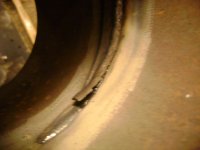
Arc blow in G3 test plate

/ Arc blow in G3 test plate #1  

dstig1

Super Member
Joined
Apr 7, 2010
Messages
5,610
Location
W Wisc
Tractor
Kubota L5240 HSTC, JD X738 Mower, (Kubota L3130 HST - sold)
We're doing some test plates in class for AWS cert practice (not that I'm going to get a cert, it's just good practice). The teacher has us doing G3 vertical up plates with all 7018 1/8" on 5/16-3/8" mild steel (with backer strip - startup and runoff tabs). Running about 120A, usually. And DC+.

The problem: EVERYONE is having issues with massive arc blow at the top 1/4-1/3 of the root pass. That includes the teacher. Even he's a bit stumped as I get the impression he hasn't had to deal with this issue in a long while. He told me tonight that "he ran into this before but can't remember how he got past it, but he'll get it again soon."

We've tried everything we can think of. Moved ground clamp above the work, below the work, and halfway around and across the county - no effect. Raised amps, lowered amps - no effect. Added a heavy backer plate behind the backer strip - no effect.

Anyone have any clues how to fix this? No it isn't critical, but it is bugging me, and I'd like to know.
 
/ Arc blow in G3 test plate #2  
Generally my first response to this question is, it's not arc blow, it's your rod angle. But if everybody is having the same problem, and you've done everything you listed, I'd say you got some bad plate. If this is true, what I'd try just to make sure. Take a test plate that is all tacked up ready to weld, heat it up to a dull red and let it cool, to the touch, then weld it up. Or switch your machine to AC, and run the root pass with 6011.
 
/ Arc blow in G3 test plate #3  
Without actually observing the condition, I dont know what to tell you. I suspect that you have all got some magnetized plate, although it is pretty weird that everyone would have located the magnetic section in the same spot. Take a welding rod and hold it loosely in your hand and see if it is attracted to the plate. Any even slight magnetic properties will cause the arc to go wild at that point. Heating to cherry red as Shieldarc describes usually kills any residual magnetism however I have seen it return when the metal cools.
 
/ Arc blow in G3 test plate
  • Thread Starter
#4  
Interesting. SA- when you say you would suggest rod angle, what would you say is the bad rod angle that could be the problem? I'm curious as we are running pretty much straight in (stinger is ~5 deg down) while moving uphill. I've tried more of an angle myself (stinger 20 deg below puddle) and that didn't help anything.

Yes, the arc goes wild towards the top no matter what we have tried. And this is on a lot of parts. I can check for magnetism next time, but it certainly isn't significant enough that I've noticed the rod being drawn to it strongly or anything like that.

Thanks for the tips.
 
/ Arc blow in G3 test plate #5  
You'd be amazed at how many people don't raise their elbow / shoulder as they're traveling up hill. Most people start off in a comfortable position and work their way into an uncomfortable position, and that is where they loose the correct rod angle. With any welding you're suppose to know how to correct the puddle for any situation. Practicing on pipe is the best teacher I know of, with pipe the rod angle has to change all the time, or you make a fool of yourself real quick. With small bore pipe the rod angle has to change quicker. If you want to be a top hand with SMAW, start practicing on pipe!

I just have a hunch if your teacher stood back and watched you weld vertical up, he would see you're not raising you elbow / shoulder as you travel up hill.;)
 
/ Arc blow in G3 test plate #6  
You know another thing I'd suggest, is to wrap your ground lead around the positioning arm that holds your test plate 3 or 4 times. If that doesn't work, wrap it the other directions 3 or 4 times.

Before wire feeders with Innershield came out I dealt with arc blow quite often. Majority of the time we didn't have AC machines, because we worked with engine drives. So heating the joint, and wrapping the leads were just about our only options.

Can you imagine the arc blow you get splicing these H-beams after that hammer beats them at 200 blows per foot? :confused2:
 

Attachments

  • Menck.jpg
    Menck.jpg
    44.7 KB · Views: 345
/ Arc blow in G3 test plate
  • Thread Starter
#7  
Yeah I'm guilty of not raising my shoulder while doing this until I catch myself and correct it. Depends if I am paying enough attention or not. But even the teacher is seeing arc blow, and he's a pretty steady hand at it. Oh - AC isn't an option on these machines Miller 304 XMTs. DC only. I'll see about heating and the coiling the ground lead, but it isn't a very long lead so that may be tough to do. Might be able to make it happen. I'll see. Thanks again.
 
/ Arc blow in G3 test plate #8  
I've put a lot of time on the xmt. I've never had any arc blow issues but one time. I solved it by a faster oscillation of the rod and adjusting the arc force. Not that had anything to do with the actual problem.....but it worked for me, after i tried all the above.
 
/ Arc blow in G3 test plate #9  
i'm not a certified welder, but i think sticking with the 7018 for the root pass is the better choice. i've seen a lot of people say they use 60xx for the root, and then 7018 for the cover passes, but i am pretty sure that for the test here you are now required to use 7018 for the root pass as well as all cover passes. i worked in the building construction field for a lot of years, and generally all electrodes are specified to be 70xx, because the bulk of the steel used today in commercial and industrial building is a572-50 or a992 - both of which require a low hydrogen process. yeah, i know, even in the field it is generally always done with a wire feeder and not stick, so the process is automatically low hydrogen.

since it's 3/8 plate with a backer, you've probably got beveled edges on the plates, so your root pass is basically welding two knife edges together. if it happens only toward the end, to me it sounds almost as if the metal has built too much heat up in it. what i tend to do in these situations is make my weave pattern more of a j, or fish hook if i start to keyhole too much. basically, in one direction i pull the electrode a greater distance from the puddle, so it starts to cool just slightly before i dip back in.

like i said, i'm not a welder, though i try to do as much as i can, and learn what i am doing wrong and right. i spent a little time last year trying to do open root with 7018. my results were mixed. sometimes i could do it, others i couldn't. with 6011 it was way easier. getting the hang of driving the 7018 in deep enough so that you get complete penetration without sticking was the hard part. also, i found i did better with 3/32 7018 on the root pass than i did with 1/8. i'm sure it's all personal preference, and the fact that i lack great skill.
 
/ Arc blow in G3 test plate #10  
lostcause if you ever decide to give that 7018 open root another go, try using DCEN. Its a little easier on straight polarity.
 

Attachments

  • 3.jpg
    3.jpg
    159.2 KB · Views: 747
  • Pealer DC-.jpg
    Pealer DC-.jpg
    134 KB · Views: 754
/ Arc blow in G3 test plate
  • Thread Starter
#11  
We're doing all 7018 on this. Yes it's beveled as it is a G3 Groove test coupon setup. We've also tried stopping halfway, cooling the part in water, then restarting with a new rod. Same issue.

Like I indicated, it is a rather vexing problem that even the instructor is having issues with.
 
/ Arc blow in G3 test plate #12  
When magnetism is encountered on plate or pipe, it doesnt have to be a strong field to effect the arc. I have seen it when you would barely be able to feel it and it would be impossible to weld. If you have some small iron fillings or grinder dust, dust a little on the plate and see if it sticks. Shield arc mentioned wrapping the leads on it which works for pipe sometimes but it is a hit or miss. Above 500F a magnetic field will completely dissappear but may come back when the piece cools. There are demagnetizers that you can use also. I would bet you dollars to a donut that magnetism is your problem and it has nothing to do with rod angle, type of rod, current setting or any other technique problem. If your arc starts jumping around like a lightning storm, it is due to a magnetic field and something is causing that to occur.
 
/ Arc blow in G3 test plate
  • Thread Starter
#13  
Solved! The instructor looked into it more and talked with some other folks about the issue. What he had us do was to tack the plates a lot more. We had just been tacking in 3 spots on each side of the backer plate, but he said to run a full "tack" bead up and over the backer onto the front of the backer (but outside the groove joint), mainly at the top of the joint where the problems were. That seemed to fix it. I assume it allowed the magnetic flux lines to better spread out in the metal as it was more fully connected together. No more arc blow!

I suggested wrapping the work lead around the fixture but he had the same concern I did - they are so short, it would be very hard if not impossible to do.

Thanks for all your help. Good info and I like to learn more about these things.
 
/ Arc blow in G3 test plate #16  
Easier to make the weld.

Thanks SA. I'm hoping to start taking a welding class this summer and start learning to weld. Probably should have done this 30 years ago, but what the heck. Never too late, right?

Back the the reason for backing the weld. I've seen this done for years where Traffic Signal pole shafts or mast arms are spliced. I always assumed it had something to do with the strength of the weld.
 
/ Arc blow in G3 test plate #17  
The backing plate is nothing but a crutch! Doing open root separates the men from the boys.
If you want a real challenge do open root with 7018.
 

Attachments

  • Pealer DC-.jpg
    Pealer DC-.jpg
    134 KB · Views: 157
/ Arc blow in G3 test plate
  • Thread Starter
#18  
With a 1/4" root gap? I'll take the crutch please! :)
 
/ Arc blow in G3 test plate #19  
With a 1/4" root gap? I'll take the crutch please! :)

This is the first that you mentioned spanning a 1/4" gap.:confused2: (I went back and reread to make sure). Don't think I'll try that for my first weld. Maybe the second.:laughing:
 
/ Arc blow in G3 test plate
  • Thread Starter
#20  
Yeah, I can't say I am any expert in this, but I assume it is the standard configuration for this test. The teacher has us doing "G3 vertical up" plate tests now, which is what I have been having issues with. We take 2 plates that are 3/8" thick and about 6" long x 2-3" wide, and bevel one edge at 60 deg or so. We then take a 1/4" backer strip that is about 1.5-2" wide and tack the two plates to it so the bevels are facing each other and the point of the bevel (on the backer) is 1/4" apart. Then weld away!
 

Marketplace Items

2016 Caterpillar 349FL Hydraulic Excavator (A56857)
2016 Caterpillar...
(20) WOOD PALLETS (A60432)
(20) WOOD PALLETS...
2009 Kubota M5111D 108HP 4WD Agricultural Tractor (A59228)
2009 Kubota M5111D...
(INOP) 2016 CATERPILLAR 259D SKID STEER (A52709)
(INOP) 2016...
UNUSED FUTURE SB45 EXCAVATOR HYD SILENT BREAKER (A60432)
UNUSED FUTURE SB45...
(2) UNUSED 31" X 8 MM EXCAVATOR TRACKS W/ PINS (A60432)
(2) UNUSED 31" X 8...
 
Top