Basic disc mower questions

/ Basic disc mower questions #1  

gsholz

Member
Joined
Mar 19, 2014
Messages
38
Location
Sherwood
Tractor
Kioti DK45SE HST
I'm new to haying. I have some very basic question. I purchased a used Kuhn GMD55 disc mower and used it the first time the other week cutting about 10 tons of hay. The mower worked although I probably had it set too high not knowing what I would find in the field.

When mowing, the plastic skirt is pushing the grass forward before the blades get to the stem. The cut grass then falls forward and interferes with the cutting particularly during turns. Is that normal?

Also, what is the most efficient way to cut a rectangular field? I always get into trouble turning 90 degrees even when I start out with a nice rounded corner I quickly end up with concave / pillow shaped corners which creates a mess when raking and baling. There must be better way...

Thanks, Gerald
 
/ Basic disc mower questions #2  
Yes, the curtain pushing the grass is normal.

Make about 5 or 6 passes around the perimeter, then cut the field in strips.
 
/ Basic disc mower questions #3  
Yes, the curtain pushing the grass is normal.

Make about 5 or 6 passes around the perimeter, then cut the field in strips.

Same thing with the the rake and baler.
 
/ Basic disc mower questions #4  
If you don't want to cut it in strips, just turn 90° don't worry about missing a little clump at each turn. Then when you're done, go back and run an X through the field cutting the little pieces you missed at each corner.
 
/ Basic disc mower questions
  • Thread Starter
#5  
If you don't want to cut it in strips, just turn 90ー don't worry about missing a little clump at each turn. Then when you're done, go back and run an X through the field cutting the little pieces you missed at each corner.
Thanks! I'll try both approaches tomorrow
 
/ Basic disc mower questions #6  
Yes, the curtain pushing the grass is normal.

Make about 5 or 6 passes around the perimeter, then cut the field in strips.

For the life of me I'll never understand cutting a field in strips. All that does is make a lot more corners and take more time. I cut,rake & bale round & round from outside to center of field. Oh well each to their own way.
 
/ Basic disc mower questions #7  
For the life of me I'll never understand cutting a field in strips. All that does is make a lot more corners and take more time. I cut,rake & bale round & round from outside to center of field. Oh well each to their own way.

Me too. On the corners, when I ran the 1209 I used the tongue extension that comes with/is used with some round balers. That allowed me to easily make a square corner. On my current tractor with the cutter to the side, like Mr. Holtz has, I can cut about 3 out of 4 passes and on the 4th pass, with shuttle shift it just takes a second to square things back up.
--------------------

On Mr. Holtz's comment about stem length, the regrowth comes from the sugars stored in the stem...so say university ag folks. Some grasses like Pearl Millet they say need about 6-8" for good regrowth. Other thing is a reasonable amount of stubble provides "spikes" for the fallen hay to rest on keeping it off the ground allowing for air circulation and isolation from any ground moisture for faster drying. With my drum I am getting about 4 1/2 inches. We'll see how it goes, that is if I have guts enough to go another cutting.....after this experience.

Mark
 
/ Basic disc mower questions #8  
For the life of me I'll never understand cutting a field in strips. All that does is make a lot more corners and take more time. I cut,rake & bale round & round from outside to center of field. Oh well each to their own way.

Jim,
I don't cut in strips either. HE wanted an alternative, so I offered one. :)
 
/ Basic disc mower questions #9  
Jim,
I don't cut in strips either. HE wanted an alternative, so I offered one. :)

I really didn't have my reply targeted at you BUT I see my neighbors and other custom operators cut fields up in strips(lands) and just wonder if they have a clue how much longer it takes to cut the same amount of acres in strips as going round & round.
 
/ Basic disc mower questions #10  
I really didn't have my reply targeted at you BUT I see my neighbors and other custom operators cut fields up in strips(lands) and just wonder if they have a clue how much longer it takes to cut the same amount of acres in strips as going round & round.

You think it could be a leftover habit from sickle mower days? Years ago, I was taught to cut a field that way, and never the same pattern twice in a row. It was to keep from "training the grass" to lay over in one direction.
With modern disc mowers, it isn't an issue.
 
/ Basic disc mower questions #11  
I drive for a contractor. His preferance is 9 mower rounds,(3 mowers/ 1 rake row) 3 raked rows, to give the baler room to turn without running into the fence ,then rake in straight rows as he can bale fastest with this pattern.(odd row nos going out then evens on the way back.
NOTE this only applies to centre feed balers.

Mowing: can the rake/ baler get around the corner? if not don't cut in so far.
On the first round you are setting up the mowing pattern for the padock, cut lazy corners to start, as the further in the tighter the corner gets.About 6-8 rounds in you will need to cut a corner or do a stop/start 90 degree square corner.If you cut the corner then plan to cut out -and-back.(gives a tidy no fringe finish) and don't forget either. Or as you start to row up "Oh damm"
As you gain experiance you will find that it is little things that cumulativly add up.

It is much easier to show than explain and I don't have a video camera.
 
/ Basic disc mower questions #12  
it just like mowing a regular yard with a finish mower. in a sense with some extra "tricks in it"

i hate making "sharp corners" and if forced will start making "figure 8" style corners when finishing mowing the yard.

for a hey field, or just any field for that matter, "compaction" of the ground is an issue. so if you can make all your TURNS at the edge of a field. vs in the middle of it some place. then you know were your compaction is, and able to say take a couple extra passes with a plow, disc, "insert what ever implement" to loosen up the compaction. before planting. vs having to work entire field multi times due to compaction.

once you cut the hay, then you need to come back and bail it / deal with it some how. if you are using a tractor with square bailer behind that, and then a hay wagon behind that. trying to do "figure 8" style turns. on sharp corners results in VERY large turns. in order to keep the bailer input aligned. and you may end hitting the fence.

tractor + large round bailer. you are more likely able to make smaller tighter turns than square bailer and hay wagon behind it. but again you are forced to take a slight larger turn than if you just had the tractor out there "think riding lawn mower and mowing your yard"

EXAMPLES:
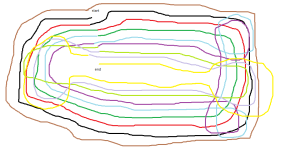
this might be a mowing pattern i might use for a riding lawn mower,
1. being able to go "round and around" first few passes around the yard,
2. and as i get closer and closer to the center i begin to start making figure 8 turns.
3. as in get down the the final narrow strips. i end up making U turns
4. and finally at end of the strip i end up turning out away from the strip and making a large U turn almost a a full 360 degree turns to finish off the final couple passes in the very center.

mowing 1.png

tractor + square bailer + hay wagon
1. again "round and around i go" for first few passes.
2. as i get closer into the center i begin getting sharper corners i can no longer turn with. forcing "much larger figure 8 turns" vs riding lawn mower above.
3. like above U shape turns but larger U shape turns than above
4. full circle nearly full 360 degree turns to get the final row.
mowing 2.png

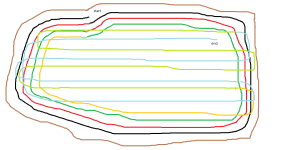
strip mowing/bailing/etc...
1 again like above "round and around i go" BUT i go around enough times i can make larger U turns around the end / edge of the field.
2. once i get enough pass around and around i go, so i have room to make those larger turns at the ends, i begin doing strips.
3. instead of travel 1/4 mile from end to end, to treat field as a single strip. field is broken up in multi strips. so i can do every other strip.
4. this keeps all the main "turning" and compaction of the soil at the ends were i know things will be, you need to remember...
4a. tractor + cutter (compaction one)
4b. tractor + wind rowing cut hay (compaction 2)
4c. tractor + bailer (compaction 3)
4d. wagon if square bailer OR tractor and moving round bails off of field. (compaction 4)
were do you want your compaction every place and randomly through out the field? OR at designated ends of the field?
mowing 3.png

with folks notation of going back and doing an X a couple times to clean out the corners can work as well.
every shape of field is different "length and width" but also any obstacles you might have to get around and when / were a figure 8 style corner may come up vs U turns to nearly 360 degree turns. to "lazy turns in X style doing, were ya don't try and make a 90 degree sharp turn but leave a patch in corners, so you are not having to make as sharp of a turn. and going back with some X style doings...

what works best hard to say. there is always an easy approach, and always a harder approach, what is best for the field / soil can be different as well.
 
/ Basic disc mower questions #13  
for a hey field, or just any field for that matter, "compaction" of the ground is an issue. so if you can make all your TURNS at the edge of a field. vs in the middle of it some place. then you know were your compaction is, and able to say take a couple extra passes with a plow, disc, "insert what ever implement" to loosen up the compaction. before planting. vs having to work entire field multi times due to compaction.


You must be kidding! Compaction is caused from turning corners but not by driving straight???????? Tractor & implement causes compaction going straight or in a turn.
 
/ Basic disc mower questions #14  
You must be kidding! Compaction is caused from turning corners but not by driving straight???????? Tractor & implement causes compaction going straight or in a turn.
you are perfectly correct, what i was trying to get across though, was. "were is the majority of the compaction going to happen at trying to make those extra turns."

if you have to make 40 plus extra turns in the middle of the field. that means a couple more extra miles of tires going over the inside of the field some place.
vs making those 40 plus extra turns at the edge of the field.

you know compaction is going to happen. but trying to get across were do you want the time turning that you are not doing anything but simply turning the tractor for the next pass. were do you want that compaction to happen? randomly almost in the middle of the field some place (most likely in corners), or at the edges of the field?

what produces more crop, the outer rows of say a corn field or bean field, wheat field, etc? or after you get so many feet into various fields, does the overall crop during harvest begin to go up rapidly? if ya know ya getting worst return on crop in given areas and bigger crop from other areas of a field. why make extra turns and compaction on those good areas?

if the issue of bad areas not producing more crop directly and majorly related to extra compaction of the soil?
 
/ Basic disc mower questions #15  
you are perfectly correct, what i was trying to get across though, was. "were is the majority of the compaction going to happen at trying to make those extra turns." what produces more crop, the outer rows of say a corn field or bean field, wheat field, etc? or after you get so many feet into various fields, does the overall crop during harvest begin to go up rapidly?

Where I live the moisture and nutrients on the perimeter of a field are sapped by trees & native vegetation causing perimeter crop to be stunted.
 
/ Basic disc mower questions
  • Thread Starter
#16  
Thanks for all the feedback. I cut a small meadow using the round and round +X method with my disk mower. It worked pretty well. I just left the little triangles standing as I came around the corners and then did 2 passes along the X. I had one problem as I did the X cleanup, hay wrapped around my PTO shaft twice. It took a few minutes to clear. Of course, if I had a PTO shaft guard that would not happen. I'll put that on my list.
 
/ Basic disc mower questions #17  
I usually just go ahead and cut my corners back after couple rounds,make rest day turning them whole lot better. I dont strip cut unless,get boried going in circles
 
/ Basic disc mower questions
  • Thread Starter
#18  
Thanks for all the pointers. I used the round and round plus X clean out for the last meadow and it worked pretty well. In the corners the cut stubble is still much longer than I'd like. It only happens in areas of heavy growth. It must be the grass laying down too much. The disc mower then cuts it 8-10 inches up the stem. On the good news side the baler did not plug once and the knotters worked perfectly after the bill hook wiper repair. It is great to still get parts for 50+ year old equipment.
 
/ Basic disc mower questions #19  
If your land is at all "soft" or has been plowed at one time (dead furrows) you will appreciate keeping all of your travel the same way all the time, crossing wheel tracks and dead furrows is not my idea of fun. I strip mow almost all of our fields, tedder, rake and baler all follow same pattern. I like straight windows and as few turns as possible since with round baler you run the windrow over on tight turns, not good in damp/wet fields.

Never did the X method, I guess I never leave anything when I make a 90 degree turn.

As far mower leave 8" up the stem, probably from your wheels knocking it down? Mow that strip the other way and it will be smooth.
 
/ Basic disc mower questions #20  
For the life of me I'll never understand cutting a field in strips. All that does is make a lot more corners and take more time. I cut,rake & bale round & round from outside to center of field. Oh well each to their own way.


Many around here use a small baler and wagons. 90 degree turns are a pain in the neck with that set up. I have yet to find a mower that doesn't at some point end up with messed up corners, either misses as others have stated or bulges on the turns after 6-8 trips around. I know when I bale I don't like it when someone goes round and round, fields around here are small and many odd shaped, so many corner are less than 90 degree's, some less that 60. Some of our fields from the air look like figure eight's due to natural issues like creeks, ponds, woods, hills etc.

Actually you have less corners doing strips.

With a mid pivot it's just back and forth, no waste across headlands. Baling just turn around and head back on like every 3rd or 4th row.

Many larger farmers are using triple mowers and raking or merging around corners seems to be a pain for them.

As I believe was already brought up. If you use mouldboard plow, no matter how smooth the field seems after disking and dragging, always a little rougher across than with.

I'm not saying what is right or wrong, you asked and I hope to have shed a little light on it. Sure if you can going round is faster mowing, no doubt, if you can harvesting too. Many pieces around here though we don't and I don't see anyone doing it unless it's a large open field with close to 90 degree corners.
 

Marketplace Items

2016 Toyota Camry Sedan (A61569)
2016 Toyota Camry...
2017 FORD F-350 XL 35' NON-INSULATED BUCKET TRK (A59823)
2017 FORD F-350 XL...
case 370 glass door never installed (A61307)
case 370 glass...
2014 BRENNER TANK CRUDE TRAILER (A60736)
2014 BRENNER TANK...
2015 Peterbilt 367 T/A Wet Kit Sleeper Cab Truck Tractor (A56858)
2015 Peterbilt 367...
2007 Capacity TJ6500T Wet Kit T/A Yard Dog Toter Truck (A55973)
2007 Capacity...
 
Top