bending 4x4x.250 sqtube

/ bending 4x4x.250 sqtube #41  
Well the engineers at work claim my 4x4 tube will support 3800lb overhung braced in the middle of 8ft. I explained that 8ft is just the root boom and the dipper boom would add 8 more ft to the overhang, right off said then it was going to bend, but he would do the math and get back to me. Well he never got back to me so i still dont know what I need to know.

Looking at the Lemco and where the cylinders are mounted, well thats almost exactly what I had in mine. I feel the plating for the cyl mounts should add some strenght, but dont know how much. I am not opposed to the truss ideal, but would prefer not to use trusses simply because of eye appeal. I would rather it look ugly than fail, so the final build will probably include some sort of truss. The ideal of build it then add weight until it gives, then add a truss if needed, I had considered. Right now the only way I see not to use a truss is One, use bigger tube. Two, add plenty of plate in the middle of the boom for the cyl mounts and let that be the extra strenght. Three, use 2x4 tube and double it along with the extra plating. Right now I think all three methods will work, but will have to see what I can scrounge before actually building anything.

In general with this design, I would proceed with some caution. There are many, many possible failure points to be considered, some of which would have more significant consequences than if the tubing bends. The attachment point on the trailer, lower pin and hinge design, etc could end up being very dangerous if not designed correctly. And remember, just because it works the first time doesn't mean it will last 100 cycles.

You also will need to spend some time figuring out the correct mounting locations for the pistons so that you get the proper range of motion. When I design a scissor lift for a truck body, I normally spend hours calculating forces, running an analysis on the scissor arms, performing measurements in the computer to determine dump angle, all before I order a cylinder or start cutting parts. And I have a pretty powerful computer program at my disposal to do that.

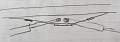
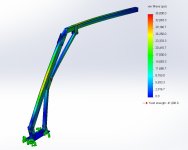
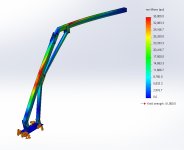
That being said, as far as the arms go, I would weld a 1/4" strip down the top center of each arm. You can see from the analysis that I did how much of a difference that strip makes. This is with 2000 pounds at the end of the arm, which was about right for a 3.5" cylinder at 2000 psi.
 

Attachments

  • ScreenHunter_81 May. 07 12.52.jpg
    ScreenHunter_81 May. 07 12.52.jpg
    61 KB · Views: 142
  • ScreenHunter_81 May. 07 12.44.jpg
    ScreenHunter_81 May. 07 12.44.jpg
    59.1 KB · Views: 147
/ bending 4x4x.250 sqtube #42  
Hey mudd I got your number,,,,,When you've already scrounged 1/2" plate, its beautiful. But when you don't know if you'll come across 1/4x4" truss material that's "ugly".

:laughing: :laughing: Hey you can't fool another scrounger. :laughing: :laughing:

FYI the truss method with 1/8" plate would be even stronger (substantially) than the piggyback method that JB ran thru his program. But more work to model it.
 
Last edited:
/ bending 4x4x.250 sqtube
  • Thread Starter
#43  
Sodo, I aint worried about finding 1/4in truss material, cant find it, its cheap enough to just buy new and not spend the gas and time trying to look for it. What I was referring to having to look for was bigger tube. All in all, I was thinking about it while driving home from SC today. That 2000lb weight is a max load condition, when in reality, I am handling firewood logs, not saw logs. If I take that same 24in dia log and used a more realistic size like 12 in, then the actual weight would be more like 628 lbs instead of 2000lbs. Another thing I thought about is how often is one going to have the boom fully extended at 0degrees level with 2000lbs hanging off of it, I would guess not very often. Of course all this is just me trying to justify to myself to use lighter material than I should, but???
 
/ bending 4x4x.250 sqtube
  • Thread Starter
#44  
In general with this design, I would proceed with some caution. There are many, many possible failure points to be considered, some of which would have more significant consequences than if the tubing bends. The attachment point on the trailer, lower pin and hinge design, etc could end up being very dangerous if not designed correctly. And remember, just because it works the first time doesn't mean it will last 100 cycles.

You also will need to spend some time figuring out the correct mounting locations for the pistons so that you get the proper range of motion. When I design a scissor lift for a truck body, I normally spend hours calculating forces, running an analysis on the scissor arms, performing measurements in the computer to determine dump angle, all before I order a cylinder or start cutting parts. And I have a pretty powerful computer program at my disposal to do that.

That being said, as far as the arms go, I would weld a 1/4" strip down the top center of each arm. You can see from the analysis that I did how much of a difference that strip makes. This is with 2000 pounds at the end of the arm, which was about right for a 3.5" cylinder at 2000 psi.

Trying to work with what I have found, has been hard for me. Pic of the boom with the circles is what I came up with for mounting points. Since I had a cyl with a known lenght that I wanted to use. It was a matter of figureing the mounting point for the boom on the base and where to attach the cyl on the boom so that it would give me a 75degree upward angle and a 30 degree downward angle. The way I determined where the base of the cyl would mount on the boom base plate was I took the retracted lenght of cyl and added half the stroke and made this measurement the mounting point on the boom from the base. I drew the boom in the 75* position, which is where the boom is supposed to be at full cyl extention. I then drew a circle equal to the full extended lenght of the cyl from the cyl mounting point on the boom. I then drew the boom in the lower 30* (105* total arc), position and then drew a circle equal to the retracted length of the cyl from the cyl mounting point on the boom. Where the circles intersected is where the base of the cyl will be mounted. Since I knew I only had a 20x20 piece of metal to make the mounting points on, I wasnt sure if I had enough material to work with. As it turned out, the base pin of the boom is about 15 inches higher than the base pin for the cyl. The cyl base pin is also about 5inches forward of the boom mount. This is how it worked out using 4x4 tube and those locations would change if I change tube size, but I still should have enough room on my plate metal to mount the cyl and boom. I just need to decide what to use for boom material. right now I am leaning toward just using the 4in tube and adding a truss. Since I will most likely have to buy new tube anyways, I may just go ahead and get the 5in tube. Just depends on where the dollars lay. I am thinking that by the time I buy the 4x4 tube and then the truss material, the cost will be very close to what I would pay if i just went ahead and bought the 5x5 tube.
 
/ bending 4x4x.250 sqtube #45  
Dunno what to tellya. Moving 2,000 lb logs you're gonna have to keep 4 fireplaces burning all thru the summer to keep up with that rig. To me, a 628 lb log is a big (firewood) log. Don't need any pics of bigger logs I know what they look like.

If it can support 1,000 lbs at full extension it can carry a lot more "up close". I think you know by now that most things on TBN are way overbuilt, heavier than they ever need to be for the action they'll see. So if you're trying to go lightweight I bet its more likely to be "just right".
 
/ bending 4x4x.250 sqtube
  • Thread Starter
#46  
I have some 4ft dia wood out back right now, but that aint the norm, nor will it fit thru the processor I am building. Main reason for building a processor with the capacity to handle large dia rounds is because I get cut offs from logging operations that are not suitable for timber. These cutoffs are usually knots and usually not very long, but large in dia. One reason for building the knuckle boom is to load these extra large rounds on my current splitter. If its to big to go thru the processor, its to big to handle by hand. I dont really see me loading a lot of 2000lb firewood logs, logs that size are sold for lumber.

As for over built, yea I am guilty, but overbuilt is better than not building strong enough and having something break and then having to rebuilt it right. My problem right now is trying to built it so it wont fail and I am not really qualified to say how strong is strong enough
 
/ bending 4x4x.250 sqtube #47  
but overbuilt is better than not building strong enough and having something break and then having to rebuilt it right. My problem right now is trying to built it so it wont fail and I am not really qualified to say how strong is strong enough

You can build it right incrementally, and measure the deflection with a string. This will tell you the strength. There is no need to break it to rebuild it right. There's something to be said for building that boom with JUST the 4x4 sq tube (no bracing) and testing it, post your test and the deflection to the forum. Engineer (and non-engineers too) can do a lot more for you with real numbers.

"This is the biggest log I will ever lift and it weighs xx lbs" is a better number than pulling some number out of the sky.

I've made several things at a construction level of what I thought was "light" ,,,,, wherein I paid attention initially and intended to brace as needed. It is a method that can work ONLY when the person building is the person using the item. Only for people with a shop, and skills. You can't do it where you hire out the work. I've always been pleasantly surprised how strong stuff is built 'light' and definitely benefitted from the light weight in all other aspects. Including moving the stuff around they yard. It always amazes me, with acres and acres how everything is 'in the way' at some point in time.
 
/ bending 4x4x.250 sqtube #48  
I have some 4ft dia wood out back right now, but that aint the norm, nor will it fit thru the processor I am building. Main reason for building a processor with the capacity to handle large dia rounds is because I get cut offs from logging operations that are not suitable for timber. These cutoffs are usually knots and usually not very long, but large in dia. One reason for building the knuckle boom is to load these extra large rounds on my current splitter. If its to big to go thru the processor, its to big to handle by hand. I dont really see me loading a lot of 2000lb firewood logs, logs that size are sold for lumber.

As for over built, yea I am guilty, but overbuilt is better than not building strong enough and having something break and then having to rebuilt it right. My problem right now is trying to built it so it wont fail and I am not really qualified to say how strong is strong enough

I'll reiterate what I was trying to say before - that I have some concern for the build of this thing and your (and others) safety. I don't think the boom is one of the primary points of concern. If it bends, so be it. Other failures could greatly harm or kill you.

If you proceed, at least make sure that your controls aren't near the base of the arm.
 
/ bending 4x4x.250 sqtube
  • Thread Starter
#49  
JB, I am listening to your every word. I think my base is more than adequate. Its a 48000 truck hub and spindle. It should carry the weight. The base metal the boom will be attached to is one inch thick and is bolted to the hub using 10- 1in bolts. The sprocket is about 1 1/4in thick and is mounted on the back side of the hub flange. Overall, the base plate, sprocket and hub flange is 3 1/2 inches thick. The hub flange is about 14in in dia, with the 10 bolts in about a 11.5in bolt circle. I think with the load evenly distributed on the hub, it should be more than strong enough. I havent built the uprights to support the hub, but am considering 12"ID round tube. Its 49lb per ft and 1/2in thick. (piling pipe). Since the overall lenght will only be about 4ft long, I dont think it will bend, just have to use enough gussets to keep it from falling over under load. Out riggers will most likely be built using the current 4x4 tube I already have.

My concern is in the boom itself. I just got back from my metal supplier, 4x4x3/8 tube is only $50 stick more than the 1/4 in thick stuff. They have 5x5x1/4 for about the same price as the 4x4x3/8. either way I look at it, its around $200+/- for which ever size tube I purchase. Money isnt the issue, getting what I need is, and knowing what I need is another.
 
/ bending 4x4x.250 sqtube
  • Thread Starter
#50  
got the Valby rotator yesterday.0508151720.jpg Its a R3 rated for 6600lbs and weighs 41lbs.
I have decided to use 5x5x1/4 instead of using 4x4x3/8. The kips of the 5x5 is about 25% more than the 4x4x3/8 even tho the 4x4 is heavier in weight. I havent ruled out using a turss if it becomes necessary, but I think I can use a piece of 5in tube welded below the boom for extra support as well as the mounting points for the cylinder, similar to what sodo drew up.beam webs.jpg. I just have to work out the interference with the cylinder. the cyl is 4in dia od. I am thinking as the boom is raised or lowered that the cyl should just slip inside the tube, but have to make allowances for hoses and fittings.

I need to add that using a cyl mounting brace similar to Sodo's drawing is going to require me to make the root boom about 8'6" instead of 8'. This is because I already have 2-24in stroke cylinders and in order for the dipper boom to go thru its full range of motion, I would only have about 3inches between the rod end of the root boom cyl and the piston end of the dipper boom cyl. Total lenght of the dipper boom has also not been determined, but will most likely be shorter than the 8ft because of the added length of the grapple, which hasnt been built yet. I will most likely finish making the base for the boom and making the grapple, but not finish the dipper boom or the base tower until the splitter and conveyor portion of the processor has been built. What ever the finished size ends up being, in the end, if I cant pick the load up high enough to lay on my processor conveyor, all that long boom would end up being is in the way.
 
Last edited:
/ bending 4x4x.250 sqtube #51  
If you are planning on using tubing other than what you got, I'd still go with 4x6x1/4 tubing. Gonna weigh the exact same as 5x5x1/4, but about 50% stronger in the direction you need it. And no trussing would be required.

And if buying, there should be minimal or no cost difference since the weight is the same.
 
/ bending 4x4x.250 sqtube
  • Thread Starter
#52  
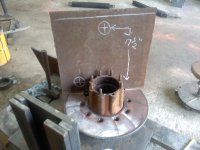
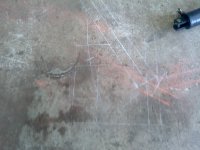
I thought about the 4x6, but what I am running into is not having enough base metal to make the base mount. Right now as I have it drawn out, the boom mount is in the center on above my hub. The base pin for the cylinder is just inside the outer edge of the 20in wide base. I can slide the side mounts forward and mount the boom off center of the hub, probably wouldnt have to move it more than about a inch, but the more I move it off center, the more side load I place on the hub. Ideally, the boom would be mounted back of center and the cyl mounted forward of center to even out the load, I think?? I could always look for more metal to make the base out of, but used flat plate around here is hard to come by and expensive to buy new. Just going from 4x4 to 5x5 moved my top boom mount up almost 2 inches. I would have thought only 1/2in, the difference between the center of tube to outer edge, but it didnt work out that way. I havent said this yet, but the hub extends 6 inches up and is 8.5 inches wide in between the upright side mounts. Just doesnt give me a lot to play with. I'll take a pic of the setup to show what I mean.

Dont know if you can tell what the first pic is, its where I drew everything out on the garage floor. Piss on Autocad.
 

Attachments

  • 0509151048.jpg
    0509151048.jpg
    766 KB · Views: 177
  • 0509151048a.jpg
    0509151048a.jpg
    806 KB · Views: 152
Last edited:
/ bending 4x4x.250 sqtube #53  
Well the engineers at work claim my 4x4 tube will support 3800lb overhung braced in the middle of 8ft. I explained that 8ft is just the root boom and the dipper boom would add 8 more ft to the overhang, right off said then it was going to bend, but he would do the math and get back to me. Well he never got back to me so i still dont know what I need to know.

Looking at the Lemco and where the cylinders are mounted, well thats almost exactly what I had in mine. I feel the plating for the cyl mounts should add some strenght, but dont know how much. I am not opposed to the truss ideal, but would prefer not to use trusses simply because of eye appeal. I would rather it look ugly than fail, so the final build will probably include some sort of truss. The ideal of build it then add weight until it gives, then add a truss if needed, I had considered. Right now the only way I see not to use a truss is One, use bigger tube. Two, add plenty of plate in the middle of the boom for the cyl mounts and let that be the extra strenght. Three, use 2x4 tube and double it along with the extra plating. Right now I think all three methods will work, but will have to see what I can scrounge before actually building anything.

Been kind of following this out of curiosity and it sounds like a fun project. Here's my thoughts, hopefully I help. You may have an extra 8' on the end but will you ever have both arms extended horizontally? That would be the only way that you would have 16 total feet. Secondly have you thought about different sizes for each arm? The boom is going to see more stress that then the dipper stick (sorry I know backhoe terms). I may have missed your posts with the answers to my questions, sorry. What are you planning on using for pins?

I'm assuming that you are kind of doing this more off of pictures and a working version. If so my advice would be to get a couple of 2x4s and make it out of wood and have someone with a tape measure where you think the cylinders are going to go so you can see what open vs closed will do plus you can get a real world feel for just how far it will reach.

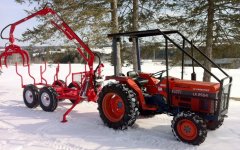
I don't know too much about log weights but I was always told that a cord of green wood weight about 5000lbs. Maybe others can chime in if I was told wrong. 2000 lbs of lifting force would be more than a 1/3 of a cord, do you think the logs/ rounds you will be lifting will produce that much firewood? There's a local rental/ repair shop that has one of these sitting in their yard:
ensemble-forestier-promo.jpg
If you would like I can try to get some measurements the next time I'm near there.
 
/ bending 4x4x.250 sqtube
  • Thread Starter
#54  
I have quite a bit of experience running a small knuckleboom loader, and this size loader is kind of what I am trying to copy. PW TC 407 Kershaw Tie Crane with Push Car and PW TC 315 Not as big as a log loader you would see in a big logging operation, but just a little bigger than the Farmi, Anderson, etc, forwarder loader. Your questions are valid. I would think very rarely would I ever have a reason to try and pick up a large log at full extendsion. Normally at full reach, you would grap one end of a log and as you raise the root boom, you would retract the dipper boom, getting the log close to the loader before actually lifting it all the way off the ground.

I have a couple of reasons for wanting a long boom. One, developers often push out a new road and leave the timber laying just below the road. I need a boom long enough to reach those logs. Another reason is a lot of the loggers around here dont have loaders on their trucks. They load them in the woods, and unload them at the log yard. I need something I can reach the logs on a loaded big truck if I want them to deliver to my yard.

Looking at the loader in your pic, you can see the booms are pretty small material. Short, the one in the pic probably not over 9-10 ft. My trailer bed is 8ft wide, a 9ft boom will only allow me to reach about 5 ft past the trailer, a 16ft boom allows about 11ft reach. Of course any boom I have ever used always seemed to need about 2 more feet added to the end of them, but I have to draw the line somewhere.

As for weight, a red oak log, 24in in dia and 14ft long will weight around 2500lbs . I am building my processor large enough to handle a 27in log. A 27 in dia red oak log 14ft long will weigh 3100lbs. A cord of red oak will weigh around 5700lbs. One 24in log and one 27 inch log and I'm right at a cord. Of course, I dont expect every log to be of these sizes, and I dont expect to load 14ft stuff of that dia with this loader. A 20 in 14ft log, weighs about 1735lbs and I think most of my wood will be under that size, but if I build to handle the weight of a 20in log, then the rest of the stuff I dont have to worry about.
 
Last edited:
/ bending 4x4x.250 sqtube #55  
The log trucks I have seen allowed you to pull a lever and unlatch the posts along one side, leaving you with a pile of logs on the ground...getting them down is usually easy. Up and into the truck, on the other hand...

Well, I suppose it makes a difference if you are only buying a couple of logs off the truck, rather than whole load.
 
/ bending 4x4x.250 sqtube
  • Thread Starter
#56  
Yea we used to have those kinds of trucks, but any more, the loggers just back up to the loader to get loaded and at the log yard they use a big loader to set the logs off. Very few folks around here even have loaders on their truck. Timber cutting isnt a little guy job now.
 
/ bending 4x4x.250 sqtube #57  
I thought about the 4x6, but what I am running into is not having enough base metal to make the base mount. Right now as I have it drawn out, the boom mount is in the center on above my hub. The base pin for the cylinder is just inside the outer edge of the 20in wide base. I can slide the side mounts forward and mount the boom off center of the hub, probably wouldnt have to move it more than about a inch, but the more I move it off center, the more side load I place on the hub. Ideally, the boom would be mounted back of center and the cyl mounted forward of center to even out the load, I think?? I could always look for more metal to make the base out of, but used flat plate around here is hard to come by and expensive to buy new. Just going from 4x4 to 5x5 moved my top boom mount up almost 2 inches. I would have thought only 1/2in, the difference between the center of tube to outer edge, but it didnt work out that way. I havent said this yet, but the hub extends 6 inches up and is 8.5 inches wide in between the upright side mounts. Just doesnt give me a lot to play with. I'll take a pic of the setup to show what I mean.

Dont know if you can tell what the first pic is, its where I drew everything out on the garage floor. Piss on Autocad.

I do not think your hub will be adequate. A wheel on a truck is almost perfectly in line with the bearing assembly. Your design places significant bending load on whatever axle fits in that hub unless you support it on both sides. If you look at a backhoe or anything similar, the pins are set apart vertically a decent distance, so you don't get the bending load. The pins in a backhoe are loaded in shear.

Bringing the pin off center won't really change the moment (bending load) on the hub. Moving it an inch off center will be negligible if you were to do a bending load calculation. This is the type of basic engineering that I feel may be lacking when building this from scratch, and hence why I have concern for your safety.
 
/ bending 4x4x.250 sqtube
  • Thread Starter
#58  
I dont know if I am following what your saying. Are you saying the hub off a 48,000lb truck axle, (24,000lbs using just one hub) which has a factory safety factor of about 5x (120,000 lbs) isnt going to support my boom with a 2000lb load at the end of the 16ft boom? There wont be any axle in the hub,http://www.tractorbynet.com/forums/...183419-bending-4x4x-250-sqtube-0509151048-jpg, this is the hub I am using, I will be using the actual axle spindle to mount the hub on. The flat plate laid up on the hub in the pic has a couple of circles with center marks in white chalk. Those chalk marks are where the boom (at the top center), and the cylinder (bottom left side and very close to the hub). The boom pin is 17.5 inches higher and in the center of the hub, and the cylinder pin is 6 inches forward of the center of the hub. With the amount of metal and cylinders I have available, this is about as good as it gets and the only way I can get the 105degrees of swing of the boom. Now I understand the pin locations on a backhoe boom,(I assume you are taking about the root boom and swing pins) and how far apart they are. A 48000lb hub has bearing about 8inches apart front to back. The hub spindle is a lot bigger than any backhoe pin I have seen even tho the spindle is hollow. I am not real sure of the distance apart of backhoe pins, but I will check a few out tomorrow. Backhoes booms are rated for much more than 2000lb and the booms are generally 14ft or longer fully extended.

Just to add, the hub itself is 8.5in in dia. I dont have a measurement on the spindle dia, but did try to put a piece of 2.5in dia shaft thru it. Shaft was to big to fit, but it didnt like much, maybe an 1/8. Didnt try to measure the outside dia, but can when I get back home Friday.
 
/ bending 4x4x.250 sqtube #59  
I dont know if I am following what your saying. Are you saying the hub off a 48,000lb truck axle, (24,000lbs using just one hub) which has a factory safety factor of about 5x (120,000 lbs) isnt going to support my boom with a 2000lb load at the end of the 16ft boom? There wont be any axle in the hub,http://www.tractorbynet.com/forums/...183419-bending-4x4x-250-sqtube-0509151048-jpg, this is the hub I am using, I will be using the actual axle spindle to mount the hub on. The flat plate laid up on the hub in the pic has a couple of circles with center marks in white chalk. Those chalk marks are where the boom (at the top center), and the cylinder (bottom left side and very close to the hub). The boom pin is 17.5 inches higher and in the center of the hub, and the cylinder pin is 6 inches forward of the center of the hub. With the amount of metal and cylinders I have available, this is about as good as it gets and the only way I can get the 105degrees of swing of the boom. Now I understand the pin locations on a backhoe boom,(I assume you are taking about the root boom and swing pins) and how far apart they are. A 48000lb hub has bearing about 8inches apart front to back. The hub spindle is a lot bigger than any backhoe pin I have seen even tho the spindle is hollow. I am not real sure of the distance apart of backhoe pins, but I will check a few out tomorrow.

Distance of bearings is of partial importance, but you are not supporting the hub above and below the bearings. This means you are relying completely on that spindle in bending. This isn't how the hub was intended to be used, and you can't guarantee (or even predict via a calculation) that it won't break at the base. The other issue is that the axle stub is probably a harder steel, so it's more prone to a brittle failure vs a bending failure. I.E. a crack that one day completely lets loose unpredictably.
 
/ bending 4x4x.250 sqtube #60  
Distance of bearings is of partial importance, but you are not supporting the hub above and below the bearings. This means you are relying completely on that spindle in bending. This isn't how the hub was intended to be used, and you can't guarantee (or even predict via a calculation) that it won't break at the base. The other issue is that the axle stub is probably a harder steel, so it's more prone to a brittle failure vs a bending failure. I.E. a crack that one day completely lets loose unpredictably.

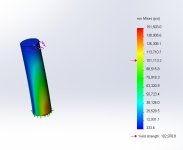
For reference, if your spindle is only restrained on one side, a 3" solid steel center hub would not be sufficient.

2000 lbs * 16 ft = 32000 ft-lbs. Here is an analysis of 32000 lbs applied to the end of a 3" solid steel bar.
 

Attachments

  • ScreenHunter_81 May. 12 16.30.jpg
    ScreenHunter_81 May. 12 16.30.jpg
    32.8 KB · Views: 128

Marketplace Items

2007 Ford F-250 4x4 Crew Cab 7ft. Flatbed Truck (A59230)
2007 Ford F-250...
Honda EM3500S Portable Gasoline Generator (A59228)
Honda EM3500S...
2012 CATERPILLAR D4K LGP CRAWLER DOZER (A60429)
2012 CATERPILLAR...
John Deere 5055E (A53317)
John Deere 5055E...
2012 VOLVO VNL (A55745)
2012 VOLVO VNL...
PREVIEW DATES AND TIMES (A61165)
PREVIEW DATES AND...
 
Top