Breakout Force

/ Breakout Force #1  

Diesel_Boy

Silver Member
Joined
Sep 11, 2005
Messages
119
Location
Central Maine
Hi all. New to TBN, and comparing specs. Could someone please explain exactly what is meant by "breakout force" when it is listed on FEL's? Does it have anything to do with how much weight it can lift? thanks for the education, i appreciate it.
 
/ Breakout Force #2  
I believe break out force is the curling of the bucket. there is more force curling the bucket than lifting the bucket David.
 
/ Breakout Force #3  
My understanding of the ASAE S301.3 standard is breakout force is the peak lifting force of the FEL, typically occuring with the FEL at ground level. Because the geometry of the load changes over the loader's range of motion lifting force isn't constant. This is why it’s misleading to look at only the lifting power at full height when comparing loaders. Its also why some people think their loader is more powerful then the manufactures specification, since when they can lift several hundred more pounds to 3' feet off the ground then their loader rated power at max height of 6' or 8'.

Rollback power is a different measurement, and not often cited. Copies of ASAE aren't free, so I can't provide a reference to the standard, but if you check out JD TLB110 loader performance specifications at TLB110 you'll see they are two distinct ratings.

Added...

I found part of the standard on line ( ASAE 301.3 ), look at paragraph 5.1.5 for details.
 
/ Breakout Force #4  
Breakout force is the maximum vertical force with the bucket at ground level using the boom lift cylinders only. The location of the vertical force can be the bucket pins or further forward. You have to read the specifications to see what is being referenced.

Rollback force is determined using the bucket curl cylinders only. It can be cited at ground level or higher. You have to read the specifications to know what is being referenced.

JackIL
 
/ Breakout Force #5  
Breakout force is measured using the bucket curl cylinders. It is the amount of force the bucket can curl or (breakout)
 

Attachments

  • 738917-pict%201.jpg
    738917-pict%201.jpg
    25.1 KB · Views: 5,332
/ Breakout Force #7  
Is it possible for JackIL and for Boomerang1 to both be correct?

From the ASAE specs, breakout force = 5.1.5 Breakout force—at pivot pin (Y): Vertical lifting force, in newtons (pounds), the loader will exert at the bucket pivot pin centerline using the lift cylinders only, with the bucket horizontal at ground line.

Now if that is not clear enough, also according to the ASAE specs, breakout force = 5.1.6 Breakout force (Z): Vertical lifting force, in newtons (pounds), the loader will exert located 800 mm (31.5 in.) forward of the bucket pivot pin centerline using the lift cylinders only, with the bucket horizontal at ground line.

The above definitions apply to "Front End Agricultural Loaders," not to commercial front end loaders as are illustrated in the picture/diagram posted by Boomerang1.

Now the problem I see is that we know that John Deere applies the ASAE specs to their brand of tractors, but we don't know what many other brands of tractors use for their definition. I have always used the commercial definition as posted by Boomerang1, but I suspect that I have been wrong to do so. At least as it pertains to JD, I have been wrong to do so. But what about the other brands? There are many others here on TBN that use the Boomerang1 supplied definition, and others who use the JackIL's ASAE version, and I can think of at least one who has switched back and forth between the two definitions! /forums/images/graemlins/blush.gif


Honestly I don't know which one is correct in terms of real use, but I suspect that the most useful one is one we don't measure. Personally I'd like to see them give us a measurement at the bucket CUTTING EDGE that uses BOTH the curl and the lifting cylinders. Seems to me that when I bury my bucket, I use both cylinders to get the load out of the pile and the cutting edge is what really needs to be freed up from the pile so I'd suggest that is the most useful way to measure it. But then again, I'm just applying real world logic, and I don't even play an engineer on TV in my spare time.
 
/ Breakout Force #8  
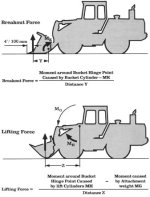
If you look closely at Boomerang1's diagram breakout force is directed upwards. Moment (MK in the diagram) is another way of saying torque, restated the equation in the diagram would read :

Torque = Breakout Force * Distance

As I said in less technical terms breakout force is defined as the FEL's maximum lifting force. Paragraph 5.1.5 calls for measuring the force at the pins and paragraph 5.1.6 calls for measuring at 500 mm on CUTs (800 mm on UTs) forward of the pins. The term breakout force means the same for both AG and construction loaders, though position of measurement may be different. If numbers for both 5.1.5 and 5.1.6 is reported you can calculate the rollback force (torque) the loader can assert. I am just an electrical engineer but these concepts are straight from freshman physics.

When breaking material out of the ground the FEL has to over come the structural strength (shear it) in addition to the weight of the material to be lifted. Since the bucket is supported underneath curling the bucket directs almost all the force into shearing the material. Using the just the lift cylinders reduces the shearing force by the force need to lift the material. All this is important if your digging with the bucket, but if you are lifting logs with a brush bucket rollback power is of far less concern then breakout force.

What I'm trying to say is for real world performance you can't just focus on one or two numbers and get the whole picture. Its important to understand how the FEL will be used, much like how the tractor itself will be used, and then compare the most relevent specifications. When I was shopping last year I was able to get at least partial ASAE S301.3 ratings for each model I was considering. Just read the specifications, if the ASAE standard was used it will be mentioned.
 
/ Breakout Force #9  
I found an article online and saved the page. However the url is missing from the file and I can't remember the site. I will see if I can post some more pages from the file.
 
/ Breakout Force #10  
<font color="green"> If you look closely at Boomerang1's diagram breakout force is directed upwards. Moment (MK in the diagram) is another way of saying torque, restated the equation in the diagram would read :

Torque = Breakout Force * Distance
</font>

Yes, it is directed upwards but is also directed back as well as part of the calculation includes subtracting the distance of travel around the pivot point. You clearly show that with your restating of Boomerang1's calculation by translating it to torque. The while Boomerang1's diagram shows the curl as part of the process, I don't see 'curl' or 'torque' in any part of the ASAE specs quoted above. All I see in the ASAE spec is use of the lift cylinder with the bucket bottom parallel to the ground; it clearly states that it uses the lift cylinder and not the curl cylinder. You state <font color="green"> The term breakout force means the same for both AG and construction loaders, though position of measurement may be different. </font> But I just don't see the same measurements being used in the ASAE CUT/UT specs and those in the diagram provided by Boomerang1.

You state <font color="green"> If numbers for both 5.1.5 and 5.1.6 is reported you can calculate the rollback force (torque) the loader can assert. </font> And while it has been 20+ years since I had freshman physics, I don't see how that can be true unless you assume that the curl cylinders have the same capacities as the lift cylinders and I am not sure that that is a valid assumption, or I am simply confused.

Again, I'm not going to pretend to be an engineer, I am just willing to question things until I get them figured out.

I do totally agree with you that you can't just focus on one or two numbers to determine real world performance. I also totally agree with you that breaking material out of the ground is different than lifting loose material like logs, and that shear force is a big issue. I just don't see how Boomerang1's diagram for construction equipment is equivalent to the ASAE 5.1.5 and 5.1.6 specs.


I think it is fair to say that breakout force is even more misunderstood that lift capacity. /forums/images/graemlins/crazy.gif
 
/ Breakout Force #11  
Here is the web site. web page After the go button, in the center of the page you will see loaders. Click on loaders and you will see wheel loader rating standards. Sorry but the direct link would not work.
 
/ Breakout Force #12  
<font color="blueclass=small">( <font color="green">

(The while Boomerang1's diagram shows the curl as part of the process, I don't see 'curl' or 'torque' in any part of the ASAE specs quoted above. All I see in the ASAE spec is use of the lift cylinder with the bucket bottom parallel to the ground; it clearly states that it uses the lift cylinder and not the curl cylinder.)

<font color="black"> The article states... The maximum upward force in lbf measured 4" behind the tip of the cutting edge that is achieved with the bucket cylinder. Breakout force is easy to understand. If a loader has 3000lbs of breakout force, that means by using the curl cylinders, you would be able to curl a 3000lb weight that is placed 4' behind the cutting edge of the bucket. Breakout force would be very important if you wanted to break out a slab of concrete for example. </font>
 
/ Breakout Force #13  
Boomerang1 . . . thanks for the link and the clarification. It sure seems clear to me that "commercial loaders" and "tractors with loaders added" each have their own separate definition of "breakout force" based on the links in this thread.

I'd also say that the ASAE standard is the one we should probably be applying to our CUTs and UTs as we discuss them here on TBN, but I will always think that the commercial loader breakout force is the one that measures 'real world' useful numbers . . . the ASAE standard, while it may be what a bunch of engineers agreed to use and that may make it valid for use as a reference point, does not actually provide consumers with a useful number that actually matters in real world use. JMHO
 
/ Breakout Force #14  
Bob,

I think the main point of this thread is getting lost in the analysis of forces. Just to be clear the meaning of breakout force, as applied to agricultural FELs, is defined in the paragraphs 5.1.5 and 5.1.6 of ASAE 301.3. The rest of this discussion is getting into an analysis of the forces involved.

I'll try to address your response without getting too wordy. <font color="blue"> Yes, it is directed upwards but is also directed back as well as part of the calculation includes subtracting the distance of travel around the pivot point. </font> If you examine the drawing Boomerang1 provided you'll see arrows indicating the direction of forces. Notice the circular arrow at the bucket pins labeled MK, which is showing a clockwise twist around the pivot point. Notice the arrow labeled breakout force points straight up and the label Y is signifying distance not a force. The equation below the picture defined MK to be the moment around the bucket hinge point. If you check a good dictionary or a physics text you find that the word moment and torque closely related and are often used synonymously ( Torque/Moment offers a nice explaination). It’s a good drawing showing how the defined forces are interacting, but its saying nothing about bucket curl being a component of breakout force.

<font color="blue"> You state </font> <font color="green"> If numbers for both 5.1.5 and 5.1.6 is reported you can calculate the rollback force (torque) the loader can assert. </font> <font color="blue"> And while it has been 20+ years since I had freshman physics, I don't see how that can be true unless you assume that the curl cylinders have the same capacities as the lift cylinders</font> Its been more then 20 years for me too. We can determine the rollback because 5.1.5 is the lifting force at the pins, since pins are the point the bucket rotates around the distance is zero. Torque is defined as the rotational force time the distance from the rotation point we know torque is zero (Anything * 0 = 0). The next part is 5.1.6 requires the bucket to remain parallel to the ground, and we know the lifting cylinders are the same. Therefore the difference between 5.1.5 and 5.1.6 is how much force the rollback cylinders can apply to resist the downward twisting force (torque) of the load. The last part is the fact the standard defines the distance (500mm CUTs, 800mm UTs) the force is applied at for the test. Keeping that in mind the equation for the rollback force the loader can assert is:

Rollback Force = (5.1.5 Breakout force - 5.1.6 Breakout force) / by 500 (or 800) mm

I am making the assumption that the FEL doesn’t use rollback cylinders so large that 5.1.6 equals 5.1.6. It would be possible to do so, and very useful for using pallet forks, but I haven’t seen any CUT FEL that does.

<font color="blue"> I just don't see the same measurements being used in the ASAE CUT/UT specs and those in the diagram provided by Boomerang1. </font> I agree this diagram doesn’t depict any measurements, only direction of forces. Its important to remember this diagram isn’t a standard; it’s a depiction of the forces involved. Sorry for being so long winded folks.
 
/ Breakout Force #15  
In real-world, when you are digging something out of a compacted pile (with a machine that might perhaps otherwise be too small for the task), the operator tends to use a combination of boom lift, roll-back, AND a wedging and cutting action of thrusting the bucket into the pile using the tractors forward drive.

When the bottom of the bucket is partially supported as it is wedged into the pile with a slight upward angle, the amount of force generated can be quite high.

This real-world "break-out" performance is hard to model with one or two specs.

In my opinion, most of the smaller CUT FEL's are fairly limited in their breakout and max lift based on their hydraulics. Compared to a small skid loader for example. Part of the issue is the total HP and the resulting hydraulic GPM available. If you put bigger cylinders on the loader to increase the lift or rollback, it starts to get too slow.

To evaluate load capability, you can look at HP, hydraulic flow at pressure, and total machine weight. Assuming the Mfg. has done a good job matching the loader design to these parameters, machines with similar specs in these areas will have similar digging/loading performance.

Many skid loaders (and improperly ballasted CUT's) are limited not by the lifting power of their hydraulics, but by the max lift they can achieve before tipping. Many Mfg even apply a conservative factor to come up with a safe "operating" load that might be 1/2 or 1/3 the tipping load.

A smaller CUT might be 20 or 25 HP with 4 to 8 GPM of hydraulics at 1800 PSI and weigh 4500 lbs fully ballasted.

I think that the smallest skid loaders start at 50 or 60 HP with 10 to 20 GPM at 3000 PSI of hydraulic power available for the loader and start at 8000 lbs and up.

Also in my opinion, a key spec to check is if the loader can (safely) lift a heaping full bucket of heavy dirt to max height. Using a machine that cannot do this is very frustrating when you have to stop and dump a bit of dirt down low before you can get the bucket full to the top of the pile or into the truck. A good estimate to use is that dirt (and anything dirt-like like rock, concrete, sand, etc) weighs up to maybe 3500 lbs per cu yard. If you have a 1/3-yard bucket (struck), you can probably fit close to 1/2 of a yard in it heaping and you would want to be able to lift 1800 lbs to full height.

Conversely, you can match the bucket size to the full-height lift ability (asuming your primary use is moving dirt).

- Rick
 

Marketplace Items

1997 LUFKIN 48X102 FLATBED TRAILER (A60736)
1997 LUFKIN 48X102...
2025 Swict 72in. Bucket Skid Steer Attachment (A61567)
2025 Swict 72in...
2019 BOBCAT T740 TRACK SKID STEER (A60736)
2019 BOBCAT T740...
New/Unused Landhonor Quick Attach Tree Puller (A61166)
New/Unused...
BOSS MT 660 Fuel Trailer - 660 Gallon Mobile Diesel Tank, DOT-Approved (A55315)
BOSS MT 660 Fuel...
2017 PETERBILT 389 FITZGERALD GLIDER VOLUMETRIC MIXER (A60736)
2017 PETERBILT 389...
 
Top