Brush Hog question: lean backwards?

   / Brush Hog question: lean backwards? #1  

Flatheadyoungin

Veteran Member
Joined
Mar 26, 2008
Messages
1,077
Location
Southern, OH
Tractor
New Holland TC45 Shuttle
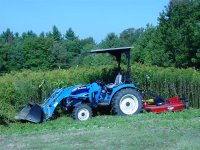
I was up to my buddy's last night and he was showing me his new land pride hog- really nice, BTW. Anywho, he was saying something about the hog should lean backwards so that the blade wouldn't impact, say, a stump as it enters the front of the brush hog.....I guess this is how the stump jumper works.

Well, his rakes/leans forward toward the tractor.....he's tried changing the top link adjustment and using the other holes in the top link pivot on the brush hog.

Are brush hogs supposed to lean back?

I looked it over and couldn't see any other adjustment points on the hog.
 
   / Brush Hog question: lean backwards? #2  
I have had a Woods and 2 Tebben rotary cutters. In both cases the manufacturers recommended that the rear of the cutter (i.e. blade height) should be ~1" - 2" higher making the deck lean forward towards the tractor. Jay
 

Attachments

  • DSC00630 (Medium).JPG
    DSC00630 (Medium).JPG
    116.8 KB · Views: 331
   / Brush Hog question: lean backwards? #3  
If by leaning back you mean that the rear of the mower should be lower than the front, no that is not correct. The front should be 3/4" (or so) lower than the rear. That's how mine is set up.

Mark
 
   / Brush Hog question: lean backwards? #4  
It would seem if the rear side of the blade is lower it will be hitting stuff and kicking out the FRONT where you sure don't want it, cause that is where you and your tractor should be. :) kt
 
   / Brush Hog question: lean backwards? #5  
I was up to my buddy's last night and he was showing me his new land pride hog- really nice, BTW. Anywho, he was saying something about the hog should lean backwards so that the blade wouldn't impact, say, a stump as it enters the front of the brush hog.....I guess this is how the stump jumper works.

It sounds like somebody filled your buddy's head full of "smoke and mirrors" about how a stump jumper works. As everyone has pointed out, the front of the cutter should always be slightly lower than the rear.

The stump jumper is there to protect the gearbox. If you had rigid arms coming out of the gearbox to attach to swinging blades. Those arms could impact a stump or big rock and instantly transfer the shock to the gearbox causing it to explode. The blades can flex at the pivot and the dish-shaped stump jumper pan keeps the center portion of the cutter covered and protects the gearbox fixed arms and also the lower seal and bearing. The only thing that can stop blades from hitting stumps is a careful operator or leaving the tractor and cutter in the barn.;)
 
   / Brush Hog question: lean backwards? #6  
With the rear lower, you cut everything twice. JC
 
   / Brush Hog question: lean backwards? #7  
Ditto what the others said... a slight lean forward is the way to set it up.

Who told your buddy it needed to lean back?

soundguy
 
   / Brush Hog question: lean backwards? #8  
The way you set it up depends on what you're trying to do. Didn't he get a manual? From the Bush Hog operating Manual:

For best results under heavier cutting conditions, always tilt the cutter approximately 2 inches (51mm) lower in the front. This decreases horsepower requirements and increases potential ground speed. When fine shredding is desired, adjust cutter deck level or slightly lower in the rear. This will keep the foliage under cutter until thoroughly shredded. More power is required for shredding.
 
   / Brush Hog question: lean backwards? #9  
With the rear lower, you cut everything twice. JC
Yes. Actually, even worse, you try to cut it many times as each successive blade pass is lower. In the case if cutting small trees and substantial brush this setup will soon damage the mower as the blades are continually wedged upward as the mower tries to cut again with parts of the blade that arent sharpened.
larry
 
   / Brush Hog question: lean backwards? #10  
In the case if cutting small trees and substantial brush this setup will soon damage the mower as the blades are continually wedged upward as the mower tries to cut again with parts of the blade that arent sharpened.
larry

I'm not sure I understand that part...the sharpened side of the blade will always make contact first no matter what the setup is. The rotation would have to reverse for the dull side to lead. What did you mean by that?
 
   / Brush Hog question: lean backwards? #11  
My sense is that as the RC moves forward over the "obstruction" :eek: the forward travel takes the blades beyond the sharpened area of the blade itself. Jay :)
 
   / Brush Hog question: lean backwards? #12  
I'm not sure I understand that part...the sharpened side of the blade will always make contact first no matter what the setup is. The rotation would have to reverse for the dull side to lead. What did you mean by that?

jbrumberg said:
My sense is that as the RC moves forward over the "obstruction" the forward travel takes the blades beyond the sharpened area of the blade itself. Jay
Yes, and then again as the obstruction starts to pass out the back of the mower the dull area hits it 1st, then the sharp area hits it successively lower each time it comes around. Even with something sharp there is always the tendency for it to deflect to the area of least resistance [over the top in this case] when cutting near an edge.
larry
 
   / Brush Hog question: lean backwards? #13  
i run mine near on level. if anything i might have a slightly nose heavy setting (higher in the rear, but it would be meausred in 1/8's of an inch)
 
   / Brush Hog question: lean backwards? #14  
The dealer just proved that salesmen often know very little about the stuff they are selling!!!

jb
 
   / Brush Hog question: lean backwards? #15  
There are several good answers in this thread. To quote from the Bush Hog Squealer Operator's Manual:


3-2 ADJUSTING FOR WORK​
The cutter should be operated at the highest position
which will give desired cutting results. This will help
prevent the blades from striking the ground, reducing
blade wear and undue strain on the machine. For
best results under heavier cutting conditions, always
tilt the cutter approximately 2 inches (51mm) lower in
the front. This tilt decreases horsepower requirements
and increases potential ground speed. When
fine shredding is desired, adjust cutter deck level or
slightly lower in the rear. This will keep the foliage
under cutter until thoroughly shredded. More power​
is required for shredding.

In other words, you can have it higher in the front, higher in the rear, or level depending on what results you want and how fast you want to go.
 
   / Brush Hog question: lean backwards? #16  
My Land Pride manual instructs the owner to maintain the front of the mower at a slight angle which places it lower than the rear......and of course level left to right in that lower position.
 
   / Brush Hog question: lean backwards? #17  
I'm not sure I understand that part...the sharpened side of the blade will always make contact first no matter what the setup is. The rotation would have to reverse for the dull side to lead. What did you mean by that?

I'm pretty sure he is refering to the non sharpened portion of the blade .. IE.. take a 2' blade.. 6-8" might be the sharp section.. then it's round back till the mounting hole....

soundguy
 
   / Brush Hog question: lean backwards? #18  
I proved Larry correct a few years ago. I was clearing pine and hardwood saplings up to about 3" diameter and set the front of the mower about 3" above the rear. My theory was that the stump would be shorter because the "rear" blade would only be cutting off the top 2-3" of the stump and would make a lower and cleaner cut.

The stumps were a bit shorter, though not nearly as much as I expected. But there seemed to be no harm done, so I left the front set higher than the back.

After a few days of cutting, one blade broke at the bolt hole, and it was clear from examining the break that it had started on the bottom of the blade, which indicated that upward force on the free end of the blade caused it. On that particular mower, the blade carrier barely extended beyond the end of the bolt hole, so the upward force on the end of the blade was highly leveraged on the end of the carrier, and the clearance between the carrier and blade bolt allowed the blade to twist upward, putting stress right across the bolt hole.

That is one of only a few blades I have broken in many years of mowing, and the only one that broke in that manner. It seems pretty clear that it was caused by the upward force of the stumps on the blade as it swung at the rear.

Shortly after that I mounted stump grinder teeth on the underside of the blades, and they worked well. The stumps were flat on top and about 1" above the ground.
 
   / Brush Hog question: lean backwards? #19  
I proved Larry correct a few years ago. I was clearing pine and hardwood saplings up to about 3" diameter and set the front of the mower about 3" above the rear. My theory was that the stump would be shorter because the "rear" blade would only be cutting off the top 2-3" of the stump and would make a lower and cleaner cut.

The stumps were a bit shorter, though not nearly as much as I expected. But there seemed to be no harm done, so I left the front set higher than the back.

After a few days of cutting, one blade broke at the bolt hole, and it was clear from examining the break that it had started on the bottom of the blade, which indicated that upward force on the free end of the blade caused it. On that particular mower, the blade carrier barely extended beyond the end of the bolt hole, so the upward force on the end of the blade was highly leveraged on the end of the carrier, and the clearance between the carrier and blade bolt allowed the blade to twist upward, putting stress right across the bolt hole.

That is one of only a few blades I have broken in many years of mowing, and the only one that broke in that manner. It seems pretty clear that it was caused by the upward force of the stumps on the blade as it swung at the rear.

Shortly after that I mounted stump grinder teeth on the underside of the blades, and they worked well. The stumps were flat on top and about 1" above the ground.

Whatever!! :D

The manual clearly states if you want stuff chopped up more, angle it down in the rear to keep it under the deck longer. Makes sense to me and it works for me.

Perhaps 3" trees had something to do with a broken blade. :D :D
 

Tractor & Equipment Auctions

2017 Ford Transit 350 Passenger Van (A59230)
2017 Ford Transit...
NEW HOLLAND HAY CUTTER (A58214)
NEW HOLLAND HAY...
2008 CAT 305C (A53317)
2019 Ford F-150XL (A60462)
2019 Ford F-150XL...
2014 Dodge Charger Sedan (A59231)
2014 Dodge Charger...
(INOP) JLG E300AJP ARTICLATED MANLIFT (A60429)
(INOP) JLG E300AJP...
 
Top