Bucket rolled backwards

/ Bucket rolled backwards
  • Thread Starter
#42  
I took the rod to a machine shop today & they were able to run a die over it. The local Ag coop threw out using a swagger nut that threads on the rod, then another is threaded on that nut and squeezes the first one down to the rod.

I’m still trying to get the gland out.
 
/ Bucket rolled backwards #43  
I remember that project you did. I did much the same thing on my old JD 46 QA loader. The 46 loader project was pre-internet, so I had the local hydraulic shop make the new cylinders from scratch. The charge for making cylinders was much the same as buying them at the Surplus Center today, but the dual spool valve I bought at the same time was kind of expensive. Surplus Center is good for comparing prices. I tend to go for brands I recognize - particularly for valves.

On your 420 project .... does it still leak down? Did you ever decide if the leak-down was in the cylinders or the valve?
rScotty

Loader still leaks down over night but doesn't seem to be an issue during use. The subject came up on another forum and someone produced this chart that supposedly came from JD on acceptable leakage rates. I assume it's in the SCV.

loader-leakage-rates.jpg
 
/ Bucket rolled backwards #44  
I took the rod to a machine shop today & they were able to run a die over it. The local Ag coop threw out using a swagger nut that threads on the rod, then another is threaded on that nut and squeezes the first one down to the rod.

I’m still trying to get the gland out.

Could you drive a plug in the center of the gland and blow it out with compressed air?
 
/ Bucket rolled backwards #45  
Reckon I can use a die over the threads or need to get someone professional to do it?

Large diameter threads have a lot of holding power if you get rid of the problem of the smashed part. To restore threads I just do it by hand. Sitting down at the bench with the bolt in a vise, a small sharp triangular file, and wearing reading glasses. Looking at yours, I'd say it would take about an hour of careful file work.

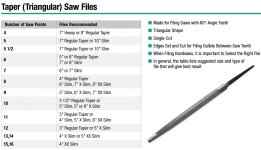
If you hand-sharpen your saws like many do, then bolts are easy because bolt threads have the same 60 degree included angle between the teeth just as hand saws do. And that means you can buy the perfect tool for the job at the hardware store....or at McMaster.com. What you want is a specially hardened triangular file made for the purpose of sharpening saws. You may already have one if you inherited some carpenter's tools from the last generation. Remember that files only cut in one direction, so let up on the backstroke to keep them sharp. Get a nut to fit while you are at the hardware store. It's handy for testing how the job is going.

Sometimes I will use a die to finish up... but I don't do that until it is 90% done. That part is up to you....

To shorten the job, first check for what part of the threaded area is actually used to do the fastening. If the threads stick out past the nut, I'll often taper the first half inch or more of the bolt down so that those starter threads aren't very tall. All those threads do anyway is make the nut start easier; they don't do any holding so don't need full engagement.

Here's a chart on files. The number of saw points is also in number per inch....just like threads. So count the threads per inch of your bolt to get the right size file.

I'd like to hear from others who do this type of hand repair - it works for all kinds of things.
rScotty
 

Attachments

  • nicholson-taper-file-chart-d.jpg
    nicholson-taper-file-chart-d.jpg
    112.1 KB · Views: 105
/ Bucket rolled backwards #47  
Loader still leaks down over night but doesn't seem to be an issue during use. The subject came up on another forum and someone produced this chart that supposedly came from JD on acceptable leakage rates. I assume it's in the SCV.

View attachment 636943


Wow, they didn't expect much out of some of their models.
 
/ Bucket rolled backwards #48  
...

I'd like to hear from others who do this type of hand repair - it works for all kinds of things.
rScotty
I do it also.
Most threads are of the "V" shape so a triangular file works well. However, i've encountered square threads on occasion so a thin flat file (like what was used to file the points on a distributor) may be needed for that.

Sometimes, it is not obvious as to where the binding is occurring on threads. What I do in that case is to take the blue marking dye and coat the threads with it, then run the nut on until it binds which will scratch the dye. That's where I file - carefully, slowly, and recheck frequently. This is what I did on a $2,000 lathe whose threaded spindle wouldn't accept any of the tools because of thread interference.

Since we're talking about nuts, threads, and locktite, another way to keep nuts on is to take a center punch and deform the threads after the nut is on. Obviously, this will require some filing to be able to remove the nuts so I rarely use it, but is quite effective and cheap.
 
/ Bucket rolled backwards #50  
Above using water and hydraulics was mentioned, but has anyone see this? How to Remove Blind Bearings with a wet Paper Towel - YouTube

I'm still working on this when I get time, just no luck yet.

Yep, seen it. It’s still the same as the water/hydraulic method but unlike the paper towel method you still have hyd seals in the gland to help you out (unless you use a torch to heat the gland). I like the water method best cuz it doesn’t waste hyd oil and easier to clean up the mess.
 
/ Bucket rolled backwards
  • Thread Starter
#51  
Use a slide hammer with a internal puller.

That's exactly what I had to do. I went to AutoZone & did their loaner program & got the pulley puller set with 5 pound slide hammer. I used the 2-sided puller and had to put one in at a time & bolt up because of the 3/4" hole. It took quite a bit of coercing at first, but after about 10 good hits it started moving. I got it out over lunch today and hopefully get to use it this weekend. I still have to figure out if I'm going to use a double-nut.

I appreciate all of the replies..
 
/ Bucket rolled backwards #52  
The seal shouldn’t be very tight. If you could grip it like with the rod still attached it should be easily done by hand. Does it have other issues?
 
/ Bucket rolled backwards #53  
I'm not really advising this but they do make a Green Loctite product but be warned, you will never get it apart again if you use it.
I had to cut a welded JD steering cylinder apart because the bolt fell off the shaft, I cleaned it up and impacted the bolt in with the green loctite then welded the cylinder back together. That was a year ago and that tractor gets used a lot as it also has a backhoe on it. I figured we had nothing to lose except buying a new cylinder :) Keeping my fingers crossed !
 
/ Bucket rolled backwards #54  
You can get something apart when using green Loctite, you just have to heat it.

Red Loctite is even stronger.

SR
 
/ Bucket rolled backwards #55  
I'm not really advising this but they do make a Green Loctite product but be warned, you will never get it apart again if you use it.
I had to cut a welded JD steering cylinder apart because the bolt fell off the shaft, I cleaned it up and impacted the bolt in with the green loctite then welded the cylinder back together. That was a year ago and that tractor gets used a lot as it also has a backhoe on it. I figured we had nothing to lose except buying a new cylinder :) Keeping my fingers crossed !

The threads are pretty badly damaged. It’s not a matter of loosening up, but pulling off.
 
/ Bucket rolled backwards #56  
You can get something apart when using green Loctite, you just have to heat it.

Red Loctite is even stronger.

SR
Yes, the reds are strong. The top performance greens are stronger tho. Loctite 270 Studlocker green is 40% stronger than the strongest red. --Typically the Greens are rated as retaining compounds and there is a good selection to choose from. Shopping the specs can sometimes find some real compatible characteristics for your need.

For instance, MAXIMUM strength is offered by Loctite 620, 635, and 638. All weaken as temperature rises, but not at the same rate:

# 620 [4000psi] retains very near its full nominal strength up to 450F - You dont want to use this if you ever want to remove a part near a seal.

# 635 [4500] is the strongest by ~10% but loses ~25% strength at 212F

# 638 [4000] is a marginally weaker but, from there, also loses more strength, ~30% at 212F. This is the one I use near a seal.​
 
/ Bucket rolled backwards #57  
This may have been mentioned already but, if you add any jamb nuts or make any other changes you run the risk of changing the extended or retracted stroke length of the cylinder. Both cylinders need to match at both ends of travel to keep from twisting the bucket/loader arms.

Steve
 
/ Bucket rolled backwards #58  
This may have been mentioned already but, if you add any jamb nuts or make any other changes you run the risk of changing the extended or retracted stroke length of the cylinder. Both cylinders need to match at both ends of travel to keep from twisting the bucket/loader arms.

Steve
If the nut doesn’t extend past the end of the stud it shouldn’t affect anything.
 
/ Bucket rolled backwards #59  
I didn't read back through all posts but maybe it could be cut to a smaller or finer thread? Then a new nut and maybe a washer.
 

Marketplace Items

LandHonor LHR-BLC1106 Rolling Tool Cart (A60353)
LandHonor...
2000 KOMATSU GD530A-2CY MOTORGRADER (A62129)
2000 KOMATSU...
UNKNOWN  SPOOL TRAILER (A58216)
UNKNOWN SPOOL...
UNUSED WOLVERINE QMP1-16-6T QUICK ATTACH PLATE (A62131)
UNUSED WOLVERINE...
UNUSED WOLVERINE ADB-13-1218R HYD AUGER (A62131)
UNUSED WOLVERINE...
2006 Generac SD0150 187kVA T/A Towable Diesel Generator (A61567)
2006 Generac...
 
Top
