Building with 'thermal mass'. Are the claims bogus?

   / Building with 'thermal mass'. Are the claims bogus? #21  
In 3rd world countries, like where I grew up in South Africa, there was and is no such thing as "cheap energy". The buying power of the average family was extremely limited. Probably 3/4 of the country was at a mean elevation of about 5000ft. Hot dry summers and frosty in winter. The town I grew up in was in a "bowl" and cold air flowed downhill into it at night resulting in temperatures of 6F in the early morning hours.

The homes had single pane windows, since double glazed ones were out of the question price wise. If there was any insulation at all, it might have been a 4" layer of fiberglass insulation on top of the ceilings. Usually a tin roof. The walls were masonry with an air gap. The air gap provided a modest thermal break from inside to outside and also helped keep the inner wall dry (the bricks were often exposed on the outer wall).

The big thing was that all homes were sited and designed to maximise passive solar gain. Homes were not sited to face the road the way they typically are in the US. It does not look unusual, since every home on every lot is oriented the same way, facing the sun. 80% of the glazing was on the sun facing facade and extended to within about 12" of the floor (which was concrete and all interior walls were masonry). The solar facing roof overhang was large, to shade the home in summer when the sun was high, but in winter the sun could penetrate. Probably 80-90% of the winter heating needs was though the sun. Of course that means that all curtains have to be open from sunrise to sunset and then promptly closed at sunset to reduce heat loss at night. Floors were tiled typically, to ensure that the floor covering did not act as a thermal barrier to the suns energy. Rugs and the like were used only in the sleeping rooms, usually on the opposite side of the home, where the suns direct rays could not penetrate. For the balance we used a coal stove on the coldest days of winter and sparingly a few space heaters in the morning when getting up in the dark to get ready for school. The water pipes were generally installed on the outside of the building (I never did figure out why - except bad planning) and in the morning they would be frozen solid, yet we never had a pipe split/burst. At night a jug of water would get filled up for brushing teeth and the like and baths were taken, since it could not be done in the morning. A pot of water would be filled and placed where it could be put on the coal stove in the morning for washing dishes and anything else that needed hot water (coffee, tea, breakfast etc)

We slept with down comforters and typically a hot water bottle to pre-heat the bed. I lived in this kind of environment from when I was 1 until middle school when we moved to the coast. It was amazing that by virtue of the coast being foggy, we actually found the climate less comfortable at the coast than it had been up on the plateau. Of course the homes were designed, built and laid out in the exact same way.

As an outsider, it is rather baffling to see the impact that years of cheap energy have made on society in America and the kinds of "rules" that have evolved regarding home siting and the like. Even the way homes are styled, which is generally completely at odds with the environment (like facing the facade west, into the setting sun, windows all over, even on the northern facade, hallways with no windows or natural light at all etc etc......)
 
   / Building with 'thermal mass'. Are the claims bogus? #22  
I should also add that masonry / concrete homes tend to be tight, so long as the weak points are addressed (windows/doors/ceiling to wall interfaces) No need for any membrane to act as an air barrier, since the medium itself is a terrific barrier. It just needs to have a thermal break to the dirt outside and under the floor, since heating the earths mantle is a rather tough job to do and the prevailing 55F is not exactly comfortable (might be better than a drafty tent in the tundra - but definitely not T shirt and shorts type temperatures). Earth berming to the north and west (with 2-3" rigid foam thermal break) and if the roof slopes down from South to North and combined with a berm, the shadow behind the home is minimized and roof access is not nearly as dangerous as a traditional roof. All doors need an airlock to minimize cold air intrusion in northern climates. Thats where you can keep food items where they can stay naturally cold and the ideal place for the refrigerator, instead of inside the heated space...
 
   / Building with 'thermal mass'. Are the claims bogus? #23  
Alchemysa,

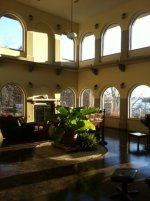
We live in a high thermal mass home, it has 100 cu yards of concrete exposed mass on the interior. A total of 400 cu yards including exterior ICF walls. The floors are on steel bar joists with no contact with earth. All the floors are stained concrete. It is a south facing home with a lot of triple pane glass with 32' overhangs. The overhangs were designed to allow max solar during the winter and minimum in the summer.

Each space has in floor radiant heat with a separate t-stat, meaning guest rooms are closed off and not heated. The wood frame interior walls separating these rooms are insulated to insure this is done.

As many have mentioned, the mass acts as a flywheel. So for example, Mid Spring and mid Fall nearly never call for heat or AC. Warm Spring days are offset by cool Spring nights. During the Spring/Fall time frame, there is still 1/2 solar exposure due to the overhangs. Late Spring/early Summer where where it is low 60's at night but high 70's or more, we open some windows during the night. The home stays cool all day after closing.

During the Summer, due to the flywheel effect, the AC often runs late at night. This is fine because it's the coolest time of the day. So you can imagine an AC unit cooling a home to 74 deg with an ambient air of 70-72 deg outside is nearly no load.

During the winter, the heat will not come on if the sun is shinning. But the fact is, Indiana can have some cold gloomy days and requires heat. We leave the heat set constant all Winter, there is almost no way to fight the flywheel by Setback thinking. To give an example of the power of mass during the winter, we had the power go out during an ice storm a few years back. The power was out for 5 days and the temps were in the 'teens. Over that time frame all my neighbors with out wood heat ended up moving out due to frozen water pipes. Our house temp dropped by only 5 deg. It even rose on a sunny day!

At this time we heat with an electric boiler but I would like to install a wood boiler. It would take years for payback though. We do work from the home but other than the window opening/closing for a month in optimum times of Spring/Fall, we do nothing.
 

Attachments

  • sun room.jpg
    sun room.jpg
    85.3 KB · Views: 109
   / Building with 'thermal mass'. Are the claims bogus? #24  
Paddy

This statement is a popular "misconception" regarding conventional A/C operation.
"
During the Summer, due to the flywheel effect, the AC often runs late at night. This is fine because it's the coolest time of the day. So you can imagine an AC unit cooling a home to 74 deg with an ambient air of 70-72 deg outside is nearly no load. "

The "no load" condition does NOT APPLY to the operation of a compressor type A/C unit.

Whenever the compressor is running, the full motor amperage for operation is drawn. The "work" being done is compressing the refrigerant, not moving heat.

The "savings" comes from the possibility that the A/C will run for less time.

So when the A/C turns on in the middle of the night, It costs the same per operational hour as it does when the outdoor air temperature is 104.

Just a point of clarity

Your home is so open and spacious. Very nice!
 
   / Building with 'thermal mass'. Are the claims bogus? #25  
Paddy

This statement is a popular "misconception" regarding conventional A/C operation.
"
During the Summer, due to the flywheel effect, the AC often runs late at night. This is fine because it's the coolest time of the day. So you can imagine an AC unit cooling a home to 74 deg with an ambient air of 70-72 deg outside is nearly no load. "

The "no load" condition does NOT APPLY to the operation of a compressor type A/C unit.

Whenever the compressor is running, the full motor amperage for operation is drawn. The "work" being done is compressing the refrigerant, not moving heat.

The "savings" comes from the possibility that the A/C will run for less time.

So when the A/C turns on in the middle of the night, It costs the same per operational hour as it does when the outdoor air temperature is 104.

Just a point of clarity

Your home is so open and spacious. Very nice!

Bingo.

It cost the same per hour (or per minute) to run no matter the temp.

The savings comes in from the fact that the cooler it is outside, the more efficient the unit can be. Which is twofold cause the cooler it is, the less loss there is through the walls.
 
   / Building with 'thermal mass'. Are the claims bogus? #26  
No expert here, but it sounds like thermal mass would work in any area where you heat at night and cool during the day. It's not uncommon for me to run AC for several hours during the after noon, when it's 80-85; and heat overnight when it's 45-55.
 
   / Building with 'thermal mass'. Are the claims bogus? #27  
We are having a heat wave or so it seems after this very long and very cold winter. Yesterday, when I left the house the thermostat was 73. I think the outside temp was in the 40s. Driving home, I the temp was 87! :shocked: Noticed quite a few people on the lake fishing. This time of year is when people drawn because we have high air temperatures but the water temp is still very low heck there was ice on the water a few weeks ago. If people wall into the water in that cold temperature it is not gonna be good...

Any who, it was 87 driving home but the house was 75 or 77. The mass in the house was still cool and moderating the temp in the house even though it was 87 outside.

Tuesday, it was a bit cool in the house and warm outside so I opened a window to WARM up the house. :shocked::laughing::laughing::laughing:

Later,
Dan
 
   / Building with 'thermal mass'. Are the claims bogus? #28  
CalG,

So you agree, low delta T, equals lower costs? That was my point. With temp swings on a hot July day from 70 to 80+ from night to day, it costs less at 70 deg because the system is more efficient. So it might cost the same per hr of run time, but it runs much less at 70 vs. 88 deg ambient.
 
   / Building with 'thermal mass'. Are the claims bogus? #29  
Yes, I agree Lower costs will be realized every hour the AC doesn't run.

But your comment:

"So you can imagine an AC unit cooling a home to 74 deg with an ambient air of 70-72 deg outside is nearly no load. "

This is just not true. the "no load" situation does not transfer to any realized efficiency. If the heat load within the house (thermal mass) were sufficient, that AC unit could run all night regardless of the outside air temp. That is, the out door air temperature does not make it easier for the AC to reduce the heat load of the interior space, nor does it assist in the heat transfer efficiency (read electricity expense) out of the interior space. If there were gains to be made due to Delta T, that would imply that your thermal INSULATION is inadequate. (in which case you would do as well to open a window or two ;-)


When the A/C is running, It consumes the same energy regardless of Delta T. It is either ON, or it is OFF

You would realize the same savings by changing your thermostat setting! There is no "efficiency" there, but there is savings.
But you have to ask yourself, Where did the extra heat inside your house come from that kicks ON the AC late at night? "solar gain and thermal mass is a good bet.

I assume your AC system senses air temperature, and not the temperature of your floor slab.
 
   / Building with 'thermal mass'. Are the claims bogus? #30  
<snip>

But you have to ask yourself, Where did the extra heat inside your house come from that kicks ON the AC late at night? "solar gain and thermal mass is a good bet.

That thermal mass never stops working. :) Once it gets warmed up good, it takes a while (days) to cool off, and overnight won't do it unless the outside temps are cool enough. Lots of glass is a significant heat gain source in summer too, even if it isn't getting direct sunlight.

The last two summers have pushed us toward getting AC of some sort. Both had extended periods of warmer and more humid than the usual Maine weather. Too warm inside, and too much condensation on the earth-bermed wall interior surfaces because they are constantly cooled below the dew point.
 
   / Building with 'thermal mass'. Are the claims bogus? #31  
Dave

You bring up a different aspect.

That is, the in's and out's of cooling and dehumidifying. (I run a dehumidifier all summer, It's the biggest electrical expense we have!)

There is something to NOT allowing cooler but more humid (night time air) to come into a space that is going to need heat removal a short while later.

Something about the drying of a space taking more energy than cooling it.

Any thoughts on how that plays with thermal storage?
 
   / Building with 'thermal mass'. Are the claims bogus? #32  
Dave

You bring up a different aspect.

That is, the in's and out's of cooling and dehumidifying. (I run a dehumidifier all summer, It's the biggest electrical expense we have!)

There is something to NOT allowing cooler but more humid (night time air) to come into a space that is going to need heat removal a short while later.

Something about the drying of a space taking more energy than cooling it.

Any thoughts on how that plays with thermal storage?

Not really.

In my case for condensation, I think it comes down to lowering the humidity or warming the cool walls. I have no practical way of warming the walls. ICF walls may be less susceptible to condensation than regular poured concrete, but if true, that ship has sailed. :laughing: Our bermed walls are plaster over concrete.

Lowering the humidity will feel more comfortable and it's absolutely necessary, but I think some cooling would be good too. There is going to be a performance penalty for cooling the thermal mass because it stores a ton of btu's compared to wood frame construction. I don't see any way around that.

If I circulated cool well water in the radiant heat loops, that would cool the slab but only compound the condensation issue, a dehumidifier would be needed in combination with that approach.

What is frustrating is I only need a 2-4 week solution. We haven't tried closing up the house and running a dehumidifier. I think that would get very stuffy without adding an air handler of some sort.

I have four ceiling exhaust fans that vent to the attic space. My theory was in hot weather, we could open windows at night, run the fans to draw in cool air and push it all out the attic vents. That would cool the attic space as well as the house. That doesn't work when it stays warm and humid overnight.
 
Last edited:
   / Building with 'thermal mass'. Are the claims bogus? #33  
Not really.

In my case for condensation, I think it comes down to lowering the humidity or warming the cool walls. I have no practical way of warming the walls. ICF walls may be less susceptible to condensation than regular poured concrete, but if true, that ship has sailed. :laughing: Our bermed walls are plaster over concrete.

If I circulated cool well water in the my radiant heat loops, that would cool the slab but only compound the condensation issue, a dehumidifier would be needed in combination with that approach.

Don't cool the walls

Run the cold well water exposed.

Any humidity that condenses is then "dehumidified". Catch the run off and dispose of it. Iven if the condensate hangs in drops off the pipes, it's still not in the air.

I have a friend not far from here who has a spring running through his cellar. (not uncommon to hit water digging a cellar hole around here)

We set his "cold energy source" up with just over 100 feet of 3/4 inch copper. All at a bit of a slope. with the condensate running down the sloped pipes and dripping into the same outlet as the spring run. The system "appears" to work well. The pipes are dripping all summer, the basement "feels dryer". (he stocks his fire wood there, so dry is improtant!)

Whatever work!

ps

I run the dehumidifier downstairs.

Humid air is lighter than dry air, so there shouldn't be a lot of migration up our open staircase, but I'm sure there is some.

I would never close up the house on those sultry days, It's just not livable!
 
   / Building with 'thermal mass'. Are the claims bogus? #34  
Thats why you need altitude... Low humidity and the temperature drops at night, even in summer... Of course that presents a whole different problem when you want to grow food to eat...

To accomplish de-humidification only requires dropping the temperature of the evaporator to below the indoor dew point. Further cooling beyond that point would be wasteful since it is merely producing cold condensate. If you need an efficient AC/dehumidifier, you need to get one that has a brushless DC motor as opposed to a single speed single phase AC motor with a starter cap. The controller can ramp up the speed of the motor and can also run at the appropriate speed for the conditions instead of simply cycling on and off like a traditional AC. Of course, they cost more to buy, but then you are getting something for the money.
 
   / Building with 'thermal mass'. Are the claims bogus? #35  
Air conditioners are inefficient dehumidifiers. But they help!
 
   / Building with 'thermal mass'. Are the claims bogus? #36  
With heat my house rides right through the outside temperature swings. But you had better start getting it warm three days in advance. Fireplace,baseboard hot water , and electric heat will not make a difference in one day.
 
   / Building with 'thermal mass'. Are the claims bogus? #37  
Thats why you need altitude... Low humidity and the temperature drops at night, even in summer... Of course that presents a whole different problem when you want to grow food to eat...

To accomplish de-humidification only requires dropping the temperature of the evaporator to below the indoor dew point. Further cooling beyond that point would be wasteful since it is merely producing cold condensate. If you need an efficient AC/dehumidifier, you need to get one that has a brushless DC motor as opposed to a single speed single phase AC motor with a starter cap. The controller can ramp up the speed of the motor and can also run at the appropriate speed for the conditions instead of simply cycling on and off like a traditional AC. Of course, they cost more to buy, but then you are getting something for the money.

Our summer weather the past two years has been odd. We usually get decently cool nights in summer. The past two summers reminded me more of NW Ohio where I grew up. There in Ohio without AC, if you take a shower in the evening, the towel is still wet the next morning. :)

The garden was happy with the warmth and extended growing season, but lots of folks here are going to AC that never had it before. I'm curious to see what this summer brings.
 
   / Building with 'thermal mass'. Are the claims bogus? #38  
Our house is high thermal mass just because we have passive solar and wood heat and we need to soak up / slow down the temp swings inside.

If you have a heat source that you can modulate like oil, propane, gas, etc there is very little point to thermal mass.

Its almost always a better investment to buy insulation.
 
   / Building with 'thermal mass'. Are the claims bogus? #39  
GalG,

"Air conditioners are inefficient dehumidifiers. But they help!"

I would say I agree if the temp is not the issue. As you know, sizing AC equipment is important. Oversized equipment leaves a damp but cold room. Undersized and it runs all day but can't get the home cool.

Due to our mass, temperature is not the issue. Often, By opening windows at night we can keep it cool.To control the humidity, we have a whole house dehumidifier. It's an AprilAir and can removed 96 pints a day. We set the AC to 75 but set the humidity to 45%. The 75 deg at 45% feels much better to us than 72 deg at 70%.

The whole house dehumidifier is really is nice is when in the Spring and Fall when clearly no heat/cooling is required. The mass is holding the temp in a comfortable range but damp Indiana days get's old. Now is a good example. Our heat has not kicked on for quite some time. But it has been raining alot and the dehumidifier has been cycling a bit.
 
   / Building with 'thermal mass'. Are the claims bogus? #40  
Alchemysa,

We live in a high thermal mass home, it has 100 cu yards of concrete exposed mass on the interior. A total of 400 cu yards including exterior ICF walls. The floors are on steel bar joists with no contact with earth. All the floors are stained concrete. It is a south facing home with a lot of triple pane glass with 32' overhangs. The overhangs were designed to allow max solar during the winter and minimum in the summer.

Each space has in floor radiant heat with a separate t-stat, meaning guest rooms are closed off and not heated. The wood frame interior walls separating these rooms are insulated to insure this is done.

As many have mentioned, the mass acts as a flywheel. So for example, Mid Spring and mid Fall nearly never call for heat or AC. Warm Spring days are offset by cool Spring nights. During the Spring/Fall time frame, there is still 1/2 solar exposure due to the overhangs. Late Spring/early Summer where where it is low 60's at night but high 70's or more, we open some windows during the night. The home stays cool all day after closing.

During the Summer, due to the flywheel effect, the AC often runs late at night. This is fine because it's the coolest time of the day. So you can imagine an AC unit cooling a home to 74 deg with an ambient air of 70-72 deg outside is nearly no load.

During the winter, the heat will not come on if the sun is shinning. But the fact is, Indiana can have some cold gloomy days and requires heat. We leave the heat set constant all Winter, there is almost no way to fight the flywheel by Setback thinking. To give an example of the power of mass during the winter, we had the power go out during an ice storm a few years back. The power was out for 5 days and the temps were in the 'teens. Over that time frame all my neighbors with out wood heat ended up moving out due to frozen water pipes. Our house temp dropped by only 5 deg. It even rose on a sunny day!

At this time we heat with an electric boiler but I would like to install a wood boiler. It would take years for payback though. We do work from the home but other than the window opening/closing for a month in optimum times of Spring/Fall, we do nothing.

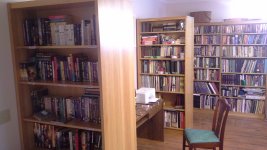
Nice house. Also people need to realize that thermal mass does not have to be created by hundreds of cubic yards of concrete, just hundreds of cubic yards of something dense that holds the temperature. Dirt will do.

SWMBO's solution is books.

8x520140117_093602.jpg

We also try to keep bookcases against external walls.

I prefer heavy metal tools.
 

Marketplace Items

2019 BOBCAT E45 EXCAVATOR (A59823)
2019 BOBCAT E45...
Commercial Lawn Mower 652R (A56859)
Commercial Lawn...
John Deere 690B Excavator with Auxiliary Hydraulics (A57024)
John Deere 690B...
Tug Boat with Tri Axle Magic Tilt Boat Trailer (A59231)
Tug Boat with Tri...
401 (A52706)
401 (A52706)
2024 COLEMAN MINI BIKE (A58375)
2024 COLEMAN MINI...
 
Top