Cement Bag Retaining Wall

/ Cement Bag Retaining Wall #42  
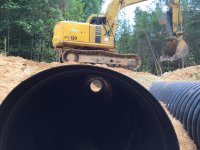
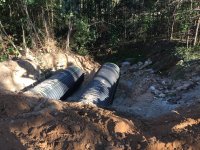
I guess I've been doing it wrong. My understanding is that gravel allows water to pass through it and compacted clay was water proof, especially when it's forced into the ribs of the pipe. The challenge, or hard part is getting it compacted on the bottom. That's where mixed concrete works well. You pour the concrete and then set the pipe on top of it so it spreads into every rib of the pipe.
 
/ Cement Bag Retaining Wall
  • Thread Starter
#43  
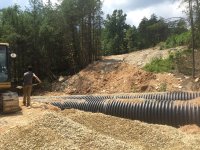
I will put gravel around about 40 feet that sits in the middle, then clay on the front end to keep the water out, and the cement bag head wall in front of that. I'm pretty happy about the way it is going. I just wish I had the whole week to do it and just get it done. Although my body would probably be wrecked if I didn't take a couple days off.
 
/ Cement Bag Retaining Wall #44  
Looks like a great project and I can't wait to see how everything turns out. I don't know if it's available in your area, but #78 or #8 is much easier to work with in situations like that. I still use a lot of #57, especially for drainage where I want water to flow, but for backfilling or bedding stuff I love #78 or #8. It flows into crevices and self compacts very easily. A bonus is that it's easier to shovel too.
 
/ Cement Bag Retaining Wall #45  
BTW, I hear you on the heat. Has been heat index of 107-111 here lately, and brutal to be outside, even doing light work. Hope it ends soon -- I have a lot to catch up on.
 
/ Cement Bag Retaining Wall
  • Thread Starter
#46  
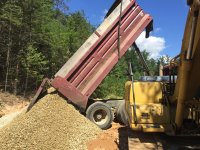
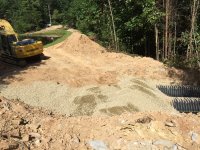
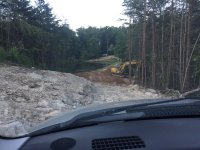
I have a bridge. I still have a lot of work to do. I'll be be doing more fill and cover work next weekend. But I have a bridge. I had two more trucks of stone delivered Friday. And then two more today. I was able to get the last one dropped right on the job site. Saved me at least 4 hours of picking at it with the tractor. So far that is 136 tons of crushed stone for backfill. Ive driven the excavator back and forth over it 30 times packing down the dirt. I feel confident that it can handle day to day traffic with no problem. image-4058305844.jpg
 
/ Cement Bag Retaining Wall
  • Thread Starter
#47  
I was able to send that first picture from the mountain, but couldn't follow it up. Let me back up a bit. this weekend, I made good progress. I started early moving stone for an hour or so and then My wife showed up and was moving stone for about 7 hours on Saturday. I would wait till she had delivered 5-10 loads before I would mess with it. I had plenty of work to do because my son and I were putting clay at the start of the drain pipes, Tamping down inch or two layers of dirt by hand. Plenty of cardio Saturday. We got a lot of backfill in there.
IMG_4617.jpgIMG_4620.jpgIMG_4624.jpg
Sunday we did ok, but it started to rain around 2:30...some big dark storm clouds and enough rain to turn the dry clay into a mess. I pulled the plug before we could tear up the soil.
Today I went back alone and did some maintenance while the sun finished drying out the roads and work area. This morning, at 8 I went into the quarry office and ordered two more truck loads of stone. I asked if the could deliver them to the pond. ....I was in town getting diesel when the first load came and it was dropped by the road...I pained a big sign on the ground with utility marking paint asking that they deliver the next load to the pond. I was tightening longest on the tractor when I heard them a truck so I ran up to tell them to come down. The driver walked down with me and checked it out and back the truck all the way to the bridge and dumped the stone. Made me happy as could be.
I spread the stone that was dumped at the bridge, then ferried more stone for an hour. I got things spread outing started to put some dirt down. Then I drove the tractor for another hour, getting more stone. I thought I had moved enough....
IMG_4634.jpgIMG_4656.jpg
 
/ Cement Bag Retaining Wall
  • Thread Starter
#48  
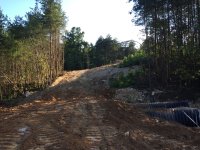
I would spread out 5 or so buckets of dirt then pick thru it to remove sticks, roots, and large rocks. When there was about 6 inches I drove on it to compact it. When there was a foot of dirt I stopped worrying about the larger rocks unless they were larger than a bowling ball. I am amazed at how much material I have put in that hole. I put all that pipe, 250,000 lbs of crushed stone and most of the clay back in it, and I still need more stone and will need more clay. Changing the contour of the land and joining tow pieces together is more than I thought it would be. IMG_4660 (1).jpgIMG_4659 (1).jpg

I was able to drive up to the home site. I kicked back in the bed of the truck for about half an hour to enjoy the sun setting behind the mountain......then I drove back down, and sprayed my trees. The work don't end.IMG_4667.jpgIMG_4669.jpg
 
/ Cement Bag Retaining Wall #49  
Great job WoodChuck. It looks great, looking forward to more post as you progress towards the home building. I am sure jealous of the pond and trees!

As far as the work never ending; I tell my wife, I can rest when I die.:laughing:
 
/ Cement Bag Retaining Wall #50  
Lots of. Work going on there. Placing gravel around a culvert is a total new one to me, never seen that done before. What is the reasoning? Is it so water will seep through without washing out around the culverts?
 
/ Cement Bag Retaining Wall
  • Thread Starter
#51  
The stone is supposed to lock together easier, and require very little compacting. It also worked out for me because I am not just filling the hole back in, I am trying to create a bridge that rises up and changes the contour of the land right there. Basically a large ramp.
 
/ Cement Bag Retaining Wall #52  
Not to beat this to death, but could you provide a link to where it says to use gravel on a spillway pipe?
 
/ Cement Bag Retaining Wall
  • Thread Starter
#53  
Not to beat this to death, but could you provide a link to where it says to use gravel on a spillway pipe?


No problem. I used ADS pipe so their documentation was one that I followed, as well as reading several state's highway standards.
ADS drainage handbook
Drainage Handbook- ADS Pipe

table 5-2 in the installation section lists different materials to use for fill
http://www.ads-pipe.com/pdf/en/ADH5-Installation_March_21_2016.pdf

page 5-16 specifically talks about compaction
COMPACTION
The level of compaction will vary depending on the material and installation requirements, see product specific guidelines in Appendix A-5, Table A-5-2 for minimum compaction requirements based on soil type and application. Crushed stone or similar materials are usually not compacted, but do require care during installation to eliminate large voids in the backfill envelope. Using a shovel to 'slice' or 遡nife the material under and around the pipe is many times sufficient.
For other materials, compaction methods will depend primarily on the amount of compaction, or modulus of soil reaction, required and the moisture level of the material. At optimum moisture levels, some Class II and III soils can be compacted to minimum recommended levels simply by walking on each backfill lift. While this technique may not be acceptable for all installations, the point is that compaction need not always require a great deal of extra effort or mechanical equipment. If, however, mechanical compaction equipment is needed in the backfill envelope or elsewhere on the site, the subsequent paragraphs provide guidance on compaction equipment and the soils for which they are most appropriate."
 
/ Cement Bag Retaining Wall
  • Thread Starter
#54  
Not to beat this to death, but could you provide a link to where it says to use gravel on a spillway pipe?

I also found several videos from ADP that show installation techniques.
This one specifically uses gravel as backfill. I used crushed stone, which is considered a class I fill.
HDPE Pipe Installation Video - HDPE Pipe Backfill Procedure - YouTube

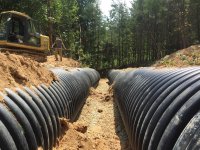
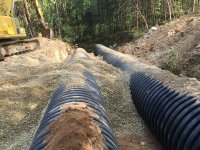
I spent significant time knifing the material in, and really trying to pack it into the ribs with the bad of the shovel. I did the same with the clay on the front end of the pipe. On the outlet end, I still need to add fill. Also, I "walked the fill in" in layers. Meaning I would spread small layers of the gravel, then get down and knife it into the sides, then stomp back and forth thru the trench to try to work it together and lock it in place. You can feel it being a little loose wen you first put it in, but after working it for a bit it becomes very solid under your feet. I even got down on all fours, and basically did a bear, mountain climber sort of push with my feet to try to grind the stones into the edges of the trench and against the pipe. I have at least one more weekend worth of work to do before I will be done, but it will be worth it because I will not feel like I have to worry too much about the bridge. Continued maintenance and observation, of course, but I will have a lot more faith in it's stability.
 
/ Cement Bag Retaining Wall #55  
I can see how they are using gravel backfill for near level trenches with the HDPE pipe since it has little or no water pressure to seep around the pipe and wash out. A spillway is much different though, isn't it? I think you said you are only using the gravel in the center area of the long trench, with clay on the upper and lower ends. Hopefully that clay will seal the upper end.
 
/ Cement Bag Retaining Wall #56  
Good links. I enjoyed reading them and seeing the video on how to join the pipe. From everything you've posted, compared to the links you provided, in my opinion, you are doing everything right for a culvert installation on a road. Easily going above what is needed and not cutting any corners.

My concern is that you are also using the pipes as a pond overflow. Crushed rock is one of the best materials in the world to allow water to flow through it. If any water gets past your cement bag retaining wall, it will eventually undermine the integrity of the foundation under your pipes. Will you even notice it? How long will it take until there is a problem? With everything you've done, and how often the pond overflows, you may very well never have an issue. If it was me, I would just do all I could to ensure water did not get under your pipes and into the gravel.
 
/ Cement Bag Retaining Wall
  • Thread Starter
#57  
That is why the first 8 feet at the inlet is clay that I have tamped in by hand. Once I get the cement retaining wall built I will decide if I need to make a more advanced inlet. The concerns you listed have definitely been on my mind. I think that by having the inlet side be clay and having 3-5 feet of compacted clay over the rock I should have a pretty good set up to prevent erosion under the pipe. I may also dig down in front of the pip band do a cast in place inlet ramp with concrete. That remains to be seen.
 
/ Cement Bag Retaining Wall #58  
Bentonite is an option to seal the upper portion of the pipe too. I'm looking forward to more pictures, especially when you get to the wall. :thumbsup:
 
/ Cement Bag Retaining Wall
  • Thread Starter
#59  
I wasn't familiar with bentonite. Interesting stuff.
 
/ Cement Bag Retaining Wall #60  
The county recently replaced a culvert.....which I found going out right after a storm...It was quite old......right near the end of my drive. They dug the old out, laid the new one in, and encased it in road pack type gravel...not a smidgen of dirt. Seems to do the job, and when it rains really hard water will go up and over the road at that culvert point.
 

Marketplace Items

2015 Dodge Charger Sedan (A61574)
2015 Dodge Charger...
2015 Ford Explorer AWD SUV (A64557)
2015 Ford Explorer...
Gleaner N630 Corn Head (Allis Chalmer Branded) (A61307)
Gleaner N630 Corn...
PORTER CABLE AIR COMPRESSOR (A65643)
PORTER CABLE AIR...
2011 JOHN DEERE 710J BACKHOE (A65053)
2011 JOHN DEERE...
2017 FREIGHTLINER CASCADIA 6X2 T/A SLEEPER TRUCK TRACTOR (A59910)
2017 FREIGHTLINER...
 
Top