I'm struggling to understand how and why the frequency of the utility grid would vary.
The frequency of the grid varies, very very very slightly, as a function of load. And when I say slightly, I mean less than 0.25%, or about 0.15Hz on a nominal 60Hz generation/distribution system, and that is over a course of a day -- not instantaneously. There is no possible way for a modern interconnected power grid to wander 1Hz off the nominal (60Hz here in the USA and most countries with 120Vac mains, 50Hz in most other countries with 240Vac mains, and interestingly both 60Hz *and* 50Hz in Japan).
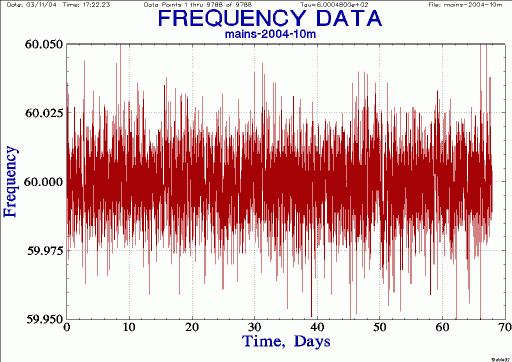
Here is 2 months of data, taken at 1 second intervals, by a private individual:
Note the excursion over that period is within 0.05Hz of nominal 60Hz, or about 0.08% variance.
There is tremendous inertia in the grid. All generation stations are synchronized together when connected to their grid. Every generation station, regardless of how large (even the largest nuclear plants >1500Mw) must match generator speed with the grid prior to closing the breaker connecting the generator to the grid. If the generator (and the turbine that drives the generator) are not matched at exactly 1800 rpm for 60 hz, the grid will instantly match the turbine speed for you. If this happens, millions of dollars of equipment are damaged. There is no room for error when syncing to the grid. The inertia of the grid is essentially infinite relative to any one generation station.
^^^ This!

There is limited "official" reported data on the USA's distribution system. In contrast, you can see the UK's power transimssion system frequency shown graphically here,
Dynamic Demand
As you can see, 0.1Hz in either direction (0.2%) is the normal condition.
There is a historical graph of the same data here,
National Grid: Real Time Frequency Data - Last 60 Minutes
Again, the excursion is within 0.1Hz.
I find it had to believe a 1.6% change in speed, even for just a second, can be absorbed in turbine/generator shaft windup.
You are right -- it can't -- the power imbalance in this case would result in a power transmission fault and the affected generator will automatically be pulled offline. As you can imagine there is a potential for a cascade problem -- a few generators trip, the rest slow down due to undercapacity, more trip, more slow down, ... this is why load shedding and fault isolation measures have to happen extremely rapidly with the power transmission control system.
Having said all that, I'm not a electrical guy. But my first reaction when someone says the grid frequency varies is there's a problem with the measuring equipment or method.
The typical handheld frequency/voltage/distortion measurement device lacks sufficient measurement accuracy to make an valid assessment of grid frequency. For example, a (not inexpensive) Fluke 43B Single Phase Power Quality Analyzer (
Power Quality Analyzer, Power Quality Analyzers, Single Phase Power Analyzer specifies "0.5% + 2 counts" as the base frequency measurement accuracy. Using this type of device to measure power line frequency will not give you a good indication of the actual line frequency -- short term measurement repeatability (precision) will be good, but the accuracy is not sufficient to make a statement of merit.
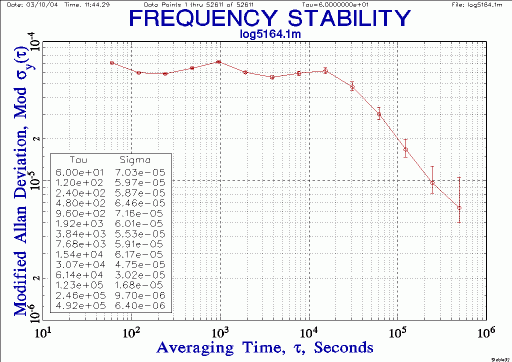
In the lab at work we use a 10MHz/1pps feed from a cesium (atomic) reference clock (it's about 1 part in 10e14 accurate) as the timebase for a TIE (time interval error) analyzer, which produces Allan deviation plots similar to the one pictured below -- which incidentally is an Allan deviation plot for the 60Hz mains. As you can see, for "medium term" durations, say 2 minutes, the power line frequency is held to better than 10e-4.
A small (Pout <= 20KW) , mechanically-governed, gasoline- (or diesel-) engine powered portable generator can not match the above noted utility line frequency performance to any degree; there is simply not enough rotational inertia nor a PLL-like external control mechanism which self-governs the generator speed and therefore the frequency. This effect is compounded with the introduction of dynamic loads -- a step-function load of ~50% on a small generator will typically cause an easily detectable (>0.25Hz) phase angle to nominal 60Hz.
Wrooster