You are using an out of date browser. It may not display this or other websites correctly.
You should upgrade or use an alternative browser.
You should upgrade or use an alternative browser.
Clutch: Wet vs. Dry
- Thread starter Beavis
- Start date
- Views: 62599
More options
Who Replied?
/ Clutch: Wet vs. Dry
#1
dave1949
Super Star Member
Good question. I'd appreciate hearing of experiences/opinions on this too.
Dave.
Dave.

RickB
Super Star Member
- Joined
- Sep 18, 2000
- Messages
- 15,190
- Location
- Up the road from Dollar General WNC
- Tractor
- Just a Scag
A dry clutch is just that, a clutch that lives and works in a dry environment. Usually, but not always a single disc between two pressure plates or one pressure plate and the flywheel. Usually, but not always mechanically controlled, a dry clutch can sometimes be hydraulically controlled. Dry clutches are cheaper to build, cheaper to replace, and generally do not last as long as wet clutches.
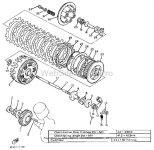
A wet clutch is a clutch or clutch pack that lives and works in an oil bath. Usually, but not always a stack of alternating lined and unlined discs with alternating internal and external splines within a drum and having a shaft extending through the assembly. The shaft and drum are the drive and driven elements, one way or the other. Usually, but not always hydraulically controlled by an oil filled piston that compresses the discs directly, or a hydraulic piston that controls pressure plate fingers. Wet clutches are more expensive to build considering the control circuits and clutch together and usually more expensive to repair or replace than dry clutches. Wet clutches will outlast dry clutches in like operating conditions by a wide, wide margin. This longevity and the ability to marry wet clutches with computer controlled modulation and engagement adds to their popularity and use.
A wet clutch is a clutch or clutch pack that lives and works in an oil bath. Usually, but not always a stack of alternating lined and unlined discs with alternating internal and external splines within a drum and having a shaft extending through the assembly. The shaft and drum are the drive and driven elements, one way or the other. Usually, but not always hydraulically controlled by an oil filled piston that compresses the discs directly, or a hydraulic piston that controls pressure plate fingers. Wet clutches are more expensive to build considering the control circuits and clutch together and usually more expensive to repair or replace than dry clutches. Wet clutches will outlast dry clutches in like operating conditions by a wide, wide margin. This longevity and the ability to marry wet clutches with computer controlled modulation and engagement adds to their popularity and use.

Slacker
Gold Member
Just to add to the wet clutch discussion, they require oil with no friction modifiers.
Most motorcycles and atv's have wet clutches and require motorcycle oil.
Normal oil has an additive that's no good for wet clutches.
Most motorcycles and atv's have wet clutches and require motorcycle oil.
Normal oil has an additive that's no good for wet clutches.
oldnslo
Super Member
Just to add to the wet clutch discussion, they require oil with no friction modifiers.
Most motorcycles and atv's have wet clutches and require motorcycle oil.
Normal oil has an additive that's no good for wet clutches.
Would you please explain this. Are you talking synthetic oils or oil additives like STP?

mostly_gas
Super Member
Would you please explain this. Are you talking synthetic oils or oil additives like STP?
I had a 1000cc Kawasaki for 46,000 miles and it had a wet clutch. I ran the same 19w-40 oil that cars used for the first 30,000 then switched to Amsoil 10w-40. Same clutch in it when I sold it as when I bought it.


RoyJackson
Rest in Peace
- Joined
- Nov 17, 2001
- Messages
- 24,646
- Location
- Bethel, Vermont
- Tractor
- John Deere 4052R Cab,, Deere 855D UTV, Z920A Zero Turn Mower and assorted implements
RickB wrote a great description of wet and dry clutches...thank you very much!
I think some posters may be confusing wet clutches with hydraulic assists (hydraulic slave cylinders to aid clutch actuation).
I think some posters may be confusing wet clutches with hydraulic assists (hydraulic slave cylinders to aid clutch actuation).

radman1
Elite Member
- Joined
- Jul 8, 2006
- Messages
- 3,017
- Location
- midwest
- Tractor
- JD 4520, Toolcat 5610, Bobcat S300, Case-IH 125 Pro, Case-IH 245, IH 1086, IH 806
Because the wet clutch is in an oil bath and the nature of engagement, it stays cooler during frequent shifts which causes excessive clutch heating. If you use a FEL heavily, start and stop mowing ect, then the wet clutch will last much longer. My dry clutch in my JD 5300 lasted until around 2000 hours. About $1500 to replace by mechanic. I did not use the clutch hard or lots of FEL work. However, I bought it used at 900 hours from a landscaper and the clutch was probably used much harder by the prior owner. A wet clutch may never require replacement.
Sweden-Art
Bronze Member
The advantage with a wet clutch is that you get a smoother engagement/ performance and longer life before wear out, a correct designed clutch pack and SW design with minimum slippage should outlast the machine life time easy.
A disadvantage with a wet clutch is what we call drag, and the energy losses you get from heating the oil. Drag is best explained as "you are running in water"
I would choose the wet clutch machine with no hesitations.
A disadvantage with a wet clutch is what we call drag, and the energy losses you get from heating the oil. Drag is best explained as "you are running in water"
I would choose the wet clutch machine with no hesitations.
RoyJackson
Rest in Peace
- Joined
- Nov 17, 2001
- Messages
- 24,646
- Location
- Bethel, Vermont
- Tractor
- John Deere 4052R Cab,, Deere 855D UTV, Z920A Zero Turn Mower and assorted implements
There's no doubt a wet type clutch has advantages...
However, we must all realize dry clutches have been around for decades and have served us well.
As long as the operator can keep his or her foot OFF the clutch (no "riding the clutch"), a dry clutch will last hundreds or even thousands of hours. This includes work that requires heavy clutch usage, such as loader work.
This also requires the operator be smarter then the clutch...
However, we must all realize dry clutches have been around for decades and have served us well.
As long as the operator can keep his or her foot OFF the clutch (no "riding the clutch"), a dry clutch will last hundreds or even thousands of hours. This includes work that requires heavy clutch usage, such as loader work.
This also requires the operator be smarter then the clutch...
Slacker
Gold Member
Would you please explain this. Are you talking synthetic oils or oil additives like STP?
I based this on the fact that every motorcycle and ATV I've ever owned had a wet clutch AND stated in the owners manual to NOT USE Energy Conserving oils. This is because the Energy Conserving oils have a friction modifier that causes slippage in the wet clutch.
I have no other info on it.
Slacker
Gold Member
Would you please explain this. Are you talking synthetic oils or oil additives like STP?
I based this on the fact that every motorcycle and ATV I've ever owned had a wet clutch AND stated in the owners manual to NOT USE Energy Conserving oils. This is because the Energy Conserving oils have a friction modifier that causes slippage in the wet clutch.
I stole the below statements from here, it explains pretty good:
Using Non-friction Oil with Wet Clutch - ThumperTalk
Very early on, when levels of some oil additives were being lowered, some alternative additives were used as a replacement. One of them at the time was molybdenum disulfide(MoS2). This element is used in gear oils and greases, and at that time also in a couple of new motor oils. This element will indeed cause problems with a wet clutch situation. And it was found out real fast that this was the case.
I think the issue was initially tackled by the Honda folks and the reports of their Goldwing bikes having a massive slippage problem from using the recommended Honda shelf oil. They found out that it was indeed the MoS2 that was the culprit.
Fastforward to today...
It didn't take long for oil makers to realize that another element was needed to replace the slip causing MoS2 additive. The oil makers, and their multi-million dollar tech staffs, realized that using molybdenum diathiocarbamate (MoDTC) was a much better alternative. It was not only oil soluable, unlike it's solid predeccesor, but was proven to not be a problem in the wet clutch situation.
And the wet clutch was only one minute part of the engineers considerations...as MoS2 is a very antagonistic element, which can actually create other unwanted chemicals when mixed with other chemicals and elements. Specifically, MoS2, when in the presence of other chemicals, can create a substance known as sulfuric acid, which is not a good thing in a IC engine that utilizes elastomer seals.
But...it was too late...the myths and legends were already started...
And continue to this day...and mostly passed around by thge less-than-learned, and those wanting to seem as if they have some sort of knowledge in this area.
The truth is about 180degs out of phase with what these folks will tell you. They simply lack credible information...and are backing their warnings up with myth, legend, and hearsay.
Sure, some MC mfgs will state to not use Energy Conserving oils, as they were the ones that would be using alternative elements...and some of these oil makers may simply still be using MoS2...and the bike mfg is simply convering their ***. They are not making a definitive statement by their recommendations. Again, it's just CYA, and nothing more.
Besides, EC (energy conserving) oils do not come in the viscosities that are recommended for use in motorcycles. It shouldn't really even be an issue...but as we see on a daily basis, the issue gets perpetuated by the less-than-learned.
Spudland_Dave
Veteran Member
There's no doubt a wet type clutch has advantages...
However, we must all realize dry clutches have been around for decades and have served us well.
As long as the operator can keep his or her foot OFF the clutch (no "riding the clutch"), a dry clutch will last hundreds or even thousands of hours. This includes work that requires heavy clutch usage, such as loader work.
This also requires the operator be smarter then the clutch...
Very good points... The problem from my point of view is how you use the tractor. While you are very correct in that if you keep your foot off the clutch it will serve a long happy life, in reality the very size and use of these machines make that pratically imposible. It really depends on how you'll use your machine. if you plan on spending hours and hours cultivating potato fields then yeah a dry clutch would be fine. But if loader work and chores are your thing, I'd probably get something with a wet clutch.
truckerswife
New member
So, please tell me if a mitsubshi 372d tractor is a wet or dry clutch. My father in law got this tractor and dont know much about it. But the clutch is making a grinding sound. We found it in a field and it had been there for like 8 years. please help me, not sure what year we have been told maybe in the early 80's
Last edited:
Samuellm
Member
So, please tell me if a mitsubshi 372d tractor is a wet or dry clutch. My father in law got this tractor and dont know much about it. But the clutch is making a grinding sound. We found it in a field and it had been there for like 8 years. please help me, not sure what year we have been told maybe in the early 80's
Very unlikely that it is a wet clutch TractorData.com Mitsubishi MT372 tractor transmission information if this is it.
Does it grind all the time or only when the clutch is pressed in?
DK35vince
Super Member
Very unlikely that it is a wet clutch TractorData.com Mitsubishi MT372 tractor transmission information if this is it.
+1
According to the tractordata listed above, you have a sliding gear transmission. So it very likely has a dry clutch.
I think most wet clutch's are generally used on power shift/glide shift type transmissions

Raspy
Veteran Member
- Joined
- Dec 16, 2006
- Messages
- 1,656
- Location
- Smith Valley, Nevada
- Tractor
- NH TC29DA, F250 Tremor, Jeep Rubicon
So, please tell me if a mitsubshi 372d tractor is a wet or dry clutch. My father in law got this tractor and dont know much about it. But the clutch is making a grinding sound. We found it in a field and it had been there for like 8 years. please help me, not sure what year we have been told maybe in the early 80's
If it grinds when you depress the clutch pedal, but not when you let it up, it's probably the throwout bearing. If it only grinds when in gear and moving, it's most likely a transmission bearing.
Jim Timber
Veteran Member
Dry clutches last thousands of hours in regular automotive/truck use - daily commuting, towing, etc. Even semi tractors use dry clutches (double disks though). Unless you sit there and slip it constantly, it's going to last a long time. Slipping is what they're designed to do under pressure not high enough to lock them up.
The 5e 3cyl versions use an 11" clutch and it runs about $600 for the drive elements, and another $300 if you wear out the PTO elements. The rest of the expense would be labor to split the tractor.
The 5e 3cyl versions use an 11" clutch and it runs about $600 for the drive elements, and another $300 if you wear out the PTO elements. The rest of the expense would be labor to split the tractor.


