Concrete house

/ Concrete house #41  
Newly purchased S/S safety wire bought for the job at hand should have no kinks in it, so that makes it 3 things wrong with S/S.
I wasn't thinking about using it in a plastic pipe. Although I have plastic in my garage, most of my experience has been with steel conduit, so the wire doesn't hurt the metal no matter how many curves you pulll it around. So for my use, down to 2 things.
S/S chips will cut you, and you never even realize it. Having a couple of lathes, and even more milling machines in my garage, (hobby use) I can vouch for that. However, I have never, ever been cut by a piece of safety wire. Not sure if it is the alloy, or the fact that all corners are curved, but a round piece of safety wire usually only cuts on the end, which is sharp.
Wire correctly manufactured should have no camber and an appropriate cast for the size of the wire and the spool it is wound onto. The roll of safety wire I have has a 34" cast, meaning if you cut several feet of it, and then remove one loop of it, as it is lying on the ground, the circle it makes has a 34" diameter. The cast is the amount one end raises up off the floor. Having been in the QA end of a wire manufacturer for the last 7 years of a 15 year employment, I am able to recognise good and bad wire charactistics.
I was just thinking that when you start to pull all the wires in a single run, just add a piece of safety wire and it will be there long after any string I have ever dealt with. Pulling the safety wire after the run has been energized is not a consideration, and pulling new wires thru it while anything is still hot is asking for trouble. People do it all the time, but not with residential electrical.
David from jax
 
/ Concrete house #42  
Many years ago, probably 1975, I worked for a pretress concrete company that built and erected a building with CIC prestess wall panels. The panels were the normal 24" double "T" like you see in a lot of roof panels, but standing on end. Before we stripped them out of the bed where they are poured, we added a 4" layer of foam, then added additional sides to the form and poured another 6" of concrete over the foam.
Later we built another larger one, using what is known as a Lin T form.
The owner of the wire company had his house built completely with prestressed concrete, and it is still standing out at Jax Beach. Good planning is required with prestressed concrete, because you can't just drill a hole anywhere you want without effecting the integrity of the unit.
David from jax
 
/ Concrete house #43  
Paddy, I prefer the "we don't have to lock our doors" concept but it just is not practical anymore in most places. Regretable but true. Although I had designed some alarm systems they were for commercial and special projects and I never had any sort of intruder alarm till after the turn of the century. I think it is prudent to have as is insurance but hope it never has to work.

We have concealed carry permits too and hope to never ever NEED a weapon for personal protection. Well... my wife PACKS when going out in the backyard to fill the bird feeding stations because of the number of sightings of mountain lions in our yard in the middle of the day and I fantasize about bagging a big kitty close to the house. (Note: We have a dozen calves that are a smorgasbord for a puma.)

Regarding my comments on SS wire for pulling cable. I was thinking the small stranded stuff and it will sure as heck substitute for a saw.

I had electricians out who had a commercial fuzzball on a string and it blew/sucked through conduit pretty nicely when powered by a small shopvac. I had run my string before in conduit thte OLD FASHIONED WAY by tieing a hex nut on the end and putting it through each length of conduit by gravity and centrifugal force in turn before they were joined. Boy oh boy the vacuum and fuzzball are certainly superior!

I certainly am no ICF bigot and think we should build using whatever methodology is provident and affordable. While a typical cinderblock house is not a thing of great beauty, to me, if it is coated in stucco you can't tell it is blocks and in some climates (and economic or environmental considerations prevent continuous running mechanical systems) you want to REDUCE the R factor and increase the infiltration. A sprawling block home with maximum surface (within reason) for the enclosed volume and jalosie windows nearly "locks" the home into the climate with just a little averaging due to the blocks thermal mass.

A very important influence on the applicatioin of "NEW" technology is the economical availability of experienced practitioners. In many instances it would seem around here that anything more complicated than slip joint pliers is HIGH TECH.

Patrick_G
 
/ Concrete house #44  
patrick_g said:
While a typical cinderblock house is not a thing of great beauty, to me, if it is coated in stucco you can't tell it is blocks and in some climates (and economic or environmental considerations prevent continuous running mechanical systems) you want to REDUCE the R factor and increase the infiltration.

Patrick_G

Mornin Patrick,
All I wanted to add was that my parents built a block home in the northeast in 1950, it was covered with white stucco and actually didnt look bad at all. The home was virtually maintainence free and was quite tight for its day. This was very unconventional for a residential building in that time frame, for that local ! The home was an L shaped ranch that had its windows installed high on the surrounding walls except for the large picture windows overlooking the rear patio. Even at that time my Pop took advantage of the solar energy, because the sun poured in those windows durring the daylight hours !
 
/ Concrete house
  • Thread Starter
#45  
Patrick G,

I think the CIC and ICF will be close in price. Do you recall the material cost of your ICF forms on a per sq-ft bases? If I use Dow 2" foam from the big box stores at $22.50 per sheet, that's $0.70/sq-ft times 3 layers to get 6" = $2.10 a sq-ft plus the cost of a $1.25 fiberglass tie, $3.35/sq-ft. For ICFs you pay to have them stacked and poured. With CIC, you pay to have walls formed around the foam and poured. The price to have convential walls formed at 8" thick 10' tall and running foot is approx, $75.00 or $7.50 a square foot. Each square foot requires;
8/12'x 1'x1'= 0.6667 sq-ft of concrete. With concrete cost $90 a a cubic yard or $3.33 per cubic ft. Then 0.6667x $3.33=$2.22 a wall sq-ft. The formers are getting over $5.00 a square ft to form and pour (for labor). So for your average 30'x40' bacement, 140 running foot and 1400 sq-ft, the contractor is charging $7000 + for labor. OK, this usally includes the footer/steel, so let's take off $2k. These guys seem to get in and out in just a few days with 3-4 guys. Sounds like someone is making money.

Since I will be pouring in stages, basements wall, slab, second floor, second set of walls and roof, I will likely buy a set of used forms and pour myself. Well, have my crew pour. This way I can take my time to get the foam, R-bar and ele in place for each pour. At the end of the job, sell the forms.

Since I have had a hard time finding any one intersted in bidding this, I will be working with a GC willing to take this on T&M. He likes the idea of having the forms at his ready. His crew consists of 4-5 guys all above 38 years old. No dumb kids turned loose! They like doing these owner driven projects vs tract homes. As stated a few posts back, they have done a few ICFs, so they are capable.

By the way, did you check out the stats on the CIC from the ORNL site? If you dig a bit, you will see an area where raw data is presented. Neat stuff. It's a big site so if you need "directions" how to find it, let me know. I would appreciate your feed back on the data with your Physics/engineering/school of hard knocks back ground.

Patrick M
 
/ Concrete house #46  
dfkrug said:
As for the "ideal" building envelope, there are always trade-offs with costs
and compromises in other areas. The best for one criterion is not the
best for another. Why ICFs are so good is that they provide very high
benefits with fairly low cost impact.

I agree. My 30 dollars average heating and cooling bill for a 3500 square foot house seems low enought. My base of $100 is too high. Some of that may be from the blower.

One of the things that we really like is low sound level, both coming from outside (we barely hear storms), and sound that is generated inside is minimal. The house also seems "warm" even when you are near walls and ceiling. ICF was about the same cost as six inch wood walls, but a whole lot more energy efficient.
Was the analysis comparing the various walls based upon actual construction or just theoretical analysis? Was credit given for the concrete pulling heat from the ground in the winter and sending heat into the ground during the summer. This increase the effrective R value.
 
/ Concrete house
  • Thread Starter
#47  
You should see the study your self but, actual wall sections were built. What do you mean by "my base of $100 was to high"?

I'm glad you like concrete. Everybody I talk to is one happy customer
 
/ Concrete house #48  
The best technique for a house is the one that you can build and build well. Wood, brick, concrete, really does not matter. Can you build it and build it well, that is what matters. All homes no matter the technique will be energy efficient independent of materails if done well.

Looks like a great project.
Bob
 
/ Concrete house #49  
Paddy said:
You should see the study your self but, actual wall sections were built. What do you mean by "my base of $100 was to high"?

I'm glad you like concrete. Everybody I talk to is one happy customer

My bill runs between $100 and $200. The base is therefore $100. This is the stuff other than heating and cooling. To further reduce my bill I need to work on this base, not the heating and cooling part. This means I need a more efficient refrigator, washer, dryer, hot water heater, lights, wife (that would be too expensive to change), and the applicances that always leave something on (TV, Cable Box, wall warts, clock radios, etc.).

I have improved on the lights, clothes dryer, and hot water heater.
 
/ Concrete house
  • Thread Starter
#50  
DocBob,

You are correct in your statement that a home should be built well. But material does play a mojor role in it's efficiency. Much like copper wire is more efficient than steel wire with regards to ele applications. We have the technoligy to build much higher efficiency cars and homes, but with current low cost energy it's not cost effective. As the true cost of energy comes to light, the price of efficiency comes down fast.

R-/inch
Fiberglass batts, R-3.16
Dow expanded foam, R-5
Vacuum, R-250!
 
/ Concrete house
  • Thread Starter
#51  
BobRip,

I have a friend who lives in FL and he always is complaining how high his ele bill is monthly. His family came to visit for a week this Summer. Now I know why he has a high bill! Lights were left on in every room, doors left open when it was close to 100 deg and the TVs were left on.

I felt like a mom going around the house shutting every thing down

Did you build with ICFs above grade?
 
/ Concrete house #52  
Paddy said:
BobRip,

I have a friend who lives in FL and he always is complaining how high his ele bill is monthly. His family came to visit for a week this Summer. Now I know why he has a high bill! Lights were left on in every room, doors left open when it was close to 100 deg and the TVs were left on.

You said it all! My wife and I turn off lights in every room when not in them. And all lights are compact flourescents! Out electric bill has gone down, not up.
Bob
 
/ Concrete house #53  
BobRip said:
One of the things that we really like is low sound level, both coming from outside (we barely hear storms), and sound that is generated inside is minimal.

So true. It is so quiet in our house that virtually all our appliances seem
annoyingly loud, even the electric water heater.

We pay 55-65/mo for electric and maybe 10-15/mo for LP gas, averaged
year-round. That is for 2100 sf and 2 occupants. Our mild climate
and ICF construction allowed us to eliminate an AC system.
 
/ Concrete house #54  
Paddy said:
BobRip,
Did you build with ICFs above grade?

The ICFs go from below grade to the roof line.

I always seem to go around and turn off lights. The compact florescents help.
 
/ Concrete house #55  
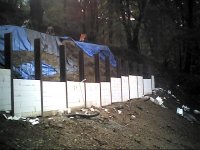
I have always been an experimenter with construction methods
and materials. Here is a soldier pile retaining wall I designed using
steel I-beams and a 4" thick ICF between the columns. This was
for a failed section of roadway in an area that the county stopped
maintaining, so the neighbors got together and fixed it. The best
contractor bid was somewhere north of $150K. Cost of construction
and materials was about $25K.

People who want superior alternative construction for their own house
often fail to accurately guage the impact of government oversight.
Getting building permits for an alternative method can be tough enough
for code-approved alternative methods. Non-code-approved methods
can be VERY tough. Manufacturers of ICFs have done the work to
get code approvals. Other alternative methods (e.g. straw bales,
rammed earth, etc.) may require extensive engineering certifications
and sometimes even testing. I remember an article in Fine Homebuilding
about 20 y ago where a guy wanted to build a straw bale house. His
first choice of location in WA refused to let him do it at all. He eventually
built it in rural Nothern CA, but the bldg dept made him build a test
structure and test it to failure.
 

Attachments

  • Apr29~03.JPG
    Apr29~03.JPG
    95.9 KB · Views: 186
/ Concrete house #56  
Doc Bob I don't want to be penalized for "piling on" but Paddy beat me to the punch and I wanted to comment. Materials DO make a difference. Each building system has a "best practice" efficiency that can be approcached asymptotically to varying degrees by different practitioners.

Traditional stick built walls, even with special attention to corner details, using some readily available insulating material such as blown F/G, batts, or foam, at best will not achieve the efficiency of an ICF wall or concrete-insulation-concrete sandwich. There is much more to comfort than high R-Values. Your radiant environment is a big chunk of comfort.

There are perfectly sound methods of building stick built walls that are both economical and can produce performance equal to ICF and other highly rated practices. For example, in general, 2x4 studs are a loss leader item at big box stores with competition in the area. There are tested designs that use wider than 16 inch centers for a stud wall but uses two stud walls, one inside the other to give whatever cavity depth is desired to get the R-values desired using the insulating material of choice. The studs are staggered so there is a thermal break at the studs. A thicker than standard wall can be built with 2x4 for about the price of 2x6 construction but with deeper cavities to accept sufficient insulation for way higher R-values without having to use expensive foam in place insulation.

The above is NOT A TRADITIONAL APPROACH and although homes have been built in this manner and instrumented to measure and prove thermal performance, by and large it just is ignored by the good ole boys and folks miss out on a very good approach that can easily be applied by traditional framing crews with little "TRAINING." Inovation is a hard sell.

Another innovative but built and tested idea for a passive or mostly passive solar home is to embed cinder blocks on their sides under the slab. The blocks are placed so that the holes (cavities) line up not so they are staggered. The holes run N-S. The slab floor is poured over the blocks and bonds to them. The air chanels formed by the blocks are brought out next to the south wall by floor registers and similarly at the north wall.

As insolation warms the slab in the living room/dining room or great room, depending on layout, the warmed air rises out of these southern registers which draws floor level cold air into the registers along the north wall. This convective current distributes the thermal gains quite well. At stasis the slab temp at the south wall vs the slab temp at the north wall is only a few tenths of a degree apart. The convective current diminishes after sundown but may continue at reduced levels for some hours. Supplemental heat is easy to integrate with this system by various approaches. Warmer floors are achieved with little extra expense as compared to typical hydronic radiant floors. System response with supplemental heat is faster than a hydronic/radiant in-slab installation due to the warm air distribution via the chanels in the floor. Small quiet fans may be used to assist Ma Nature.

I just got back after leaving early Sat morning to stay with relatives in Lawton. I set the thermostats for 60F and the great room fell from 72-74 to 67F in 3 1/2 days. Since our geo heat pump produces hot air, hot water , or both when I reset the thermostats we got rapid heating by forced air. I set the thermostats for warm air 2 degrees lower than the hydronics so ordinarily the hot air doesn't come on. It will if say you have a party and enough folks are going in and out enough ourtside doors. This restores the air temp quickly and then reverts to "Pure" hydronic.

Paddy, I don't recall the prices and they are surely obsolete by now but if you want current info then contact Mr. Than Maynard at Polysteel of Central Oklahoma at Purcell, OK. or the polysteel dealer near you. I went with plain 8 inch concrete cross sections with no post and beam or waffle grid out of ignorance regarding penetration resistance.4-6 would have been MORE THAN adequate as air cannon testing produced no cracks or spawling in 2 inch thicknesses (the thin parts of waffle grid.)

I can appreciate your hiring a contractor to give you their best effort to do what you ask them to do instead of what they may have always done. A large part of my project went like that as frequently my selected methods and materials were totally new to my GC and his subs.

Pat
 
/ Concrete house #57  
patrick_g said:
Doc Bob I don't want to be penalized for "piling on" but Paddy beat me to the punch and I wanted to comment. Materials DO make a difference.

No problem, pile it on :D . ICF sounds great. But, (big but) assuming the local talent only knows wood construction, ICF won't make it. If the fellow building your stick built knows how to do it well, house wrap, vapor barrier, etc. then the results will be very close. Now, if we talk about thermal mass, then concrete is better, unless you have lots of thermal mass in the form of tile floors, etc.

I would love to build a concrete (ICF, CIC) earth sheltered home.
Bob
 
/ Concrete house #58  
ICF is not rocket science and is way easier for DIY or DIY supervision of neophytes than standard stick framing.

NOTE: I have an ICF "SECTION/module" in my house just as I have a stick built section and a red iron steel truss supported by "I" beams section and a formed and cast concrete basement. I am not a method or materials bigot. I think it is sufficient to use whatever you can do a good job with especially if you can make an economical job that gives good economics over the life of the structure. That said, I caution you to hunker down behind your sand bags!

There is just no practical and economical way with anything coming close to standard practice to build a traditional stick built house which will outperform a concrete-insulation-concrete layered approach or an ICF in most US climate zones. Yes there are good stick houses built that are very good "FOR THEIR GENRE" in being tight and energy efficient. It would be a pretty rare case to find a builder that has typical results close to those achievable with concrete.

I don't know what kind of tile you refer to when you claim equality in the thermal mass department for a tile floor compared to concrete walls. Certainly a concrete box has way more thermal mass than a wooden box with a tile floor or a wooden box with a concrete floor covered in tile. The time delay/phase shifting aspects of high thermal mass will not be adequately provided by tile or even slab floor with tile.

The phase shifting effect of concrete walls between the outside and inside environments requires significant thermal mass and the thermal mass has to be distributed in the exterior walls. Thermal mass in the floor of a stick built structure can be a good thing just not the same thing as the effects of high thermal mass walls. ICF has a phase shift capacity as does the concrete-insulation-concrete (inside out ICF).

If you are familiar with electronics you can think of the thermal mass of concrete in walls and the insulation on/in them as RC filters where the concrete's thermal storage is analgous to a capacitor and the insulation is analgous to a resistor. There are both capacitive and resistive input RC filters and combinations thereof such as the popular pi filter. Because of the combined action of a pi filter the filtering (smoothing) action is better than either a capacitive or resistive input RC filter.

A capacitive input RC filter in wall terms is a concrete wall with insulation on the inside. A resistive input filter is a concrete wall with insulation on the outside. The pi filter is a pair of concrete walls with insulation between them and has better thermal characteristics than the same amount of concrete in a single wall and the insulation on either the inside or outside.

The ICF is a resistive input RC filter with a series resistor in the output and is NOT the best use of the materials. It is however thermally superior to any standard construction stick built wall.

You can have too much of a good thing and get too much phase shift but it is not a serious shortcoming.

The phase shift shows its advantages most clearly in environments with large diurnal temperature swings, not places like the deep south with hot humid days and nights. The deep south (except for wood destroying organisms) would be a good place to find a defense of traditional building methods. Arid and semi-arid climates could use the phase shift available with high thermal mass to good advantage.

If you are going to include a stick built house with wider stud spacing and a double stud wall with 8-12 inch cavities for insulation and a slab over sideways concrete blocks style radiant floor then the economics of beating that with ICF or inside out ICF just might not wash for performance/$ comparisons. This of course is NOT the way most stick built houses are framed.

Pat
 
/ Concrete house #59  
Just to add to the value of ICF, we had the power company do an air leak test on my ICF house. The guy who did it had constructed his own house and made every effort he could think of to reduce air leakage. He stated that he would bet nobody could equal his house leakage rate. He did use conventional construction. He tested my house and found 1/2 of the leakage on his house. The power company did not quite believe their own results and came back to test it again. We had found a few leaks during the earlier testing and fixed them, and there was now even less leakage. Air leakage control is just as (if not more) important as insulation value. With conventional construction and the many possible leak paths it is difficult to seal the leaks. With ICF the concrete forms a continuous barrier in the walls. I think with concrete walls that are poured and then put up, there may be more leakage. Of course care must be taken on the rest of the house as well.
 
/ Concrete house #60  
patrick_g said:
ICF is not rocket science and is way easier for DIY or DIY supervision of neophytes than standard stick framing.

If you are going to include a stick built house with wider stud spacing and a double stud wall with 8-12 inch cavities for insulation and a slab over sideways concrete blocks style radiant floor then the economics of beating that with ICF or inside out ICF just might not wash for performance/$ comparisons. This of course is NOT the way most stick built houses are framed.

Pat

Pat, any good references for ICF? So I can read more about it?
Bob
 

Marketplace Items

2020 INTERNATIONAL LT625 6X4 T/A SLEEPER TRUCK TRACTOR (A67147)
2020 INTERNATIONAL...
PRIEFERT PORTABLE CATTLE SQUEEZE CHUTE (A64277)
PRIEFERT PORTABLE...
2016 280 Trailers Towable LED Advertisement Board (A64553)
2016 280 Trailers...
2005 MACK CHN613 (A65643)
2005 MACK CHN613...
White Metal Roof Vents (A64194)
White Metal Roof...
New/Unused Landhonor Quick Attach Receiver Hitch Adapter (A65583)
New/Unused...
 
Top