Concrete slab

/ Concrete slab #1  

Humbleto

Silver Member
Joined
Dec 1, 2005
Messages
141
Location
Fredericksburg, Tx
Tractor
Kubota L3400 HST
I've got a quick question for some of you more knowledgable folks. I'm planning to put up a 30x50 metal building on a slab in the hill country of Texas. Should there be plastic (moisture barrier) under the rebar? The guy I'm using doesn't think there needs to be one. I'm leaning the other way. Any comments??

Thanks in advance
 
/ Concrete slab #2  
Use the moisture barrier [ plastic ] under the slab. It helps retain the concrete moisture for proper curing.
 
/ Concrete slab #3  
Yes, absolutely put the plastic down, and under the rebar.
Why do he say no to?
consider getting another guy.
 
/ Concrete slab #4  
Humbleto said:
I've got a quick question for some of you more knowledgable folks. I'm planning to put up a 30x50 metal building on a slab in the hill country of Texas. Should there be plastic (moisture barrier) under the rebar? The guy I'm using doesn't think there needs to be one. I'm leaning the other way. Any comments??

Thanks in advance

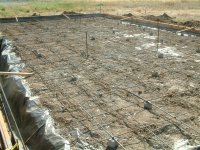
I had a 24'x42' slab poured for my metal garage/shop in Jun05. Here's what it looked like before the concrete pour.
The black plastic is 10-mil Visqueen laid over about 4" thickness of gravel.
 

Attachments

  • DSCF0047.JPG
    DSCF0047.JPG
    301.6 KB · Views: 8,141
/ Concrete slab #5  
The vapor barrier seems to be pretty common up North, but just about unheard of down here. From what I understand, it keeps the moisture from coming up from the ground and into your slab.

I've never seen anybody do this who works concrete for a living in my part of Texas. I've also never seen it done in California where I lived before here. Neither areas get any snow, so that might be part of it too.

One thing to keep in mind is that the dryer your mix, the harder it will be when it cures. I don't know how or if this has anything to do with moisture barriers or not.

Listen to your contractor. He knows the area that he's working in better than anybody else. There are reasons people do things different all over the country, and while I'm sure it won't hurt anything if you put a moisture barrier down, I don't know why you would want to.

Eddie
 
/ Concrete slab #6  
They put a vapor barrier under my slab when i had an addition put on. My 30 x 40 shop on the other hand doesn't have one. The floor will sweat under certain conditions, meaning that moisture migrates up through the slab.

In my opinion, put one down. What is it, $100 worth of materials. If put it in and don't need it you wasted $100. If you don't put it in and you did need it, then your screwed.

I understand what Eddie's saying, but there's an awful lot of contractors that do things wrong out of ignorance or laziness. How many concrete guys do you think really want to be bothered fooling with plastic sheeting? If they can avoid it, I'm sure they do. Maybe if you're on a true sandy soil, like some parts of Texas and California then it's not needed. I'd rather play it safe.
 
/ Concrete slab #7  
I was taught that there are three "zones" for concrete slabs.
Dessert, Wet/warm areas, and cold areas, and that the vapor barrier is required in cold zones and wet/warm zones. But I have been wrong before (lots).
 
/ Concrete slab #8  
The concrete company can add something called berlex to the concrete to make it water proof. Did my workshop that why and had no problems with water.
 
/ Concrete slab #9  
Pretty common in this part of Kalifornia. For the minimal cost, I'd sure insist on it too.
 
/ Concrete slab #10  
I put up a 30'x40' metal building in 2000 in Fannin county. I put up the building, but had a contractor do the slab for me. They put the plastic down under my slab. I didn't ask, he didn't say. He just did it.
 
/ Concrete slab #11  
flusher said:
I had a 24'x42' slab poured for my metal garage/shop in Jun05. Here's what it looked like before the concrete pour.
The black plastic is 10-mil Visqueen laid over about 4" thickness of gravel.

The picture shows exactly the right way to do it.

Gravel/Visqueen/Sand/Rebar

Don't forget the sand on top of the barrier, it prevents cracking.

In my part of CA this is the way both the engineer and the bldg department insisted I should do it. I tried to leave the sand out & got a ration of chit from both of them, so I added it.
 
/ Concrete slab #12  
When I lived in Maine, we used plastic. We live in Florida and its code here, never heard of sand over it though?
Jim
 
/ Concrete slab
  • Thread Starter
#13  
Thanks everyone. I'll just go with the plastic and be done with it. The guy didn't have a problem putting it down, he just didn't see the need for it in the area that I am building.
 
/ Concrete slab #14  
Concrete contractors like to leave the vapour barrier out because the slap dries out quickers and sets up quicker so they can go home sooner. This is not the best for the concrete though, it makes a weaker floor.
 
/ Concrete slab #15  
The plastic will definitely slow down how quick the cement cures. I did mine on a cool day and couldn't run the power trowel until 12 hours later. Nothing like being by yourself, in a poorly lit shed after midnight smoothing out the cement with a power trowel.
Unless there is a strong reason not to do it, I would use the plastic. Really cheap compared to the overall cost. In my area, the cement will sweat in the spring time as the temperature fluctuates. Also keeps down radon levels!
 
/ Concrete slab #16  
My attached two car garage does not have a moisture barrier under the slab and when the slightest bit of moisture is in the air it sweats a lot. My soil is composed of 12 inches of top soil on top of sand. My pole barn has a moisture barrier as well as 2 inch foam insulation under the slab and does not sweat. My small red barn does not have any moisture barrier under it but the slab is directly on sand and it does not sweat.
Any concrete work I have done will have a moisture barrier under it and if it is going to be under a structure I will add insulation as well.
I didn't know about the sand on top of the barrier and don't know the purpose of the sand other than to hold the barrier down and protect it from damage while the concrete is being poured. Sounds like a good idea and will probably have it added on any more of my projects.
Farwell
 
/ Concrete slab #17  
Around the weekend place they all use it, also every home in Houston. So I used it on the house and later on the garage. Just to cheap of stuff not to use.
 

Attachments

  • concretepour_07_all.jpg
    concretepour_07_all.jpg
    58.8 KB · Views: 588
  • 05232004-form5.JPG
    05232004-form5.JPG
    87.2 KB · Views: 1,342
/ Concrete slab #18  
All this talk about a plastic moisture barrier stoping a concrete slab from sweating has me scratching my head in bewilderment. Here in East Texas, 80 percent humidity is pretty common in the summer. The air holds tons and tons of moisture in it. I don't have a plastic barrier under my slab and I've never seen moisture come up from the ground through the concret. My slab is dry at all times.

After a few months, the ground under a slab is so dry that when you go to break out any part of a slab, you normally need a jackhammer just to dig in it. There is none, to very, very little moisture in the soil under a slab.

The faom makes sense to me in Norther and cold climates. The plastic sheet doesn't.

Adding things to a mix just because they don't cost that much is a real good way to run out of money. Some places you use 3/8 rebar on 2 foot centers. Others use wire mesh. But if you really want a strong foundation, you go to half inch. But why stop there? You can put them on 12 inch centers and than realy beef it up with 5/8 rebar. I was told that's code in parts of Florida. 5/8 rebar on 12 inch centers.

So far I haven't read a reason to put the plastic down that makes any sense to me. I'll be happy to start using it if there is a valid reason to do so, but until then, I'll do like the other contractors I know and leave it out.

Eddie
 
/ Concrete slab #19  
I like it because I believe the plastic allows the conrete to cure slower and more even. If poured directly on top of fill the water will be pulled out causing the slab to dry to fast. I have seen slabs sweat just thought it was because it was cooler than the hot sticky air. Never looked at it as moisture coming up from underneath. Here in Florida it is called a vapor barrier. That leads me to believe that it is more for Radon protection than any thing else.
 
/ Concrete slab #20  
EddieWalker said:
All this talk about a plastic moisture barrier stoping a concrete slab from sweating has me scratching my head in bewilderment. Here in East Texas, 80 percent humidity is pretty common in the summer. The air holds tons and tons of moisture in it. I don't have a plastic barrier under my slab and I've never seen moisture come up from the ground through the concret. My slab is dry at all times.

After a few months, the ground under a slab is so dry that when you go to break out any part of a slab, you normally need a jackhammer just to dig in it. There is none, to very, very little moisture in the soil under a slab.

The faom makes sense to me in Norther and cold climates. The plastic sheet doesn't.

Adding things to a mix just because they don't cost that much is a real good way to run out of money. Some places you use 3/8 rebar on 2 foot centers. Others use wire mesh. But if you really want a strong foundation, you go to half inch. But why stop there? You can put them on 12 inch centers and than realy beef it up with 5/8 rebar. I was told that's code in parts of Florida. 5/8 rebar on 12 inch centers.

So far I haven't read a reason to put the plastic down that makes any sense to me. I'll be happy to start using it if there is a valid reason to do so, but until then, I'll do like the other contractors I know and leave it out.

Eddie


My experiance has been that its the moisture coming up through the ground not the humidity in the air. Here are just a couple of my personal experiances.

Our last house was built in a subdivision before most of the other houses. They poured the garage floor on ~4" of pea gravel, no plastic. Everytime we had a fair amount of rain or exteneded wet period the garage floor would be damp. This was the same for the other houses as well except for one. The guy across the street put down plastic and his was the only one that would stay dry.

We built a new house in the country and a 50x64 shop several years ago. We did not put down plastic in the garage because it did not need it. The Garage floor was poured on top of ~6' of recycled concrete. Not much chance of moisture wicking its way through that. If we have that much moisture I'll be collecting animals and looking for an Ark.

We did put down plastic in the shop on top of ~8" base of crusher run and it stays dry as well.

So do you need plastic? The answer is...it depends however as a general rule I'd say yes. I've seen the same type of results listed above in Iowa, Nebraska, Montana and California.
 

Marketplace Items

2014 PETERBILT 579 (A60736)
2014 PETERBILT 579...
2015 GMC 3500 HD 4x4 Crew Cab Pickup Truck (A60352)
2015 GMC 3500 HD...
2018 International 4300 TMA Attenuator Truck (A60352)
2018 International...
2025 Unused SDLGC80 60v Electric Golf Cart (A60352)
2025 Unused...
8 TOOTHED BUCKET FOR MINI EXCAVATOR (A58214)
8 TOOTHED BUCKET...
2019 Toyota Corolla Sedan (A55853)
2019 Toyota...
 
Top