Creating a Lake

   / Creating a Lake #1,181  
bindian said:
Spiveyman,
That is the best motivation God ever gave man. She's a cutie. Does she have you wrapped around her finger? ;)
hugs, Brandi

HA! Well....... kind of, but not as bad as you'd think. I'm pretty strict on her, but she likes to play me too.

Eddie, thanks for the tips... yikes! :eek: I have a question about that $$$/acre under water. If you have a long valley Vs. a short valley that you plan to flood, but the height of the water at the dam is the same, can the dam be the same size? In reading this thread I recall somewhere in the middle a discussion about that and the force being applied to the dam being a result of the depth of water, not the width of the channel. My thoughts there are that the major expense will be making the dam, but depending on where in the valley I put it, I could really varry the size of the lake but keep the dam relatively similar in size. I realize there's prep work to the bottom of the lake to make sure it holds water, but I'm not planning to "dig" the lake out, meaning I am hoping not to have to dig down 15 feet to get a 15 foot deep section. I want to flood the valley and bring the water level up the sides of the existing terrain. That's part of the reason to put it there. I have horrible soil for everything except holding water. I don't think it will take a ton of work to get the bottom rolled in. That other pond (it was there when I bought the place, not my choice of spots) is on the crest of a hill, NO run off to speak of at all, and it's almost completely full in the midst of one of the worst droughts we've had in decades. Maybe I'm naive, I like to think of it as optimistic, but I'm hoping it will be less work than you are describing. However, that's why I'm here, to figure out what is really going to happen when I start that sucker. If we're talking $60K or more to build that sucker it's going to be a loooooong while before I can pull that off. :(
 
   / Creating a Lake #1,182  
Spiveyman said:
HA! Well....... kind of, but not as bad as you'd think. I'm pretty strict on her, but she likes to play me too.

Eddie, thanks for the tips... yikes! :eek: I have a question about that $$$/acre under water. If you have a long valley Vs. a short valley that you plan to flood, but the height of the water at the dam is the same, can the dam be the same size? In reading this thread I recall somewhere in the middle a discussion about that and the force being applied to the dam being a result of the depth of water, not the width of the channel. My thoughts there are that the major expense will be making the dam, but depending on where in the valley I put it, I could really varry the size of the lake but keep the dam relatively similar in size. I realize there's prep work to the bottom of the lake to make sure it holds water, but I'm not planning to "dig" the lake out, meaning I am hoping not to have to dig down 15 feet to get a 15 foot deep section. I want to flood the valley and bring the water level up the sides of the existing terrain. That's part of the reason to put it there. I have horrible soil for everything except holding water. I don't think it will take a ton of work to get the bottom rolled in. That other pond (it was there when I bought the place, not my choice of spots) is on the crest of a hill, NO run off to speak of at all, and it's almost completely full in the midst of one of the worst droughts we've had in decades. Maybe I'm naive, I like to think of it as optimistic, but I'm hoping it will be less work than you are describing. However, that's why I'm here, to figure out what is really going to happen when I start that sucker. If we're talking $60K or more to build that sucker it's going to be a loooooong while before I can pull that off. :(

Around my area pond costs run on the lower end of Eddies per acre cost estimates from what I have been told. Of course it all depends on the situation and that can vary considerably. I think you will find that the volume of water as well as the depth of the water will decide what is required when engineering the dam. All the water is weight and it all wants to continue down hill unless there is something big enough to stop it. It would be great if the government will come in and help engineer the project for you. There is much more to a dam than making a big enough pile of dirt. It needs to be built a specific way with the right material and compaction. Not the kind of job I want a contractor who is building his first pond to do. You hear a lot of stories where someone has a 25k mud hole because of a poorly designed dam. You also have some liability issues if a dam lets go and you send 10 acres of lake down stream to damage others property.

Start doing some reading at www.pondboss.com in their discussion forum. There is a lot of good information there and some friendly people.

Is it a pond or a lake? I ask a pond management person that and he told me it was whatever his clients wanted to call it. :D The best definition I have heard was that nature makes lakes and people make ponds.

MarkV
 
   / Creating a Lake #1,183  
MarkV said:
Around my area pond costs run on the lower end of Eddies per acre cost estimates from what I have been told. Of course it all depends on the situation and that can vary considerably. I think you will find that the volume of water as well as the depth of the water will decide what is required when engineering the dam. All the water is weight and it all wants to continue down hill unless there is something big enough to stop it. It would be great if the government will come in and help engineer the project for you. There is much more to a dam than making a big enough pile of dirt. It needs to be built a specific way with the right material and compaction. Not the kind of job I want a contractor who is building his first pond to do. You hear a lot of stories where someone has a 25k mud hole because of a poorly designed dam. You also have some liability issues if a dam lets go and you send 10 acres of lake down stream to damage others property.

Start doing some reading at www.pondboss.com in their discussion forum. There is a lot of good information there and some friendly people.

Is it a pond or a lake? I ask a pond management person that and he told me it was whatever his clients wanted to call it. :D The best definition I have heard was that nature makes lakes and people make ponds.

MarkV

Yep, the NRCS has a pond "expert" been doing it for several decades. They will design the whole thing for me based on my goals. As for the naming, I'd say people make dams and/or wholes, nature still has to make the pond or lake. Well... that is unless you are Eddie and don't mind helping it out a bit with 40,000 hrs of pumping water!! :D I'm hoping nature will be kinder to me.
 
   / Creating a Lake #1,184  
Please don't flame me but... contrary to misinformed opinion...

The force of water on a dam is proportional to the depth and it is impossible to measure a difference in that force due to the volume or distance water is backed up by the dam. One of the first things you learn about hydraulics is that when a fluid (pond or lake water) is at rest the pressure is everywhere equal (+/- the gravity head.)

In a pond or lake the pressure is PURELY a function of depth and the density of the water which for our purposes is considered a constant. The deeper the water touching part of the dam the higher the pressure. This pressure increases in a LINEAR fashion with depth.

Here is a simple water calculator:

Water Density Calculator

Temperature will vary the density of water as will various substances in solution but for our purposes we can ignore those small changes. At temperatures of interest to us water weighs about 62.37 pounds per sq ft. Dividing by 144 (number of sq inches in a sq foot) we get about 0.433 pounds for a column of water one foot high so we have 0.43 pounds per square inch for each foot of depth.

At a depth of 10 feet the pressure is 4.33 PSI. and the force on the dam is 4.33 PSI or 632.5 pounds per sq ft. At 20 ft of depth the pressure is 1265 pounds per sqft.

This is the same if the lake backed up is 100 miles long or 3 ft. This is the same if the dam is 5 ft long or 50 miles long.

If you had a situation where say you had a set of locks in the dam and you could open and close them initiating a flow "through" the dam and then shutting it off, then there would be strong dynamic considerations and you'd have to consider the weight of the moving water that you were stopping. THIS IS NOT THE CASE in impoundments with no large transient flow quenching requirements.

As to economy: I like to try to hold the greatest amount of water with the least amount of dam in width and depth. If you choose your dam site carefully you can seriously decrease the number of thousands of cubic yards you have to move which is nearly directly proportional to $ without too severely limiting your acre feet of water impounded.

Large shallow bodies of water have lots of surface area for the volume. They heat and cool more quickly and are subject to greater evaporation losses. Deeper impoundments with less surface area for the stored volume are slower to heat and cool and lose much less of a percent of their volume to evaporation.

It is easy to get carried away with surface area and not get enough depth. All this is relative of course and depends on many factors. If you have ample RELIABLE rainfall or reliable springs and or no droughts then shallow isn't as risky. Bigger surface looks more impressive until a drought if you don't have sufficient depth.

Pat
 
   / Creating a Lake #1,185  
patrick_g said:
...The force of water on a dam is proportional to the depth and it is impossible to measure a difference in that force due to the volume or distance water is backed up by the dam. One of the first things you learn about hydraulics is that when a fluid (pond or lake water) is at rest the pressure is everywhere equal (+/- the gravity head.)

In a pond or lake the pressure is PURELY a function of depth and the density of the water which for our purposes is considered a constant. The deeper the water touching part of the dam the higher the pressure. This pressure increases in a LINEAR fashion with depth....

...This is the same if the lake backed up is 100 miles long or 3 ft. This is the same if the dam is 5 ft long or 50 miles long.

Yep. That's what I was counting on with placing this dam and getting the most for my money and time.

Large shallow bodies of water have lots of surface area for the volume. They heat and cool more quickly and are subject to greater evaporation losses. Deeper impoundments with less surface area for the stored volume are slower to heat and cool and lose much less of a percent of their volume to evaporation.

It is easy to get carried away with surface area and not get enough depth. All this is relative of course and depends on many factors. If you have ample RELIABLE rainfall or reliable springs and or no droughts then shallow isn't as risky. Bigger surface looks more impressive until a drought if you don't have sufficient depth.

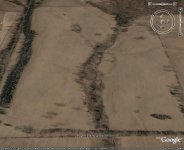
I do want sufficient depth in this lake, and do expect to have to take the surface down a bit, but also plan to take advantage of the valley there to provide much of that depth. There is a big difference between digging a 10 acre/30 ft deep lake and damming up a 26 foot deep valley that is 10 acres long. I also want max depth at the dam with some shallow-er fingers for fish habitats. What I've read here and on PondBoss so far you don't need massively deep waters for LMB - which is my favorite. This might help visualizing it. Here's a cap from Google Earth in their 3D mode of the valley. It's not detailed like an actual photo from the air, but will do. The dam would be near the viewer with the lake backing up away from you.
 

Attachments

  • Valley 02.jpg
    Valley 02.jpg
    67.8 KB · Views: 498
   / Creating a Lake #1,186  
Eddie,
Early in this lake thread, you mentioned using a laser level to mark your water line and spillway. :cool: Can you tell me what brand and model you have? :confused: Can these be rented? :confused: The cheap ones at Lowe's don't work too far in day light. :(
hugs, Brandi
 
   / Creating a Lake #1,187  
hunterridgefarm said:
Eddie,

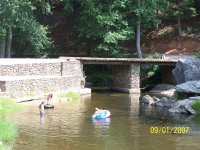
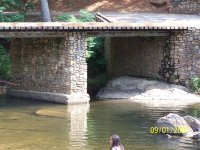
The campground I have my RV at has a lot of nice rock work and attractive bridge made from river rock. I will be up there this weekend and if I can remember to take the camera I take a few pictures a post them next week.

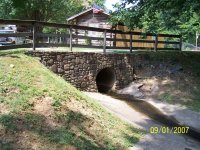
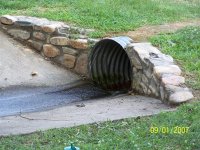
I'll also take a few of there pond and culverts.

David


Eddie,

Here are the pics of the bridge and culverts.
 

Attachments

  • 100_0373.jpg
    100_0373.jpg
    188.6 KB · Views: 607
  • 100_0374.jpg
    100_0374.jpg
    149.6 KB · Views: 560
  • 100_0375.jpg
    100_0375.jpg
    233.8 KB · Views: 520
  • 100_0376.jpg
    100_0376.jpg
    210.4 KB · Views: 526
   / Creating a Lake
  • Thread Starter
#1,188  
bindian said:
Eddie,
Early in this lake thread, you mentioned using a laser level to mark your water line and spillway. :cool: Can you tell me what brand and model you have? :confused: Can these be rented? :confused: The cheap ones at Lowe's don't work too far in day light. :(
hugs, Brandi

I use a Specta LL200 laser level. It's a one person kit that included a case, the tripod, laser, grade rod and receiver. I spent a very long time doing a search on ebay for it. Prices always started out good, but quickly got out of control. Since I was looking for it by doing a search, I saw every one that was for sale on ebay, not just the ones in the business section. Mine showed up in the tool area of ebay and there was some person bidding up everyones bid the second it came in. He/she wanted it so bad that he upped teh bid every time somebody else cam along with a bid. The last hour, the price was still aroudn $100. I bid on it with five minutes to go and won it.


Unlike the basic home owner models, light or brightness doesn't affect this one. Just set it up, make it level and turn everything on. The sensor does all the work. Tha laser just sends out it's signal in a total circle all around the tripod out 250 feet. With it rotateing all around, I can get a signal from it over a five hudnred foot area.

Again, you never see the lazer or any light. You just hear the receiver and can watch teh screen to see if you need to go up or down.

Hope this helps,
Eddie
 
   / Creating a Lake
  • Thread Starter
#1,189  
David,

That rock really looks great!! I can see that it was added after the bridge was built, but done so in a very nice way. Just being in that creek looks very inviting!!!!

My bridge won't be nearly as tall There will be two feet from the bottom of the bridge to the spillway. In that two feet, I'm gonna put on a dry stack, ledgestone cultured stone. It will also just be for walking across. No cars.

What will make it unique and an attraction will be my railings. When done, it should be one of those places people want to stop and take pictures. If I do this right, it will be just such a location.

Thanks again for the pics. I really like it!!!

Eddie
 
   / Creating a Lake #1,190  
bindian said:
Eddie,
Early in this lake thread, you mentioned using a laser level to mark your water line and spillway. :cool: Can you tell me what brand and model you have? :confused: Can these be rented? :confused: The cheap ones at Lowe's don't work too far in day light. :(
hugs, Brandi

Brandi, IF you are allowed out at night you can save a lot of $ on lasers. While a contractor MUST be able to work in bright sunlight, a DIY person doing something like "shooting" a contour to see where water will back up to could do so at night and use a much less powerfuland much less expensive laser.

Just put flags out as place holders and then revisit the area in the day to better see what you have. Another downside of a cheap laser is beam divergence, i.e. spot size at a fair distance. Still, you aren't aligning a space shot so a couple inches one way or the other is no big deal.

We used an old optical transit to "shoot" grades in several places at our place and did just fine. There is no requirement to use a LASER. The Panama canal and Boulder Dam got built without them. They are convenient and are time savers for someone "in the trade" but if yo don't do this sort of thing a lot it is no big deal.

Pat
 
   / Creating a Lake
  • Thread Starter
#1,191  
EddieWalker said:
I use a Specta LL200 laser level. It's a one person kit that included a case, the tripod, laser, grade rod and receiver. I spent a very long time doing a search on ebay for it. Prices always started out good, but quickly got out of control. Since I was looking for it by doing a search, I saw every one that was for sale on ebay, not just the ones in the business section. Mine showed up in the tool area of ebay and there was some person bidding up everyones bid the second it came in. He/she wanted it so bad that he upped teh bid every time somebody else cam along with a bid. The last hour, the price was still aroudn $100. I bid on it with five minutes to go and won it.

I forgot to finish this. My winning bid was $200

I know ebay doesn't have the deals it used to, but if you are patient and consistant in your searches, you can still find a bargain. The trick is to know what you are looking for and do a search in "all" of ebay to find it.

I also agree with Pat that for digging a pond, or general farm work, just about any lazer type system will get the job done with accuracy plenty close enough to not worry about it. I think mine is rated for a quarter inch accuracy at 250 feet. I've done house pads, septic drain lines and found where the low spots are areas that look flat with it.

If you come out here for the get together on October 27th, mention it to me and we'll set it up. Others might enjoy seeing how it works too.

Eddie
 
   / Creating a Lake
  • Thread Starter
#1,192  
Steph and Alissa cought 11 catfish yesterday in our small pond. We're worried that they are growing so fast, that they will outgrow that pond. It's just 3/4 of an acre and those fish are all over a pound now with some at three pounds or better. Steph lost two that she swears were more then three pounds. She landed a few three pounders, so we know that there are some in there that big.

Peyton and I carried catfish down to the lake three times. Each time we did this, the girls had more fish for us when we got back!!!!! :eek: :D

This picture shows Peyton letting some go that were just over a pound.

Eddie
 

Attachments

  • Lake Marabou 439 (Small).jpg
    Lake Marabou 439 (Small).jpg
    45.7 KB · Views: 835
   / Creating a Lake
  • Thread Starter
#1,193  
While the girls were fishing, Peyton and I decided to fix an erosion problem on the big culvert. Last spring I had the same problem with my 15 inch culvert, but the 18 inch was doing fine. Then we had some very severe storms over the summer that started to erode aroudn the entrance to the 18 inch culvert.

I've waited for it to dry out, which never really happened, to build the wall around the entrance to it. We have a bunch of storms that are supposed to drop allot of water, so I figured it was now or never. hahaha

Lowes had a sale on 50 pounds sacks of readi mix concrete for $1.98 each over the holiday weekend that sounded too good to pass up. Home Depot has the 40 pound sacks for $2.38 each.

I bought 40 sacks and some lumber for my hot tub first thing in the morning. Peyton pushed the sacks to the back of my truck, and I laid them. Forty sacks disapeared really quick without coming close to finishing the job. I sort of guessed that I needed another 40 sacks, so I drove to Lowes and bought 50! hahaha

It took a total of 87 sacks to build this bulkhead around my culvert. I also cut up ten half sticks of 3/8's rebar into various lengths and drove them through the sacks. I hammered them in almost all the way, then Peyton finished them off. He loves hammering!!!!!!!!

The reason the hole is so deep is to catch silt before it goes into the lake. These holes fill up after a heavy storm, or a few small rains. I have to dig them out with my backhoe from time to time in order to cut down on the level of silt that enters Lake Marabou.

Peyton is just over four feet tall.

Eddie
 

Attachments

  • Lake Marabou 440 (Small).jpg
    Lake Marabou 440 (Small).jpg
    72.4 KB · Views: 884
   / Creating a Lake #1,194  
EddieWalker said:
...I also agree with Pat that for digging a pond, or general farm work, just about any lazer type system will get the job done with accuracy plenty close enough to not worry about it. I think mine is rated for a quarter inch accuracy at 250 feet. I've done house pads, septic drain lines and found where the low spots are areas that look flat with it.

How do you do this if the lake is more irregularly shaped with fingers and such that will block the line of site of the lazer? I wash thinking about some kind of GPS deal that would tell elevation, then walk the shore line and drop flags to mark the water line??? :confused: I don't know if the GPS deals are accurate enough though.
 
   / Creating a Lake #1,195  
patrick_g said:
Brandi, IF you are allowed out at night you can save a lot of $ on lasers. While a contractor MUST be able to work in bright sunlight, a DIY person doing something like "shooting" a contour to see where water will back up to could do so at night and use a much less powerfuland much less expensive laser.

Just put flags out as place holders and then revisit the area in the day to better see what you have. Another downside of a cheap laser is beam divergence, i.e. spot size at a fair distance. Still, you aren't aligning a space shot so a couple inches one way or the other is no big deal.

We used an old optical transit to "shoot" grades in several places at our place and did just fine. There is no requirement to use a LASER. The Panama canal and Boulder Dam got built without them. They are convenient and are time savers for someone "in the trade" but if yo don't do this sort of thing a lot it is no big deal.

Pat

Pat,
Allowed out at night???:confused: I work nights on airliners as a mechanic. :D I like neat tools and gadgets. :cool: You sure have a strange way of stating........Do it at night. I had a cheap laser level from Lowe's but it's beam blurred at 40 feet, even at night. So how much is an old optical transit cost? Don't they need two people to do it right. I leveled my pole barn site with a water hose and clear hose on each end, secured to a stake driven into the ground. Now that is cheap. :rolleyes: Oh yeah, down here copperheads have been seen at night. You can't see them even with a flashlight until they move.
Brandi
 
   / Creating a Lake #1,196  
EddieWalker said:
I forgot to finish this. My winning bid was $200

I know ebay doesn't have the deals it used to, but if you are patient and consistant in your searches, you can still find a bargain. The trick is to know what you are looking for and do a search in "all" of ebay to find it.

I also agree with Pat that for digging a pond, or general farm work, just about any lazer type system will get the job done with accuracy plenty close enough to not worry about it. I think mine is rated for a quarter inch accuracy at 250 feet. I've done house pads, septic drain lines and found where the low spots are areas that look flat with it.

If you come out here for the get together on October 27th, mention it to me and we'll set it up. Others might enjoy seeing how it works too.

Eddie

Eddie,
Thanks, I would like to see how it works.
hugs, Brandi
 
   / Creating a Lake
  • Thread Starter
#1,197  
Spiveyman said:
How do you do this if the lake is more irregularly shaped with fingers and such that will block the line of site of the lazer? I wash thinking about some kind of GPS deal that would tell elevation, then walk the shore line and drop flags to mark the water line??? :confused: I don't know if the GPS deals are accurate enough though.

It's easy. First you need to decide where you want to start. At some point, you need to determine where the shoreline will be. For me, it was a point where I wanted the spillway to be. That land was to be left untouched.

I set up the tripod with the lazer on top of it so that I can see the lazer, and it's up above the shoreline. Then I extend my rod so that it's resting on the point I decided that I want the shoreline to be. This is my starting and ending point. I raise the rod until my receiver says it's level with the lazer. it doesn't matter how high you raise the rod, that's not important. What is important is to know the exact height that you raised it.

Now you just start walking along your land, while in sight of your lazer and put the rod down at various places. Adjust it's location until you get the beep that the receiver will give you to tell you when it's level. If it rod is the exact same height as it was when you started, it will only read level when the rod is at the EXACT same elevation.

I mark those spots with an orange survereyors flag.

When I get to a point that I can't see the lazer anymore, I move it to another location that I can see it from the last place I marked the shoreling. Kind of jump ahead on my expected path. After I set the tripod and adjust it for level, I put the rod back down on that last spot and adjust the height again. The previous height no longer matters as this new starting location will change that because the lazer will be at a different height. It doesn't matter what the height is, just that adjust the rod to get a reading from the last point you marked.

You keep doing this until you work your way all around your shoreline. When you get back to where you started, you should be at the same height. If you are off, then you either have a bad lazer, or you didn't keep the rod at the same height while moving around. Either way, you'll at least know where the shoreline is within the margins of where you end up.

Does this help?

Eddie
 
   / Creating a Lake #1,198  
Eddie,
That's awesome, I didn't know how those laser deals worked, but that makes perfect sense. I can totally see how that would work, and allow me to work my way around the shore line. I think I might approach it backwards though. I know where the water will enter the lake, and there's a point at which I don't want the water to back-up past. I'd probably step down a few feet from there and mark that as my max water level point, then start following that around both sides of the main valley marking it up the various fingers, then when I get close to the spot where I might like the dam I'll know how high the spill way needs to be to keep the water from flooding too far back up stream, and then I'll be able to mark the height of the dam that I'd want above the spillway. Then I can measure the depth that I would have naturally (which I estimate to be about 15 - 20 feet). Then I can decide how much dirt I want to remove to get the depths that would work best for me.

Is that a messed up way to plan it out? That would be a very cool day's work for me to flag it out. It seems like that would be the first step in starting to get bids. It may still be a couple of years before I can really get that project started, but marking it out would help get things rolling and let me know what I'm getting in to. I"ll have to check out the Specta LL200 laser level you mentioned a little while back. Thanks!
 
   / Creating a Lake #1,199  
bindian said:
Now that is cheap. :rolleyes: Oh yeah, down here copperheads have been seen at night. You can't see them even with a flashlight until they move.
Brandi

Well, if they aren't moving they aren't a problem are they?

You aren't in "production mode" so you don't just have to have two people with an optical transit. It helps but isn't mandatory. A really good LASER pointer on top of a spirit level will do a good job for many DIY tasks. Even a LASER type weapon sight on a spirit level is a good DIY tool and you get to use the LASER on your carry piece too. Way better than trying to duct tape a LASER level to your pistol!

I bought one of the cheapie LASER levels at HF for $9 and it was terrific under about 10 ft. It had a beam divergence greater than an improved cylinder barreled 12 ga with #9 shot.

With a HF LASER level and a piece of string you can make a fairly decent plumb bob.

Brandi, Sorry the humor flopped. I in no way intended to connote that you were in any way not in full control of your comings and goings day or night.

I have used the cheap HF LASER level in reduced ambient light and that helps but the real problem is the LASER is a piece of crap.

Pat
 
   / Creating a Lake #1,200  
Spiveyman said:
If you have a long valley Vs. a short valley that you plan to flood, but the height of the water at the dam is the same, can the dam be the same size? In reading this thread I recall somewhere in the middle a discussion about that and the force being applied to the dam being a result of the depth of water, not the width of the channel.

I have written some other stuff in this thread about dams but i'll do it again: It's easier for me to write it again than for you to wade through more than 120 pages of this thread ;)

Just one thing: i'm from the Netherlands, and us people use the metric system ;)

pressure can be measured in PSI, Bar, Atmosphere. Atmosphere is like Mach: 3 mach is the speed of sound (311 meter per second?) and 3 atmosphere is 3 times the pressure of the atmosphere, the average pressure of the weight of several kilometers of atmosphere around us. YES ! air has a weight !! it aint light either, because it puts a pressure on us of 1 kg per square centimeter, which equals 1 bar or 1 atmosphere.
We dont notice that pressure because the pressure is all around us: from above, from the inside (your lungs) and from beneath: unless your feet are sucked to the ground by an absolute vacuum, which is practically impossible.

anyways, enough about the weight of air.

There is just 1 more way of expressing pressure: by meters of water column.


If you have a pipe of 10 meters high, filled with water, with a cap on the end that's sitting on the ground, the pressure on the bottom cap of that pipe will be 1 kg per square centimeter, which equals 1 bar or 1 atmosphere.


There's the law of.... Bernouille ?? or did i forgot his name. But the law of this ancient scientist says that the pressure on a pressurised vessel (like an air compressor vessel) puts a force in ALL directions equally.

So the pressure from the meters of water column presses with the same force aside, as the weight of the water on top of it.


This means that if your dam is 1 meter high, the water pressure on a square meter of dam surface varies from 0 to 1 bar, which mediates 0,5 bar on the first meter of dam.
This means the water is pressing with a force of 500 kg against the dam body.
A standard gravity dam (held in place by the gravity on earth or rocks, not by concrete constructions) for this 1 meter deep pond will need to weigh at least 500 kg per meter to hold the water in place.

there are lots of variables not taken into account, like the cohesion of the sand particles in the dam, or the case where the dam starts to get soaked with water.

I will not advise a safety factor here, as some people on this board think it is dangerous if i do so, which will get me into endless discussions like in Koop's bridge thread... :p anyhow my profession is steel, not dirt
Anyways, you need to increase dam weight only for the depth of the water, and not for the water behind it.

as someone stated earlier in this thread, if that was true, boats would be deeper in a small pond than in a large sea... ;)
 

Tractor & Equipment Auctions

2016 UTILITY VS2RA 48FT REEFER TRAILER (A59575)
2016 UTILITY VS2RA...
DEUTZ MARATHON 60KW GENERATOR (A55745)
DEUTZ MARATHON...
12' CONTAINER (A52706)
SKID STEER ATTACHMENT HAMMER (A58214)
SKID STEER...
2014 Ford Edge SUV (A56859)
2014 Ford Edge SUV...
GENIE S-60 MANLIFT (A58214)
GENIE S-60 MANLIFT...
 
Top