Deck Stairs Rotten

   / Deck Stairs Rotten #1  

N80

Super Member
Joined
Aug 2, 2005
Messages
6,940
Location
SC
Tractor
Kubota L4400 4wd w/LA 703 FEL
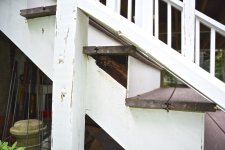
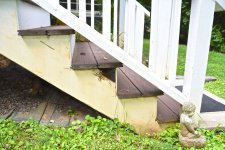
I had my grandmother's house remodeled about 4 years ago. We added a screen porch on the back with stairs leading down to the back yard. The stairs have 4 treated lumber stringers. The treads are made of Trex. The risers are faced with Hardi-plank. I noticed the other day that the outside stringer had three places that were totally rotten. I mean black and falling apart. Each of these spots was the triangle shaped area of the riser/tread. No termites. The outside edge of the stringer is painted.

The other stringers are fine. The entire stairway is uncovered.

Now this seems strange to me. The outside stairs on my cabin that I built 11 years ago are still okay. They don't look great and will need replacing but that is ten years verses four for these stairs at home.

The only thing I can see that might be a clue is that the carpenter that cut the stringer made the cuts where the riser and the tread meet with a circular saw (which is normal) but rather than finishing the cut with a hand saw he extended the cut into the stringer in both directions with the circular saw. To me, that's just lazy and sloppy but I'm not sure if that is why this stringer rotted so fast. Maybe this extended cut was a site for water to get into the wood? Any thoughts on this?

I can fix this but it is going to be time consuming. I'll have to remove all of the Trex treads as well as the Hardi-plank riser facing. The Hardi-plank is nailed in to it will crack and shatter when I remove it and it will all have to be replaced. This will not be an easy job.

Our contractor was VERY expensive. I wanted the best workmanship. Granted, it has been four years and there is no written guarantee on his work four years out but this does not speak well for his work. I'm wondering if I should call him?
 
   / Deck Stairs Rotten #2  
My opinion,I don't think it had anything to do with the cut..

I built my deck 6 yrs ago,I had to replace 2 -5 1/4 that had rotted out on my deck yesterday...

Not sure the quality of the treated lumber you buy today is very good
 
   / Deck Stairs Rotten #3  
pictures?

wondering if it is simply not "mold" when was the last time you "power washed" the deck / stairs? when was the last time you put on any sort of stain or paint? most of the paint / strain for decks has some sort of "anti mold" stuff in it.

every year or couple years. get out the electrical power washer (cheapy) and need to run it over all the decks to clean the mold / and stuff off. at my mom's house. the back deck is for most part completely shaded entire day. and with sap from trees.... the deck can get rather nasty in a year, due to damp conditions. and needs to be power washed yearly.
 
   / Deck Stairs Rotten #4  
Here where our "normal" humidity might get as high as 25% my stair treads actually wore out about three years ago - after being in use for 30+ years. They were commercially treated 2x12 lumber. I replaced with the same and carried on. The treads wore so thin after thirty year that one broke in the middle when I stepped on it. The deck is treated 2x6 and I've "oiled" it once in the 30+ years and its still in great shape.

I think high humidity, more rain than we get here and the surprisingly inferior wood we now get is probably your concern there.
 
   / Deck Stairs Rotten #5  
Are you 100% sure that pressure treated wood was used? Four years is about right for non treated wood to rot out on you.

What was the Hardie for? Was it to cover and hide the non treated wood? Could it have held moisture behind it and caused the wood to rot?

Is there good airflow around the stairs. Mold grows quickly on decks and any exposed treated wood that does not get good airflow. Especially if it is a shaded area.

Are the stairs resting on concrete or do they touch dirt? While touching dirt would only affect that part of the stairs and not explain any other rot.

Does water coming off the roof hit the stairs and cause additional moisture there? What about dew or other sources of constant or extra moisture hitting the stairs?
 
   / Deck Stairs Rotten #6  
Are you 100% sure that pressure treated wood was used? Four years is about right for non treated wood to rot out on you.

What was the Hardie for? Was it to cover and hide the non treated wood? Could it have held moisture behind it and caused the wood to rot?

Is there good airflow around the stairs. Mold grows quickly on decks and any exposed treated wood that does not get good airflow. Especially if it is a shaded area.

Are the stairs resting on concrete or do they touch dirt? While touching dirt would only affect that part of the stairs and not explain any other rot.

Does water coming off the roof hit the stairs and cause additional moisture there? What about dew or other sources of constant or extra moisture hitting the stairs?
 
   / Deck Stairs Rotten #7  
It seems like the plasticized wood and plastic (PVC) products condense a lot more water than wood on account of their heat-holding. Between sawing into the heart of modern PT, and opening up the extra grain overcutting, he may have gotten into poorly or unsaturated lumber, then screwed deeper into that. It sure seems weird to be gone so quick--it had to be holding (and getting) a lot of moisture between the trex and wood.
 
   / Deck Stairs Rotten
  • Thread Starter
#8  
A few answers to questions. Air circulation is good. The Hardi-plank riser fronts are cosmetic to match the rest of the screen porch. Only the outside part of the wood is painted. Exposure to water is from rain only. Gutters in good shape. I have provided no care, paint, washing or stain for the stairs other than a light pressure washing just before I discovered these rotted areas. But as mentioned the other four stringers are in perfect shape. Yes, all four stringers are treated. Yes, they do contact the bare ground at the bottom. Areas of rot are up high. Most of the rest of the affected stringer is fine, including where it contacts the ground. All three areas of rot are the "step" area. And when I say rot, I'm talking poke a hole in it with my finger and it disintegrates.

There are scraps of treated lumber from my cabin that have been lying in the woods for ten years that have not rotted this bad.

If it isn't the extended cuts (which weaken the stringer even if they are not an entry point for water) then the only other conclusion is that it was just a bad piece of lumber. And I would agree that treated lumber is not what it used to be.

I'll provide some pictures when I get a chance. I think the bottom line is that I've got some work to do.

I did see one of those tree house shows where the guy building the tree house used sticky sided water impervious membrane on every tread side of the stringer before he put the actual tread on it. This was in Seattle or somewhere like that and we don't get that much rain here (not much rain at all this summer) but the humidity is commonly 80-90%.
 
   / Deck Stairs Rotten
  • Thread Starter
#9  
Pics: DSC_0635.jpgDSC_0636.jpg
 
   / Deck Stairs Rotten #10  
I just found another 5 1/4 board I'll have to replace due to rot.. I bought all this Yellow wood lumber 6 yrs ago and built the deck.
Not all the boards are bad ,and the boards are in different areas.

I just think it's the chemicals they use, aren't as good as what they once used..

Guess I'll just replace them as they go bad

Good luck with your repair !
 
   / Deck Stairs Rotten #11  
I just found another 5 1/4 board I'll have to replace due to rot.. I bought all this Yellow wood lumber 6 yrs ago and built the deck.
Not all the boards are bad ,and the boards are in different areas.

I just think it's the chemicals they use, aren't as good as what they once used..

Guess I'll just replace them as they go bad

Good luck with your repair !
 
   / Deck Stairs Rotten #12  
While I wouldn't have thought it possible, I'm pretty sure the problem is caused by the Hardie blocking air flow under the steps. I think you have created a pocket under your treads that never dries out.
 
   / Deck Stairs Rotten
  • Thread Starter
#13  
Could be Eddie. Maybe I'll leave the Hardi-plank off. It will be easier and cheaper. Looking at the picture and the actual steps I'm quite sure it wasn't the cuts made in the corners. I still don't approve of that technique but don't think it caused my problems.
 
   / Deck Stairs Rotten #14  
After Katrina ruined my "shack", I built a new set of steps for it with treated lumber I got from Home Depot. This was about 8 years ago.

Three years ago I put an addition on my son's house which is about 300' from my shack and I built a set of steps for it with the new "yellow" treated wood from Home Depot. These steps built with the new treated wood are rotted out and need to be totally replaced but the old steps are in good shape. So my answer is "it's the wood".
 
   / Deck Stairs Rotten #15  
Bet the carpenter never treated the cuts that he made and if so they would soak water and rot.
One trick I use when making decks is to lay about 3" wide strips of roof membrane on the joists B4 laying the deck planking.
This way when water gets down between the cracks in the decking the joists remain dry.
My take is with a sound structure you could re plank a deck a few times as long as the joists are sound.

I got the idea from an old guy that had laid 3" strips of galvanized tin under the decking.*
The decking was all rotted out after 40 years but the structure very sound so I just re-decked saving the client many $$'s.

* back then with labor being cheap he probably spent hours with tin snips making those strips.
 
   / Deck Stairs Rotten #16  
I used the same trick but instead of using galvanized tin I used felt paper. In the many pole barns I built, I learned early on that the roof would sweat with water running down on my 2x8 rafters causing them to rot.

Next I used treated rafters but they still looked like they would rot in time with the water running down them plus I was worried about the treated lumber rusting out the metal. So on the next pole barn I cut strips of felt paper wider than the rafter which were easily attached with a hammer stapler and saw that the moisture would then run down the edge of the felt paper onto the ground and never touch the rafter.
 
   / Deck Stairs Rotten #17  
Looks like either non PT wood, or they didn't treat the cuts. When the rules changed in 2003, it really became important to treat the cuts. The old treated incised wood was a lot hardier thought its cross section than the newer material
 
   / Deck Stairs Rotten #18  
I wonder if the paint and hardy plank caused too much moisture retention.
 
   / Deck Stairs Rotten #19  
It's the crappy treating process/chemicals. For some reason the good CCA chemicals of old were outlawed, EPA? No 2X material is now rated for "ground contact", you need to go up to a "timber" size material, possibly 4x4 & up but I'm pretty sure that a 6x6 is rated for ground contact but that does not help you with your stair stringer. I have a 4 year old picnic table & the PT "leg" is rotted where it touches the ground:confused2: I guess that the EPA wants us to go back to dipping/painting our lumber in crankcase & diesel oil every few years.
 
   / Deck Stairs Rotten #20  
On the lower priced 'treated wood' I believe they simply dunk green wood in a large vat. Being green vs kiln dried there is very little absorbing of the treatment solution.

1st grade treated wood is usually kiln dried #1 pine and the 'pressure treating' is conducted in some sort of vacuum.

You can tell the difference when you pick up the boards.
The quality stock is 1/2 the weight of the discount brands.
 

Tractor & Equipment Auctions

2017 Yale GLC050VX 3,500 lb LPG Forklift - Powershift, Aux Hydraulics (A61306)
2017 Yale GLC050VX...
(APPROX. 25) 4' X 8' X 3/4" OSB SHEETS (A52706)
(APPROX. 25) 4' X...
2015 AMERITRAIL MANIFOLD TRAILER (A58214)
2015 AMERITRAIL...
2020 DY TP90 TRAILER MOUNTER CONCRETE PUMP (A59905)
2020 DY TP90...
Enmark Z Spray (A53316)
Enmark Z Spray...
378721 (A54865)
378721 (A54865)
 
Top