3RRL said:
Skunk,
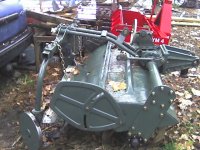
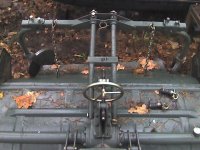
I was thinking more in terms of when you go to adjust the cylinders, not when they are already extended. I don't think you could budge them, like you say, once they are out there already. But when you go to adjust them down more, and the weight of the tiller is on the skids, the lighter side of the tiller will move up, or more correctly, that side's skid will move down before the heavier side. And visa versa, when sucking them up, the heavier side will suck up before the lighter side.
I am going with the premise that you were going to adjust the cylinders when it was on the ground....That's what I was thinking?
And again, I don't know for sure either.

It would be cool for you to make them without the detents first, since they can be added later. Then test it and maybe it will work just fine? I love this thread because I'm getting a tiller pretty soon and would like to do what you are contemplating. I like your idea a lot, and none of my hair brained projects have needed to have synchronized cylinders.
Rob, (and Wayne County),
Thanks for the continued thoughts, this is a very good discussion.
Rob I do see what you are saying, and that's how this whole discussion got started, because that was my concern.
Let me offer another side of the coin, again.
Q: How much weight or external pressure/force would it take to compress a 2" cylinder at 1000psi? Let's just say we aren't going to be able to budge it by hand, or even by standing on it, just like a bottle jack, it will be rigid.
If it takes XXX force to compress a 2" cylinder a total of 1" , then, wouldn't it also still take that much force to compress it even if it were plumbed in parallel with another 2" cylinder?
I guess my thinking is this: If wer were using wimpy small 3/4" bore cylinders, then the threshold to compress them with outside forces would be much more "likely" to happen, than when we use much larger cylinders that take force beyond what we reasonably expect in our application.
Simply put: If KingKong stepped on one side of the tiller, then yes, that side is going to compress, but in the same example, if we have a 120 lb. boy step on one side of the tiller, would the downward force he exerted be anywhere near the force needed compress the cylinder even a 1/4" ????
I am theorizing that a pair of 2" cylinders are grossly overkill for this application, however, that fact will give them the strength not to compress due to some extra weight on one side, or a bump in the ground. There must be a threshold for comprssion?
I am theorizing THAT threshold is the amount of force it would take to overcome the pressuirized cylinder??
OK, so, if that is the case, it's a pretty easy build.
If, in fact, they do have problems balancing, then my thought would be coil-over compression spring, like on a Shock absorber or a MacPherson strut.
That may be costly, so, the obvious alternative would be standard "stretch" springs, holding the cylinders back a bit.
But, as I pondered what the springs are doing, aren't they simply exerting additional force in an attempt to keep the cylinders in balance? Wouldn't the weight of the tiller be accomplishing the same thing?
I'm having a circular disuccsion with myself...this is great!
Thanks guys, for the thoughts and suggestions. Worse case scenario, we'll bolt on a pair of cylinders, and start taking readings and deflection measurments.