Drilling Water Well

   / Drilling Water Well #21  
3. After getting 30 feet of PVC casing in the ground, I started jetting deeper. I hit gravel at about 40 feet. Unfortunately, gravel/rock is not good for the pressure washer method. :)
...

This is what happened to me. I hit gravel and all my progress came to a halt. I tried to make a bit that I could put on a half inch metal pipe and turn with my 3/4 inpact wrench, but that just got stuck. I need to come up with a better bit to get through the gravel.

From what I understand, the gravel is where the water flows. If you get through the gravel, then you will hit water. Filling your hole with water and watching it seep out just means that water is flowing through the gravel. How much water is in there depends on your local rain conditions and how big the gravel vein is. There is more gravel down there as iron ore and red clay go together. It's just a mystery as to how much you have and how deep it runs. If you are lucky, it will all be small stones, but I've found some that were rather large and if I hit one of those bigger pieces, I'm never going to get through it in that location.

Thanks for the update. I'm really interested in how you get through the gravel.

Eddie
 
   / Drilling Water Well #22  
Bobcat:

At the end of the ball pump weld on a chisel the width of the desired hole and thread that onto a one or 1 1/4 in. pipe. Rig up a boom that will raise and fall with the pipe attached by a rope. Fill the hole with water and start the boom going up and down while rotating the pipe. It will chisel out the well bore and pump the debris to the surface.

Egon,

I cut about a 30 degree angle on the end of the sand sucker pipe so that it would work much like the chisel you described. I used the backhoe with an attached pulley as my boom. I clamped on an extension which put my pulley about 12 feet in the air.

On the ground, I had an electric motor which turned a drum. I put one wrap of the rope around the drum. To raise the sand sucker I had only to pull on the rope enough that the drum would raise it. When I let in some slack, the sand sucker would fall. Worked pretty slick!
 
   / Drilling Water Well #23  
Bobcat;

Put a wider chisel edge on that sand sucker and use the pit and chunk of casing at the top
and rotate the pipe and your in the well drilling business.

With the rope around a bucket [some would call that a cathead] you just let out a little more rope as the chisel bit goes deeper and about every five feet or so [whatever works for you] put another section of pipe on.

About two days for a well to 200 ft. in normal ground conditions.

Grandfather and Father have gone to about 400 feet with this method.

It's also very easy to see when you hit as the pit will overflow water.:thumbsup:
 
   / Drilling Water Well #24  
Bobcat;

Put a wider chisel edge on that sand sucker and use the pit and chunk of casing at the top
and rotate the pipe and your in the well drilling business.

With the rope around a bucket [some would call that a cathead] you just let out a little more rope as the chisel bit goes deeper and about every five feet or so [whatever works for you] put another section of pipe on.

About two days for a well to 200 ft. in normal ground conditions.

Grandfather and Father have gone to about 400 feet with this method.

It's also very easy to see when you hit as the pit will overflow water.:thumbsup:
'"

Egon,

Would they slide casing down the well as the hole got deeper? If so, did they push it by hand or use something like a tractor bucket to push it down?

Were they rotating the pipe by hand?
 
   / Drilling Water Well #25  
How to Drill Your Own Water Well

A video of a similar type drilling. It seems it's called "The Baptist Well Drilling Method". Google finds lots of results.

The well was drilled without a casing. The slurry down hole kept it open. Usually a two or three in. hole was made till water was reached. Then it would be reamed out four or six inches and the casing pushed in by hand. Using the drill stem and pumping the sludge around would seal up the casing. Sometimes they added clay to help.

The pipe was rotated by hand. No manual down pressure was required. Just the weight of the drill stem and chisel pump was enough. They had a simple winch using a pipe with a handle on it for raising or lowering the drill stem as it went deeper. The up down motion was given by a boom on a crankshaft with a pulley on the end like you used. A small tractor and belt were used to turn the crankshaft.

It was not really a labour intensive job. Digging the pit and hand auguring the first few feet for a piece of steel casing was the most work. That short piece of casing was removed when the well was done.

If you watch some of the videos you will see a sloppy mess. The way Grandfather had it set up there was no mess.:) actually it got quite boring just turning the pipe [handle clamped on for that] and lowering the drill stem every so often.
 
   / Drilling Water Well
  • Thread Starter
#26  
Hey Guys,

Some great information being posted. I've read through the responses and watched the "Baptist Drilling" video. I'm really intrigued with all the different methods people use to drill wells.

What I really need is a rock magnet. :D

I likely have water at the 40 foot depth, but I want to go deeper. It's now a manhood challenge to get past this spot, so I'll be working on that this weekend.......
 
   / Drilling Water Well #27  
It's now a manhood challenge to get past this spot.

No kidding...my mantra has been a quote from the movie "The Edge" with Anthony Hopkins -- "What one man can do, another can do!"

Come he11 or highwater (pun intended) I will have a well!
 
   / Drilling Water Well #29  
So, it's been 3.5 years - do you have a well yet? :)

I punched six sand points in an H pattern with each point being more than 10 feet apart and plumbed them all together. I'm getting 40 GPM flow. I bought a pneumatic jack hammer off craigs list for $75 and that's what I used for punching the points.
 
   / Drilling Water Well #32  

At 17 Feet it is most likely surface water unless you are in FL or someplace it may end up being a bit of contamination or bacteria. Be sure to use good filters and UV light on that for any drinking water use with a final carbon filter to take out any chemicals that may pass thru filters & UV.

Mark
 
   / Drilling Water Well #33  
At 17 Feet it is most likely surface water unless you are in FL or someplace it may end up being a bit of contamination or bacteria. Be sure to use good filters and UV light on that for any drinking water use with a final carbon filter to take out any chemicals that may pass thru filters & UV.

Mark

Mark,

We have a layer of clay at 20 feet and this is water from a swamp that sits on top of the clay. Would never drink it. We use it for watering the garden and other irrigation.

My main well is 165 feet deep and in the aquifer.
 
   / Drilling Water Well #34  
I punched six sand points in an H pattern with each point being more than 10 feet apart and plumbed them all together. I'm getting 40 GPM flow. I bought a pneumatic jack hammer off craigs list for $75 and that's what I used for punching the points.

How did you plumb them together? What size sand points did you use and what size pipe did you put in them for your suction? What type of pump are you using? I have a low area that I think would be perfect for something like this to supply water for my garden. I'm thinking of a pump powered by a solar cell that would run all day filling a tank, then every evening we would open the valve and let the water drain into the garden.

Thanks,
Eddie
 
   / Drilling Water Well #35  
How did you plumb them together? What size sand points did you use and what size pipe did you put in them for your suction? What type of pump are you using? I have a low area that I think would be perfect for something like this to supply water for my garden. I'm thinking of a pump powered by a solar cell that would run all day filling a tank, then every evening we would open the valve and let the water drain into the garden.

Thanks,
Eddie


Hi Eddie,

The points need to be spaced far enough apart that when you draw water that they don't affect each other. My points were 1 1/2" points. I think each was about 36 inches long. Steel points. They were driven in with 1 1/2" well pipe. I added a steel "tee" to the pipe at about one foot below ground level. From that tee I came up to ground level and then capped the end of the pipe. I used 1 1/2" pvc tied into the horizontal leg of the tee. So everything was steel well pipe except for the horizontal runs tying everything together -- which is PVC.

The 1 1/2" pvc from each point then goes to a 2" main leg that runs over to the pump. I'd have to look but I think the pump is a 1 horse. Though it may be 1.5hp. It can run off 110 or 220. Right now I use a generator but I will run 220 to it this spring.

Its a sprinkler pump like what is used in irrigation. I'm able to run 6 sprinklers on my garden at one time off this well. So no longer do I have to move sprinklers all day long. I can water the whole garden at once.

My install is unique in that I also water 1.5 acres of grape vines. 800 vines off this same well. So from the well, I went down 4 feet and trenched about 200 feet of 2" pvc in the ground. It goes to a box where I have 4 valves. I can direct water to the garden from there, or to the vineyard.

Where it runs to the garden, I made my own manifold. I have 6 or 8 valves mounted on a wooden post with a horizontal post (Tee shaped) at the top. So I can hook up a garden hose to each valve. Eventually I'll run irrigation under ground to each sprinkler and won't have any hoses laying around.

I measured the well at I believe 40 gpm. Way more than you can get off of a single point.


In the fall, I remove the pump which has a check valve on it that keeps the prime. As soon as the check valve is removed, the water drains back down into the ground. I've had no problems with the pvc at a foot below ground freezing and rupturing. I'm sure they don't drain dry but all you need is enough air space to allow the water to expand when it freezes. The line from the vineyard/garden to the pump gets blown out with air in the fall.
 
   / Drilling Water Well #36  
Oh...I also have a sand filter at the pump. I have thousands of feet of irrigation tubing in the vineyard and don't want sand getting in there and plugging the emitters.
 
   / Drilling Water Well #37  
All,

Thanks for all the replies. I will certainly keep you updated on the project and I may very well be dreaming. :) I got this idea from a couple of different things I've read. First, they use hydro-excavation all the time to cut clay with a pressure washer. I've actually used a pressure washer in the past to dig a hole to pour concrete piers. Going 4 feet was very quick and I cleaned the hole out with post hole diggers. If I don't hit rock, I don't see why it would get any harder the deeper I go with the exception of removing the muck from the hole at depth. That's where the water pumped down the pipe comes into play. Second, there is a guy on the internet advertising it's possible to use an air drill attached to the end of pvc pipe along with water to drill a well. I'm a bit more skeptic about that method, but it seems logical.

I may rent a trash pump to pump a bunch of water down the hole every two - four feet. I have a 10 acre lake I can draw from (it's not spring fed and I live in Southwest Arkansas, I really don't want to pump this water to irrigate), so that might work with all the muddy water running back into the lake. I'll experiment with the first 10 feet before I rent the pump.

As for casing size, I was thinking 6 inch so I would have room to drop a submersible pump. Do they make submersible pumps that fit inside a 4 inch PVC pipe? I'm going to do a search for pumps tonight. The smaller the better as far as I'm concerned.

They also have eductors for materials transport/mixing that works with compressed air. Does anyone know if using a big air compressor pushing a lot of air at higher psi would push water/muck up 60 feet?

If I do get the pipe sunk, I'll have to have some kind of well screen. I don't have that part figured out yet unless they make a well screen the size of the 3 inch pvc that I can push down once the pipe is sunk.

My Dad thinks I'm crazy. I may be. :thumbsup: But, I think I'm going to give it a try before I cough up 5K to get an 80 foot well dug. If I hit rock. all bets are off. I'll then have to figure out if I want to rig something up to pound through it.

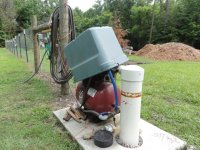
I ran across your post while searching for "using a pressure washer to jet a water well". I have a garden irrigation well I dug a few years ago using a 6 inch post hole auger; adding sections of 3/4" pipe as I went down. I got to 21 feet, then reamed the bore using a 8 inch auger and inserted a 6 inch pvc well casing. It was clay most of the way with a narrow band of sand at about 18 feet which is where my water comes from. This source fills the 6 inch casing to within about 8 ft from the surface, but obviously does not maintain that level when running the sprinklers. I run a 3/4 hp above ground pump with pipe and foot valve going down the well. I would like to get it a little deeper, but could do not more with the auger method. That is why I was thinking about using a pressure washer strapped to a piece of pvc big enough to support it. Before I tried I was hoping to find out you had tried and learn from your experience. Like one of the other posters suggested, I bought a semi trash pump and it easily pulled up muck from the bottom of my 21 foot bore. Of course I have a foot valve on the bottom of my trash pump suction hose and prime the whole pump and suction hose first. When it "catches" it sucks the well and muck dry in short order. I do realize that method will not continue to work past a certain depth of around 30 feet maximum due to something about an atmosphere. While augering, I pulled up lots of stone half the size of my hand. I once removed the foot valve strainer from the trash pump suction hose and was getting excited about how it was removing muck from the bottom of the bore until my pump stopped working. It had sucked up rocks and busted the cast iron pump impeller. The trash pump I am using is a Predator and can be purchased at Northern Tool weekend sales sometimes for under $200. I dream of finding a way to go around 10 feet deeper, but have not been able to do so yet. Like you I don't want to pay thousands for a truck to do it and don't want the county permit process to dictate a garden irrigation well either though I completely understand the need to seal the casing and protect the underground water source form contamination. Let me know if you have had any success using the pressure washer method. Thanks
 

Attachments

  • 2016 Garden Irrigation (1).JPG
    2016 Garden Irrigation (1).JPG
    389.4 KB · Views: 176

Marketplace Items

2022 CATERPILLAR 303.5 CR EXCAVATOR (A60429)
2022 CATERPILLAR...
JMR STUMP/ TRENCHING BUCKET (A56857)
JMR STUMP/...
2002 Ford F-550 Crew Cab Landscape Dump Truck (A56858)
2002 Ford F-550...
2008 HINO 26FT NON CDL BOX TRUCK (A59905)
2008 HINO 26FT NON...
2015 LOAD TRAIL 24+6 GOOSENECK TRAILER (A58214)
2015 LOAD TRAIL...
2008 CATERPILLAR 320DL EXCAVATOR (A60429)
2008 CATERPILLAR...
 
Top